Will the Results Be Clear in Three Years? Crystal-Optech Bets on AR Optics as Its Second Growth Engine
 04/22 2026
 548
548
In the tech industry, a company's ability to navigate cycles and sustain growth often hinges on its strategic positioning ahead of the next technological wave.
On April 21, Crystal-Optech stated in response to investor inquiries that AR optics has been confirmed as its second growth engine, and the company will continue to push forward with unwavering commitment.
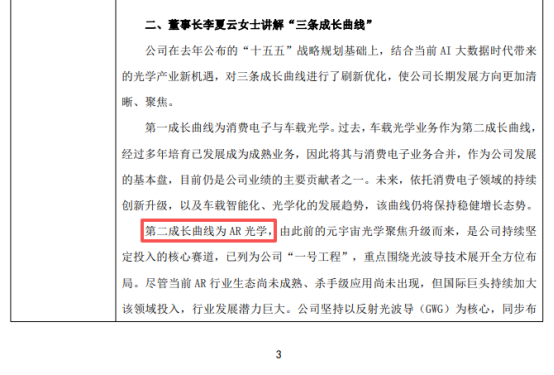
According to Chairwoman Li Xiayun, the company has completed a new round of comb, sort out, organize, arrange, streamline (review) and update (update) of its three growth engines. Specifically, consumer electronics and automotive optics serve as the first growth engine—the "ballast"—to solidify the foundation;
AR optics, which has evolved from the previous focus on "metaverse optics," has been clearly defined as the second growth engine and designated as the company's "Project Number One" for priority advancement;
AI optics has been established as the third growth engine, venturing into the optical communications sector. The company is striving to integrate optics across the entire chain of "information sensing/acquisition—information transmission—information processing—information storage—information presentation." Currently, multiple in-development projects for optical communications, including photoelectric glass substrates, filters, and silicon lenses, are progressing steadily.
This is not a simple reordering of business priorities but a strategic bet on competitiveness for the next decade. Crystal-Optech stated that while the AR industry's overall maturity and large-scale adoption will still take three to five years, positive changes have recently emerged. International leading clients are expected to launch multiple optical waveguide eyewear products in the future, and multiple technological paths will continue to evolve in parallel.
Strategic resolve must ultimately manifest on the production line. Crystal-Optech's AR optics layout (layout) is not a broad, speculative concept but has a clear focus: building a full range of AR optical product matrices centered around GWG reflective optical waveguide technology.
To date, the company's construction of core GWG-related production lines has been largely completed, with the current focus shifting from line construction to line optimization. This covers key areas such as replicable and scalable mass-production plans, automation solutions, alternatives for domestic equipment, production efficiency improvements and cost optimization, as well as upstream supply chain layout (deployment).
Meanwhile, in the diffractive optical waveguide direction, the company's core production lines have been upgraded, and it is actively expanding its terminal client base. The volume holographic waveguide production line has also achieved small-batch commercial-grade shipments. This dual-track approach enables Crystal-Optech to better hedge risks during the chaotic period of multiple parallel AR optical waveguide technologies.
Over the past two decades, Crystal-Optech's core competitiveness has been built on foundational technologies such as precision coating and micro-nano optical manufacturing, with deep ties to major North American clients, making it a key player in the mobile optics supply chain. However, with slowing growth in consumer electronics and the automotive HUD market—while showing impressive growth—remaining relatively limited in scale compared to mobile optics, it is better suited as a "ballast" business to solidify the foundation rather than support a new wave of high growth. The significance of AR optics lies in its potential to be the next optical terminal with true mass-market consumer appeal after mobile phones.
Crystal-Optech's strategic logic is clear and resolute: first, secure a leading position in the large field-of-view segment with GWG mass-production capabilities; then, cover diverse client needs with a full product matrix; and ultimately, upgrade from an optical component supplier to an AR optical system-level solution provider. This path is inevitably long and fraught with uncertainty—large-scale AR adoption will still take three to five years, technological paths are far from converging, and cultivating end-consumer habits remains the biggest unknown.
But for an optical leader with nearly seven billion yuan in revenue, this may be the necessary path to navigate cycles and achieve a value leap. Let us await its subsequent market progress, with OFweek Optoelectronics continuing to follow the developments.
-
On the Eve of Its IPO, Avatr Finds Itself Embroiled in a 'Farce of Controversy and Belittlement'
-
![]()
Yutong Optics' Japanese Subsidiary Unveiled in Tokyo, Shifting Strategic Focus to Technology-Driven Growth
-
![]()
Half-Year Revenue Outstrips Last Year’s Total! Zhongrun Optics Forecasts 80.2% H1 Revenue Growth
-
![]()
Why Does AI Competition Start with Computing Power?
-
![]()
Apple AI Finally Makes Its Debut in China, Yet iPhone's 'AI Autonomy' Faces Uncertainty
-
![]()
Apple AI and QianWen Make Up Lessons: Alibaba Has Its Own 'Doubao Phone'
-
![]()
QianWen Joins Apple, Signal for Large Models to ‘Fade into the Background’
-
![]()
The ‘Anchor’ Strategy of Google Hidden Behind the Bleeding Financial Report