Single-Quarter Orders Break $1 Billion Barrier! Cisco’s Acacia Surfs the AI Boom
 05/27 2026
 664
664
Recently, Acacia, Cisco’s optical component subsidiary, made history by securing over $1 billion in optical component orders in a single quarter—the third quarter of fiscal year 2026. Data from Cisco’s earnings call revealed that AI-driven optical demand accounted for approximately $950 million of this total, marking a nearly fourfold year-over-year surge and driving nearly all new order growth.
Previous market forecasts for Acacia’s full-year orders had generally clustered around the $3 billion threshold. The fact that a single quarter has already surpassed the $1 billion mark underscores the impact of accelerated artificial intelligence infrastructure deployment.
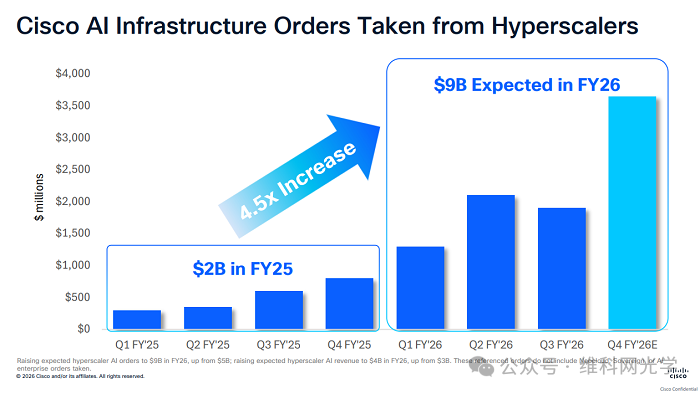
During the earnings call, Cisco CEO Charles Robbins raised the full-year AI infrastructure order outlook from $5 billion to approximately $9 billion. This bullish projection quickly reverberated through Wall Street, with Bank of America Securities lifting Cisco’s target price to $135 and raising Ciena’s target to $660. Bank of America analysts view the AI-fueled optical demand not as a fleeting spike, but as a fundamental industry transformation.
Notably, even excluding the explosive AI-related growth, Acacia continues to benefit from sustained investments by hyperscale clients in traditional non-AI optical infrastructure. This dual-track growth model combines the sharp rise in AI-driven orders with foundational demand from traditional network architecture upgrades to 400G/800G standards.
Cisco management reported that overall network product orders surged by over 50% during the quarter, maintaining double-digit growth for seven consecutive quarters. Even excluding hyperscale client orders, product orders still grew 19% year-over-year, with enterprise orders up 18% and public sector orders increasing by 27%. This balanced segment growth strengthens the resilience of Acacia’s order portfolio.
Bank of America estimates that Cisco currently commands over 50% market share in the 800G optical module segment, with Ciena holding roughly 30%. These two industry leaders dominate the 800G ZR/ZR+ market, shaping its competitive landscape.
Corresponding with Acacia’s order surge, the entire 800G optical module market is experiencing robust demand and accelerating shipments. TrendForce projects that the global market for AI-specific optical transceiver modules will jump from $16.5 billion in 2025 to $26 billion in 2026—a 57% increase.
However, the 800G technology window won’t remain open indefinitely. LightCounting data indicates that the 1.6T optical module market will experience rapid growth in 2026, with PAM4-based 1.6T chipset sales expected to exceed $2 billion and shipments scaling from a modest 2025 base to tens of millions of ports.
The 1.6T market features both PAM4 and coherent technology pathways. Whether Acacia can leverage its coherent technology leadership to smoothly transition to 1.6T speeds remains an open question.
Currently, multiple institutions including Bank of America note that Ciena has established a differentiated power efficiency advantage through its proprietary 3nm DSP technology. Meanwhile, Cisco secured five new design wins among hyperscale clients during the quarter—two in the optical domain—as it seeks growth opportunities beyond existing customers. The 1.6T market’s competitive landscape remains fluid.
Additionally, ongoing supply chain constraints in optical communications provide important context for Acacia’s growth. Core components like EML lasers remain in tight supply, with extended lead times potentially affecting order fulfillment schedules. Backed by Cisco’s supply chain integration capabilities, Acacia maintains relative delivery advantages in this supply-demand imbalance—a key factor behind its rapid 800G shipment growth.
When an optical component company achieves $1 billion in quarterly orders—with over 90% directly tied to AI, a long-cycle technological trend—market focus naturally shifts from growth possibility to growth limits. The investment intensity in non-AI optical infrastructure, the generational transition from 800G to 1.6T, and core chip supply fluctuations will collectively determine Acacia’s growth trajectory in the coming phase.
In the quarter that saw $1 billion in orders materialize, the market witnessed not merely a surge but a fundamental reshaping of the optical industry landscape by AI. Whether Acacia can maintain its central position in this evolving map will become clearer with each 1.6T-era shipment. OFweek Optical will continue tracking these developments.
-
When Cost-Effectiveness Falters, Mobile Phone Sub-brands Engage in a Survival Showdown
-
![]()
Automotive-Grade Fragrance Generator: Safety as the Foundation, Pleasant Aroma as the Norm
-
![]()
Tengjing Technology’s Revenue Projected to Soar by Over 50% in First Half of 2026!
-
![]()
Insta360 Ramps Up 'Bundling' with Upstream Optical Supply Chain with 110 Million Yuan in Related Procurement
-
![]()
Following NIO and CATL’s Footsteps, Guangzhou Nurtures Another Billion-Dollar Unicorn
-
![]()
No Choice for Mobile Phone Companies | Waves
-
![]()
From Jiyue to Li Auto and Saido: The Expedition of AI Cars Has Just Begun | Business Wave
-
![]()
Why Chinese Domestic Brands Are Embracing the Supercar Race Despite Its Unprofitable Nature