What Occurs When You "Slice a Photon in Two"? Norwegian Physicists Reveal: It Unleashes a Spectrum of Colors
 07/27 2026
 359
359
Abruptly removing a mirror during photon reflection unexpectedly triggers the emergence of a multitude of new photons. Nonlinear quantum effects demonstrate that "cutting photons can generate a rainbow," with experiments potentially realizable within the next year.
A photon, the tiniest unit of light, is generally considered indivisible. Yet, three Norwegian physicists have recently offered a startling response: What transpires if you suddenly remove the mirror midway through a photon's reflection? Contrary to the photon simply vanishing, an entirely new array of photons springs into existence.
This may seem like a conundrum, but it's grounded in serious physics. A photon embodies both particle-like and non-particle-like characteristics—it doesn't occupy a specific position but exists in a diffuse form. When it reflects off a perfect mirror and the mirror is abruptly removed, the smoothly transitioning electromagnetic field is abruptly severed. Theoretical calculations indicate that this forces the system to emit a wide range of new light frequencies.
Can photons be divided?
Let's delve into the concepts of splitting and merging. If photons could be split like a cake in our everyday experience, then observing monochromatic light through glass or a mirror would result in a continuous splitting and merging of colors, transforming the world into a legally induced hallucinatory experience. However, this doesn't occur in reality, so photons typically behave predictably.
Nevertheless, splitting and merging do occur when the medium through which light travels is altered by the light itself. For instance, certain nonlinear crystals can split monochromatic light into a rainbow. Technically speaking, most light interactions around us are linear, whereas the splitting and merging of photons belong to nonlinear processes, typically necessitating highly sensitive media or high-intensity light sources, such as lasers, to initiate.
Removing the mirror to unleash a photon rainbow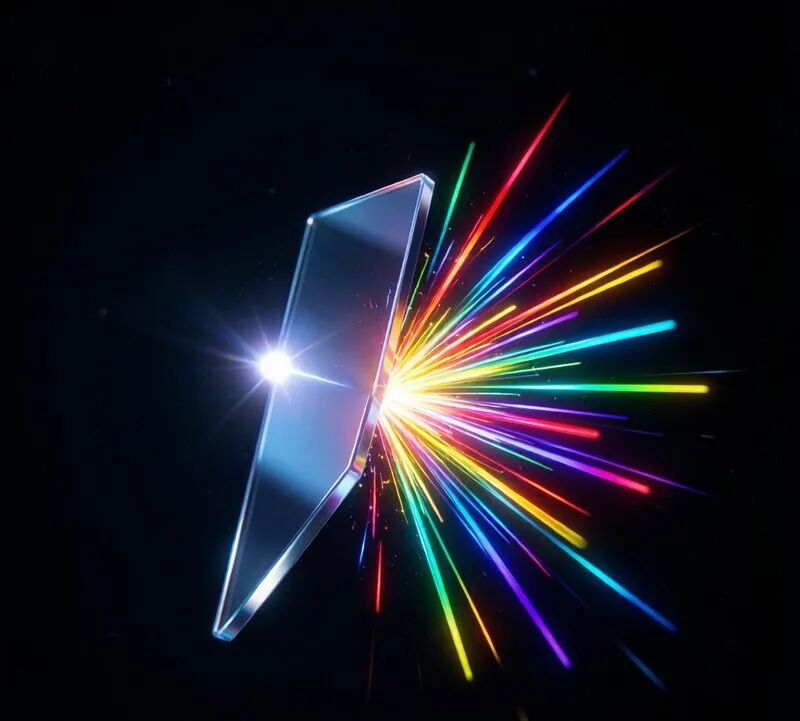
Image source: AI-generated
Removing the mirror during reflection doesn't initially appear to be a typical nonlinear process, but upon closer examination, it creates a sudden change. The photon exists in a superposition of reflected and transmitted states, with probabilities contingent on the timing of mirror removal relative to the photon's size. Normally, upon measurement, the superposition should collapse, with only one detector registering a response.
However, the Norwegian team's calculations suggest otherwise. Because the moment the mirror is abruptly removed, the amplitude of the reflected wave drops to zero, while the transmitted wave jumps from zero. These two abrupt transitions necessitate a much broader spectrum than the original photon to support. Thus, the interrupted photon remains in a superposition state but with sharp edges, requiring a large number of photons of different frequencies to collectively form. In other words, cutting photons generates rainbows, and these new photons also exist in a superposition of reflection and transmission, enabling the detection of light on both sides simultaneously.
To actually achieve this, it must happen faster than 10 femtoseconds
The experiment is extremely challenging. Researchers require a single-photon source capable of emitting on demand with an extremely narrow spectrum, stretching the photon out in time so that the additional photons generated by the interruption can be clearly observed. Then, they must trigger the mirror switching at a precise moment. Clearly, a bathroom mirror won't suffice—the authors calculate that the switch from reflection to transmission must occur within about 10 femtoseconds, far too rapid for a physical mirror to move.
But certain materials can accomplish this. Semiconductors, driven by ultrafast laser pulses, can switch from reflection to transmission within 30 to 100 femtoseconds. The only issue is that the driving laser itself obstructs the view, making it difficult to filter out the large laser used to remove the mirror and leave only the new photons generated by the interrupted long photon. Fortunately, there is already evidence—the ultrashort pulse compression mirrors we commonly use rely on increasing frequencies after reflection to shorten pulse width, indicating that new photons are indeed excited, although no one has directly observed this at the single-photon level yet. The authors wager that within about another year, this will be achieved.
Today's Inspirational Quote
"In the quantum realm, cutting never signifies an end—it allows a beam of light to split into an entire spectrum, becoming a reason to embark anew."
Follow [Degaoxing Zhiqinglang] for three minutes a day to grasp how the quantum world forges new possibilities through division.
-
[Insight] Miniature Fiber Optic Spectrometers Have a Wide Range of Application Fields, with Jingfei Technology as a Leading Enterprise
-
![]()
Half-Year Report | Global TV OEM Market Sees Slight 0.3% Growth in H1 2026; Expected to Decline in H2, Full-Year Drop of 1.1%, Ending Four-Year Growth Cycle
-
![]()
JD's AI Bet: 700,000 'Brothers' and a Supply Chain Worth Hundreds of Billions
-
![]()
AI Smartphone War: The Endgame is a World Without AI Phones
-
![]()
What Occurs When You "Slice a Photon in Two"? Norwegian Physicists Reveal: It Unleashes a Spectrum of Colors
-
![]()
In-depth: Why Has the 'King of Glasses' Fallen Out of Favor After a Plunge in Stock Price and a Vaporization of 600 Billion Yuan Following the Explosive Sales of AI Glasses?
-
![]()
Used Cars Step into the Limelight Alongside New Cars: What Does This Trend Indicate?
-
![]()
After 20 Million Vehicles, How Can Chery Conquer the 'Brand Value' Challenge?