Why is Hong Kong a Realistic 'Testing Ground' for the Low-Altitude Economy? | Cover Story: Flying Cars Usher in a New Era (Part VII)
 02/24 2026
 660
660
Editor's Note
With the advent of the electric and intelligent era, the landscape for flying cars (eVTOL) has expanded dramatically, showcasing vigorous development. As a key carrier (carrier) of future industries and the third mass transportation revolution, flying cars are set to profoundly reshape urban landscapes and economic patterns, becoming a strategic direction for the low-altitude economy. However, the development of flying cars is still in its infancy, with large-scale commercial applications constrained by multiple factors, requiring comprehensive coordination and systematic support in terms of technology, regulations, costs, and ecosystems.
Around the theme of flying cars, Auto Review presents this special 'Cover Story' report. This series consists of seven articles, with the seventh installment being released today. Stay tuned.
At a time when the low-altitude economy is still in its exploratory phase, Hong Kong has taken the lead in exploring feasible paths for integrating it into urban systems, from regulatory sandboxes to cross-border practices.
In this modern jungle of densely packed buildings that is Hong Kong, the value and challenges of developing the low-altitude economy warrant careful examination.
As the global low-altitude economy remains in the stages of conceptual exploration, diverse technological approaches, and the initial construction of regulatory frameworks, a more fundamental challenge has emerged: How can low-altitude flight be transformed from a dazzling 'technological demonstration' into a urban system project that operates safely and is effectively regulated within the fabric of real, high-density cities, while also possessing sustained spillover value?
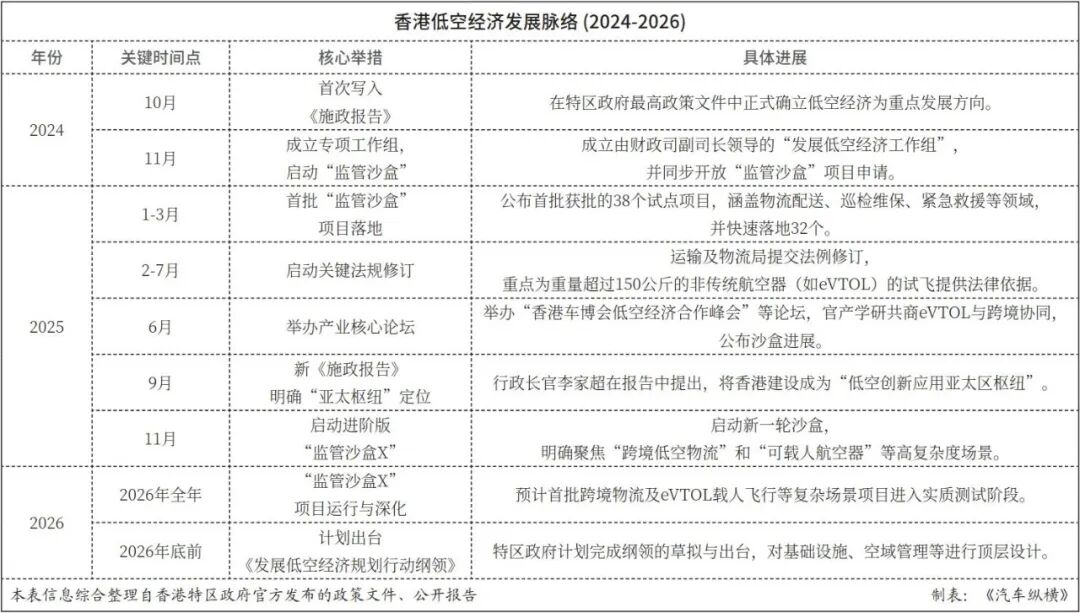
Today, Hong Kong's explorations seem to have pierced through the conceptual fog, entering a more practical and complex deep-water zone. From the first inclusion of the low-altitude economy in the Special Administrative Region's Policy Address in 2024, setting the top-level tone, to the dense (intensive) implementation of 'regulatory sandbox' projects in 2025, providing institutional soil for technological experimentation, and then to the gradual entry of advanced applications such as cross-border logistics and eVTOL manned flights into testing sequences—Hong Kong has rapidly established a comprehensive, three-dimensional promotion system covering top-level design, pilot mechanisms, regulatory revisions, infrastructure, and regional collaboration in less than two years.
The Hong Kong SAR Government has also explicitly positioned the low-altitude economy as a key lever for cultivating 'new quality productive forces' and has designated Hong Kong as the 'Asia-Pacific hub for low-altitude innovation applications.'
Thus, the weight of this proposition has long surpassed initial judgments of technical feasibility. Under the real conditions of busy airspace and a highly concentrated population, the city is attempting to answer a more profound question through its ongoing practices: Can the low-altitude economy truly move beyond test sites and promotional videos to become embedded within the urban operational system itself?
Why Hong Kong is Committed to 'Taking Off'
Hong Kong's sustained investment in the low-altitude economy is not a fleeting trend judgment but the result of multiple overlapping practical factors.
The most direct context is the consideration of new growth poles. For a long time, Hong Kong's economic structure has been highly concentrated in finance, real estate, shipping, and professional services. According to data from the Hong Kong SAR Government's Census and Statistics Department, finance and professional services-related industries have consistently accounted for over 40% of GDP. While this structure offers advantages during stable periods, its resilience to shocks and growth flexibility are being tested amid intensifying global financial volatility and regional competition.
Against this backdrop, the SAR Government explicitly proposed in its 2024 Policy Address to use 'new industrialization' and 'innovation and technology' as breakthroughs to cultivate new industries with scale potential. The low-altitude economy was thus brought into focus, and policy advancement did not stop at the principled level. Just one month later, in November 2024, the 'Working Group on Developing the Low-Altitude Economy,' led by Hong Kong's Deputy Financial Secretary, Chris Wong Wai-lun, was officially established, marking the institutionalization of the issue.
From an international perspective, the low-altitude economy is not a single manufacturing industry but a highly composite industrial chain: The upstream segment covers aircraft design, composite materials, power systems, avionics, and sensors; in its foreseeable evolutionary path, it further extends to mid- and downstream application scenarios such as low-altitude communications, logistics and delivery, emergency rescue and inspection, low-altitude cultural tourism, and urban mobility.
The World Economic Forum (WEF), in its Advanced Air Mobility Report, points out that the core value of the low-altitude economy lies more in system integration and service model innovation than in single hardware sales. This judgment aligns highly with Hong Kong's urban strengths of 'strong services, strong regulations, and weak manufacturing.'
The second driver behind Hong Kong's development of the low-altitude economy comes from urban governance considerations.
From an urban operational perspective, Hong Kong's demand for low-altitude systems is equally specific and urgent. Its complex terrain, interspersed with mountains and seas and numerous outlying islands, creates obvious bottlenecks for ground transportation during peak hours and extreme weather conditions. Between 2023 and 2024, during multiple typhoons and rainstorms, the efficiency of deploying medical supplies and emergency items to outlying islands was repeatedly raised as an issue.
Against this backdrop, low-altitude systems offer a 'complementary upward path' for high-density cities: When roads are blocked or port operations are limited, low-altitude logistics can serve as an emergency fallback solution; drone inspections can significantly reduce manual operation risks in elevated and hazardous environments; and eVTOLs and other electric aircraft align with Hong Kong's existing carbon reduction and green transformation goals.
The International Energy Agency (IEA), in its Aviation and Clean Energy report, points out that short-haul flights represent one of the most feasible initial markets for aviation electrification, highly consistent with the urban air mobility scenarios targeted by eVTOLs. Under this global industry trend, high-density cities like Hong Kong are proactively establishing corresponding regulatory frameworks to address potential transportation transformations.
The third factor, and one of more structural significance, lies in the opportunities for deep collaboration within the Guangdong-Hong Kong-Macao Greater Bay Area.
Objectively speaking, Shenzhen has formed a globally leading industrial cluster for drones and low-altitude manufacturing. According to data from the Shenzhen Municipal Bureau of Industry and Information Technology, Shenzhen is home to over 1,700 drone supply chain enterprises, holding a significant share of the global market. Meanwhile, Hong Kong retains irreplaceable institutional and service advantages in finance, insurance, law, certification, and international rule alignment.
The low-altitude economy precisely provides a highly compatible application scenario for 'Shenzhen manufacturing + Hong Kong services/standards': Shenzhen supplies aircraft and system capabilities, while Hong Kong offers testing environments, insurance, compliance, and international certification interfaces. Together, they explore the synergistic potential of cross-border low-altitude routes and customs clearance models.
The goal is not merely the landing of a single project but to provide a new technological fulcrum for the 'Greater Bay Area one-hour living circle.'
How Hong Kong is Advancing
Unlike the approach of many cities—'first drawing blueprints, then seeking applications'—Hong Kong has chosen regulatory sandboxes as its core governance and advancement tool for the low-altitude economy.
The concept of regulatory sandboxes originated in fintech regulation. Its essence is not to relax regulations but to allow innovative technologies to operate in controlled, traceable environments, using real operational data to calibrate institutional design in reverse. From a governance logic perspective, this mechanism can be likened to a 'virtual environment' in computer systems, fully testing new technologies while isolating risks.
According to the Policy Paper on the Development of the Low-Altitude Economy released by the Hong Kong Transport and Logistics Bureau, the core logic of implementing regulatory sandboxes lies in constructing a closed-loop path of 'pilot first, data-driven, legislation follows,' transforming abstract industrial visions into executable and verifiable legal and policy foundations.
The sandbox's primary goal is to systematically collect real operational data to verify the technical feasibility and operational parameters of new aircraft such as eVTOLs in various application scenarios. At the same time, by allowing the testing of 'non-traditional aircraft' not yet fully covered by existing regulations, it proactively identifies and exposes blind spots in the current legal framework. All pilot projects and data collection ultimately aim to provide an empirical basis for more scientific and precise future legislation.
Since the launch of the first regulatory sandbox, the working group has received over 70 applications, ultimately approving 38 projects. The proposals come from diverse sources, including drone operators, system integrators, research institutions, and cross-disciplinary technology teams, reflecting high market attention to Hong Kong's low-altitude economy prospects. As of January 2026, 32 projects have completed or are undergoing field tests, with an overall implementation rate exceeding 84%.
In terms of application structure, logistics applications such as medical and daily necessities delivery account for about 45%, while inspections and maintenance of power, bridge, and infrastructure facilities make up about 30%. The remaining projects focus on technical R&D directions such as flight control systems, airspace management, and data platforms.
Among them, the 'Cyberport—Cheung Chau' medical supplies drone delivery project has been repeatedly cited as a landmark case by the Hong Kong Legislative Council and related policy documents. Operating in a real outlying island environment, the project reduced emergency supply transportation time from several hours to less than 30 minutes, accumulating key data for operations under complex weather conditions.
More importantly, the regulatory sandbox is not a 'one-time experiment.' Through a closed-loop mechanism of 'pilot—feedback—revision—re-release,' Hong Kong has achieved synchronous evolution of industrial advancement and regulatory capabilities.
Entering 2025, policy positioning became clearer. Chief Executive John Lee explicitly proposed in the new Policy Address to establish Hong Kong as the 'Asia-Pacific hub for low-altitude innovation applications.' This expression (formulation) means that Hong Kong's goal is no longer limited to local applications but aims to create a demonstration effect (demonstration effect), rule export, and institutional influence at the regional level.
In November of the same year, the SAR Government launched the advanced 'Regulatory Sandbox X,' expanding testing scope from basic drone applications to cross-border low-altitude logistics, eVTOLs, and integrated operation platforms. This decision marks Hong Kong's low-altitude economy transitioning from 'feasibility verification' to 'tackling high-complexity scenarios,' reflecting a governance approach of using pilots to drive institutional refinement.
Paving the Way for eVTOL and Cross-Border Flights
In the low-altitude economy, especially concerning non-traditional aircraft like eVTOLs, regulations often hold more decisive significance than technology.
The Hong Kong SAR Government has maintained a highly sober judgment on this. In February 2025, Secretary for Transport and Logistics, Mable Chan, explicitly stated in the Legislative Council that the current Small Unmanned Aircraft Order primarily targets lighter equipment and cannot cover advanced air mobility systems weighing over 150 kilograms.
This statement implies that the government now views eVTOLs and other manned aircraft as mid- to long-term practical issues rather than mere conceptual visions.
Subsequently, the SAR Government initiated phased legislative amendments: In May 2025, relevant legal revisions were submitted to the Legislative Council; in July 2025, the first-stage revisions were completed, primarily addressing weight limits and beyond-visual-line-of-sight operations. More pointedly, the government explicitly stated that once legislative revisions are complete, eVTOL projects previously unapproved in the first regulatory sandbox due to legal restrictions would be prioritized for re-entry into testing. This means Hong Kong is proactively paving the way for complex applications through regulatory innovation rather than passively adjusting after technological maturity.
In exploring cross-border low-altitude systems, the SAR Government also explicitly proposed jointly studying low-altitude cross-border airspace management, route planning, and customs clearance models with the mainland. Shenzhen has responded by offering one-time rewards of RMB 1 million per route for enterprises launching Shenzhen-Hong Kong cross-border routes, requiring take-off and landing points to be located at both sides' ports.
At the project level, among Hong Kong's first batch of regulatory sandbox projects, a Shenzhen-Hong Kong cross-border low-altitude logistics project based on RFID (radio-frequency identification) technology plans to conduct cargo test flights before the end of 2025. Longer-term visions are also brewing, including constructing a 'Shenzhen-Hong Kong Low-Altitude Technology Integration Corridor' and 'Scientist Routes' connecting the two regions. This collaboration is gradually extending from single projects to systematic alignment of technical standards, operational rules, and institutional interfaces.
The Next Steps for Hong Kong's Low-Altitude Economy
The low-altitude economy has never been merely about manufacturing or operating aircraft but represents a comprehensive urban-level system project.
According to publicly available information, the Hong Kong SAR Government plans to release the Action Agenda for Developing the Low-Altitude Economy by the end of 2026, systematically designing infrastructure, route layouts, and land support, potentially covering key elements such as vertiports, charging facilities, air route networks, three-dimensional spatial data systems, and intelligent low-altitude traffic management systems, while synchronously studying related spectrum resource arrangements.
Before the official release of policy plans, industrial exploration has already taken the lead. During the Hong Kong International Automotive and Supply Chain Expo (hereinafter referred to as the 'Hong Kong Auto Expo') held in June 2025, the concurrent 'Green Wings, Smart Airspace—Flying Cars in the Greater Bay Area Era' Low-Altitude Economy Cooperation Summit became an important platform for gathering diverse perspectives from government, industry, academia, and research. Organized by the Hong Kong Auto Expo Organizing Committee, the summit attracted leading enterprises such as GAC Group, XPENG AEROHT, and Volant Aero, along with experts from insurance, communications, and other fields. Discussion focused sharply on key issues directly determining the industrial commercialization process, such as test flight verification, cross-border airspace rule alignment, innovative technology transfer, and financial empowerment. Participants generally believed that only by breaking through these core links could the low-altitude economy transition from concept to sustainable business models.
Within the support system necessary for commercialization, insurance is widely seen as indispensable. Hong Kong's insurance industry has established a dedicated team to explore customized products for the low-altitude economy. At the summit, the 'Low-Altitude Insurance' product launched by The People's Insurance Company (Group) of China Limited became a focal point. Meanwhile, Hong Kong's long-standing accumulations in high-end professional services such as finance, law, and arbitration are viewed as unique advantages for its low-altitude economy development. Multiple participants pointed out that, relying on its mature common law system and international arbitration services, Hong Kong has the potential to develop into a legal dispute resolution center and insurance innovation hub for the low-altitude economy in the Asia-Pacific region, providing critical institutional support for the industry's cross-border operations and global layout.
Looking at the overall progress of Hong Kong's low-altitude economy, a gradually clear path is emerging: from local to cross-border, from cargo to passengers, from pilots to agendas. Each step is predicated on real operational data, with institutional revisions serving as feedback mechanisms, rather than being guided by technological imagination or commercial expectations. Taking eVTOLs as an example, the SAR Government explicitly stated that their manned testing would be predicated on long-term operational data from logistics drones.
This also determines Hong Kong's unique value in the low-altitude economy. It may not necessarily be the first city to achieve large-scale commercial returns but is likely the first to establish a functional governance logic for low-altitude operations in high-density cities. Its deeper value lies in the 'laboratory effect' it possesses. Solutions proven viable under such complex urban conditions hold high reference value for other Asian metropolises like Singapore and Tokyo. Simultaneously, Hong Kong is assigned the role of 'super-connector,' bridging mainland low-altitude economy enterprises with international rules.
From the in-depth discussions on flying car technology, Greater Bay Area collaboration, and 'regulatory sandbox' mechanisms at the 2025 Hong Kong Auto Expo Low-Altitude Economy Cooperation Summit to the upcoming new edition of the Hong Kong Auto Expo in June 2026, themed 'Riding the Electric Wave, Connecting the Global Port,' the evolutionary trajectory of Hong Kong's low-altitude economy is becoming increasingly clear. The planned 'Low-Altitude New Frontier—Greater Bay Area Smart Mobility' forum and related exhibition areas mark the industry's gradual transition from early policy discussions and closed pilots to more open and systematic industrial showcases.
The related activities are expected to focus on showcasing China's cutting-edge technological innovations and application practices in the low-altitude economy sector, particularly in areas such as flying cars, unmanned aerial vehicle (UAV) logistics, and the integrated collaborative ecosystem of 'air-ground-industry'. One of the highly anticipated highlights is the exploration, within the existing policy framework, of the possibility of promoting substantive test flight demonstrations of flying cars in Hong Kong. This holds the promise of achieving key breakthroughs in terms of technical validation and public awareness.
The next chapter of the low-altitude economy is gradually unfolding in Hong Kong. The industry can continue to follow and participate in the Hong Kong Auto Expo and related forums in 2026, jointly witnessing and driving the demonstration and commercialization process of key technologies in the low-altitude economy.
Note: This article was first published in the 'Cover Story' column of the February 2026 issue of Auto Review magazine. Please stay tuned.
Image: Sourced from the Internet
Article: Auto Review
Layout: Auto Review
-
![]()
Net Profit Surges 13.65% Year-on-Year! Yutong Optics Reports RMB 1.782 Billion in H1 Revenue
-
![]()
Q2 Net Profit Slashes Losses by 80%! Has Costar Emerged from Its Darkest Hour?
-
AI Agents: The Paradigm Shift from 'Conversation' to 'Execution'
-
NVIDIA Takes Bold Strides to Lead in Both Hardware and Software Realms
-
![]()
It's Hard to Build Cars, Even Harder to Build Humans, and XPENG is Doing Both
-
![]()
Valuation Soars by $57 Billion: Three Entrepreneurs Born in the 1980s Forge an AI Unicorn Now Suddenly on the Market
-
![]()
How Can We Achieve the Goal of 100,000 Hydrogen Vehicles by 2030?
-
![]()
July Online Market for Consumer-Grade Sports Cameras: Robust Double-Digit Growth in Sales Volume and Value, Mid-Range Products Fuel Market Expansion