Self-Driving Sightseeing Vehicles: A Viral Sensation in Scenic Spots by 2026, Featuring Bear Robotics, Shangyuan Zhixing, Yicheng Innovation, Guizhou Zhonghui Heavy Industry, Guoqi Pujin, Nanjing Wanx
 04/13 2026
 556
556
Introduction
Hey there, travel enthusiasts! Imagine visiting a scenic spot and simply waving your hand to summon a self-driving sightseeing vehicle. You scan the code to pay and then leisurely cruise through the entire park.
This scene, once confined to the realm of sci-fi movies, has now become a reality in numerous scenic spots across China, including the Kunming Dianchi Greenway, Nanjing Niushou Mountain, and Beihai Silver Beach.
Today, The Self-Driving Vehicle is Coming (WeChat Official Account: The Self-Driving Vehicle is Coming) delves deeper: Why have self-driving sightseeing vehicles become such a hit?
(For further reading, please click: "Self-Driving Sightseeing Vehicles Upgrade to Mobile Promoters: Self-Driving Empowers All-Domain Information Service Hubs, Creating an Efficient Model of 'One Vehicle Replacing Multiple Positions'")
I. Scenic Areas Transform into Amusement Parks, and Vehicles Are "Coming to Life"
Let's first explore how "magical" the recent developments have been.
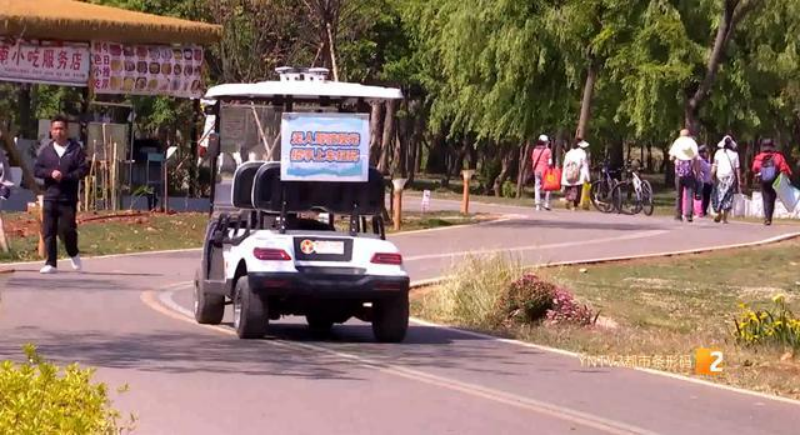
In April 2026, two white self-driving sightseeing vehicles became new internet sensations on the Xiaoyu Village section of the Kunming Dianchi Greenway.
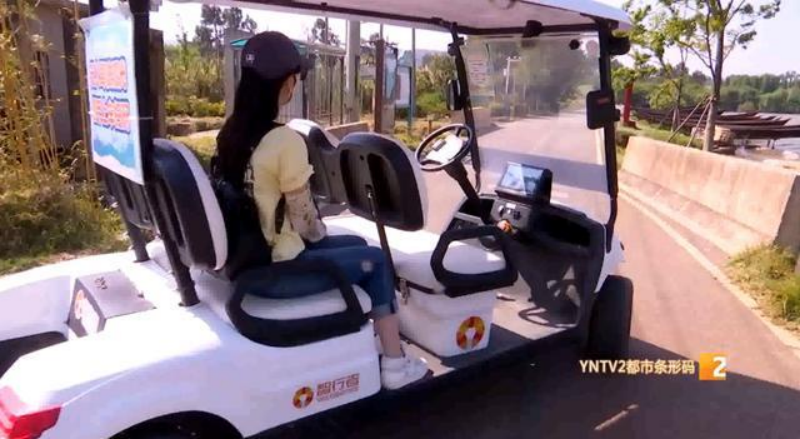
The operator, Yunnan Fisherman Cultural Tourism Development Management Company, revealed that these vehicles were put into trial operation before this year's Spring Festival, with "quite ideal" results. Operating them is extremely simple: when you're tired from walking along the roadside, just raise your hand, and it will stop as obediently as a well-trained dog.
Scan the code to pay upon boarding—49.9 yuan per ride, with a maximum of 4 passengers. You can also switch to manual mode at any time.
A tourist interviewed couldn't stop smiling: "It's so novel! Sitting here with my kids and elderly parents is particularly pleasant, showcasing both the changes in rural China and advancements in technology."
Don't think this is just a stunt by Kunming; this trend has swept across the country.
At Nanjing Niushou Mountain, famous for the Buddha's tooth relic, 15 custom-made self-driving sightseeing vehicles officially began operations in early April this year. The vehicle bodies incorporate cultural and creative elements, named "Jixiang" (Auspicious) and "Ping'an" (Peace).
These vehicles not only stop when waved at but also proactively seek out customers—stand in front of it, and it automatically recognizes you as a potential customer. After boarding, it not only takes you for a ride but also automatically plays explanations when passing scenic spots, acting like a diligent, never-complaining AI tour guide. So far, it has served nearly 20,000 tourists.
Now, let's talk about Wuhan East Lake, which is even more impressive. In January this year, 128 smart sightseeing vehicles were put into operation, all 17-seat behemoths, also self-driving.
Tourists can simply tap a mini-program on their phones, scan the code to board, and the previous "Spring Festival travel rush" feeling of long queues and crowded vehicles is now compressed into a "hassle-free boarding" within a few dozen seconds.
Nowadays, scenic areas seem to have transformed overnight from "labor-intensive" to "computing-intensive."
The underlying logic is simple: young people are getting lazier, and the elderly population is increasing, so nobody wants to walk anymore.
Previously, sightseeing vehicles were a "take it or leave it" option, and drivers might have had bad attitudes.
Now, self-driving vehicles are "begging you to ride"—machines don't get tired or angry; they only use cold radar waves to provide you with the warmest, albeit somewhat socially awkward, service.
II. Safe and Profitable: Scenic Areas Have Figured It Out
Some may ask, "Is this thing reliable? What if it hits someone?"
Don't worry; let's calculate the safety and economic benefits.
In terms of safety, current scenic area self-driving vehicles are heavily equipped. Vehicles at Niushou Mountain are limited to 8 km/h, while those in Kunming are limited to 15 km/h, slower than electric bikes.
More crucially, they feature a "cautious algorithm"—equipped with 360-degree obstacle avoidance radar, they immediately stop when pedestrians or vehicles appear within 3 meters.
Simply put, current self-driving sightseeing vehicles are just "oversized robotic vacuum cleaners" running on closed scenic greenways, which is a "beginner's level" difficulty.
Now, let's discuss how scenic areas and operators are "quietly making a fortune."
Previously, transportation costs in scenic areas were mainly labor-intensive. A driver's monthly salary was around 5,000 to 6,000 yuan, plus social security contributions. Now, although the initial purchase cost of these vehicles is higher, they are "perpetual motion machines."
In Kunming, a ride costs 49.9 yuan, with a maximum of 4 passengers, averaging 12.5 yuan per person.
During holidays, they can make dozens of trips a day, with a relatively quick return on investment. Moreover, these vehicles can do side jobs—when scenic areas hold night tours, previous drivers would clock out, but self-driving vehicles can be on standby 24/7.
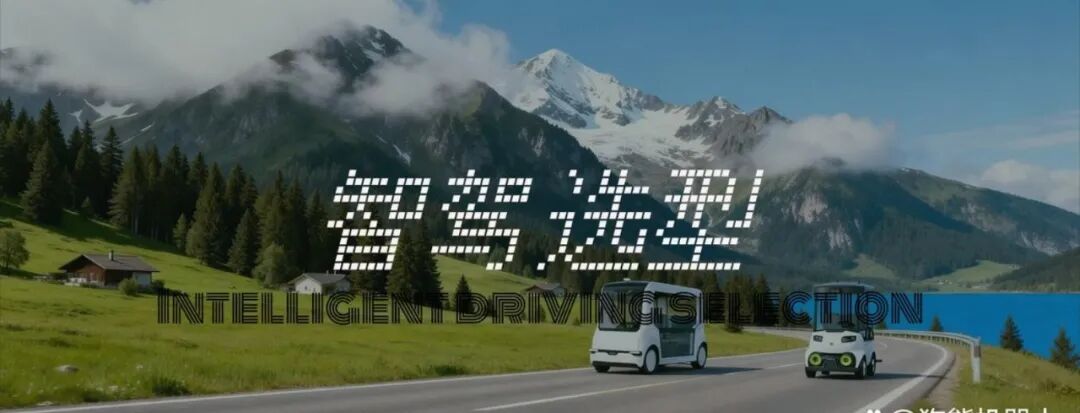
The case of Beihai Silver Beach is even more convincing. After introducing Bear Robotics' self-driving sightseeing vehicles in 2025, the scenic area received 17 million tourists that year, a record high.
During the same period, the business volumes of Beihai's accommodation and catering industries grew by 17.4% and 7.3%, respectively, ranking first in Guangxi in terms of growth rate. A clear chain of effects emerged: technology drives traffic → increased consumption → industrial upgrading.
Nowadays, young tourists pursue "material for social media." Riding a self-driving vehicle, posting a Douyin video with the caption "Being served by AI in 2026," and the views will pour in.
III. Large and Small Vehicles: Each Has Its Own "Competition Strategy"
Although they are all self-driving, there's a lot more to it. The current market landscape resembles the "large-screen vs. small-screen" debate in the early days of the mobile phone market.
One type is the "behemoth faction." Like the 17-seat vehicles at Wuhan East Lake or the 14-seat vehicles launched by Shangyuan Zhixing and Yicheng Innovation. The logic behind these vehicles is "public transportation replacement," running fixed routes to solve the "from A to B" demand. They can carry a full load of passengers at once, suitable for "special forces tourists" who want to visit only core attractions in vast areas.
The other type is the "cute little faction." Like the 2-4 seat vehicles in Kunming and Niushou Mountain. The logic here is "private mobile lounge," with no fixed routes and excellent privacy, particularly suitable for families of three or young couples.
Market analysis reports indicate:
Small vehicles are suitable for "in-depth tours," capable of navigating narrow roads and equipped with features like AI tour guides and voice interactions; large vehicles are suitable for "efficient tours," focusing on large-scale passenger transport.
However, most tourists in scenic areas are actually "lost," craving the freedom to "stop and go" as they please.
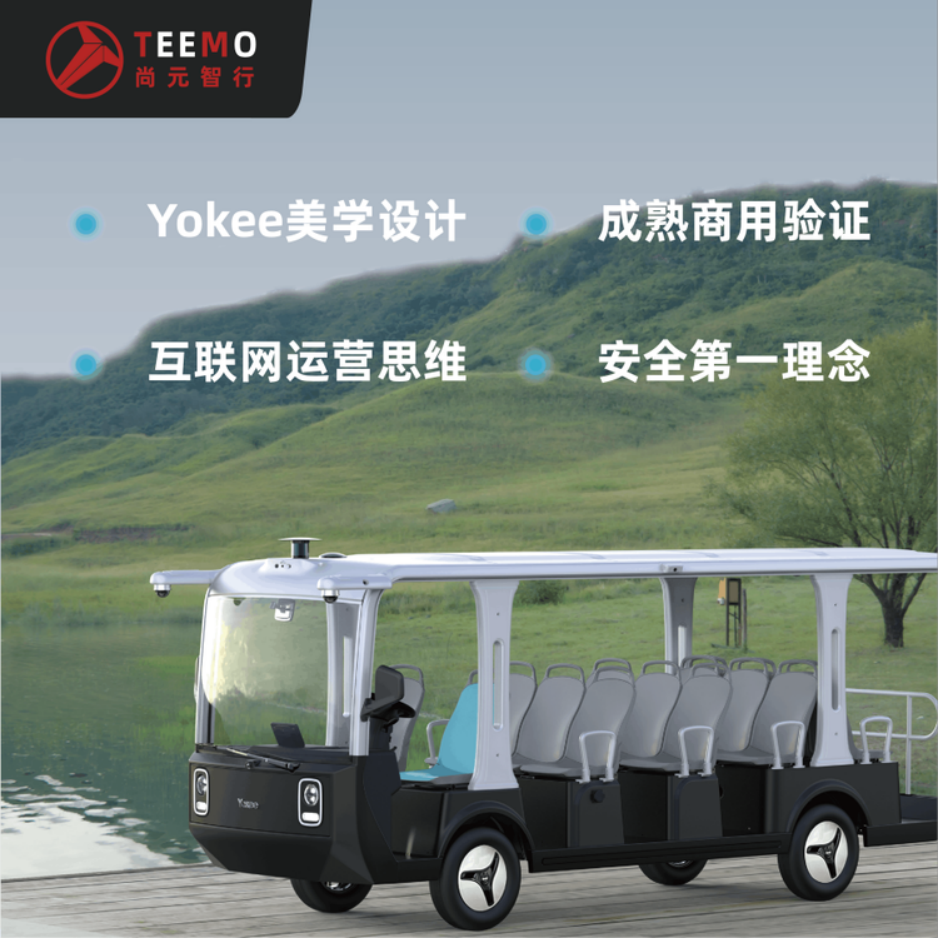
So, who is manufacturing these "mobile fortresses"? The market is already a red ocean of brand competition.
Tech Giants: Such as "Idriverplus," originating from Tsinghua University, with over 1,200 patents, recognized as a national-level specialized, sophisticated, unique, and innovative "little giant" enterprise. Equipped with a self-developed "self-driving brain," it boasts hardcore technology.
Traditional Transformation Champions: Such as Guizhou Zhonghui Heavy Industry, which transitioned from heavy industry and allegedly holds over 70% of the domestic market share. Its products range from 2-seat to 14-seat vehicles, fully customizable to deeply integrate with scenic area cultures, serving as a model for "down-to-earth profitability."
Scenario Solution Experts: Such as Yicheng Innovation, which focuses on "vehicle-road-cloud" coordination, with over 700 park cases. It not only provides shuttle services but also offers AI tour guides and multilingual services, aiming to transform vehicles into service terminals.
There are also numerous players like Bear Robotics, Shangyuan Zhixing, Guoqi Pujin, and Nanjing Wanxinghui. This track is already crowded with full-chain contenders from technology, manufacturing, to operations, vying for the vast and closed "test field" and "showcase" of scenic areas.
IV. "Complaints" and Warmth
No new technology is perfect; there are always moments that make people chuckle.
Some tourists have complained that although it's called self-driving, a "safety officer" must still sit inside the vehicle for compliance, idly tapping the screen, feeling like they're playing with a remote-controlled car.
There's also the braking issue—many self-driving vehicles have algorithms tuned for absolute safety, resulting in overly sensitive braking. Encountering an obstacle triggers an abrupt stop, nearly jolting passengers into vomiting. This exposes a current technological shortcoming: although they can "see," they haven't mastered the smooth footwork of an experienced driver.
But besides "complaints," there's also warmth.
A 60-something Aunt Zhang from Nanjing said she can't drive, and when she gets tired from walking and sees a self-driving sightseeing vehicle slowly approaching, waving it down, "it's incredibly friendly for us elderly folks who can't drive."
Parents with young children finally don't have to coax their kids while carrying heavy loads.
The meaning of technology is sometimes not to create "faster horses" but to care for those who can't run anymore.
When we talk about the computing power of self-driving vehicles, let's not forget that their greatest value might be allowing an elderly person to easily see the entire mountain in their twilight years.
In conclusion, The Self-Driving Vehicle is Coming (WeChat Official Account: The Self-Driving Vehicle is Coming) believes:
Next time you visit a scenic area, don't stupidly walk around exhausted. When you see a self-driving sightseeing vehicle without rearview mirrors, resembling a "bread spirit," boldly wave your hand.
You're not just boarding a sightseeing vehicle but stepping into a future that has already arrived.
Hey, what do you think?
References: Reports from Xiaoxiang Morning Herald, Guangming Net, Aicai Auto Industry, Bear Robotics Baijiahao, Yicheng Innovation Self-Driving Vehicle Official Website, Jiangning District Media Center, and other media outlets.
#SelfDrivingVehicleIsComing #SelfDriving #AutonomousDriving #SelfDrivingVehicles
-
![]()
Is Tencent AI Heading in the Right Direction?
-
Latest Update! Jinding Optics’ GEM IPO Review Now “Under Inquiry”
-
![]()
VOYAH’s CBO Sets Ambitious Target: Secure Top 3 Spot in Luxury BEV Market Within Two Years, Launch 4 New Models to Cover All BEV Segments
-
![]()
Sehwa Technology Invests 740 Million Yuan, Eyeing the Lucrative Optical Film Market!
-
![]()
150 Million Users, $40 Million ARR: AIShige Technology Enters the Final Round of AI Video Competition
-
![]()
StepOn Star Forays into Smartphone Manufacturing: A Rationally Sound Yet High-Risk Endeavor
-
![]()
TCL Zhonghuan: Embracing a New Story Despite Anticipated Losses
-
![]()
Forty Years On: From Volkswagen’s State-Backed Entry into China to BYD’s Hiring of a Former European Foreign Minister