Where Will BYD’s Autonomous Driving Stand in 2026?
 06/01 2026
 426
426
Among China’s domestic new energy vehicle manufacturers, BYD’s sales performance is unparalleled. However, when it comes to intelligent driving, the brands that first come to mind are not BYD but new automotive players like Huawei and XPENG. BYD appears to excel in vehicle sales but remains relatively average in software capabilities. Yet, a closer look at BYD’s recent moves in the field of intelligent driving reveals a determined effort to change this perception. From universal intelligent driving solutions to self-developed chips, and from organizational integration to safety guarantees, every step reflects BYD’s resolve to move beyond being a mere supporting player.

What Has BYD’s Intelligent Driving Journey Involved?
In 2013, when most people still regarded autonomous driving as a concept in its infancy, BYD collaborated with the Beijing Institute of Technology to develop a wire-controlled autonomous driving experimental vehicle. In the following years, BYD formed partnerships with industry leaders such as Baidu, Huawei, Horizon Robotics, RoboSense, and Momenta. In 2018, BYD launched the D++ development ecosystem, opening up vehicle data to third-party developers—a move that demonstrated both humility and pragmatism.
The real turning point for BYD’s intelligent driving ambitions came after 2021. BYD introduced its self-developed operating system, BYD OS, and began investing in partners like Horizon Robotics and RoboSense, signaling its ambition to transcend the role of a mere vehicle integrator. In 2022, BYD teamed up with NVIDIA to equip some of its new energy vehicle models with the DRIVE Hyperion platform (based on the DRIVE Orin chip). In 2023, BYD restructured its intelligent driving R&D leadership, appointing Han Bing to oversee both hardware and software while discreetly assembling a chip design team. These strategic moves collectively indicated that BYD no longer wanted to rely solely on external suppliers.
Interestingly, while pursuing self-development, BYD did not shun collaborations. In 2024, the Fangchengbao Leopard 8 announced it would be equipped with Huawei’s ADS 3.0 intelligent driving system, bringing together two seemingly competing entities. This dual approach reflects BYD’s strategy in intelligent driving: self-development is crucial, but external procurement remains a viable option. The choice between the two depends on which path is more effective and faster, without stubbornly adhering to one approach.

Is the Divine Eye Just One Solution?
If you observe the rear of BYD vehicles on the road, you may notice that some display golden intelligent driving logos, others red, and still others blue. These colors distinguish the three versions of the Divine Eye system.
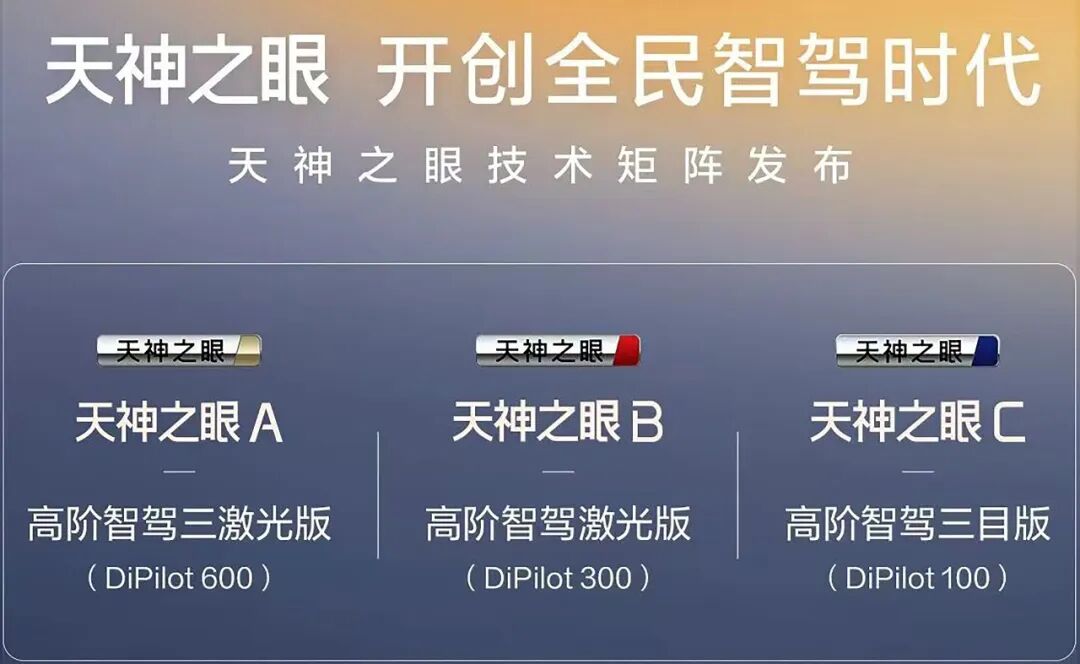
Image Source: Internet
The golden logo corresponds to Divine Eye A, also known as DiPilot 600, currently exclusive to the Yangwang brand. It is equipped with three LiDAR sensors, five millimeter-wave radars, eleven cameras, twelve ultrasonic radars, and dual NVIDIA Orin-X chips, delivering 508 TOPS of computing power. It includes nearly all advanced functions imaginable, such as urban navigation, highway navigation, and Yi Si Fang parking. The hardware configuration of this solution places it in the top tier across the entire industry.
The red logo represents Divine Eye B, or DiPilot 300, used in mid-to-high-end models like the Tengshi and high-end versions of the BYD Han and Tang. It features one LiDAR sensor, a single Orin-X chip, and 254 TOPS of computing power. Its functions are similar to those of the A version, albeit with less extreme redundancy.
The most noteworthy is the blue-labeled Divine Eye C, or DiPilot 100. This solution covers BYD’s best-selling models, ranging from the Seagull to the Qin PLUS and Song Pro, priced between 70,000 and 200,000 yuan. It adopts a pure vision approach, without LiDAR, relying instead on a front-view trinocular camera, five millimeter-wave radars, and twelve ultrasonic radars. The chips used are Horizon J6M or NVIDIA Orin-N, with computing power ranging from 84 to 128 TOPS. Its main functions include highway navigation and valet parking. By the end of 2025, OTA updates added memory navigation, enabling it to remember frequently traveled routes.
This approach reveals BYD’s distinct strategy compared to many new automotive forces. Most brands place their best intelligent driving systems in their most expensive vehicles, using technological premiums to generate profits. BYD, however, has widely deployed the entry-level Divine Eye C. Recently, BYD even equipped the Seagull with a digital LiDAR, further democratizing access to intelligent driving (Related Reading: BYD Seagull at the 60,000 yuan level equipped with digital LiDAR: What did RoboSense do right?).
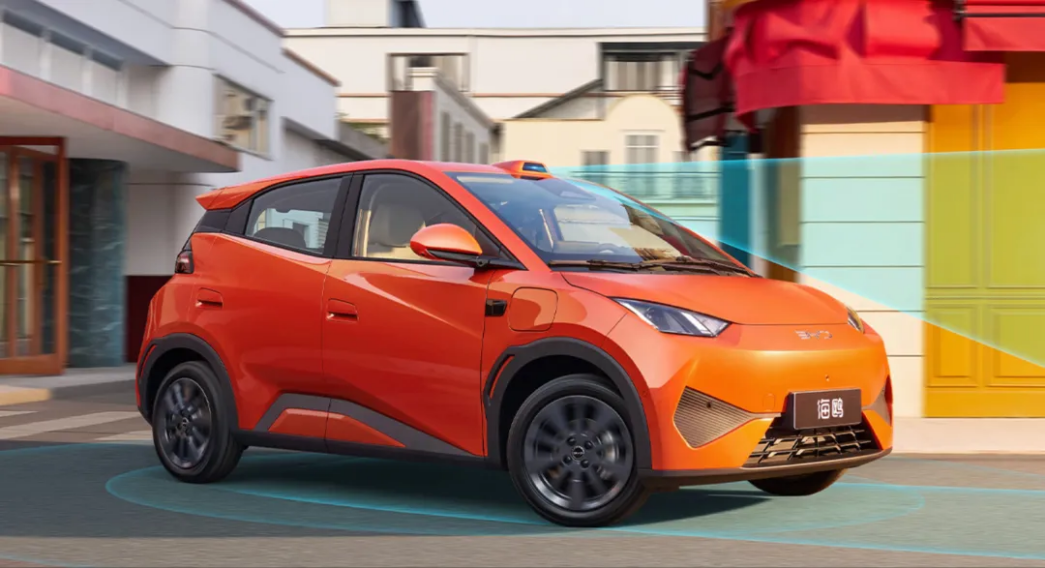
Image Source: Internet
This demonstrates that Wang Chuanfu’s statement—that good technology should be accessible to everyone—is not just empty rhetoric but a direct expression of BYD’s technology inclusion strategy. Of course, for the intelligent driving industry, achieving scale is essential for data to accumulate like a snowball, allowing algorithms to iterate faster and faster.
From the software iteration perspective of the Divine Eye, there are also generational differences between versions. The Divine Eye 4.0 uses a fully closed-loop end-to-end large model, while 5.0 upgrades to a reinforcement learning version, handling complex urban driving scenarios such as merging, yielding, and maneuvering more delicately.
For the intelligent driving industry, end-to-end solutions are easier said than done, as they require extremely high data quality and scale. BYD happens to possess the industry’s largest data foundation, with over 3 million intelligent driving vehicles on the road, generating more than 200 million kilometers of real driving data daily. Once this data flywheel starts spinning, the iteration speed will only accelerate.

What Was the Purpose of Internal Competition and Integration Over the Years?
BYD’s internal development of intelligent driving has not been smooth sailing, and there have been organizational adjustments along the way.
In mid-2024, BYD established two self-developed teams: Tianxuan and Tianlang. Tianxuan focused on high-level intelligent driving solutions, led by Xu Lingyun, while Tianlang was responsible for mid-to-low-level solutions, led by Li Feng. The two teams advanced in parallel, engaging in internal competition to see who could progress faster. This approach is not uncommon during phases requiring acceleration, as large companies often adopt such strategies. However, the drawbacks of competition are also evident, such as scattered resources and duplicated efforts. By September 2024, the two teams were merged, with Li Feng becoming the overall person in charge of self-developed technologies, unifying the management of assisted driving software business.
Image Source: Internet
In early 2025, BYD conducted an even broader integration, bringing the R&D of assisted driving and intelligent cockpit hardware and software under unified management. Li Feng was responsible for all self-developed intelligent software, while Han Bing’s team oversaw intelligent driving domain controllers and cockpit hardware. This adjustment towards an integrated cockpit and driving system, while seemingly an organizational change, was essentially driven by cost and technological trends. Integrating intelligent driving and cockpit functions onto a single chip could save over a thousand yuan in hardware costs, which, for BYD with millions of annual sales, translates to billions in profits.
Of course, BYD’s personnel changes have not ceased. Liao Jie, who came from Horizon Robotics, joined BYD in 2023 to lead the Shanghai team but left after the Spring Festival in 2025 to return to Horizon. Xu Lingyun, the head of Tianxuan, also proposed his resignation around the end of 2024. By the second half of 2025, the intelligent driving team stabilized at around 5,000 people, with the cockpit team at three to four thousand, and the overall intelligent R&D exceeding 8,000 people—a considerable scale among domestic automakers.

What New Cards Does BYD Have in Intelligent Driving in 2026?
On May 28, 2026, BYD held a press conference themed “Dare to Lead,” sparking extensive online discussions. During this event, BYD played several new cards.
The first card was the official mass production of the self-developed chip Xuanji A3, a 4nm automotive-grade intelligent driving chip with a single-chip computing power exceeding 700 TOPS and over 2100 TOPS when three chips work in synergy. Some media outlets claimed it was on par with NVIDIA’s latest Thor. More importantly, it achieved a closed-loop self-development from chip design to algorithm adaptation, with about 20% lower power consumption than similar products and doubled computing power utilization. The high-computing-power chip market, long dominated by NVIDIA and Qualcomm, finally had an option from an automaker itself. The significance for supply chain security might be even greater than the computing power figures themselves.
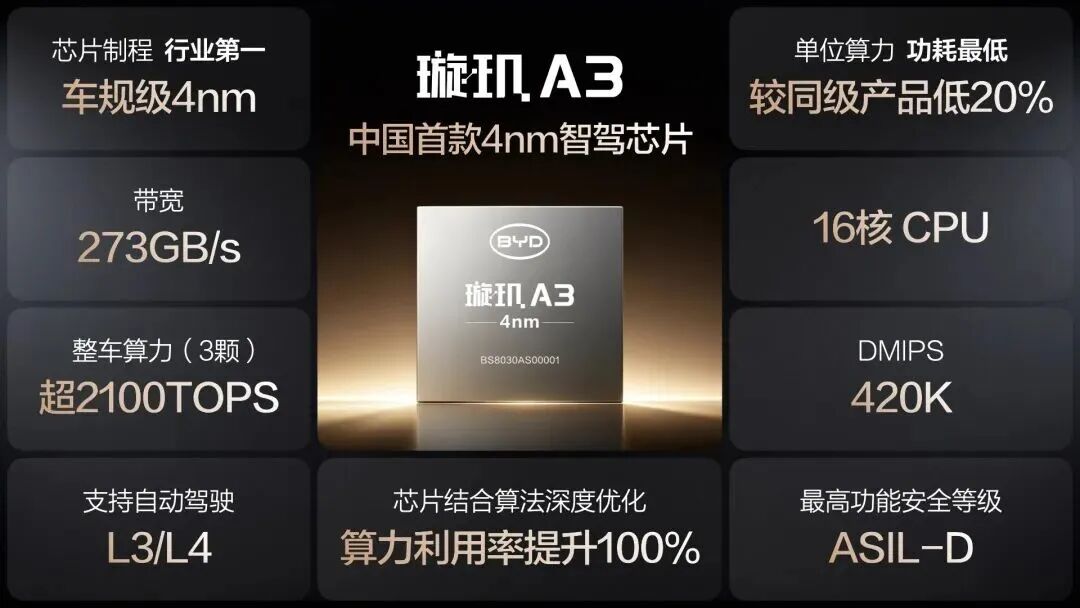
Image Source: Internet
The second card was the upgrade of the Xuanji Architecture to version 2.0. The Xuanji Architecture 1.0, released by BYD in 2024, essentially connected systems such as the intelligent cockpit, intelligent driving, vehicle control, and the three electric systems (battery, motor, and electronic control) to achieve vehicle-wide intelligence. Version 2.0 introduced several key upgrades, integrating the cockpit, intelligent driving, and motor drive modules into a single controller, reducing system latency to 8 microseconds, 80% faster than the industry average. It also introduced a sensor satellite architecture, where sensors solely handle perception, sending raw data directly to the central brain for unified processing, avoiding efficiency losses from individual sensor computations. This design increased data bandwidth by 60 times, extended detection range by 33%, and allowed 4D millimeter-wave radars to detect up to 400 meters.
The third card was the switch to a Physics AI large model for algorithms. This change is quite interesting. Past end-to-end models primarily mimicked human driving behavior, while the Physics AI large model incorporates physical constraints such as vehicle dynamics, road friction coefficients, and inertia into the decision-making process. Simply put, it not only learns to drive like a human but also understands that vehicles cannot violate physical laws. Combined with the daily 200 million kilometers of real data from over 3 million intelligent driving vehicles, this model’s iteration speed will be much faster than systems relying solely on simulation training.
The fourth card was the expansion of safety guarantees from parking to urban navigation. In July 2025, BYD introduced intelligent parking safety guarantees, fully compensating users for any accidents during autonomous parking. As a result, the usage rate of the parking function soared from 21% to 93%, with the accident rate dropping to nearly zero. These figures illustrate a simple truth: users are not unwilling to use intelligent driving but are afraid to. Once manufacturers take responsibility, usage rates explode. In May 2026, BYD extended this commitment to urban navigation, fully compensating users for any liable accidents during compliant use of urban navigation, without any upper limit or impact on personal vehicle insurance. This was an industry first and a public declaration of confidence in its technology.
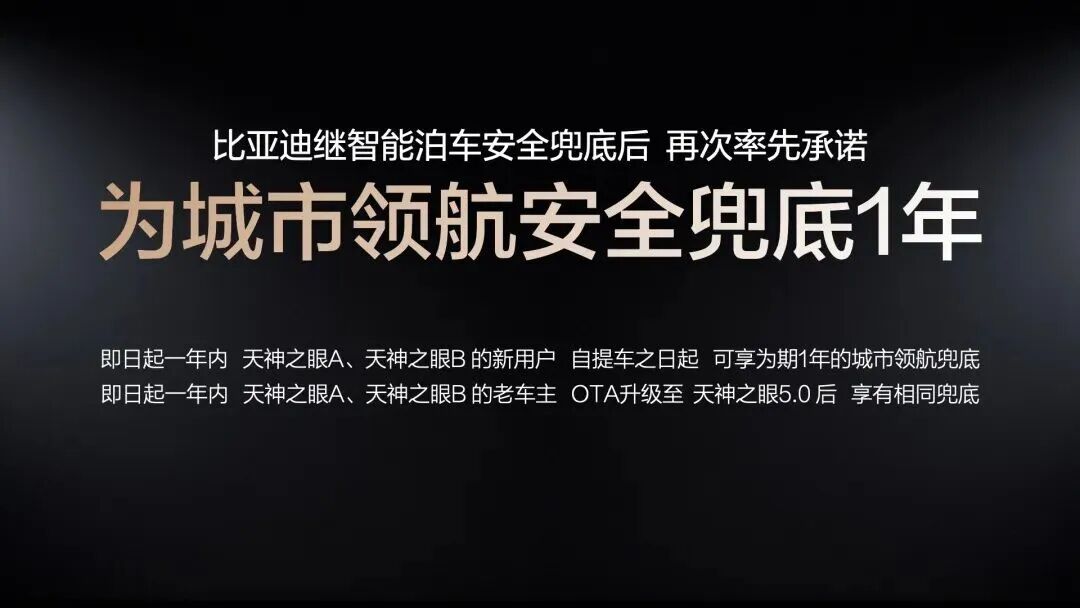
Image Source: Internet
The fifth card was the Divine Eye autonomous driving version for L3/L4, globally first equipped with ultra-high-resolution LiDAR (in collaboration with RoboSense), paired with flash cameras and dual far-infrared cameras. Redundancy was implemented in ten areas: sensors, SOC, MCU, algorithms, power supplies, unlocking, braking, communication, steering, and parking. This hardware architecture is prepared for L3 and above levels. Although regulations have not fully caught up, the technological groundwork is in place.
There is also a new development in intelligent cockpit technology: the super intelligent agent Didi Xia. It is not just a simple voice assistant but an agent with long-term memory capabilities, capable of processing complex instructions, supporting dialects, and compatible with the mobile ecosystem and various Agent applications. This reflects a trend in intelligent driving development: intelligent driving and the cockpit are not isolated; future human-vehicle interactions should be seamless and proactive.

Final Thoughts
Looking back at BYD’s intelligent driving strategy, the path is clear. In the early stages, it relied on partnerships to bring products to market; in the middle stage, it accumulated capabilities through a dual approach of investment and self-development; in the later stage, it focused on self-developed chips and vehicle-wide intelligent architectures to establish its technological moat. Whether it can catch up with first-tier players like Huawei and XPENG depends on the actual performance of the Xuanji A3 chip after its launch and the speed of urban navigation coverage. But at least now, BYD holds a complete hand of cards.
-- END --

-
![]()
Hisense's World Cup Sponsorship 'Hat-Trick': A Journey of Globalization
-
![]()
4G RAM Computers Stage a Comeback Amid AI-Driven Storage Crunch: How Many Will Feel the Pinch of Rising Storage Costs?
-
![]()
Mac mini Out of Stock: Has the “Headless MacBook” Emerged as the New Favorite for AI?
-
The Pivotal ‘Track Switch’ in the Computing Power Race
-
![]()
What Kind of Scientific Spirit Should We Reclaim Amidst the AI Boom?
-
![]()
vivo S60 First Launch Review: IMX921 May Not Be Top-Tier, But It Really Excels in "People Photography"
-
![]()
Where Will BYD’s Autonomous Driving Stand in 2026?
-
![]()
Embrace Freedom, Live Boldly! Great Wall Motor’s Menglong PLUS Launches in the Greater Bay Area, Unlocking Enhanced Lifestyles with One Vehicle