1215 Units! Shenzhen's Autonomous Vehicle Report for March: 'Night Riders' Take to the Streets, Delivery Volume Jumps 57%, Revolutionizing Urban Logistics!
 04/15 2026
 634
634
Introduction
In March 2026, Shenzhen officially opened its roads to functional autonomous vehicles during nighttime hours, elevating autonomous delivery services from 'daytime-only' operations to a round-the-clock affair.
The latest operational report for March from the Shenzhen Intelligent Connected Vehicle Transportation Association provides concrete evidence of this acceleration:
- 1,215 registered operational vehicles across the city: 778 autonomous logistics vehicles, 432 autonomous sanitation vehicles, and 5 autonomous inspection vehicles;
- 2,299 approved routes spanning a total of 9,818 kilometers;
- 3.15 million autonomous deliveries completed in a single month, marking a significant 57% increase from the previous month.
'Autonomous Vehicle Insights' (WeChat ID: wurenchelaiye) delves into the rationale, data, commercial implications, and industry impact of this report.
(Related reading: 'Shenzhen's Functional Autonomous Vehicle February Report: With Couriers Home for Lunar New Year, 1,158 Autonomous Vehicles Handle 2.01 Million Holiday Deliveries, Compliance Rate Climbs to 96.2%') 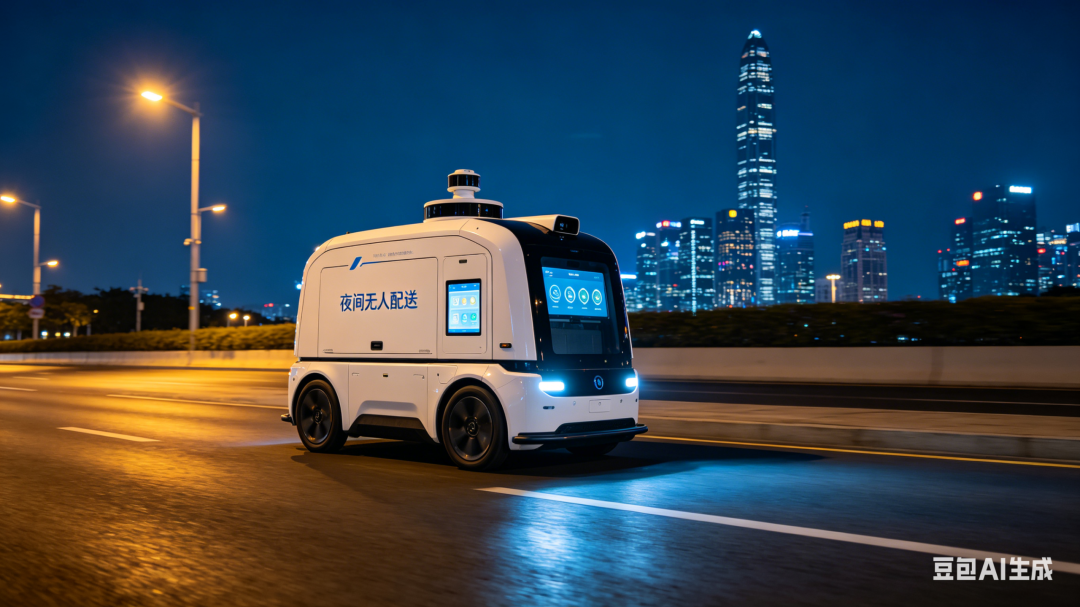
I. Nighttime Road Access: The 'Efficiency Revolution' Sparked by One Policy
Why is nighttime road access so crucial? The answer lies in the 'spatial-temporal mismatch' that plagues urban logistics.
During the day, urban roads are bustling with commuters, social activities, and economic transactions. Truck restrictions and congestion severely limit logistics efficiency.
At night, however, road resources lie underutilized, while logistics capacity remains dormant due to human constraints—high nighttime labor costs, safety risks, and low willingness to work.
Shenzhen's decision to grant nighttime road access was not a hasty one. It followed a rigorous review process involving three stages: enterprise applications, traffic impact assessments, and expert panel reviews.
Technical standards, regulatory compliance, and operational safety all underwent strict scrutiny.
JD Logistics emerged as the first 'pioneer.' It established two cross-district nighttime routes, each exceeding 50 kilometers, connecting multiple logistics nodes in Pingshan and Longgang.
The same vehicle handled last-mile deliveries during the day and cross-district routes at night, picking up goods at front warehouses (micro-fulfillment centers) and delivering them instantly to warehouses (instant delivery hubs) for both inter-warehouse transfers and end-customer deliveries.
This 'daytime last-mile, nighttime network replenishment' flexibility transformed autonomous vehicles from single-purpose tools into active nodes within a 24/7 logistics network.
II. Data-Driven Growth: 1,215 Vehicles, 3.15 Million Deliveries, RMB 26.22 Million in Value
March data underscores Shenzhen's autonomous delivery boom:
1. Fleet Scale
- 1,215 registered functional autonomous vehicles citywide: 778 logistics, 432 sanitation, 5 inspection.
- A 77% online rate for logistics vehicles (+2% MoM), indicating that over three-quarters are ready for 24/7 operations.
2. Route Expansion
- 98 new routes in March (including 2 nighttime routes), bringing the total to 2,299 routes (9,818 km, +7% MoM).
- Nanshan and Bao'an districts led the way in cross-district interconnection, unlocking key channels for nighttime commercial operations.

3. Delivery Efficiency
- Autonomous logistics vehicles traveled 138,000 km in March (+17% MoM).
- The average daily operational hours per vehicle increased to 9.1 (+8% MoM).
- 3.15 million deliveries were completed (+57% MoM): 3 million parcels, 150,000 fresh produce items.
- Cost savings amounted to approximately RMB 3 million; commercial value reached RMB 26.22 million.
4. Safety Record
- Behind the 3.15 million deliveries: a continuous improvement in safety standards.
- 30 complaints were filed in March (-57% MoM); the compliance rate stood at 96.2%.
These figures demonstrate that Shenzhen's autonomous delivery has transitioned from a 'pilot' phase to 'scale,' and from 'operational' to 'stable, efficient, and high-volume.'
III. Corporate Rankings: Neolix, Jiushi, Meituan Lead the Charge
March data reveals the industry's leading players:
1. Fleet Size: Neolix, Jiushi, Meituan Top the List
- Neolix: 372 vehicles (No.1); Jiushi Intelligence: 145 (No.2); Meituan: 138 (No.3).
- Others: Baixiniu (59), JD (42), Minieye (14), Cainiao (6), WeRide (1), GoFirst (1).
2. Online Rate: WeRide, GoFirst, Minieye Excel
Fleet size is less important than operational uptime. The online rate is the key metric:
- WeRide and GoFirst: 100% (small fleets).
- Minieye: 93% (No.3).
- All brands operational: Neolix (78%), Jiushi (66%), Meituan (75%), Baixiniu (90%), JD (81%).
3. Mileage: Neolix, Jiushi, JD Lead the Way
- Neolix: 72,000 km (No.1); Jiushi: 29,000 km; Meituan: 11,000 km; Baixiniu: 5,000 km; JD: 21,000 km.
4. Operational Hours: Gaps Widen
- Average daily hours: Neolix (9), Jiushi (8.8), Meituan (3.9), Baixiniu (6.4), JD (14.7), Cainiao (13.67), Minieye (4.5).
- JD and Cainiao exceed human driver limits—the 'Night Riders' advantage!
- Future potential: No need for rest, no shifts required.
IV. Safety & Compliance: The 'Invisible Moat' Behind 3.15M Deliveries
Shenzhen's March success is rooted in robust safety systems:
- 6 traffic accidents involving autonomous logistics vehicles (0.43 accidents/10,000 km).
- How does this compare? Far lower than the average for human drivers.
- Crucially, no accidents occurred where autonomous vehicles held primary or major responsibility—all were the fault of other parties.
Compliance:
- Vehicle compliance: 99.4%; operational compliance: 93.4% (+0.5 and +3 pts MoM).
- Non-compliance issues: Parking spots occupied, poor parking planning, abnormal stops, route deviations, signal failures.
- Complaints: 47 in March (+57% MoM): 3 safety-related, 8 technical, 36 management-related. By district: Longgang (26), Pingshan (10), Bao'an (8).
- 2 of 3 major complaints were resolved in March (67% resolution rate).
- SW40008 signal issues persist, highlighting gaps in infrastructure-operation coordination.
V. Policy Support: Shenzhen's Ambitions Extend Beyond Logistics
On March 23, Shenzhen's Development and Reform Commission released the '2026 Work Plan for Optimizing the Market-Oriented Business Environment,' prioritizing:
- 'Accelerating the commercialization of intelligent connected vehicles (ICVs)';
- 'Promoting the large-scale adoption of functional autonomous vehicles.'
A key breakthrough: Nanshan and Bao'an districts will pilot unified standards for cross-district ICV commercialization, including technical norms and regulatory frameworks, enabling route connectivity and mutual recognition of qualifications.
Why does this matter?
Previously, cross-district operations faced 'regulatory fragmentation'—each district had its own standards and approvals. A vehicle traveling from Nanshan to Bao'an needed two permits.
The Nanshan-Bao'an integration sets a national model.
Meanwhile, Longgang released draft ICV regulations, and Pingshan held legislative research forums.
From city-level policies to district-level rules, Shenzhen is constructing a comprehensive institutional framework for ICV industrialization.
In Summary:
'Autonomous Vehicle Insights' argues that Shenzhen transcends its geographical boundaries to serve as a 'super testbed' for China's ICV industry.
From Pingshan's 2023 breakthrough in commercial autonomous trials to March 2026's nighttime road access and 3.15 million deliveries, Shenzhen has achieved in three years what others take a decade to accomplish—transforming autonomous driving from a laboratory 'bonsai' into an urban 'forest.'
The 'Shenzhen Model' combines:
- Scenario-driven market entry;
- Technology iteration through cycles;
- Scale replication to shape the future.
What's your perspective?
References: Reports from the Shenzhen Intelligent Connected Vehicle Transportation Association's official WeChat and other media.
#AutonomousVehicleInsights #AutonomousDriving #SelfDriving #AutonomousVehicles
-
![]()
Is Tencent AI Heading in the Right Direction?
-
Latest Update! Jinding Optics’ GEM IPO Review Now “Under Inquiry”
-
![]()
VOYAH’s CBO Sets Ambitious Target: Secure Top 3 Spot in Luxury BEV Market Within Two Years, Launch 4 New Models to Cover All BEV Segments
-
![]()
Sehwa Technology Invests 740 Million Yuan, Eyeing the Lucrative Optical Film Market!
-
![]()
150 Million Users, $40 Million ARR: AIShige Technology Enters the Final Round of AI Video Competition
-
![]()
StepOn Star Forays into Smartphone Manufacturing: A Rationally Sound Yet High-Risk Endeavor
-
![]()
TCL Zhonghuan: Embracing a New Story Despite Anticipated Losses
-
![]()
Forty Years On: From Volkswagen’s State-Backed Entry into China to BYD’s Hiring of a Former European Foreign Minister