Shenzhen Elevates Unmanned Vehicle 'Management' to Unprecedented Levels: How Does One Large Screen Command 1,214 'Iron Warriors'?
 04/21 2026
 701
701
Introduction
Envision a cityscape where thousands of unmanned vehicles seamlessly navigate 2,299 roads around the clock, executing tasks such as parcel delivery, street sweeping, and inspections. While this may seem like a scene from a futuristic movie, it is the daily reality in Shenzhen.
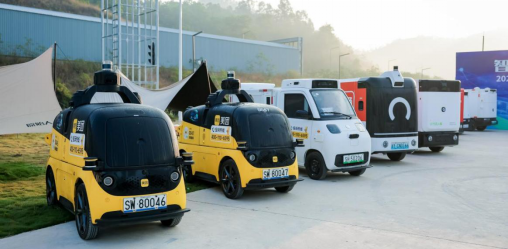
By the end of March 2026, Shenzhen boasted 1,214 operational unmanned vehicles traversing 2,299 public roads—the largest deployment of its kind in the nation.
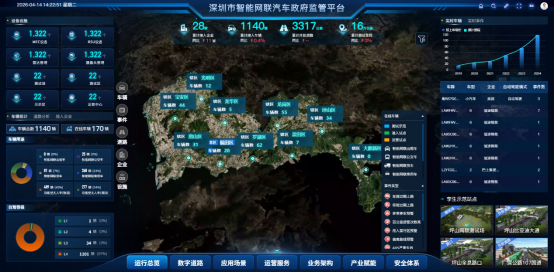
What's even more remarkable is that, in tackling the challenge of managing over a thousand vehicles, Shenzhen did not resort to "human surveillance." Instead, it transitioned from "human-led governance" to "intelligence-driven governance" through an intelligent connected vehicle supervision platform, evolving from "mere control" to "comprehensive governance."
Three public transport companies collaborated, leveraging aerial surveillance and ground operations, online approvals, and a unified management screen to achieve exemplary operations in unmanned vehicle governance.
Today, Unmanned Vehicle Cometh (WeChat Official Account: Unmanned Vehicle Cometh) delves into Shenzhen's remarkable journey in integrating unmanned vehicles into its urban management framework.
(For further reading, please click: "1,215 Unmanned Vehicles! Shenzhen's March Report: 'Night Riders' Go Online, Delivery Orders Surge by 57%, Reshaping Urban Capillaries!")
I. Inspection Transformation: From 'Exhaustive Ground Inspections' to 'Aerial Surveillance + Ground Operations,' Efficiency Soars 10-Fold
Traditionally, managing unmanned vehicles relied heavily on manual road inspections. Each inspector could cover a maximum of 10-15 kilometers daily, often exhausting themselves while leaving numerous blind spots. Violations were mostly discovered by chance.
Now, Shenzhen has embraced a novel approach—combining online "aerial surveillance" with offline "ground operations," setting a new industry benchmark for inspection efficiency.
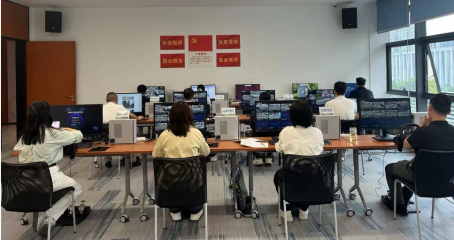
Online, the three public transport companies have established dedicated inspection stations within monitoring centers, maintaining a 24-hour vigil over the supervision platform.
The screens display real-time positions, speeds, routes, and statuses of every unmanned vehicle, with 42 intelligent driving data points monitored instantaneously and 11 types of risks automatically flagged.
Issues such as sudden acceleration/deceleration, abnormal stops, route deviations, and prohibited stops—problems that previously required on-site staking out—are now clearly visible from a computer screen.
One online inspector can now monitor 100 vehicles in 8 hours, boosting efficiency tenfold and achieving true "human rest, vehicle oversight."
Offline, a 60-member professional inspection team no longer operates aimlessly. Upon receiving platform alerts, they are dispatched with precise instructions and mobile accounts, recording "advised to leave" or "requires follow-up" with a few taps—fully traceable and documented.
More impressively, offline efforts complement online gaps, with on-site discoveries reported directly, forming a closed-loop system.
Data reveals that 68% of online-pushed anomalies are genuine violations, with violation detection rates tripling and ineffective inspection mileage reduced by 60%.
From "humans seeking vehicles" to "vehicles finding humans, platform dispatching," the "manpower-intensive" approach is now obsolete.
II. Approval Revolution: From '20-Day Odyssey' to '5-Day Online Processing, Instant Approvals for Simple Cases'
Previously, enterprises faced a daunting task when applying for unmanned vehicle road rights:
Visiting transport, traffic police, and urban management departments one by one, submitting materials repeatedly—a process that took at least 20 days. Enterprises were frustrated by the inefficiency.
Shenzhen discarded this outdated model, introducing a "negative list + categorized approval" system with fully online processing, letting data do the running and enterprises relax.
Now, enterprises need not visit departments in person. They can submit applications and upload materials via the supervision platform, with departments conducting online reviews and parallel approvals.
Routine route approvals are now compressed to 5 days, with simple scenarios receiving "instant approvals"—submitted in the morning, approved by afternoon, eliminating long waits.
More impressively, Shenzhen implements dynamic road rights, precisely allocating permissions across six dimensions: roads, time, and vehicle types, ensuring safety without wasting road network resources.
From "exhaustive ground runs" to "fingertip processing," from 20 days to 5 days or even instant approvals, Shenzhen has transformed road right approvals from an "administrative hurdle" into a "service express," delighting enterprises.
III. Data Integration: From 'Information Silos' to 'Unified Screen Management, Immediate Response to Complaints'
Previously, unmanned vehicle management suffered from "data conflicts":
Anomaly records were scattered, departments operated in silos, and public complaints were disconnected from management processes. Problems led to mutual blame, slow resolutions, and low efficiency.
Shenzhen has broken down all barriers through its supervision platform, achieving "one-screen city overview, one-network comprehensive management."
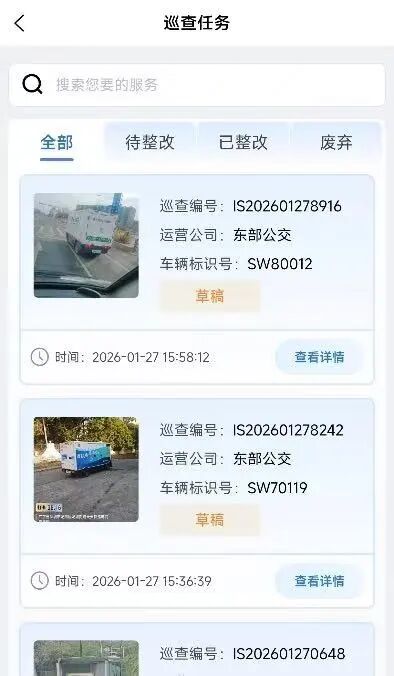
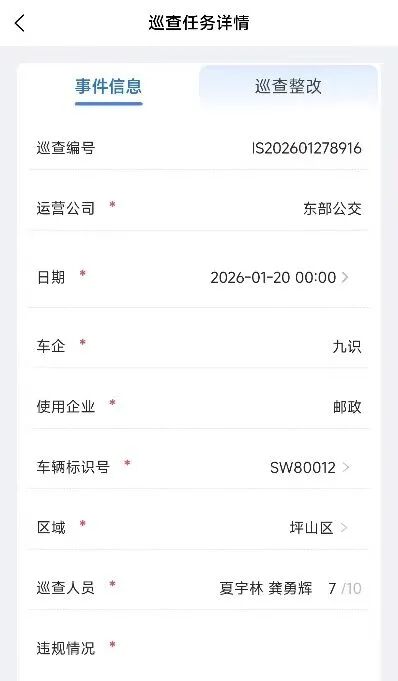
Now, all anomaly events, complaints, and disposal records are electronically archived, with data interoperability among transport, traffic police, and urban management departments. Public complaints via hotlines are synchronized into management workflows, ensuring "immediate response, timed feedback, and full tracking."
In Q1 2026, the platform aggregated over 500 anomalies and complaints, achieving a complete closed loop from discovery, dispatch, disposal, verification to archiving, with a 95% closure rate.
From "dormant data, accumulated problems" to "data-driven, rapid resolutions," true "intelligent" urban governance leaves no gaps.
IV. Smart Governance Delivers Results: Complaints Drop 32%, Accidents Fall 28%, Shenzhen's Model Goes National
The platform's impact is immediate and significant.
Since 2026, complaints about unmanned delivery vehicles in Shenzhen have decreased by 32% month-on-month, with safety accidents down 28% year-on-year.
Nearly 2,000 vehicles are connected to the platform for supervision, with over 1,200 functional unmanned vehicles stably operating citywide. Logistics, sanitation, and inspection scenarios have scaled, driving commercial value skyward.
In March, unmanned vehicles handled 3.15 million deliveries, saving RMB 3 million in costs and generating over RMB 26 million in commercial value. With nighttime road rights opened, 24/7 operations became a reality.
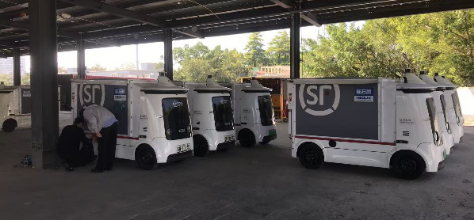
Looking ahead, Shenzhen aims beyond delivery vehicles, planning to integrate autonomous taxis into its management system. Leveraging the Autonomous Driving Safety Laboratory, it will build a "technology + management + collaboration" trifecta safety framework (Shenzhen Government Online).
From "pilot trials" to "thousand-vehicle scale," from "man-to-man" to "platform intelligence," Shenzhen has blazed a replicable, scalable path for unmanned vehicle governance, with cities nationwide taking notes.
V. 'Old Masters' Deliver Dimensional Strike: Why Public Transport Companies Lead?
You might wonder: Why are three traditional public transport companies (the "Big Three") operating this cutting-edge "urban-scale unmanned vehicle operating system," rather than a tech firm?
This is precisely where Shenzhen's model shines brightest—and deserves deep reflection. The "old masters'" advantages are overwhelming:
Understand the Rules:
Public transport companies have traffic safety regulations, operational scheduling, and emergency protocols ingrained in their DNA.
They know what truly constitutes public safety bottom lines.
Have the Network:
They operate citywide parking lots, maintenance stations, and dispatch centers.
Their 60-member inspection team seamlessly integrates into this physical network, enabling rapid response.

No Conflicts of Interest:
They don't develop, produce, or operate unmanned vehicles, ensuring neutrality and fairness.
This avoids the "player-referee" dilemma, earning trust from all unmanned vehicle enterprises.
Calculate the Big Picture:
Public transport companies routinely assess costs and safety for millions of daily trips. They excel at planning road rights and capacity from an urban efficiency and safety perspective, not just corporate profit.
Thus, this isn't a tech firm-led "disruption" but a traditional urban operator's "empowerment" and "upgrade" through digital tools.
In internet terms, it's a "dimensional strike."
VI. The Future Is Here: From 'Control' to 'Excellence,' Shenzhen Defines New Urban Standards for Unmanned Vehicles
The Shenzhen Special Economic Zone has long been a bellwether of the times, a "window" into future development.
In 2023, Shenzhen pioneered a national management system for functional unmanned vehicles (including delivery vehicles), laying the institutional groundwork for large-scale applications.
In 2025, Shenzhen launched the nation's first management service platform for functional unmanned vehicles.
By March 2026, the Municipal Development and Reform Commission released the "2026 Work Plan for Optimizing Market-Oriented Business Environment," explicitly proposing to "accelerate commercial operations of intelligent connected vehicles" and "promote large-scale applications of functional unmanned vehicles."
From "building mechanisms" to "optimizing systems," from "control" to "excellence," from "human-led governance" to "intelligence-driven governance"—Shenzhen has achieved in three years what other cities might take a decade to accomplish.
The core of this "Shenzhen Model" lies not in technological superiority but in a replicable, scalable system of institutions and methods:
Scenario-First Approach—Let unmanned vehicles operate in real urban conditions.
Platform-Centric Management—Use data to break down departmental barriers, transforming supervision from "man-to-man" to "screen-to-vehicle."
Public Transport Empowerment—Leverage existing depot resources to deeply integrate state-owned enterprise capabilities into the smart logistics ecosystem.
Enterprise Collaboration—From SF Express to Meituan, from Neolix to 9D Robotics, let market forces drive industrial evolution.
As 1,214 unmanned vehicles navigate Shenzhen's streets, as data streams pulse in real-time on the big screen, as public complaints and accident rates decline—we witness not just urban governance innovation but an industry's transition from "wild growth" to "orderly prosperity."
In summary, Unmanned Vehicle Cometh (WeChat Official Account: Unmanned Vehicle Cometh) argues:
Shenzhen's unmanned vehicle management story reflects China's tech development—from "following" to "leading," from "problem-solving" to "standard-setting." As more unmanned vehicles hit the roads, we have every reason to believe Shenzhen will surprise us further. After all, this is a city that turns "impossible" into "I can do it."
What do you think?
References: Reports from the Shenzhen Intelligent Connected Transportation Association's official WeChat account, Southern Metropolis Daily, and other media.
#UnmannedVehicleCometh #AutonomousDriving #SelfDriving #UnmannedVehicles
-
![]()
6 Park Companies Shine at WAIC: How Hong Kong Science Park Bridges AI from Research to Industry
-
![]()
Wang Wenjing’s Third Act: Can Yonyou Reinvent Itself in the AI Era?
-
![]()
Performance Coupe Entry Threshold Reduced to 170,000 Yuan: Assessing the 2027 Exeed ES's Prospects
-
![]()
Battery "Crisis" for 4 Million New Energy Commercial Vehicles
-
【Focus】Fluorinated Photosensitive Polyimide (FPSPI): A High-End Subdivision of PSPI with Great Potential in High-Tech Industries
-
![]()
Some New Thoughts on ModelBest
-
![]()
After Three Attempts to List on the Hong Kong Stock Exchange, Has Yonyou Finally Broken Free from Its Painful Transition?
-
![]()
Qianwen Powers Apple’s AI: Alibaba Secures Its ‘Doubao Moment’ with iPhone Integration