The 'Shenzhen Pavilion' at the Xiamen Smart Transportation Expo: 2,400 Roads, 2,000 Vehicles, 8.66 Million Orders—How Does Pengcheng Define the 'Chinese Approach' to Autonomous Vehicles?
 05/18 2026
 555
555
Introduction
From May 13 to 15, 2026, at the 2026 Xiamen International Smart Transportation Expo, Shenzhen's intelligent connected vehicle (ICV) industry showcased remarkable achievements:
- Over 2,400 open functional autonomous vehicle routes covering more than 10,000 kilometers, with over 2,000 vehicles deployed;
- In 2025, autonomous taxis and minibusses accumulated 686,000 passenger orders, along with 8.66 million unmanned delivery orders, generating approximately RMB 73 million in commercial value.
The 'Shenzhen Pavilion' was themed 'Pengcheng Intelligent Driving · Global Benchmark'.
Shenzhen Transport's 'Chengjiaolong' minibus, Didi and GAC Aion's Robotaxi R2, Minieye's truly map-free L4-level Xiaozhu T5 Pro, 9D Recognizing Intelligence's Z5 urban delivery autonomous vehicle, and Neolix's 10,000-unit RoboVan matrix all made notable appearances.
Autonomous Vehicles Are Here (WeChat Official Account: Autonomous Vehicles Are Here) explores this with everyone!
(For further reading, please click: 'May 13-15: The Shenzhen Intelligent Connected Transportation Association Invites You to the 2026 Xiamen Smart Transportation Expo, with Member Companies Such as Huawei, Didi, Minieye, 9D Recognizing Intelligence, Neolix, and Gaode Making Joint Appearances')
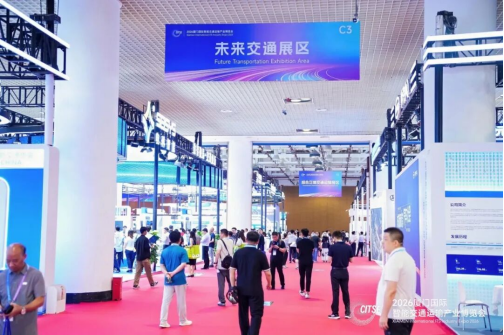
Image Source: Shenzhen Intelligent Connected Transportation Association
I. 'Shenzhen Pavilion': The 'City-Level' Confidence Behind a Set of Numbers
The 'Shenzhen Pavilion' focused on tangible achievements rather than flashy concepts:
- China's first intelligent connected vehicle management regulations—providing a legal framework;
- The first full-chain management platform—vehicles online, people online, management online;
- 2,400 routes, over 10,000 kilometers, over 2,000 vehicles—the largest and densest operational scale for domestic functional autonomous vehicles;
- 686,000 passenger orders, 8.66 million unmanned delivery orders, commercial value of RMB 73 million—successfully transitioning from 'pilot' to 'business'.
The significance of these numbers lies in the fact that they represent not just the achievements of individual companies but the 'systemic capabilities' of an entire city.
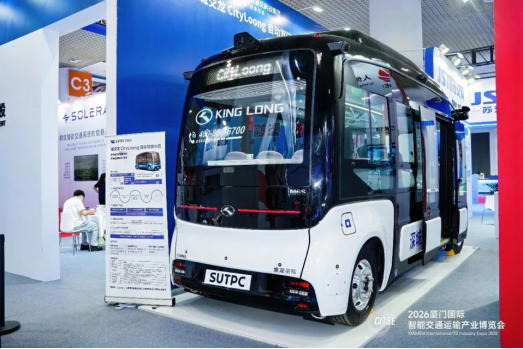
Image Source: 2026 Xiamen International Smart Transportation Industry Expo Official Website
Shenzhen's approach is clear: Autonomous vehicles are not just 'toys for tech companies' but 'urban infrastructure'. Only by fully integrating regulations, platforms, road rights, scenarios, and commerce can companies 'thrive'.
The 'Chengjiaolong' autonomous minibus, displayed by Shenzhen Transport, a leading member company, utilizes domestic high-computing-power chips, AI large model decision-making capabilities, and safety redundancy design, supporting 'on-demand response and precise scheduling'. It is planned for trial operation on Shenzhen's park loop in 2026, with unmanned commercial operations expected within three years.
'Chengjiaolong'—'Chengjia' is the abbreviation for Shenzhen Transport, and 'Long' is a Chinese totem.
This is no coincidence but reflects Shenzhen's self-positioning for autonomous vehicles: to be a 'Chinese Solution', not a 'Silicon Valley Replica'.
II. Shenzhen Transport's 'Dual-Wheel Drive': From 'Can Run' to 'Can Operate'
Shenzhen Transport's booth featured two notable products.
The first: 'Chengjiaolong' autonomous minibus.
A mass-production model for open roads, featuring domestic chips + AI large models + safety redundancy.
The keyword is 'mass production'—not a demo vehicle but a genuine product capable of batch production and operation.
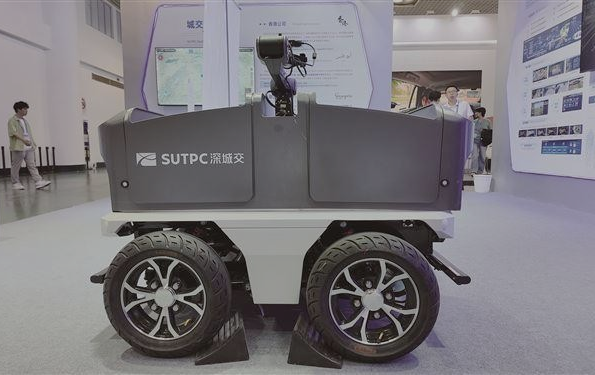
Shenzhen Transport's embodied intelligent unmanned delivery vehicle. Image Source: Xiamen Evening News
The second: Embodied intelligent unmanned delivery vehicle.
Combining an autonomous driving chassis with an intelligent robotic arm, it can autonomously pass through access control, navigate floors, and load/unload goods. On display, it accurately completed autonomous item pickup and placement, with smooth movements resembling a human arm.
From 'can run' to 'can operate, interact, and implement'—this is Shenzhen Transport's redefinition of unmanned delivery.
Previously, autonomous vehicles were 'boxes on wheels', delivering to doorsteps and waiting for pickup;
Now, embodied intelligent unmanned vehicles are 'robots on wheels', capable of entering doors, climbing floors, and placing goods independently.
Suitable for semi-enclosed scenarios such as park office buildings, hotels, and hospitals—the pain point is not 'difficult roads' but 'difficult doors to enter, floors to climb, and goods to place'. Shenzhen Transport solved the 'last ten meters' with a robotic arm.
III. 'Eight Immortals Crossing the Sea' and 'Racing Overseas': Shenzhen's Technological Diversity and Global Ambitions
The charm of the 'Shenzhen Pavilion' lies in its presentation not of a single dominant player but a vibrant 'corps'.
Various member companies 'each showcase their unique strengths', collectively outlining the diverse landscape and global ambitions of China's intelligent connected vehicle industry.
Didi Autonomous Driving's collaboration with GAC Aion on the new-generation Robotaxi model R2 represents a strong alliance between a 'new automotive force' and a 'mobility giant'.
Its core goals are 'cost reduction' and 'globalization', achieving significant cost reductions while enhancing reliability through autonomous driving-specific design and a new-generation hardware platform, paving the way for future large-scale commercial operations.
Currently undergoing regular road testing, the R2 is a key carrier for Didi to integrate its vast mobility data with autonomous driving technology.
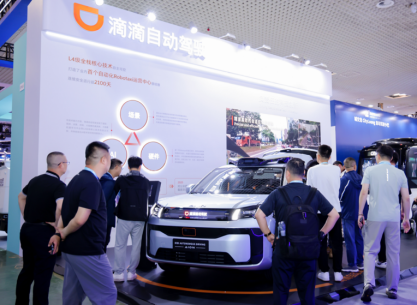
Image Source: 2026 Xiamen International Smart Transportation Industry Expo Official Website
Minieye, on the other hand, has chosen a more 'hardcore' technological route.
Its displayed Xiaozhu autonomous vehicle T5 Pro claims to be China's first 'truly map-free' L4-level unmanned logistics vehicle.
'Map-free' means completely eliminating reliance on high-definition maps, relying solely on self-developed end-to-end large models and real-time perception capabilities to handle complex road conditions.
The breakthrough of this technology lies in compressing the deployment cycle for map collection and annotation, which traditionally takes weeks, to 'hourly' levels, significantly reducing costs and barriers for business expansion in new cities and regions.
For Chinese autonomous vehicle companies aiming to expand globally, this is akin to a 'master key'.
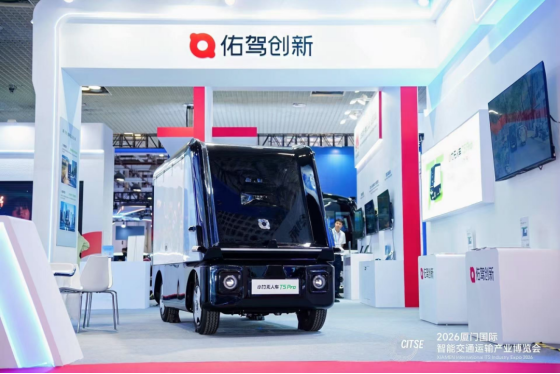
Image Source: Shenzhen Intelligent Connected Transportation Association
9D Recognizing Intelligence and Neolix represent 'scenario experts' deeply cultivating vertical fields.
9D Recognizing Intelligence is a global leading autonomous driving technology company, consistently ranked among global and Chinese unicorn lists.
9D Recognizing Intelligence's Z5 autonomous vehicle, with its large capacity, high payload, and long range, focuses on urban full-scenario logistics delivery, with business covering over 20 countries globally.
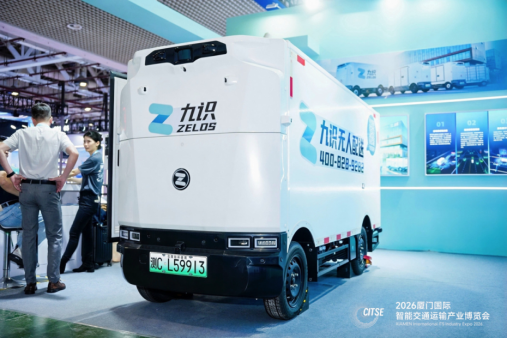
Image Source: 2026 Xiamen International Smart Transportation Industry Expo Official Website
Neolix, meanwhile, has built a full-spectrum RoboVan matrix ranging from 3 to 20 cubic meters, achieving full-link coverage from last-mile delivery to regional transportation. Its autonomous driving mileage has surpassed 150 million kilometers, serving nearly 20 countries and over 300 cities worldwide.
(For further reading, please click: 'A Comparison of 49 Players in the Unmanned Delivery Vehicle Sector: 37 New Entrants Rush In, 12 Incumbents Build High Walls—Who Will Laugh Last?')
Behind these numbers lies the immense ambition of Chinese autonomous vehicle companies to no longer confine themselves to domestic 'involution' but to actively 'go global', exporting mature solutions worldwide and participating in international competition.
IV. From 'Bonsai' to 'Forest': The Enlightenment of the 'Chinese Approach' for Autonomous Driving
Observing Shenzhen's strength at the Xiamen Smart Transportation Expo, we can clearly see a 'Chinese Path' distinct from the Waymo model: It does not insist on achieving the ultimate dream of L5-level 'fully autonomous' driving in one step but adopts a pragmatic strategy of 'layered advancement, scenario-driven development, and commercial closure'.
First, policy leads the way, providing certainty.
Shenzhen has cleared the largest institutional barriers for enterprises through local legislation and full-chain management, creating a globally leading friendly development environment.
Second, scenarios are opened up, providing a training ground.
From bus shuttles to logistics delivery, from sanitation sweeping to security patrols, Shenzhen uses the entire city as an open laboratory, allowing technology to be tempered in the most complex and authentic environments.
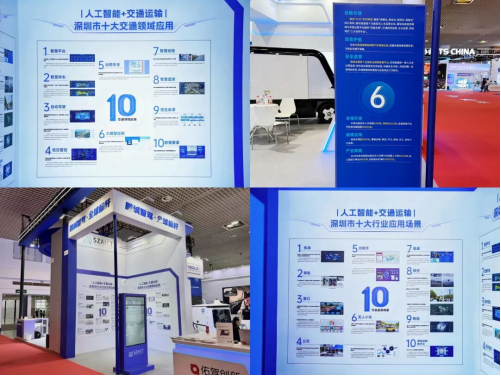
Image Source: 2026 Xiamen International Smart Transportation Industry Expo Official Website
Third, commerce drives progress, emphasizing self-sufficiency.
Whether it's RMB 9.9 same-city freight or autonomous minibusses on park loops, Shenzhen's enterprises have from the outset considered how to reduce costs and generate revenue, rather than merely burning money to survive.
Finally, ecological collaboration forms a synergistic force.
From system integrators like Shenzhen Transport to scenario operators like Didi, Minieye, 9D Recognizing Intelligence, and Neolix, and countless sensor, chip, and algorithm companies behind them, Shenzhen has formed a tightly collaborative industrial ecosystem with both competition and cooperation.
This model is like cultivating a 'forest' rather than meticulously trimming a few 'bonsai'.
In conclusion, Autonomous Vehicles Are Here (WeChat Official Account: Autonomous Vehicles Are Here) believes:
When the 'Shenzhen Pavilion' display boards were photographed by merchants from over 30 countries and regions worldwide, the signal was clear: The 'Chinese Approach' for autonomous vehicles has moved from the 'can it be done' stage to the 'how to replicate it' stage. From Pengcheng to the globe, Shenzhen has taken the lead on this path!
What do you think, dear?
References: Official WeChat Account of the Shenzhen Intelligent Connected Transportation Association, 2026 Xiamen International Smart Transportation Industry Expo Official Website, Xiamen Evening News, and other media reports
#AutonomousVehiclesAreHere #AutonomousDriving #SelfDriving #AutonomousVehicles
-
![]()
Breaking the Mold: LG, Haier, and Hisense Redefine Online and Offline Home Appliance Sales Strategies in India
-
Lenovo's AI Goldmine: How Long Can Yang Yuanqing Keep 'Feasting'?
-
![]()
Samsung Galaxy Z Fold 8 Review: Ultra-Slim Dual Design Shines, but Telephoto Absence is a Bummer
-
![]()
Dongfeng VOYAH’s New Car Makes a Splash, Targeting More Than Just the 30s and 40s Crowd
-
![]()
Annual Salary of 700 Million Fails to Retain Him! AI Genius Jiahui Yu Departs Meta to Launch His Own Startup
-
Qianwen Seeks to Move Beyond Its 'Alibaba Identity'
-
![]()
How Can We Comprehensively Resolve Ctrip's Monopoly Issue?
-
![]()
From Computing Power Supply-Demand Dynamics to Capital Integration: Jin Jing New Energy Embarks on a New Business Phase