Real Insights from New Energy Vehicle Owners in China’s Top 30 Cities by Ownership
 06/30 2026
 443
443
Analysys Insight: China has witnessed a remarkable surge in new energy vehicle (NEV) ownership, transforming the NEV owner demographic from a niche group of early adopters to a diverse cross-section of society spanning various age groups and income levels. This shift has fueled a multifaceted demand for public charging infrastructure. As the public charging service sector enters a new era shaped by evolving supply and demand dynamics, understanding user behavior and addressing their primary concerns have become pivotal for operators aiming to thrive in the competitive market. To accurately capture the genuine needs of today’s users, Analysys conducted an online survey targeting the top 30 cities in China with the highest NEV ownership. The survey encompassed first-tier cities like Beijing, Shanghai, Guangzhou, and Shenzhen, emerging first-tier cities such as Hangzhou, Chengdu, Zhengzhou, and Wuhan, as well as other cities including Wenzhou, Wuxi, and Xiamen. A total of 100 questionnaires were distributed in each city, yielding 3,000 valid responses. The survey participants were vehicle owners who rely on public charging stations for their daily charging needs and have utilized third-party public charging services within the past month.
I. User Demographics: Young and Middle-Aged Professionals Dominate, with Middle-to-High Income Levels
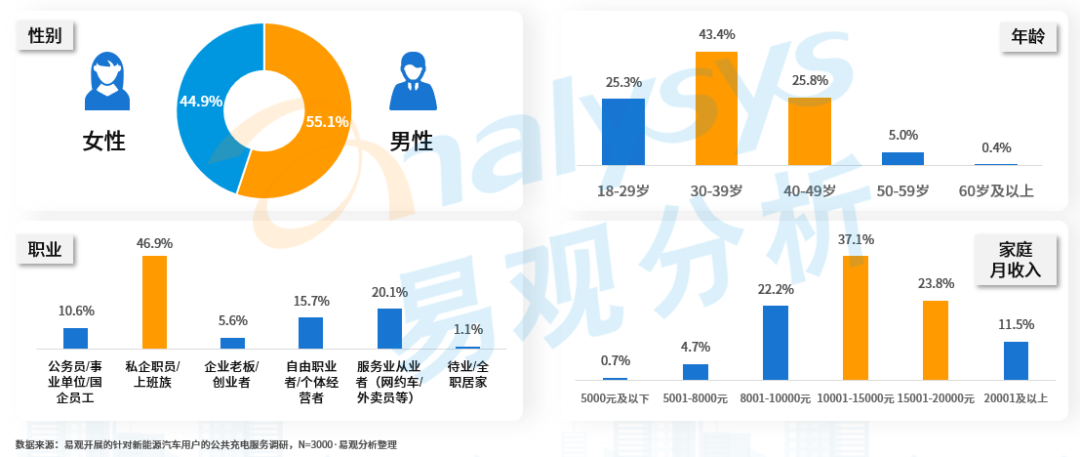
An analysis of the respondents’ basic demographics reveals that the primary users of public charging services share distinct social characteristics. In terms of gender distribution, male vehicle owners slightly outnumber their female counterparts, comprising 55.1% and 44.9% of the respondents, respectively. When it comes to age, the 30-39 age group (43.4%) and the 40-49 age group (25.8%) form the core user base, collectively accounting for nearly 70% of the survey participants. This indicates that young and middle-aged individuals are the main drivers of public charging consumption.
In terms of occupation and income, private sector employees and office workers constitute the largest segment at 46.9%, followed by service industry workers (e.g., ride-hailing drivers and food delivery personnel) at 20.1%, freelancers or self-employed individuals at 15.7%, and employees of civil servants, public institutions, and state-owned enterprises at 10.6%. The monthly household incomes of these groups are predominantly concentrated in the 10,001-15,000 yuan (37.1%) and 15,001-20,000 yuan (23.8%) brackets.
II. Charging Patterns: Frequent, Fragmented Charging, with Workplaces and Residential Areas as Key Locations
Vehicle owners exhibit a tendency towards fragmented and proximity-based charging in their daily routines. Those who frequently utilize public charging services charge their vehicles an average of 1.87 times per week, with each session averaging 25.21 kWh. This suggests a preference for frequent, timely charging rather than waiting for the battery to deplete before charging large amounts.
In terms of preferred charging locations, stations near workplaces or companies are the top choice, accounting for 40.2% of respondents, followed closely by those near residential areas at 39.3%. Charging stations near shopping malls rank third at 20.5%. This highlights the need for operators to seamlessly integrate charging station planning into vehicle owners’ daily life circles encompassing “commute-residence-consumption.”
III. Brand Perception: Leading Operators Enjoy Strong Recognition and Recommendation
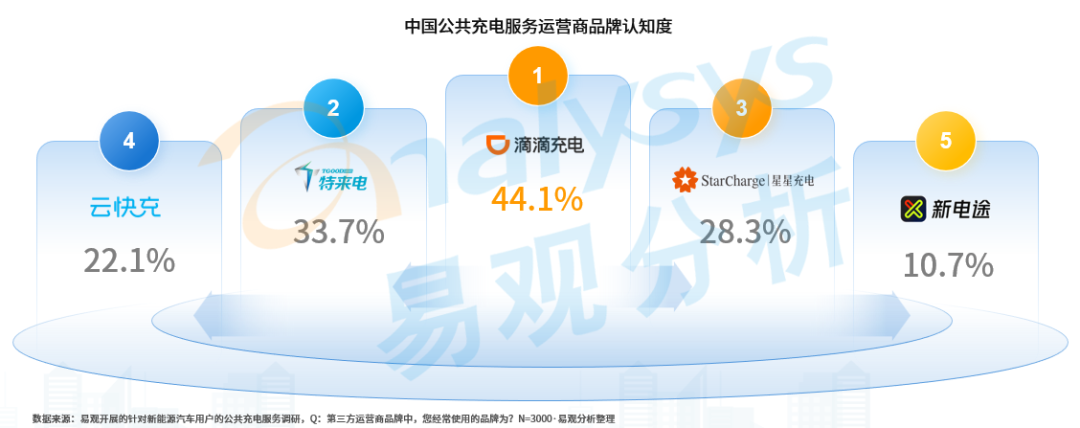
Amidst the plethora of third-party public charging brands in the market, users’ recognition and recommendation exhibit a pronounced concentration towards leading brands. In terms of brand recognition, Didi Charging leads the pack with a 44.1% regular usage rate, followed by Teld at 33.7%, with Xingxing Charging (28.3%), Yunkuai Charging (22.1%), and Xindiantu (10.7%) ranking third to fifth, respectively.
When it comes to user recommendation, Didi Charging again tops the list with a 33% recommendation rate, followed by Teld (20%), Xingxing Charging (15%), Yunkuai Charging (10%), Kaimaisi (4%), Jingchong (4%), Kuaidian (4%), Xindiantu (3%), Lvchongchong (3%), Weijingyun (2%), and Wanma Aichong (1%).
IV. Satisfaction and Expectations: Speed and Price Remain Key Concerns, with Service Details in Dire Need of Enhancement
In evaluating their experience with third-party charging operators, the survey assessed five key dimensions: overall satisfaction, charging station coverage, charging experience, charging speed, and charging safety. The results reveal that Didi Charging ranks first with an overall satisfaction score of 17.21, excelling in charging experience (4.26 points), charging speed (4.30 points), and safety (4.41 points). Teld ranks second with a score of 16.98, performing well in charging station coverage (4.23 points). Yunkuai Charging (16.91 points), Xingxing Charging (16.90 points), and Xindiantu (16.66 points) rank third to fifth, respectively.
Despite the decent scores achieved by leading brands, users still harbor numerous concerns regarding current public charging services and have expressed clear expectations for improvement. Among the areas identified for enhancement, increasing charging speed (42%) and reducing charging prices (42%) are tied for first place, indicating that shortening charging times and implementing refined operations (such as cost control through membership or package plans) remain crucial for enhancing user experience. Optimizing the APP user experience (41%) is also a top priority, with vehicle owners expecting the APP to help them quickly locate the most cost-effective charging stations and provide more comprehensive information on surrounding services. Additionally, strengthening maintenance to reduce failure rates (40%), increasing value-added services such as restrooms and convenience stores (33%), expanding charging station coverage, especially in rural areas (28%), and improving customer service response times (13%) are also dimensions of significant concern to users.
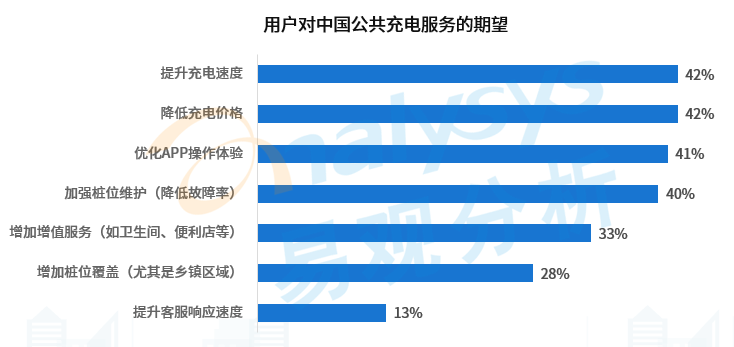
Overall, the demand for public charging among Chinese NEV owners has evolved from a basic need for “available charging” to a comprehensive experience that emphasizes “time-saving, reliability, convenience, and affordability.” In the future, operators that can first establish a strong competitive edge in terms of hardware responsiveness, refined operations, intelligent APP interactions, and comprehensive station facilities will be well-positioned to secure high-value user groups in the existing market.
Research Notes
The industry analysis provided by Analysys is primarily based on macro industry data, quarterly end-user survey data, historical vendor data, and quarterly vendor business monitoring information. Utilizing Analysys' industry analysis model and combining market research, industry research, and vendor research methodologies, the analysis primarily reflects market status, trends, turning points, and patterns, as well as the development status of vendors.
Analysys believes that the data obtained through the aforementioned industry research methods accurately reflects industry trends and changes within an industry-accepted margin of error.
The research results obtained through professional research methods are intended for decision-making reference. For actual vendor data, please refer to the financial reports published by the vendors.
Copyright Notice
The third-party data and other information cited by Analysys in this article are sourced from public channels, and Analysys assumes no responsibility for their accuracy or completeness. Under no circumstances shall this article be used as a basis for any decision-making and shall only serve as a reference. The copyright of this article belongs to the publisher. Without authorization from Analysys, any reproduction, quotation, or use in any form of any content published by Analysys is strictly prohibited. Any authorized media, website, or individual using the content should quote it verbatim and indicate the source. The analysis views shall be based on the official content released by Analysys, and no deletions, additions, splicing, interpretations, or distortions of any form shall be made. Analysys assumes no responsibility for any disputes arising from improper use and reserves the right to hold relevant responsible parties accountable.
-
![]()
Breaking the Mold: LG, Haier, and Hisense Redefine Online and Offline Home Appliance Sales Strategies in India
-
Lenovo's AI Goldmine: How Long Can Yang Yuanqing Keep 'Feasting'?
-
![]()
Samsung Galaxy Z Fold 8 Review: Ultra-Slim Dual Design Shines, but Telephoto Absence is a Bummer
-
![]()
Dongfeng VOYAH’s New Car Makes a Splash, Targeting More Than Just the 30s and 40s Crowd
-
![]()
Annual Salary of 700 Million Fails to Retain Him! AI Genius Jiahui Yu Departs Meta to Launch His Own Startup
-
Qianwen Seeks to Move Beyond Its 'Alibaba Identity'
-
![]()
How Can We Comprehensively Resolve Ctrip's Monopoly Issue?
-
![]()
From Computing Power Supply-Demand Dynamics to Capital Integration: Jin Jing New Energy Embarks on a New Business Phase