Pragmatik Labs, Founded by Former Qwen Technical Lead, Reaches $5 Billion Valuation with Tens of Millions in New Financing
 11/25 2026
 359
According to Bloomberg, Pragmatik Labs, an AI agent startup founded by Lin Junyang, former technical lead of Alibaba's Tongyi Qianwen (Qwen), has completed a new financing round in the tens of millions of dollars, reaching a post-investment valuation of $5 billion.
New investors in this round include CDH Investments, HyT Capital, and Geely Automobile. However, reports did not disclose the specific use of funds or the transaction arrangements for this financing.
On August 12 of this year, Pragmatik Labs had already announced the completion of approximately $220 million in angel-round financing, co-led by Gaorong Ventures and Sequoia China (approximately $100 million each), with Tencent participating with approximately $20 million and the Shanghai Future Industry Fund also participating. At that time, the post-investment valuation was approximately $2 billion. Compared with the first round, the amount raised in this round is smaller, but given that the company has not yet released any public product and has no commercialization revenue, its valuation rising from $2 billion to $5 billion in about three months is indeed rare.
Business registration information shows that its domestic operating entity, "Pragmatik (Shanghai) Technology Co., Ltd. (Pragmatik Labs)," was established on May 13, 2026, with registered capital of 1.25 million yuan. The legal representative is Lin Junyang, and the company is located in "MoSu Space," a large-model incubation hub in Xuhui, Shanghai.

Public information shows that Lin Junyang was born in 1993. He graduated with a bachelor's degree from the English Department of the University of International Relations and earned a master's degree from the School of Foreign Languages at Peking University. His research focuses on natural language processing and multimodal representation learning, with an academic path leaning toward the intersection of linguistics and computer science.
After graduating with his master's degree in 2019, he joined the Intelligent Computing Laboratory of Alibaba DAMO Academy, starting from underlying algorithms and participating throughout the R&D of early ultra-large-scale models such as M6 and OFA. At the end of 2022, Alibaba merged DAMO Academy's language, vision, and other AI teams into Alibaba Cloud and established the Tongyi Lab. Lin Junyang, then under 30, was formally appointed technical lead of the Tongyi Qianwen (Qwen) series of large models, and in 2025 was promoted to become one of the youngest P10-level technical leads in the Alibaba system.
During his three years in charge of Qwen, he led the team to launch the trillion-parameter Qwen3-Max flagship large model. The open-source system has accumulated more than 600 million downloads, with more than 200,000 derivative developer models. The 72B version has long remained at the top of global open-source large models and has also ranked among the first tier of global open-source models.
In March 2026, Lin Junyang announced his departure from Alibaba. According to insiders at Alibaba, as Qwen was elevated from a foundation model to an overall group strategy, the company hoped to recruit more technical talent, involving adjustments to the scope of Lin Junyang's responsibilities. He did not accept this and therefore submitted his resignation.
It is reported that Pragmatik Labs, founded by Lin Junyang, is mainly divided into two lines: digital agents and physical agents. The former targets knowledge work, enterprise operations, and industry-level workflows, while the latter focuses on embodied intelligence, promoting agents to execute tasks in real environments, with key capabilities in reasoning, tool calling, feedback learning, and multi-agent collaboration—for example, running in robots or physical devices.
The company adopts a path combining research and application, deploying cutting-edge technology into real scenarios and iterating models based on feedback, while also retaining a "long-horizon exploration" direction. Unlike the previous wave of general-purpose large language model startups, Pragmatik Labs anchors its technical direction on "next-generation agents spanning the digital world and the physical world."
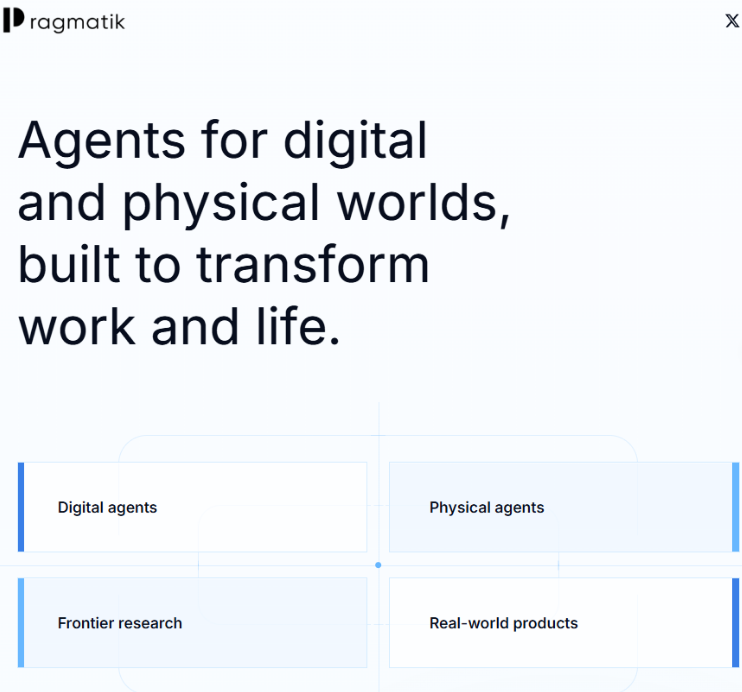
Image source: Pragmatik Labs official website
In addition to the two directions of digital intelligent agents and physical intelligent agents, the Pragmatik Labs official website also proposes translating frontier research into products, using feedback from actual use to improve research, and exploring systems that break through existing technical paradigms.
However, the official website currently focuses mainly on introducing research directions and has not disclosed sufficient product and testing information, nor has it listed specific robot models, customer deliveries, or commercial deployment cases. Therefore, it is currently difficult to judge what stage its physical intelligent agent R&D is at.
-
![]()
Pragmatik Labs, Founded by Former Qwen Technical Lead, Reaches $5 Billion Valuation with Tens of Millions in New Financing
-
![]()
From "Submitting the Paper" to "Getting It Over With": Large Models Hit "Release Inflation"
-
![]()
Guangzhou Auto Show: Debut Rights "Reversed" as Traditional Automakers Reclaim the Spotlight
-
![]()
145 Billion Parameters Squeezed onto a Laptop—Who's Paying for This?
-
![]()
Your Next Phone May Be Yielding Ground to AI Data Centers
-
The Next Main Battlefield of AI Competition Is Scientific Research
-
![]()
Wei Jianjun Publicly Airs Frustration Over Sales Decline: Is Great Wall Motors' "Unit-Price Defense" Strategy No Longer Tenable?
-
![]()
Xiaomi: Out of the Woods, but What Does the Future Hold?