145 Billion Parameters Squeezed onto a Laptop—Who's Paying for This?
 11/25 2026
 366


Training demands centralization; inference demands decentralization
Image source: Internet (contact us for removal if infringing). Partially AI-generated.
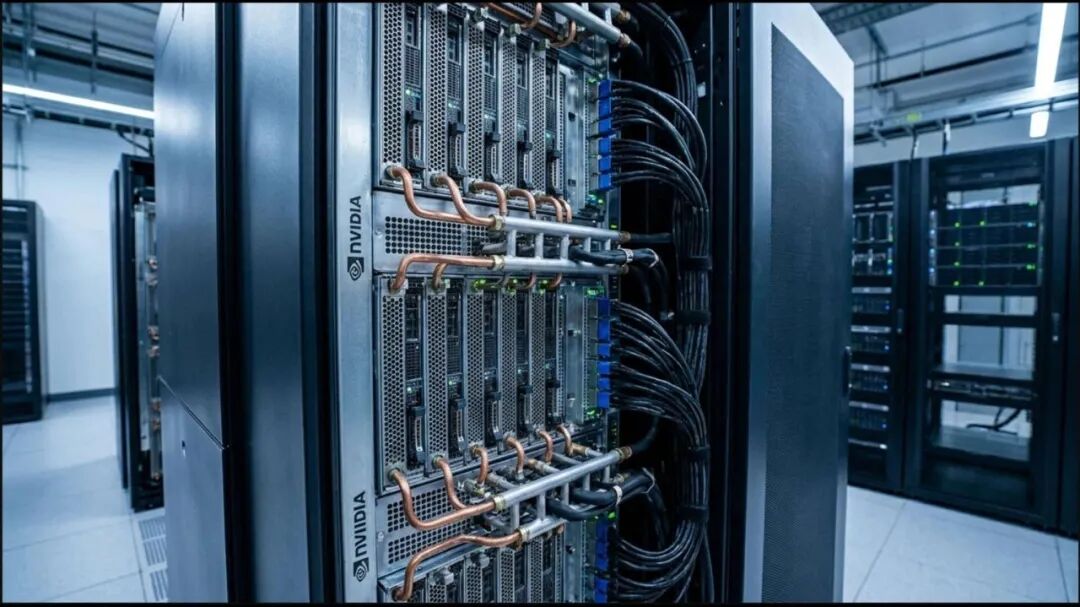
On one side, rows of server racks fill the machine room, trucks keep hauling batches of accelerator cards into the data center, and engineers are busy deploying a super-node system with 20,480 cards.
On the other side, a laptop with its network cable unplugged is completing 3D modeling, game production, and video generation locally, the progress bar on screen inching forward.
The former concentrates compute power into ever-larger machines; the latter tries to stuff capabilities that once belonged to data centers into an ordinary computer.
These two scenes happen to occur on the same day.
On the surface, they seem to point in opposite directions: one shows compute power continuing to concentrate toward the center, the other shows AI capabilities beginning to spread to personal devices.
But stretch the timeline, and you'll find these are not two conflicting industrial paths, but the two ends of the same restructuring of compute power.
Training demands centralization; inference demands decentralization.
Training models requires stable bandwidth, power supply, cooling, and device coordination—so the larger the scale of compute power, the more obvious the value of centralized deployment.
Inference is different. For a large number of everyday tasks, what users really need is not a massive data center, but a model that is cheap enough, timely enough, and callable at any time.
As more and more inference tasks can be completed locally, the cost structure of the AI industry will change accordingly.
What's truly worth paying attention to is not just whether on-device AI can run large models, but how long the business model of charging for token calls can last when the marginal cost of a single inference keeps falling.

Two Directions on the Same Day
Recently, an open-source model with a total parameter count of 145 billion has attracted attention.
According to the manufacturer, this model adopts a latent-space sparse MoE architecture, with 48 layers and 512 experts per layer. Each token routes to only 10 experts, plus 1 shared expert, and the number of parameters actually involved in computation is about 10.12B.
It supports a 256K context, and the weight file after NVFP4 quantization is about 47.79GiB.
What's more noteworthy is the operating conditions.
According to official disclosure, after enabling expert residency, this model can run on an RTX 5090 D equipped with 24GB of VRAM, with a decoding speed exceeding 80 tokens/s.
The official statement also claims that a PC with 12GB of VRAM and 20GB of memory, or a Mac with 48GB of unified memory, can also run it.
In official tests, an offline laptop completed three cases: 3D modeling, game production, and video generation.
Just 3 days after open sourcing, the model topped the Hugging Face Text Generation leaderboard, and the accompanying inference engine was also open sourced simultaneously on GitHub.
It should be emphasized that the above speeds and capabilities are disclosed by the manufacturer or related platforms, and are not the results of unified independent third-party testing.
Now look at the other end.
China Mobile's centralized procurement of next-generation AI super-node equipment for 2026 to 2027 has been finalized. The winning product is super-node servers, with a winning share of 2,048 cards, a bid price of 1.167 billion yuan (excluding tax), and a total project scale of 20,480 cards.
On one side, a 145-billion-parameter model enters personal computers; on the other side, a carrier purchases 20,480 cards at once.
The real message of these two events appearing on the same day is not whether AI should run in the cloud or locally, but that compute power is being re-divided.
Data centers handle increasingly heavy training and high-value inference, while personal devices handle more and more tasks that can be processed locally.
Compute power has not disappeared; it has simply begun to seek different cost positions.

The Parameters Haven't Changed—Their Location Has
145 billion parameters entering 24GB of VRAM is hard to understand at first glance.
After all, the model weights themselves are 47.79GiB, already clearly exceeding 24GB.
The answer lies in the fact that this type of model does not need to invoke all parameters for every computation.
It adopts MoE—a mixture-of-experts architecture. Simply put, it splits a large model into many specialized groups, and when facing different problems, only some of the groups are arranged to work, rather than having everyone on stage at the same time.
This model has 512 experts per layer, and each token selects only 10 experts, plus 1 shared expert.
Therefore, although the model has a total of 145 billion parameters, only about 10.12 billion parameters actually participate in computation each time.
This is sparse computation.
What it changes is not how many parameters the model has, but how much compute resource each inference actually needs to use.
Another key is expert residency.
Residency means not requiring all model weights to always be placed in VRAM at the same time, but arranging expert weights into appropriate storage locations according to computational needs.
This is similar to warehouse picking: you don't need to put all goods on the workbench, only deliver the goods currently needed in time.
NVFP4 is a low-precision numerical representation—simply put, using less storage space to save model weights in order to reduce memory usage.
Only by combining the three technologies did this become possible: sparse activation reduces the actual amount of computation, quantization compresses weights, and expert residency alleviates VRAM capacity limits.
So, 145 billion parameters are not completely stuffed into 24GB of VRAM.
What really happens is that the relationship among model parameters, compute resources, and storage resources has been rearranged.
The impact of this on the industrial chain is more worth attention than simply increasing model parameters.
In the past, improving large model capabilities often meant larger VRAM requirements, more expensive GPUs, and higher deployment costs.
Now, model manufacturers have begun trying to separate parameter scale from actual computational demand.
This means a device does not need to have VRAM matching the model's total parameter count for it to have a chance to run it.
For consumer-grade graphics cards, personal computers, and edge computing devices, this change directly lowers the threshold for entering the AI inference market.
But note also that 10.12B activated parameters do not equal the full computational cost, and certainly do not mean that running a 145-billion-parameter model no longer requires resources. Weight residency, data movement, memory bandwidth, and context caching will still bring additional overhead.
What is truly worth observing is: as model manufacturers continuously optimize these links, how many tasks that originally had to be handed to the cloud will be reallocated to local devices?

Why Training Must Be Centralized and Inference Can Be Distributed
To understand this change, we must first separate the two accounts of the compute power industry: CAPEX and OPEX.
CAPEX is capital expenditure—the money spent on purchasing GPUs, servers, switches, machine rooms, and power supply equipment.
OPEX is operating expenditure, including electricity bills, maintenance, equipment depreciation, networking, and daily scheduling costs.
Training large models is first of all a huge CAPEX.
Model training is not simply handing a task to one graphics card. A large number of GPUs need to continuously exchange data and coordinate computational progress. Once communication between devices becomes a bottleneck, increasing the number of GPUs may not bring a corresponding improvement in training efficiency.
Therefore, training requires centralized deployment.
After centralization, high-speed interconnection, power supply, liquid cooling, and fault management can be arranged uniformly. The more devices there are, the more complex system coordination becomes, and the higher the requirements for infrastructure.
But inference is different.
A single inference usually only needs to handle one specific request. It does not necessarily need to invoke the most expensive compute resources in a data center.
If a user only asks the model to summarize a document, modify a piece of code, or complete a local content generation, then uploading the request to the cloud and waiting for the model to return the result may not be the lowest-cost way.
Especially when the model can run locally, part of the computing fee originally paid to the cloud may become hardware cost already borne by the user.
This is also why CAPEX and OPEX perform differently in the two scenarios.
Cloud deployment requires purchasing expensive equipment first, and then amortizing depreciation and operating costs through continuous call volume.
On-device deployment transfers part of the hardware cost to consumers in advance. After the device is purchased, as long as the hardware still has usable compute power, an additional local inference does not need to separately purchase computing services in the cloud manner.
Two concepts need to be distinguished here: the marginal cost of a single inference is not equal to the full cost of the device.
A computer does not run AI for free. Electricity bills, hardware depreciation, and memory usage still exist, but they no longer appear directly on the user's bill in the form of each API call.
So, how much of the cost of one cloud inference comes from electricity, how much from depreciation, and how much from scheduling?
This account cannot be given a fixed ratio at will.
Because it depends on GPU model, equipment purchase price, utilization rate, power consumption, data center PUE, model size, output speed, and request scheduling method.
The existing disclosed materials do not provide these parameters, so a credible industry average proportion cannot be calculated.
But the cost structure can be clearly broken down:
Electricity cost: the electricity consumed by GPU and server operation, as well as the additional electricity consumed by the cooling system.
Depreciation cost: the procurement cost of GPUs, servers, and network equipment, allocated to each inference according to service life and actual utilization rate.
Scheduling cost: the overhead brought by request queuing, batch processing, VRAM management, data transmission, and service system maintenance.
Among them, depreciation is especially easy to overlook.
A GPU does not stop depreciating even when it is not running. The lower the utilization rate, the higher the fixed cost allocated to each effective token.
This is also why cloud vendors attach so much importance to inference throughput and equipment utilization.
Let's convert token cost again.
Assuming the actual cost of cloud inference is C yuan per thousand tokens, then the cost corresponding to 1,000 Chinese characters can be roughly estimated at about 1,500 to 2,500 tokens, that is, about 1.5C to 2.5C yuan.
But if it is video generation per minute, the situation is much more complicated. Video models may use different visual tokens or latent-space representations, and the number of text tokens cannot be directly applied. It is necessary to know the model's frame count, resolution, generation length, and actual computational consumption in order to convert the cost per minute of video.
This precisely illustrates a problem: token billing is only a commercial pricing unit, not a unified measurement unit for the true cost of all AI tasks.
As inference gradually sinks down, local devices no longer charge users according to API call volume, and cloud token prices will face new competitive pressure.
What cloud vendors really need to face is not how strong on-device devices are, but how many requests never enter the cloud from the very beginning.

What Are 20,480 Cards Buying?
If on-device models can already run on ordinary computers, why does China Mobile still purchase 20,480 cards at once?
Because training and large-scale centralized inference still have a set of basic needs that cannot be replaced by personal devices.
In this centralized procurement by China Mobile, the total project scale is 20,480 cards, of which the disclosed winning share is 2,048 cards, with a bid price of 1.167 billion yuan (excluding tax).
A simple calculation: 1.167 billion yuan divided by 2,048 cards gives an implied price per card of about 570,000 yuan.
It must be emphasized here that this is a rough calculation based on the winning share and total bid price, not the actual procurement price of a single GPU.
Because the procurement target is super-node servers, the quotation may include the complete server, interconnection equipment, supporting systems, and other delivery contents, and this number cannot be directly understood as the selling price of a single GPU card.
So, what is this procurement really buying?
Not simply the quantity of compute power, but certainty.
First, a certain delivery time.
For large-scale AI infrastructure projects, GPUs cannot simply be purchased and immediately put into production. Servers, networking, power supply, cooling, and software systems all require coordinated deployment. If equipment delivery timelines are uncertain, the construction cycle of the entire compute project cannot be determined.
Second, a certain level of interconnection bandwidth.
The value of a super node lies not merely in housing a large number of GPUs in the same facility, but in enabling them to exchange data with sufficiently high efficiency.
The more complex the training task, the more critical inter-device communication becomes. No matter how powerful a single card's computing capacity may be, if communication cannot keep pace, the efficiency of the entire cluster will suffer.
Third, a certain failure rate and operations and maintenance capability.
After large-scale deployment, a single failure is no longer merely a matter of one card going offline—it may also affect the execution efficiency of the entire task. Stability, fault isolation, and maintenance systems are all factors the purchaser must take into account.
Super node procurement, therefore, is in effect the purchase of a predictable set of computing power.
This also helps explain why the more on-device models flourish, the more centralized procurement may accelerate.
The reason is that the two are not handling the same category of tasks.
On-device models primarily address inference needs that can be completed locally, whereas large compute centers undertake model training, complex inference, and computational tasks that a large number of devices cannot handle independently.
Moreover, as edge devices become more widespread, the barrier to AI usage lowers, and the number of potential applications may grow accordingly.
Not all of these applications can be completed locally.
As long as demand persists for complex tasks, cross-device collaboration, and large-scale model training, centralized computing infrastructure will retain its investment value.
By the end of September, the national intelligent computing scale reached 2,592 EFLOPS, a year-on-year increase of 146%.
This figure at least indicates that domestic intelligent computing infrastructure remains in a phase of rapid expansion.
On the same day, there was another piece of news worth noting.
A certain 750B-parameter foundation model deepens its network representation by performing two rounds of recurrent forward computation across 28 of its layers. According to the manufacturer's disclosure, its intelligence level can rival 2T- to 3T-class models—though this reflects the manufacturer's own evaluation criteria, and the weights have not yet been open-sourced.
This forms yet another contrast with the 145 billion-parameter edge-side model.
One reduces actual computation through sparse activation, while the other attempts to improve model representation capability through recurrent computation.
Both demonstrate that the relationship between model capability and parameter scale is becoming increasingly complex.
Future computing demand may not necessarily be determined by parameter count alone, but also by model architecture, inference method, deployment location, and actual usage scenarios.
The 20,480 cards and the 145 billion parameters represent investments at different positions along the same industry chain.

Who gets squeezed out?
If this restructuring of the computing power landscape is viewed from a business model perspective, the first to be affected may not be GPU manufacturers, nor cloud vendors, but the middle layer between the two.
The first layer is the intermediaries that resell API price differences.
In the past, some companies had neither their own models nor core computing resources; they simply connected to third-party large model APIs and then earned profits through product packaging and price arbitrage.
This model had value in the early days, because the threshold for model invocation was high, and enterprise users lacked the ability to connect directly.
But as more and more open-source models emerge, inference engines gradually mature, and enterprises can directly deploy models or even complete certain tasks locally, the value of intermediaries will decline.
The criterion is simple: if a company's core competitiveness is merely knowing where to buy cheaper tokens, then its bargaining power will be difficult to sustain in the long term.
The second layer is the pricing model that takes a cut based on invocation volume.
In the past, many AI applications adopted subscription quotas, invocation counts, or token consumption billing.
The premise of this model is that every time a user uses a feature, the platform needs to bear a measurable cloud cost.
But when models can run locally, users completing the same tasks do not necessarily need to send requests to the cloud.
As a result, products that previously charged based on invocation volume may need to redesign their pricing systems.
In particular, AI tools with simple functions, frequent invocations, and a lack of proprietary data will be more obviously affected.
Users will not indefinitely be willing to keep paying API invocation fees for tasks that a local model can complete.
The third layer is companies that have models but no scenarios.
Model capability is important, but model capability itself does not automatically generate commercial value.
If a company has a good model but no stable user entry point, no unique data sources, and no clear application demand, then no matter how large the model parameters are, it will be difficult to establish a long-term competitive advantage.
After edge-side models become widespread, this problem will become even more pronounced.
Because models are becoming easier and easier to deploy, the scarcity of the models themselves may decline.
What is truly valuable is who controls the devices users use every day, who can access users' real workflows, and who possesses data that can be continuously accumulated.
In other words, future competition among AI companies will not just be about whose model is stronger, but about who can make the model closer to real tasks.
Here there is an industry consensus that needs to be corrected: many people believe that the rise of edge-side AI will directly weaken cloud vendors.
In fact, the biggest rival of cloud vendors is not edge-side devices, but those scenarios that no longer need to call APIs.
Edge-side models cannot replace all cloud tasks, but they can gradually eat away at part of the standardized requests that originally belonged to the cloud.
Cloud vendors can still make money from training, large-scale inference, complex tasks, and infrastructure services.
What is truly being squeezed are those companies that have no underlying technology, no independent scenarios, and rely only on intermediate links to collect fees.
The strongest argument of the opposing side must also be faced squarely: edge-side models can currently only handle light tasks, and truly valuable inference still happens in the cloud.
Although the MoE model has a total of 145 billion parameters, only about 10.12B parameters are activated each time, which means its capability ceiling is still limited by actual computing resources.
This judgment is reasonable.
But it ignores one change: the capability ceiling is moving, and it may move faster than the growth speed of demand in a large number of ordinary application scenarios.
For an ordinary user, not every task requires the strongest model.
Editing documents, generating simple code, organizing materials, and producing basic content—as long as local models can achieve acceptable results for these tasks, there is an opportunity for them to shift away from the cloud.
More importantly, the real moat may not be how large the model is, but how close the model is to the data.
A model running on a personal computer can directly read local files, call local tools, and process data authorized by the user.
It does not need to upload information to the cloud every time and then wait for the result to return.
For a large number of applications that emphasize privacy, response speed, and continuous operation, this proximity itself has value.
Of course, this does not mean that local models have comprehensively surpassed cloud models. It means that the relationship between model capability and deployment location is being readjusted.

The upward concentration and downward diffusion of computing power are no longer two contradictory industry directions.
Training requires determinism, so it concentrates; inference requires low cost, so it disperses.
When more inference tasks can be completed locally, the foundation of the token billing model will be challenged.
Next, what is truly worth tracking is not how many hundreds of billions of parameter models have appeared, but three verifiable indicators.
The first is whether consumer-grade graphics card sales have begun to be driven by AI demand.
If more and more users buy high-VRAM graphics cards no longer just for gaming and graphic rendering, but for running large models locally, then edge-side inference will begin to truly affect the hardware consumer market.
The second is whether mainstream cloud vendors' inference pricing will undergo structural cuts.
If standardized inference demand is gradually diverted to the edge side, will cloud vendors compete for the remaining requests by lowering prices, increasing throughput, and adjusting billing methods? This will directly reflect changes in the cost of the inference market.
Finally, whether the context length of edge-side models will become a new marketing battlefield.
When parameter count and basic inference capability gradually cease to be the only selling points, whether 256K context can truly translate into user value will become a new focus of competition.
The three indicators correspond respectively to hardware demand, cloud pricing, and model deployment capability.
Ultimately, they all point to the same question: as more and more AI tasks no longer need to go through the cloud, where exactly will the profits of the entire computing power industry chain be redistributed from?
-
![]()
Pragmatik Labs, Founded by Former Qwen Technical Lead, Reaches $5 Billion Valuation with Tens of Millions in New Financing
-
![]()
From "Submitting the Paper" to "Getting It Over With": Large Models Hit "Release Inflation"
-
![]()
Guangzhou Auto Show: Debut Rights "Reversed" as Traditional Automakers Reclaim the Spotlight
-
![]()
145 Billion Parameters Squeezed onto a Laptop—Who's Paying for This?
-
![]()
Your Next Phone May Be Yielding Ground to AI Data Centers
-
The Next Main Battlefield of AI Competition Is Scientific Research
-
![]()
Wei Jianjun Publicly Airs Frustration Over Sales Decline: Is Great Wall Motors' "Unit-Price Defense" Strategy No Longer Tenable?
-
![]()
Xiaomi: Out of the Woods, but What Does the Future Hold?