Xiaomi: Out of the Woods, but What Does the Future Hold?
 11/25 2026
 542
Xiaomi Group (1810.HK) released its Q3 2026 financial results (for the quarter ended September 2026) after the Hong Kong market close on the evening of November 24, 2026, Beijing time. Here are the key takeaways:
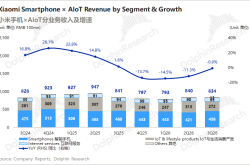
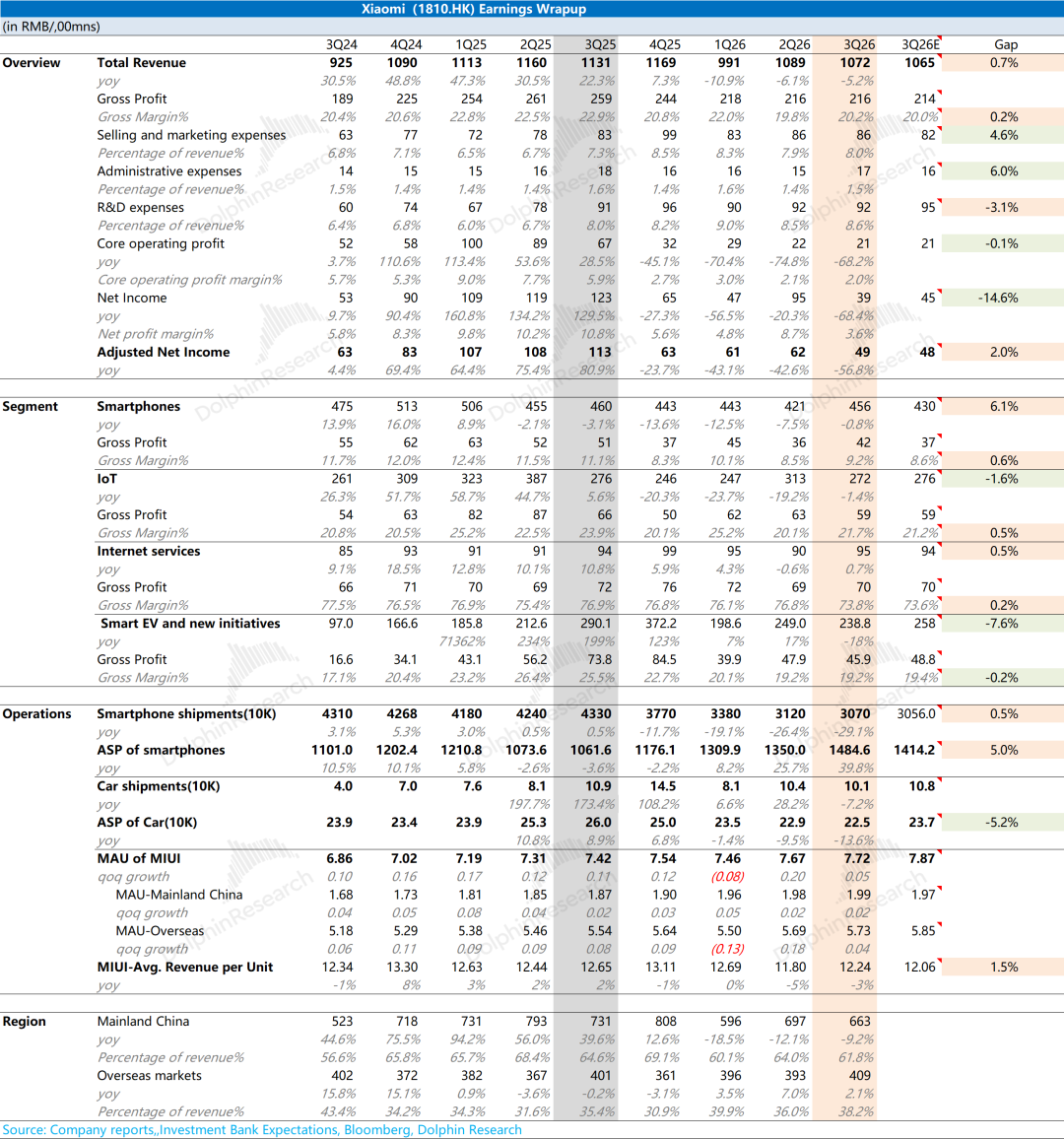
1. Overall performance: Xiaomi's revenue for the quarter came in at RMB 107.2 billion, down 5.2% year-on-year, in line with market expectations of RMB 106.5 billion.
Breaking this down, revenue from the traditional business (smartphones × AIoT) was RMB 83.4 billion, down 0.9% year-on-year. Revenue from new energy vehicles, AI, and other innovative businesses was RMB 23.9 billion, down 17.7% year-on-year and below market expectations of RMB 25.8 billion—mainly due to declines in both vehicle volume and pricing.
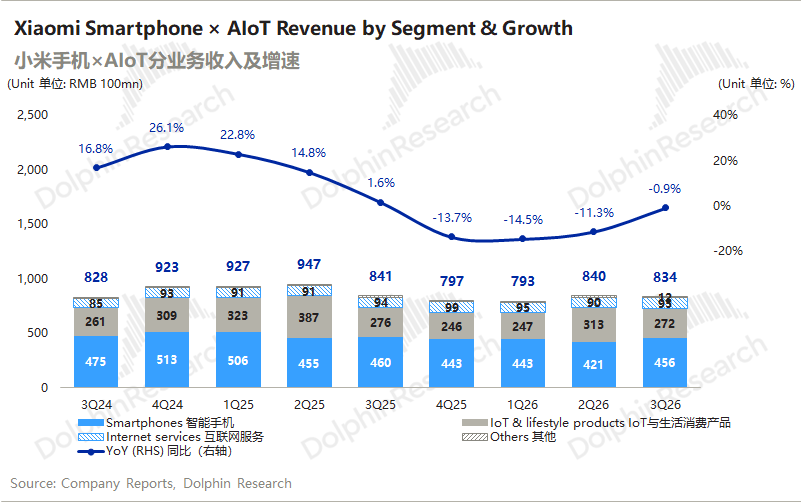
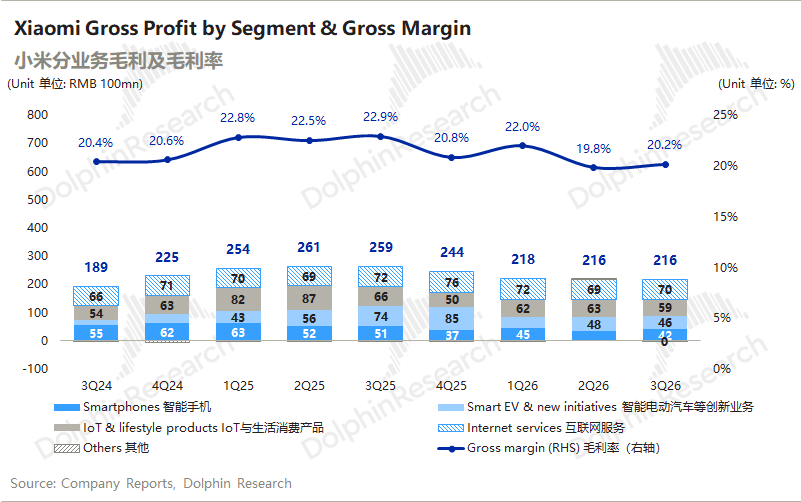
Gross margin for the quarter was 20.2%, up 0.4 percentage points quarter-on-quarter and broadly in line with market expectations of 20.0%.
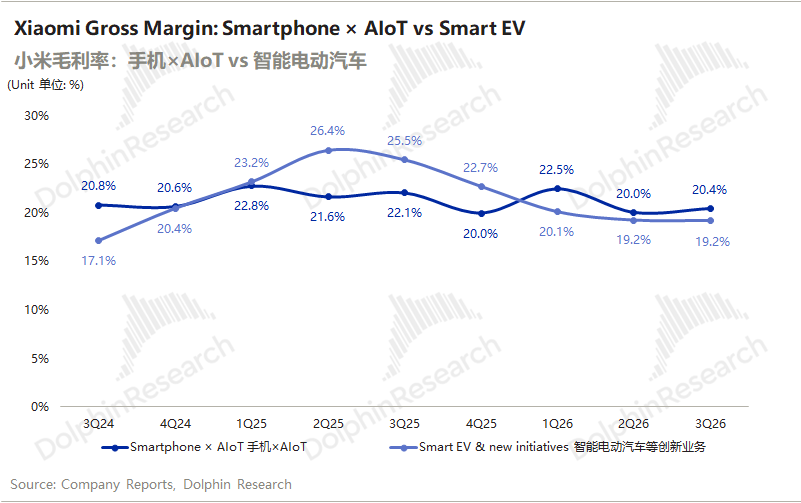
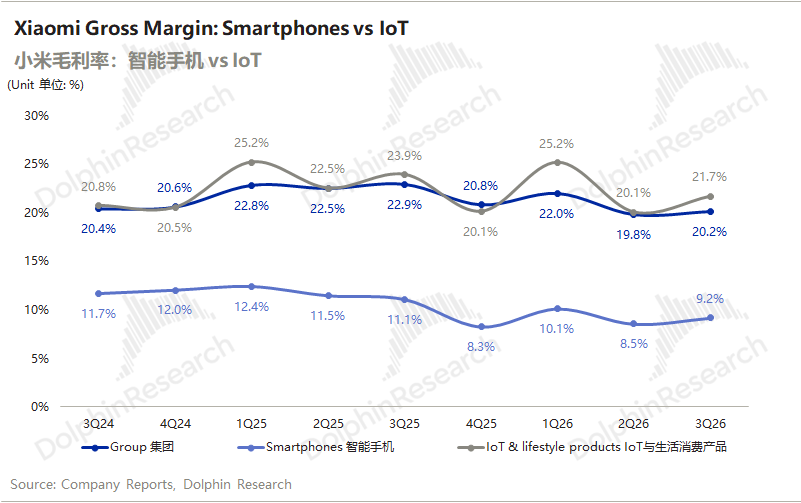
The sequential improvement came primarily from the traditional business: smartphone gross margin recovered from 8.5% to 9.2%, and IoT gross margin rebounded from 20.1% to 21.7%, while the gross margin for automotive, AI, and other innovative businesses held steady at 19.2%.
2. Automotive business: Automotive-related revenue for the quarter was RMB 23.9 billion (of which new energy vehicle revenue was RMB 22.7 billion), below market expectations of RMB 25.8 billion.
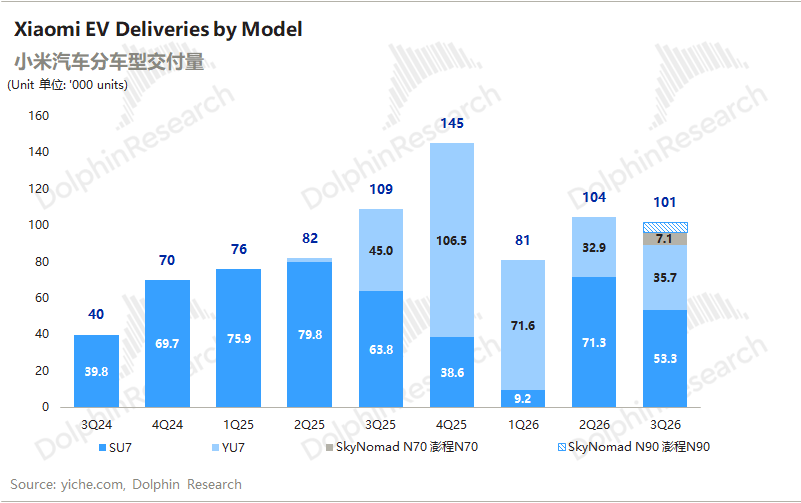
With the addition of the extended-range Pengcheng models, the company renamed this segment from "smart electric vehicles, AI, and other innovative businesses" to "new energy vehicles, AI, and other innovative businesses" starting this quarter. The company delivered 101,000 new vehicles during the quarter, down 7.2% year-on-year, of which the Pengcheng series—launched on September 7—delivered more than 10,000 units.
The average selling price (ASP) per vehicle was approximately RMB 225,000, continuing to slide by about 2% quarter-on-quarter and falling short of market expectations of RMB 237,000. The decline in ASP was the main reason automotive revenue missed expectations. Third-quarter deliveries were still dominated by the new-generation SU7 and YU7. The higher-priced Pengcheng N90 only began deliveries in September, and its boost to ASP will only be reflected in the fourth quarter.
The gross margin of the automotive business (the new energy vehicles, AI, and other innovative businesses segment) was 19.2% for the quarter, flat quarter-on-quarter and slightly below market expectations of 19.4%. The company attributed this mainly to a lower delivery mix of the SU7 Ultra, rising prices of core components, and increased costs in the AI business.
In subsequent communications, management stated that after the launch of Pengcheng, Xiaomi Auto still maintained a "relatively high and healthy" gross margin level and expressed confidence in sustaining automotive gross margin going forward.
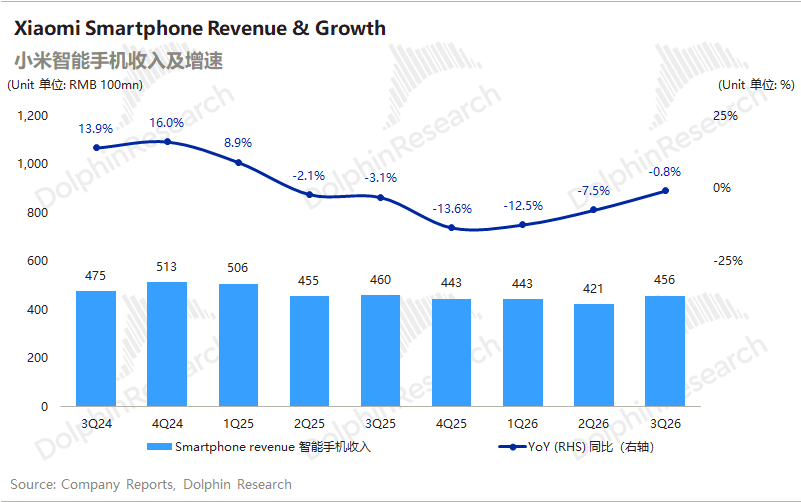
3. Smartphones: RMB 45.6 billion, down 0.8% year-on-year but up 8.2% quarter-on-quarter, beating market expectations of RMB 43 billion.
Xiaomi's smartphone shipments for the quarter were 30.7 million units, broadly in line with expectations. The ASP of smartphones was RMB 1,486, up 39.8% year-on-year—the main source of the beat—as the "control volume, protect price" strategy continued to play out.
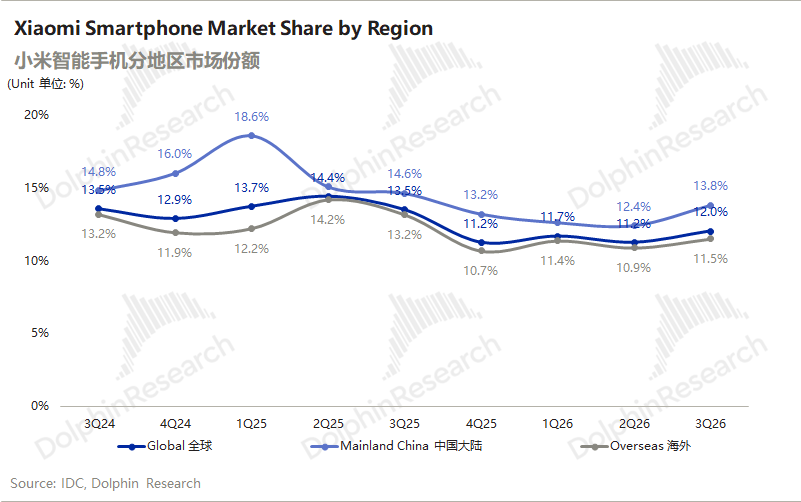
By market, Xiaomi's smartphone shipments in China were approximately 8 million units this quarter, down about 20% year-on-year, with a share of 13.8%. Overseas shipments were approximately 22.7 million units, down about 32% year-on-year, with overseas share falling to 11.5%. The proactive contraction of low-priced overseas models was the main driver of the shipment decline.
Xiaomi's smartphone ASP continued to rise this quarter, mainly because: (1) amid tight memory supply, the company prioritized allocating memory to higher-priced models; and (2) driven by cost pressure, the company raised prices on smartphone products.
Smartphone gross margin was 9.2%, up 0.7 percentage points quarter-on-quarter and above market expectations of 8.6%. The company attributed the sequential improvement to a better product mix driven by new domestic high-end products, partly offset by rising prices of core components.
Smartphone gross margin for the first three quarters was approximately 9.3%, in line with management's previous guidance of "above 9% for the full year." Management expects memory costs to remain relatively high in 2027, views another increase in smartphone ASP versus 2026 as a "near certainty," and expressed confidence in maintaining relatively solid smartphone gross margin performance.
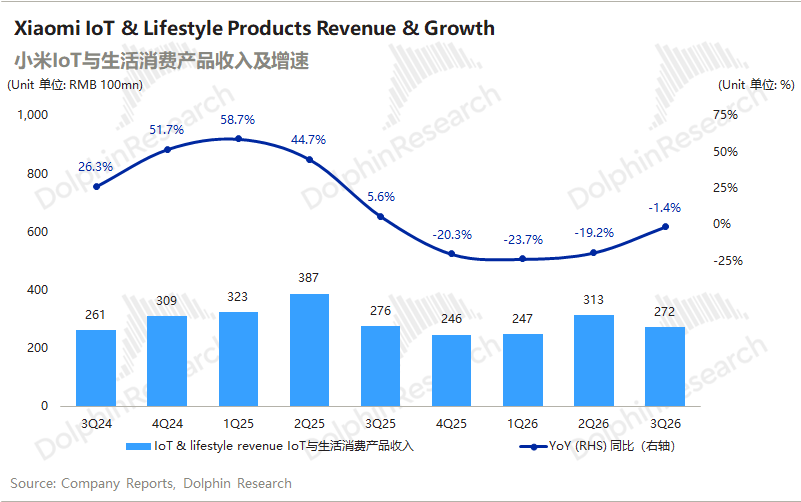
4. IoT: RMB 27.2 billion, down 1.4% year-on-year, slightly below market expectations of RMB 27.6 billion. After gradually digesting the high base brought by last year's national subsidies, the year-on-year decline in the IoT business narrowed significantly compared with the previous three quarters (around 20%).
IoT gross margin was 21.7%, up 1.6 percentage points quarter-on-quarter and above market expectations of 21.2%. The sequential improvement mainly came from higher gross margins for air conditioners and laptops, as well as higher gross margins and a larger revenue share from overseas wearable products.
To meet management's previous full-year guidance of -5% to -10%, the fourth quarter would need year-on-year growth of approximately 13%–38%. Management stated that the IoT business has "emerged from the difficult stage and entered a phase of sustained growth."
5. Internet services: RMB 9.5 billion, up 0.7% year-on-year, in line with market expectations of RMB 9.4 billion. Internet gross margin was 73.8%, down 3 percentage points quarter-on-quarter, mainly because a lower share of pre-installed revenue dragged down advertising gross margin—the continued decline in smartphone shipments has begun to feed through to high-margin pre-installed revenue.
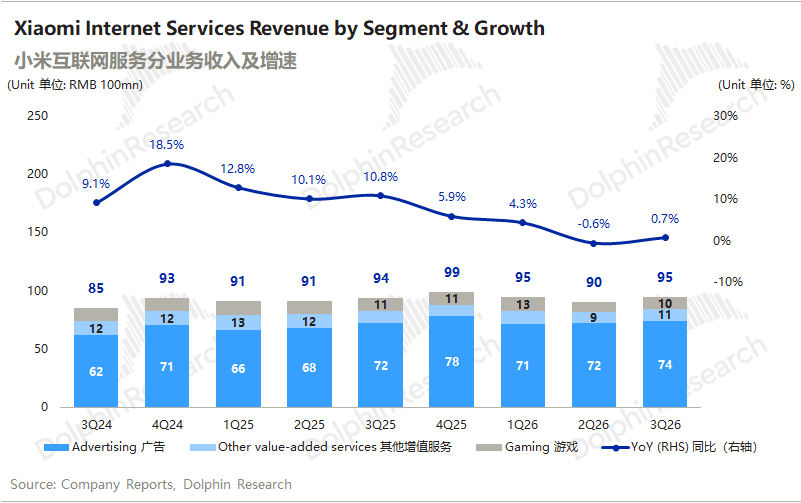
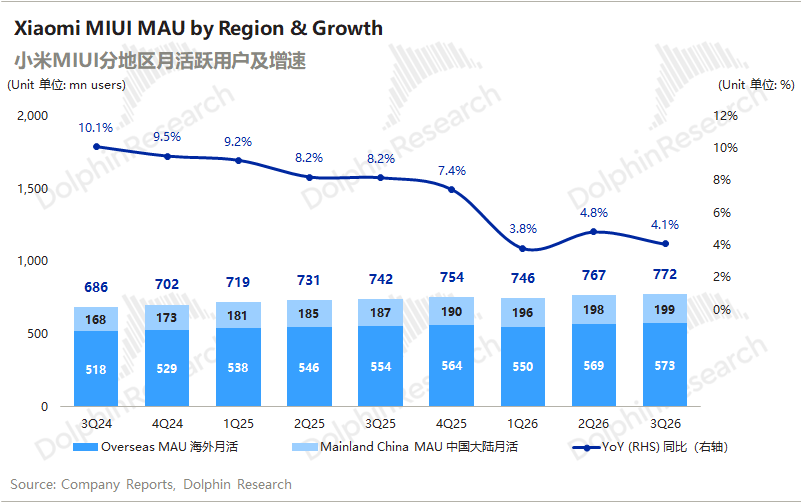
By region: overseas internet revenue for the quarter was RMB 3.2 billion, down slightly by about 1.5% year-on-year; domestic internet revenue was approximately RMB 6.2 billion, up about 2% year-on-year. Domestic monthly active users (MAU) reached 199 million, up 6.4% year-on-year; overseas MAU was approximately 573 million, up 3.3% year-on-year.
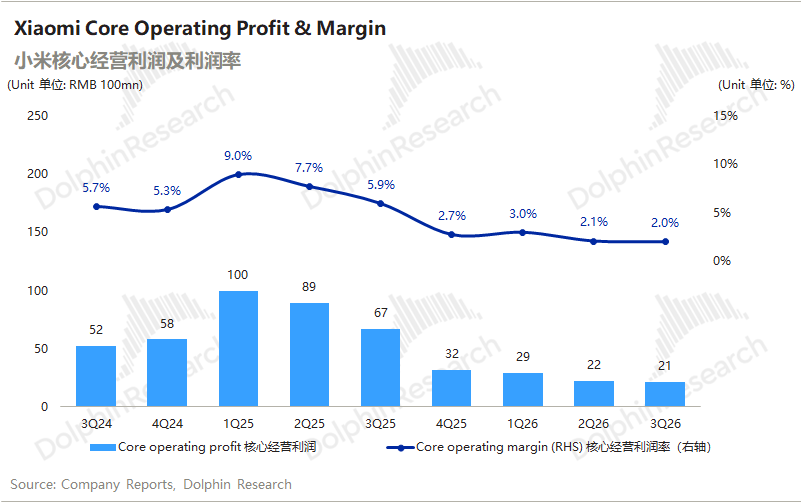
6. Profitability: Core profit was RMB 2.1 billion, and adjusted net profit was RMB 4.9 billion. Under Dolphin Research's definition (gross profit minus selling, administrative, and R&D expenses), core profit for the quarter was RMB 2.14 billion, down 68% year-on-year, with a core profit margin of only 2.0%. By business, core profit from Xiaomi's traditional business was approximately RMB 5.5 billion, down about 8% year-on-year; the loss from automotive, AI, and other innovative businesses was RMB 3.4 billion, with the loss widening by approximately RMB 800 million quarter-on-quarter.
Dolphin Research's overall take: Last year, autos carried the front line; this year, it's the smartphones' turn to bear the load.
Xiaomi's financial report this quarter was broadly in line with expectations, but the divergence beneath the surface was stark: smartphones pulled gross margin back into the guidance range through price increases, while autos slipped into a situation of declining volume, falling prices, and widening losses.
On the smartphone side, the entire quarter-on-quarter increase came from higher ASP. "Control volume, protect price" has shifted from a passive response to a deliberate choice. Coupled with the narrowing decline in IoT, price increases have begun to outpace memory cost increases, the group's gross margin edged up quarter-on-quarter, and the floor under the traditional business has become more solid.
Autos, meanwhile, are in a gap period during the transition between old and new models. The decline in ASP per vehicle dragged revenue down quarter-on-quarter and below expectations; the higher-positioned Pengcheng flagship models only began deliveries at the end of the quarter, and automotive losses widened further. One increase and one decrease kept the group's core profit at a relatively low level near RMB 2 billion.
Beyond this financial report, the market is focused on the following core business developments:
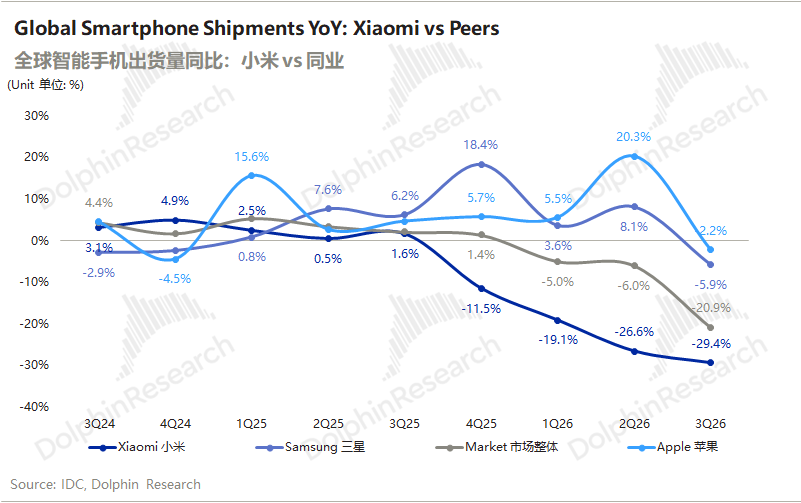
a) Smartphone business: gross margin rebounded first, while shipments are still contracting. Global smartphone shipments fell 20.9% year-on-year in the third quarter. Memory price increases pushed up device prices and suppressed demand in emerging markets. Xiaomi's shipments fell 29.4% year-on-year, while Samsung (-5.9%) and Apple (-2.2%) were relatively less affected.
On the pricing side, under memory cost pressure, the company continued to raise prices in the third quarter, which was the main factor behind the gross margin rebound. Domestically, the Redmi Note 17 rose 20%–30% compared with the previous generation, and the K100 Pro Max rose 5%–13%. Overseas, prices rose about 35% in India, about 34% in France, and about 38%–40% in Spain.
Recently the market has begun to anticipate the possibility of memory price cuts ahead of schedule (in the first half of 2027). If memory prices decline, it would undoubtedly be a positive for Xiaomi's smartphone and traditional businesses, which would also mean that 8–9% may already be the bottom of Xiaomi's smartphone gross margin.
b) Automotive business: the company previously lowered its full-year delivery target from 550,000 vehicles to 450,000 vehicles (no adjustment this quarter, stating it would strive to exceed the target and giving no 2027 target).
The company delivered a cumulative 286,000 vehicles in the first three quarters and more than 50,000 vehicles in October, totaling about 336,000 vehicles in the first 10 months—meaning about 114,000 vehicles need to be delivered in November–December (an average of about 57,000 per month, roughly 14% higher than October).
On overseas expansion, the company announced in September that Xiaomi Auto will enter the European market in 2027 and signed memoranda of cooperation with 8 leading German auto dealers.
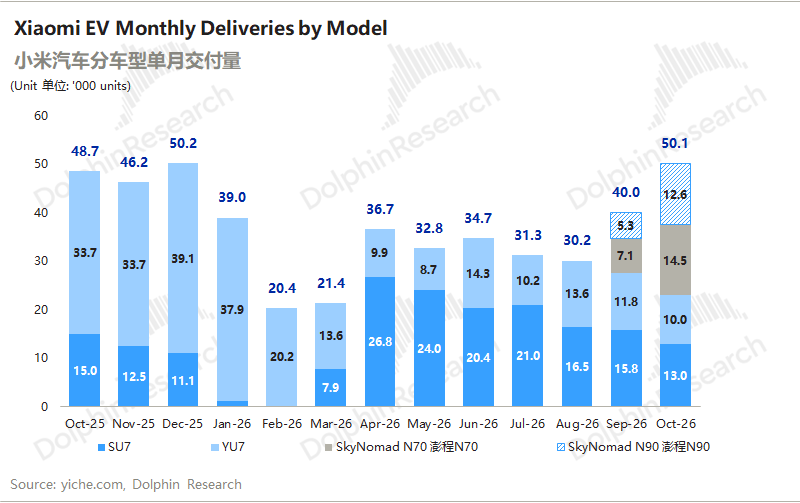
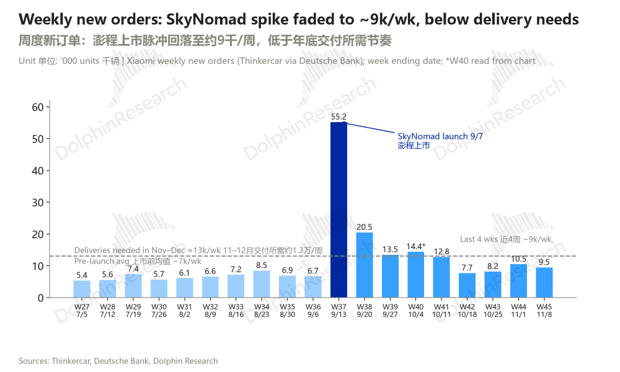
Looking at weekly orders, orders in the week Xiaomi Pengcheng was launched (9/7–13) surged to 55,200 vehicles, then gradually declined and have stabilized at 8,000–11,000 per week since mid-October—only about 2,500 more than before the launch (7,000 per week).
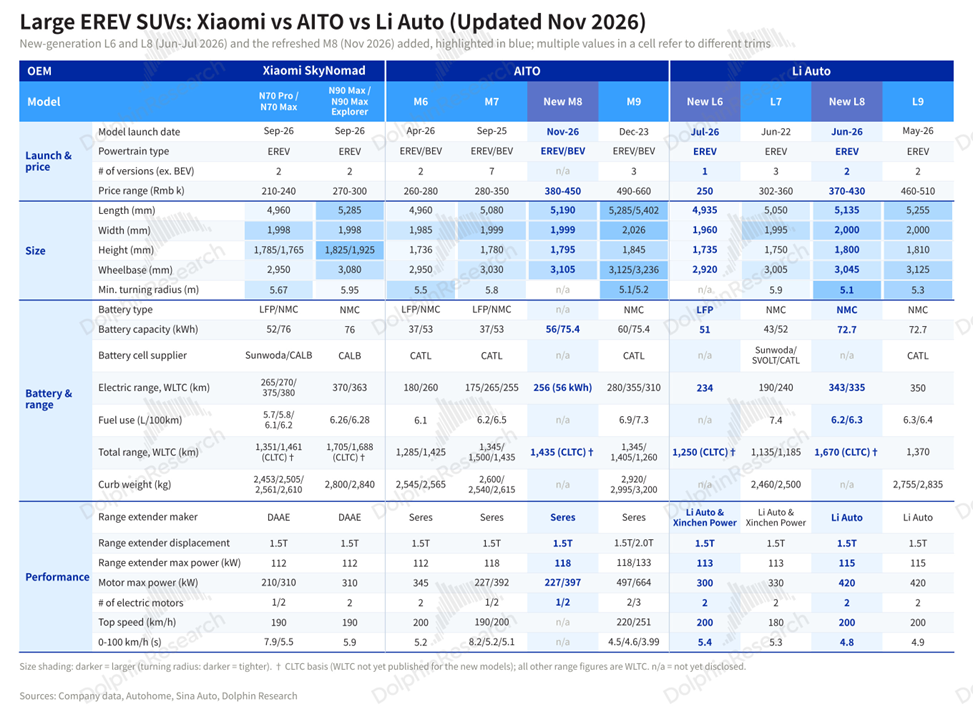
Comparing Pengcheng with competitors, the N70 is positioned as a large five-seat SUV, similar to the Li L7 and AITO M7, while the N90 Max benchmarks the Li L9 and AITO M9. Pricing is generally lower than the benchmark models, and the batteries use Sunwoda/CALB solutions.
Xiaomi's current performance mainly comes from two parts: the traditional business and the automotive business. Because the two have distinctly different characteristics, a single PE valuation is not directly applicable to the company; an SOTP (sum-of-the-parts) approach is more reasonable.
(1) Traditional business: a relatively certain floor reference
Assuming full-year smartphone shipments of about 125 million units, full-year smartphone gross margin rebounding to about 10.5%, and IoT returning to growth, the company's after-tax core operating profit from the traditional business in 2027 would be approximately RMB 23 billion.
Previously, while the memory industry underwent a major correction, the company's stock price rose significantly, and there is an obvious "seesaw" effect between the two.
(2) Automotive business: Xiaomi Auto delivered about 336,000 vehicles in the first 10 months. If the company approaches its 450,000-vehicle target in 2026 and achieves 568,000 vehicles in 2027 with an ASP of approximately RMB 228,000 per vehicle, automotive business revenue in 2027 would be approximately RMB 139.5 billion.
Taken together, with the traditional business no longer declining, the traditional segment will establish a floor valuation for the company. Although the automotive business returned to monthly deliveries of over 50,000 units after Pengcheng's launch, valuations across the EV sector have been significantly compressed, and the automotive segment's contribution to Xiaomi Group's market value is relatively limited.
Overall, the traditional business constitutes the main support for Xiaomi's value, while the automotive business provides some upside elasticity. In Q3, smartphone gross margin rebounded to 9.2%, and the judgment that the traditional business has "bottomed out" has been preliminarily validated, making the floor under this segment more solid.
Until there are meaningful signs of a downturn in memory prices (management expects high prices to persist through Q2 2027), the stock price will remain under pressure. There is a clear "seesaw" effect between Xiaomi and the AI technology chain, and whether "early memory price cuts and a recovery in the company's performance" can materialize going forward will be the key to determining whether Xiaomi's valuation can rebound.
- END -
// Reprint authorization
This article is an original piece by Dolphin Research. Authorization is required for reprinting.
// Disclaimer and general disclosure notice
This report is intended solely for general comprehensive data purposes and is aimed at users of Dolphin Research and its affiliates for general reading and data reference. It does not take into account the specific investment objectives, investment product preferences, risk tolerance, financial situation, or special needs of any person who receives this report. Investors who make investment decisions based on this report must consult an independent professional adviser. Anyone who makes investment decisions by using or referring to the content or information mentioned in this report shall bear the risk themselves. Dolphin Research shall not be liable for any direct or indirect liability or loss that may arise from the use of the data contained in this report. The information and data contained in this report are based on publicly available materials and are for reference only. Dolphin Research strives for but does not guarantee the reliability, accuracy, and completeness of the relevant information and data.
The information mentioned or views expressed in this report shall not, in any jurisdiction, be treated as or regarded as an offer to sell securities or an invitation to buy or sell securities, nor shall they constitute any recommendation, inquiry, or solicitation regarding the relevant securities or related financial instruments. The information, tools, and materials contained in this report are not intended or intended to be distributed to citizens or residents of any jurisdiction where the distribution, publication, provision, or use of the relevant information, tools, and materials would contravene applicable laws or regulations or would require Dolphin Research and/or its subsidiaries or affiliates to comply with any registration or licensing requirements in that jurisdiction.
This report reflects only the personal views, opinions, and analytical methods of the relevant creators and does not represent the position of Dolphin Research and/or its affiliates.
This report is produced by Dolphin Research, and the copyright is owned solely by Dolphin Research. Without the prior written consent of Dolphin Research, no institution or individual may (i) produce, copy, duplicate, reproduce, forward, or otherwise make any form of copy or reproduction in any manner, and/or (ii) directly or indirectly redistribute or transfer it to other unauthorized persons. Dolphin Research reserves all related rights.
-
![]()
Pragmatik Labs, Founded by Former Qwen Technical Lead, Reaches $5 Billion Valuation with Tens of Millions in New Financing
-
![]()
From "Submitting the Paper" to "Getting It Over With": Large Models Hit "Release Inflation"
-
![]()
Guangzhou Auto Show: Debut Rights "Reversed" as Traditional Automakers Reclaim the Spotlight
-
![]()
145 Billion Parameters Squeezed onto a Laptop—Who's Paying for This?
-
![]()
Your Next Phone May Be Yielding Ground to AI Data Centers
-
The Next Main Battlefield of AI Competition Is Scientific Research
-
![]()
Wei Jianjun Publicly Airs Frustration Over Sales Decline: Is Great Wall Motors' "Unit-Price Defense" Strategy No Longer Tenable?
-
![]()
Xiaomi: Out of the Woods, but What Does the Future Hold?