Guangzhou Auto Show: Debut Rights "Reversed" as Traditional Automakers Reclaim the Spotlight
 11/25 2026
 513
Original: Shenmou Finance (chutou0325)
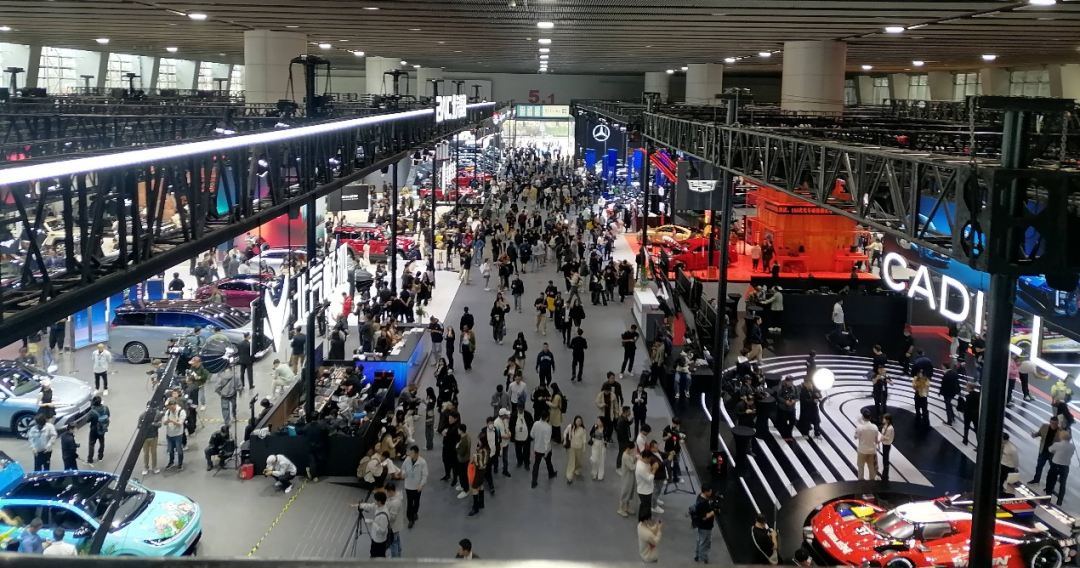
In previous years, media day at the Guangzhou Auto Show meant auto journalists' schedules revolved around new-force press conferences: one in the morning, one in the afternoon, and another user night in the evening. This year, that schedule may need to be redone.
The 24th Guangzhou International Automobile Exhibition, opening at the Canton Fair Complex on November 27, presents a scene rarely seen in the past decade: new forces such as NIO, XPeng, Li Auto, Leapmotor, and Xiaomi generally have no all-new models, media-day press conferences have been largely canceled, and those that have put heavyweight debuts on the agenda have been replaced by traditional automakers such as BMW, BYD, GAC Honda, Dongfeng Nissan, and Chery.
The debut microphone that the new forces held for many years has returned to the hands of traditional automakers for the first time. Yet what the public wants to see is not who got the microphone, but whether the one holding it has a story worth telling.
01 NIO, XPeng, and Li Auto Voluntarily Give Up Debut Slots
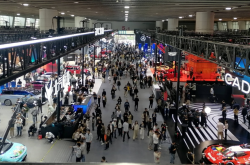
According to the information currently announced, this year's Guangzhou Auto Show is indeed quite large: an exhibition area of 240,000 square meters, more than 100 debut new cars, and an estimated 800,000 visitors—larger than last year (1,085 vehicles exhibited, of which 629 were new energy vehicles, accounting for 58%, and 93 debut new cars). Yet on such an ever-growing stage, the people standing in the center have changed.
From the debut lists recently revealed by various brands, we can glimpse the nature of this shift.
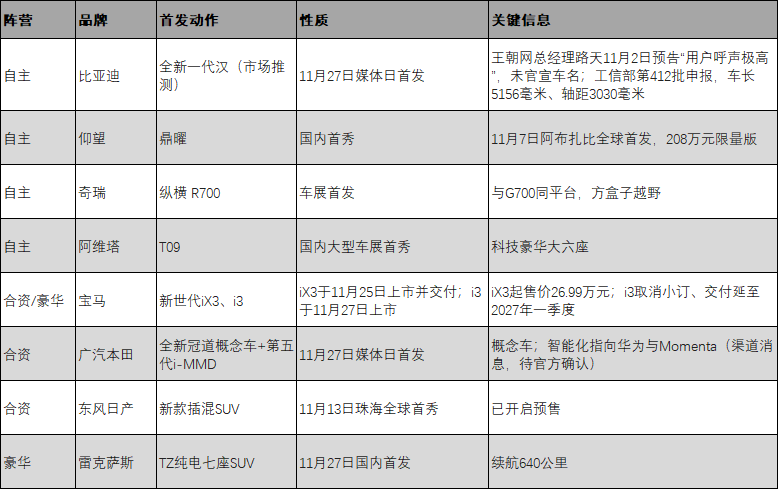
There is not a single new force on this list.
NIO, XPeng, Li Auto, Leapmotor, and Xiaomi have mostly already launched their new cars this year and have nothing all-new to offer at the auto show. For them, there is only one thing left to do at the auto show now: wait for public day on the 30th to open, treat the booth as a store, and collect orders. On another level, by 2026, these new forces seem to no longer need the auto show as a launch platform. A livestream of their own can bring in tens of millions of viewers, a single Weibo post from the boss generates more repost heat than any booth, and the new product rhythm has long since broken away from the "two auto shows a year" calendar.
The reverse logic also holds: those still desperately fighting for debut slots at auto shows are precisely the brands that most need to be seen right now.
BMW has set the new-generation iX3 for launch and simultaneous delivery on November 25, and the i3 for launch on media day, the 27th. The two cars, one after the other, have almost fully occupied the attention window before and after the auto show opens.
The iX3 comes in three versions—30L, 40L, and 50L—starting at 269,900 yuan. The long-range version achieves a CLTC range of 919 kilometers, making it the car BMW has bet most heavily on in this round; the i3 has a wheelbase of 3,005 millimeters and a range of more than 1,000 kilometers.
GAC Honda is bringing out the all-new Crown concept car and the fifth-generation i-MMD hybrid technology, Dongfeng Nissan is placing the global premiere of a plug-in hybrid SUV in Zhuhai on November 13, and Chery is having the Zongheng R700 make its debut in Guangzhou. Obviously, these traditional brands all share a common need: to complete a platform-level product delivery ceremony on an occasion like an auto show, where the media is most comprehensive and the cost is lowest.
A closer study of this list shows that the "upward exploration" moves of the self-owned brands deserve separate detailed attention.
BYD is preparing to unveil the all-new generation Han, with a vehicle length of 5,156 millimeters and a wheelbase stretched to 3,030 millimeters. Its size has already surpassed its own Han L and is approaching the Da Han that just launched last month starting at 235,900 yuan; the four-wheel-drive version has a combined power of 520 kilowatts. With this power specification placed on a family-oriented sedan, the performance redundancy has gone beyond "sufficient."
Yangwang Dingyao takes another path: it will hold its global premiere in Abu Dhabi on November 7, then return to Guangzhou for its domestic debut on the 27th, using an overseas premiere to avoid the home turf of BBA.
This limited edition priced at 2.08 million yuan stacks on suicide doors, a grille cut with 137 gemstones, a 24K gold badge, and the second-generation blade battery, with a range of more than 1,000 kilometers. It follows the upward-charging route of "maxed-out configuration, using price to set a benchmark."
Chery's Zongheng R700 is a third approach, using the aesthetic of "boxy off-roading" to carve out a new track in the SUV market.
Three self-owned brands: one pursuing size upward exploration, one pursuing an overseas premiere, and one pursuing category aesthetics. They are three samples under the same upward-charging goal.
So this "reversal of debut rights" is less about who beat whom and more about two rhythms of carmaking being misaligned on the same calendar. The new forces voluntarily withdraw, the traditional camp happens to reach its moment, and attention is redistributed once again.
02
The Technology Supporting the Debuts Comes from Chinese Suppliers
The stage on which traditional automakers "win back" debuts can be broken down and seen as the result of several forces stacking together.
At the most superficial level is the misalignment of product cycles.
The new forces follow a software rhythm: a facelift every year, a generation change every two years, and a model's popularity cycle lasts only twelve months. Press conferences must be intensive and continuous.
Traditional automakers follow a platform rhythm: one platform and one powertrain are used for five to seven years, and a generation change is a heavy-asset event that can happen only once or twice a year.
2026 happens to be a year when the traditional camp's platforms land in concentrated fashion. BMW's New Generation and Honda's fifth-generation i-MMD both mature this year. They need a public occasion to complete delivery, and the timing of the Guangzhou Auto Show catches these brands' product launch rhythms.
One layer down is the disintermediation of channels. Auto shows used to be the most cost-effective exposure channel for new brands: one booth, hundreds of media outlets, and hundreds of thousands of visitors, with one exposure worth half a year's budget. But once automakers started their own livestreams and gained traffic, auto shows degenerated from a "launch venue" into a "sales venue." Of the 10-day exhibition period of this year's Guangzhou Auto Show, 7 days are public days, which is itself a conclusion.
The stage being empty does not mean traditional automakers should take it. What they are fighting for is precisely not selling cars, but holding press conferences. Why? The answer lies in sales.
The BMW Group delivered 376,100 vehicles in China in the first three quarters, down 21.8% year on year. During the same period, it grew 4.5% in Europe and 3.4% in the United States. The Chinese market has become the only major market where it is shrinking sharply globally.
The three Japanese brands are even more anxious. Honda's sales in China in the first nine months fell 39.5% year on year, Nissan plunged 67.1% in October alone, and Toyota also fell 25% from April to September. Former volume models such as Sylphy and Qashqai saw sales halve.
Zooming out to the whole picture, according to data released by the China Passenger Car Association, in October this year the retail share of German brands was 12.6% and that of Japanese brands was 10.2%, while mainstream joint ventures' retail overall fell 38%. It can be seen that traditional automakers won back debut slots in a market where they are continuously bleeding. Holding press conferences at this juncture is to tell a new story, which is also why BMW has bet both the iX3 and i3 around the Guangzhou Auto Show.
However, the core of the new story that traditional automakers want to tell is no longer entirely in their own hands.
The intelligent driving solution of BMW's New Generation iX3 comes from Momenta, trained on more than 15 billion kilometers of Chinese road data; the cockpit large model comes from Alibaba, and the battery cells of the sixth-generation battery are supplied by CATL and EVE Energy.
For GAC Honda's all-new Crown, the cockpit cloud capability points to Huawei, and assisted driving points to Momenta. Honda officially announced in September that it had selected these two as intelligentization partners, and starting in 2027, newly launched cars will gradually adopt them; Dongfeng Nissan has gone even further, directly replacing the Teana's cockpit with Huawei HarmonyOS on October 31.
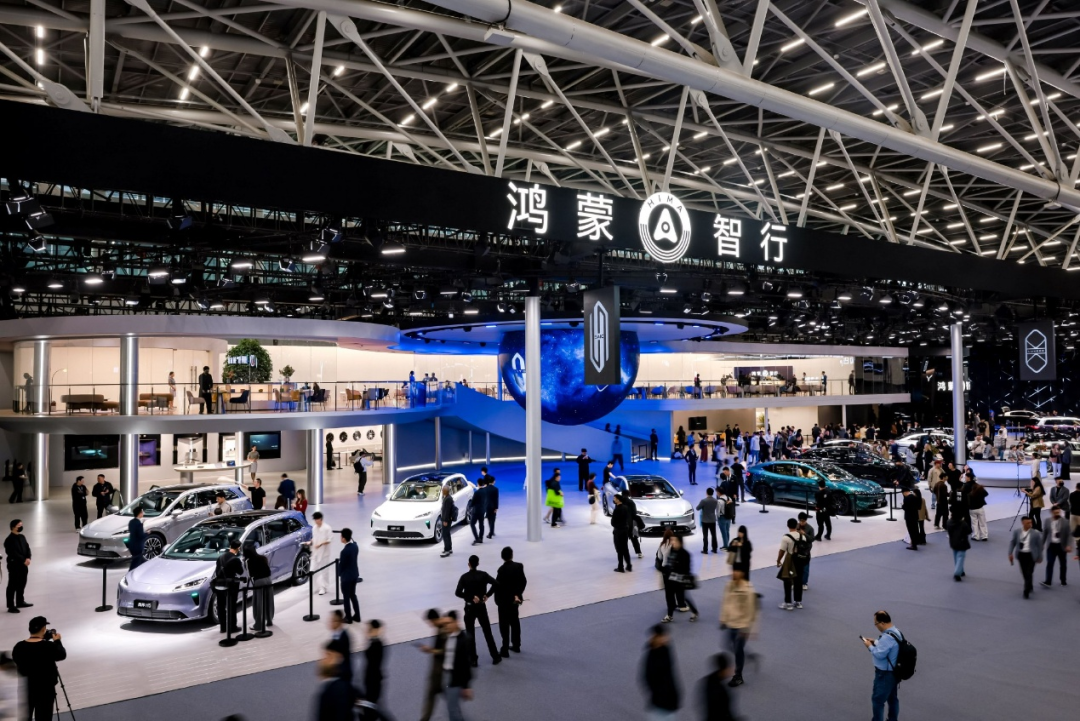
Extending from the above cases, handing intelligentization to Chinese suppliers is becoming a collective move of the traditional camp. Momenta has already reached mass-production business cooperation with 26 OEMs, with 219 cumulative designated projects, and has captured 65% of China's third-party urban intelligent driving market; Huawei Qiankun Intelligent Driving and HarmonyOS Cockpit have been installed in 25 brands and more than 60 models, with leading groups such as FAW, Dongfeng, Changan, GAC, and SAIC all on the customer list.
Honda Chief Executive Toshihiro Mibe said something very blunt after visiting China in the first half of the year: "China has already entered the smartphone era, while we are still using flip phones." Today, all three Japanese brands are still on stage, but the pen writing the script has already changed hands to the Chinese supply chain offstage.
Thus that conclusion emerges: debut slots can be given up, and they can also be won back. However, once the power to "define a car" is handed over, it will not turn back along with the microphone.
03 Mass Production and Delivery Are the Real Decisive Factors
Now, traditional automakers taking back the microphone is only the beginning. The real test lies in three things offstage.
The first is whether concept cars can make it to mass production.
The all-new Crown that GAC Honda is showing this time has its wheelbase stretched from 2,820 millimeters to about 2,920 millimeters, and seating expanded from a large five-seat layout to optional five-, six-, and seven-seat layouts, but the most critical HarmonyOS cockpit and lidar will only be seen in the production version.
This model, which once sold more than 10,000 units a month, sold only 258 units in September this year, while its generational mass-production node will not arrive until 2027, and its global premiere is even scheduled for the Tokyo Auto Show in January 2027. The concept car still has some distance to go before mass production. No matter how beautiful the debut is, it cannot immediately turn into real paid orders.
The second is whether "launch means delivery" can be fulfilled.
The most solid promise at this auto show comes from BMW: the iX3 will be "launched with simultaneous delivery." On November 16, the first domestically produced New Generation iX3 was officially put into production at the Shenyang production base, and the sixth-generation power battery had just rolled off the mass-production line. Capacity ramp-up takes time. The so-called "simultaneous delivery" means "starting delivery," not "delivering in full."
Even BMW could not fully live up to that statement: the iX3 opened reservations at the Chengdu Auto Show on August 21 and will be delivered on November 25, meaning users have waited a full three months; the i3 is expected to launch on November 27, but delivery will have to wait until the first quarter of next year. Traditional automakers have come up with plans such as "cancel small deposits and shorten waits" to optimize the user experience, but they still cannot solve the industry-wide problem that "launch does not equal delivery."
The third is whether orders can be collected in the year-end window.
In October, national passenger car retail sales were 1.643 million units, down 27.1% year on year; among them, fuel vehicle retail sales fell 45% year on year, luxury cars fell 39%, and mainstream joint ventures fell 38%. Although the retail penetration rate of new energy vehicles rose to 67.5%, new energy vehicle retail sales in October fell 13.7% year on year.
Judging from this year's market trend, the overall direction is downward, and even the new energy segment is shrinking. As of October, the annual target completion rates of major automotive groups mostly ranged between 57% and 78%, putting considerable pressure on filling the gap at year-end. The inventory warning index of a considerable number of dealers reached 62.2%, standing above the 50% boom-or-bust line; by brand, the inventory coefficient of mainstream joint ventures was 1.52, also crossing the 1.5 warning line.
Most of the models debuting from traditional automakers this time still fall in the fuel vehicle market that is accelerating its contraction. Although the auto show is positioned right in the middle of the year-end volume-boosting window, this year lacks the tax cliff of previous years, when "exemption turned into halving." The halved purchase tax will remain in effect until the end of 2027, so consumers do not need to place orders before the new year, which adds another layer of difficulty for traditional automakers in collecting orders.
None of these three things can be known on the day of the press conference. Therefore, the answer to "whether traditional automakers who have taken back the debut microphone can tell the new story well" is not under the spotlight on November 27, but in the next six months.
Now, traditional automakers have won back the auto show debut microphone, but the technology account has not yet been settled. Battery cells, intelligent driving, and cockpits are all not in their own hands. To tell this new story well, traditional automakers will still need to spend several more years turning borrowed technology into their own capabilities.
* Images are sourced from the internet. If there is any infringement, please contact us for removal.
-
![]()
Pragmatik Labs, Founded by Former Qwen Technical Lead, Reaches $5 Billion Valuation with Tens of Millions in New Financing
-
![]()
From "Submitting the Paper" to "Getting It Over With": Large Models Hit "Release Inflation"
-
![]()
Guangzhou Auto Show: Debut Rights "Reversed" as Traditional Automakers Reclaim the Spotlight
-
![]()
145 Billion Parameters Squeezed onto a Laptop—Who's Paying for This?
-
![]()
Your Next Phone May Be Yielding Ground to AI Data Centers
-
The Next Main Battlefield of AI Competition Is Scientific Research
-
![]()
Wei Jianjun Publicly Airs Frustration Over Sales Decline: Is Great Wall Motors' "Unit-Price Defense" Strategy No Longer Tenable?
-
![]()
Xiaomi: Out of the Woods, but What Does the Future Hold?