Doubao Sets Its Sights on the Travel and Hospitality Sectors
 09/30 2026
 510
510


ByteDance Aims for Broad Expansion
Image source | Internet (Please contact us for removal if there is any infringement.) Partially generated by AI
An AI assistant with over 168 million daily active users is now ready to assist you with ride-hailing, hotel bookings, and dinner reservations.
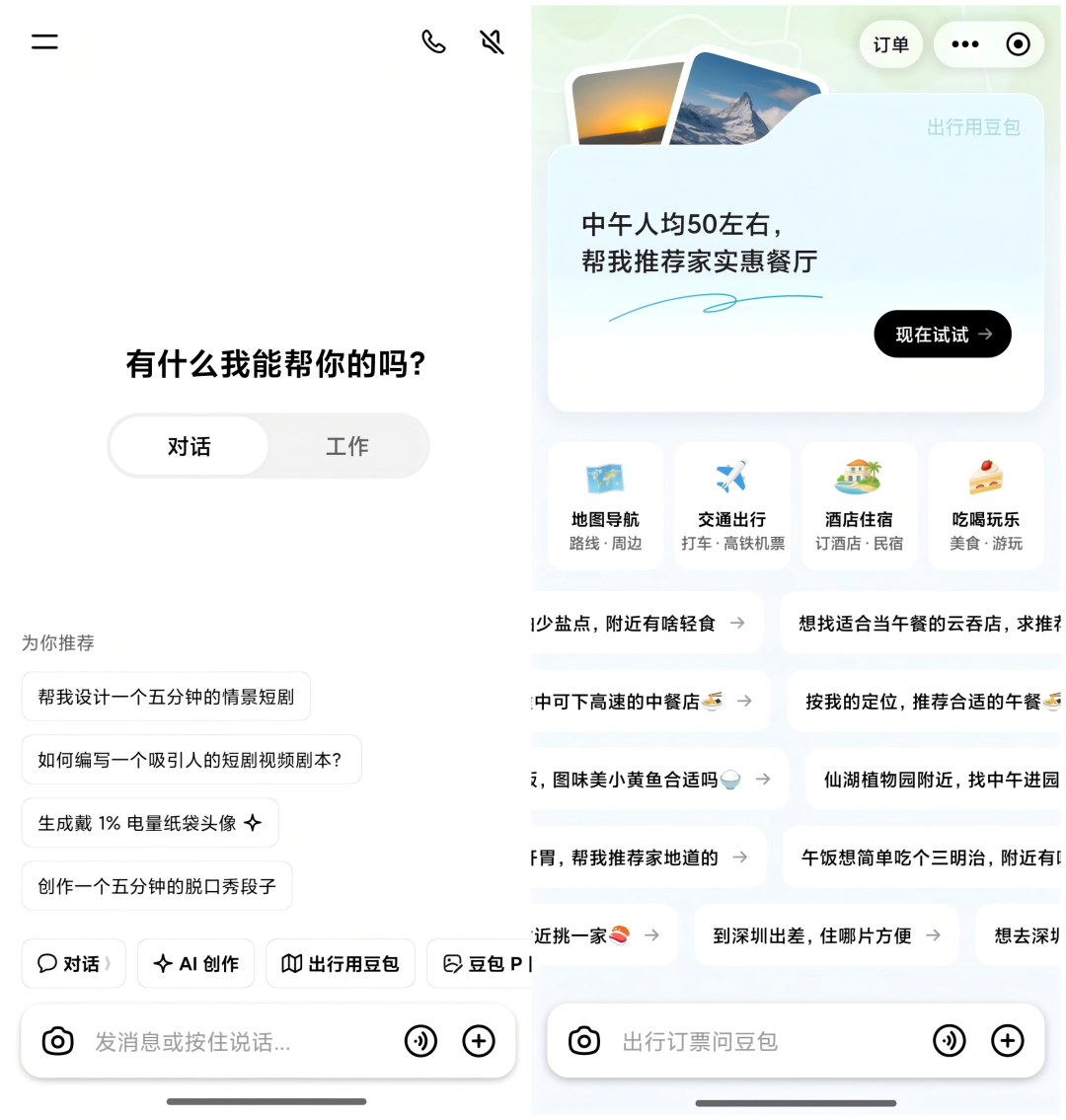
On the eve of the National Day holiday, the Doubao App discreetly introduced a new feature—"Travel with Doubao"—above the homepage input box, alongside "Chat" and "Help Me Write."
Upon launching Doubao, users are greeted with just three functional tabs above the main interface input box, with "Travel with Doubao" taking one of these prime spots. The previously industry-discussed "Ask Doubao Before Buying" feature has been relegated to a less prominent position.
ByteDance has dedicated its most valuable traffic real estate to this new addition.
Behind this new feature lies ByteDance's ambition to challenge Didi's decade-long dominance in the travel market, Meituan's eight-year-built local life empire, and Ctrip's over 20-year-accumulated hospitality supply chain.
What gives a newcomer the confidence to enter this competitive arena?

ByteDance's Strategic Long Game
Let's first explore what this new feature entails.
The "Travel with Doubao" page is divided into two sections. The upper section features one-click travel planning prompts, with Doubao pre-writing various scenario-based questions, such as "I want to eat roast duck tonight; which nearby restaurant is authentic?" Clicking on these prompts generates recommendations.
The lower section consolidates four functional modules: map navigation, transportation, hotel accommodation, and dining and entertainment. This covers nearly all travel and lifestyle scenarios, including navigation, nearby attractions, ride-hailing, high-speed rail, flights, hotels, homestays, dining, and sightseeing.
More noteworthy are the partners behind these services.
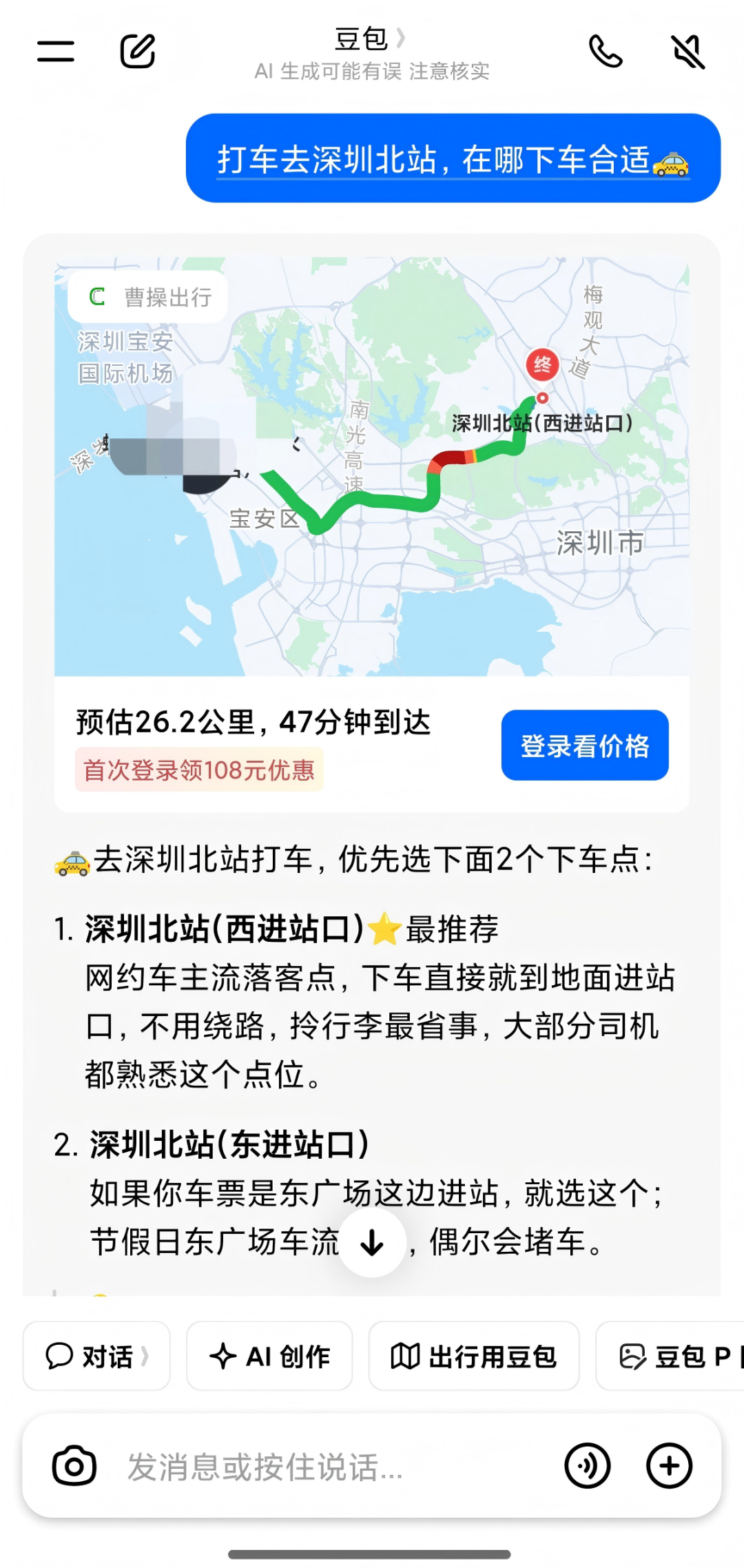
Map navigation is powered by Baidu Maps. Although Douyin (TikTok's Chinese counterpart) launched its own map product in 2021, Doubao chose not to utilize it.
Ride-hailing services are integrated with Cao Cao Mobility, with whom Doubao jointly launched an AI ride-hailing service in mid-September, initially available in Beijing, Hangzhou, and Suzhou. Hotel and homestay bookings are linked to Douyin's travel platform, while dining and entertainment connect directly to Douyin's local life services.
In essence, except for maps and transportation capacity, nearly all other core links operate within ByteDance's ecosystem.
Combined with a frequently overlooked piece of information: In August this year, Douyin's local life services officially designated Doubao as an independent transaction channel.
Hotel orders completed through the Doubao entry incur a software service fee of 11.4%, plus a 0.6% payment processing fee, totaling approximately 12%. In contrast, Douyin's main platform charges an 8% fee.
The 12% figure is telling. It falls between Ctrip and Meituan's combined fee rate (around 15%) and Douyin's main platform (8%). This higher rate than its main platform indicates ByteDance's belief that AI-recommended traffic converts at a higher quality; the lower rate than traditional OTAs provides a price advantage.
This functional update signals to the industry: Doubao is evolving beyond a chatbot; it aims to become a functional AI.

Can It Overcome Established Barriers?
The challenge lies in the fact that none of the three giants facing Doubao are easily surmountable.
Consider Meituan first. Without owning a single restaurant or chef, Meituan has millions of merchants and thousands of riders integrated into its system.
Its core competitiveness lies not in traffic but in the instant delivery network built over a decade, a meticulously refined merchant operation system, and the consumer habits cultivated through repeated usage.
When you open Meituan to order food, you don't need to be "persuaded"—you're already accustomed to it. That habit itself is a formidable barrier.
Didi's barriers are equally time-intensive. It profits from others' cars and drivers while firmly controlling pricing power.
From peak-hour dispatch algorithms to safety compliance systems, from driver incentive mechanisms to passenger credit models, these unglamorous elements represent hard-earned experience from real-world challenges and investments.
Ctrip's barrier runs deepest. With a market share of approximately 56%, and including its controlled platforms Qunar, Tongcheng, and eLong, the "Ctrip ecosystem" commands a 70% market share, nearing 80% in some segments.
But what truly intimidates is not the numbers but what lies behind them.
Hospitality fulfillment is an extremely complex system: inventory synchronization, price fluctuations, cancellations and refunds, customer complaints, fraud prevention...
Each link represents grueling work, and Ctrip took over two decades to master them.
Even OpenAI tried. In September last year, ChatGPT attempted to close the travel transaction loop, only to disable checkout functions by March this year. No matter how strong the technology, it cannot bypass the supply chain and fulfillment systems.
So, what gives Doubao the confidence?
The key lies in Doubao not needing to build a fulfillment system from scratch.
Douyin's local life services have spent three years accumulating merchant resources, POI data, group-buying systems, and hotel order systems.
Doubao's role is to integrate these capabilities into its chat interface, enabling users to complete the entire journey from "inspiration" to "purchase" through natural language interaction.
This logic differs fundamentally from traditional OTAs.
On Ctrip or Meituan, you face a shelf. You set search criteria, browse listings, compare prices, read reviews, and make decisions. The platform's business model is essentially "pay-to-play"—whoever bids higher ranks first.
On Doubao, you face a conversation. You simply say, "Help me find a homestay near Hangzhou's West Lake with breakfast, under 500 RMB," and Doubao provides recommendations and booking links directly. No listings, no filters—AI has already done the initial screening.
This represents a fundamental shift: the traffic entry point changes from "search box" to "chat box," and user decision-making shifts from "human searches for goods" to "AI recommends goods."
Experts have precisely judged this logic: Generative AI will reshape tourists' behavior in selecting travel products, with AI-driven products becoming new entry points for travel consumption, potentially restructuring existing product channel landscapes.
This judgment is being validated simultaneously. Tongcheng Travel launched its travel AI agent DeepTrip 2.0, Feizhu introduced "Feizhu Bangbang," and Meituan upgraded its local life AI assistant "Xiaotuan."
All players are betting on AI entry points. The difference lies in Ctrip and Meituan adding a layer of intelligent shopping guide to their shelves, while Doubao's AI itself is a brand-new shelf.
One is old wine in new bottles; the other starts from scratch.
This explains why Doubao chose to launch this feature before the National Day holiday. The Golden Week represents the peak season for travel and tourism demand, offering the best window to cultivate new user habits.
ByteDance clearly hopes to let as many users as possible experience "booking hotels with AI" and "hailing rides by telling AI your destination" in this high-frequency scenario.

Lofty Ideals Meet Harsh Realities
That said, ByteDance faces an uphill battle in disrupting this industry.
First, Doubao's current "experience completeness" in travel services is far from sufficient. Media tests revealed that the preset prompt words in "Travel with Doubao" lack structure and logic, unconnected to users' personal information or chat history.
In travel and local life scenarios, user purposes are explicit and demands vary widely. The "hit rate" of platform-prewritten prompts remains low.
Second, Doubao's ride-hailing currently relies on Cao Cao Mobility for capacity, initially covering only Beijing, Hangzhou, and Suzhou. Compared to Didi's network spanning hundreds of cities nationwide, this scale remains experimental.
The high-speed rail and flight segments directly instruct users to "purchase tickets on 12306 or OTA platforms," even including links to Ctrip's flight search page.
This means Doubao's "travel closed loop" is far from closed.
A deeper issue lies on the merchant side, where the relationship between hotels and OTAs is delicately balanced. After two decades, Ctrip has established direct connections with hundreds of thousands of hotels globally, securing optimal negotiated rates.
Meanwhile, Douyin's travel platform suffers from low hotel coverage and insufficient verification rates. If Doubao merely recommends from Douyin's inventory, consumers may not receive the best prices or choices.
Another easily overlooked challenge: the credibility of AI recommendations.
Traditional OTA rankings, while influenced by bidding, at least rely on public dimensions like historical reviews and sales data as references.
AI recommendation logic remains a black box. Users don't know why Doubao recommends Hotel A over Hotel B. Although Doubao claims "merchants cannot pay to influence recommendations or rankings," building user trust in AI recommendations requires time and data.

Serving People Remains Fundamental
Having discussed these points, let's briefly analyze how much ByteDance can carve out in the travel and hospitality sector.
In the short term, Doubao's realistic goal isn't to "defeat Ctrip" or "replace Meituan" but to validate its service matrix and cultivate user habits. External competition isn't its top priority for now.
But this "now" won't last long.
ByteDance's patience in the local life sector is proven. Douyin's travel business grew from a 2022 launch to approximately 60 billion RMB in GMV in 2023, projected to reach 90 billion RMB in 2024, a 50% YoY increase.
While still lagging behind Ctrip's scale, this growth rate has turned heads industry-wide. More critically, Douyin has demonstrated its ability to convert content traffic into transactions. The next step is to do the same with AI traffic.
For Doubao, the true test isn't technology but how to build a complete service ecosystem and solidify its business architecture.
This involves several dimensions:
First, expanding transportation coverage. Ride-hailing cannot rely solely on Cao Cao Mobility; hotels cannot depend only on Douyin's inventory; flights cannot redirect to Ctrip. Doubao must thicken its supply side to meet all travel needs within a single chat interface.
Second, constructing a merchant ecosystem. One of traditional OTAs' moats is merchant relationships—Ctrip assists hotels with revenue management, while Meituan helps restaurants optimize operations. These services cannot be replaced by API integrations alone. Doubao must prove it can drive not just traffic but also merchant profitability.
Finally, ensuring AI recommendation credibility and differentiation. If Doubao's logic doesn't fundamentally differ from traditional OTAs—merely replacing shelves with chat boxes—why would users migrate?
The real opportunity lies in AI achieving what traditional platforms cannot, such as generating complete travel itineraries based on users' full travel history, budget habits, and even family members' preferences, rather than fragmented single-point recommendations.
From this perspective, ByteDance is testing a hypothesis at minimal cost: In the age of intelligent agents, are people willing to entrust travel and consumption decisions to AI?
If yes, Doubao becomes more than an AI assistant—it evolves into a next-generation consumption entry point.
At that point, it won't just compete with Didi and Ctrip but target the entire local life services sector.
If no, "Travel with Doubao" may join countless corporate innovation experiments, eventually folded into an obscure corner.
Now, the first batch of National Day holiday users is answering this question with their clicks and orders.
-
![]()
GAC Group Secures 50% Stake in FAW Toyota
-
![]()
Entering a Low-Profit Era, the Auto Industry Starts to 'Squeeze Efficiency'
-
![]()
FAW and GAC Sign Agreement, Ushering in a New Era of Cooperation in China’s Auto Industry
-
![]()
Automakers Dazzle with Spectacular Stunts to Boost Car Sales
-
![]()
Doubao Sets Its Sights on the Travel and Hospitality Sectors
-
![]()
Weekly Report on New Energy Vehicles: Hainan's New Energy Vehicle Penetration Rate Exceeds 66%
-
![]()
Deng Chenghao and Chen Zhuo Spearhead Top-Tier AD Department: Unveiling the Profound Implications of Avatr-Shenlan Integration
-
![]()
GAC Group 'Swaps' Stakes with FAW Toyota, Anticipates Annual Earnings of 4.2 Billion Amid North-South Toyota Integration