GAC Group Secures 50% Stake in FAW Toyota
 09/30 2026
 334
334
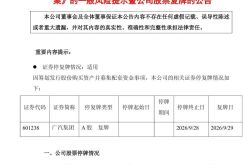
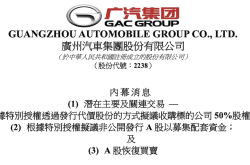
On the evening of September 28, GAC Group unveiled a significant asset restructuring plan, announcing its intention to acquire a 50% stake in FAW Toyota Motor Co., Ltd., currently held by China FAW Group Co., Ltd., through share issuance. Furthermore, the company intends to raise additional funds by issuing shares to no more than 35 qualified specific investors. Trading of the company's stock will resume on September 29.
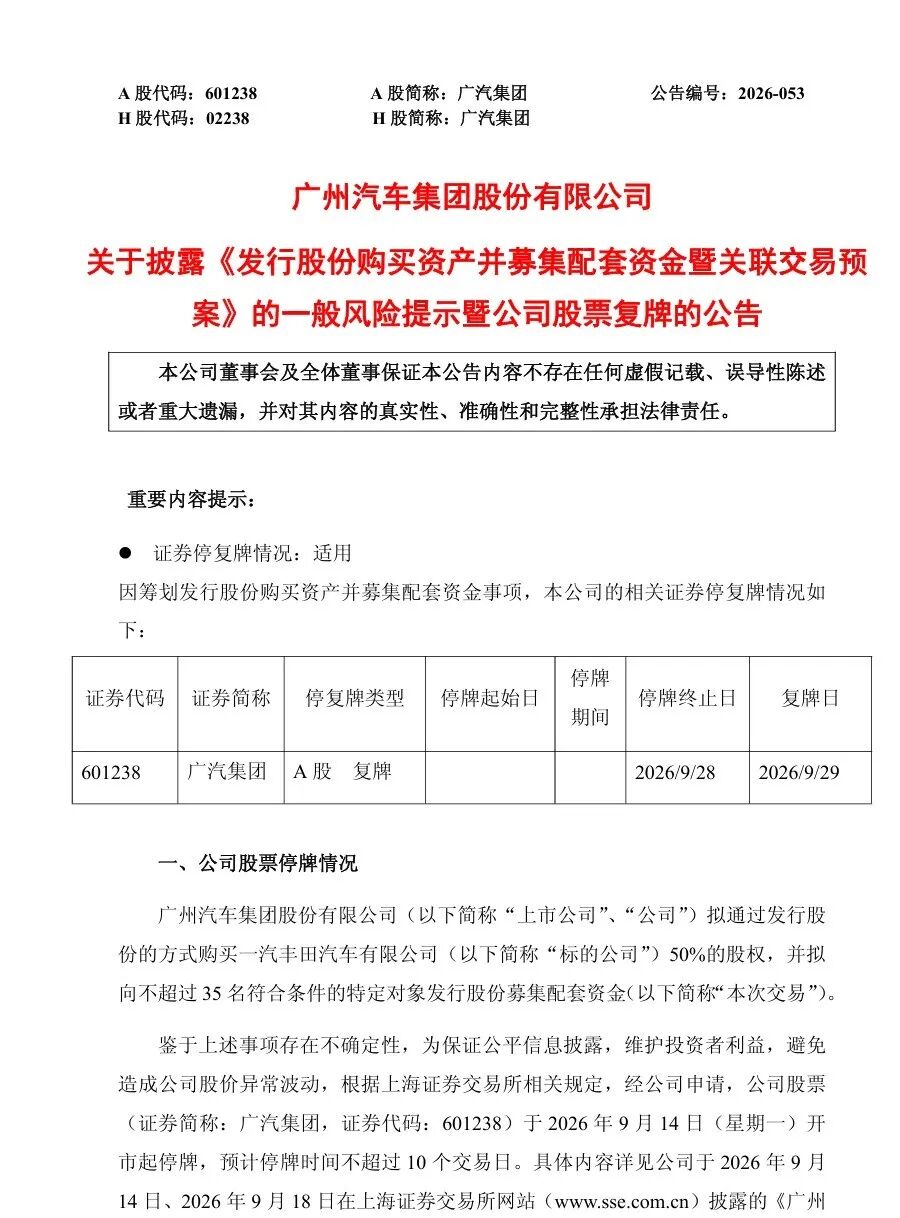
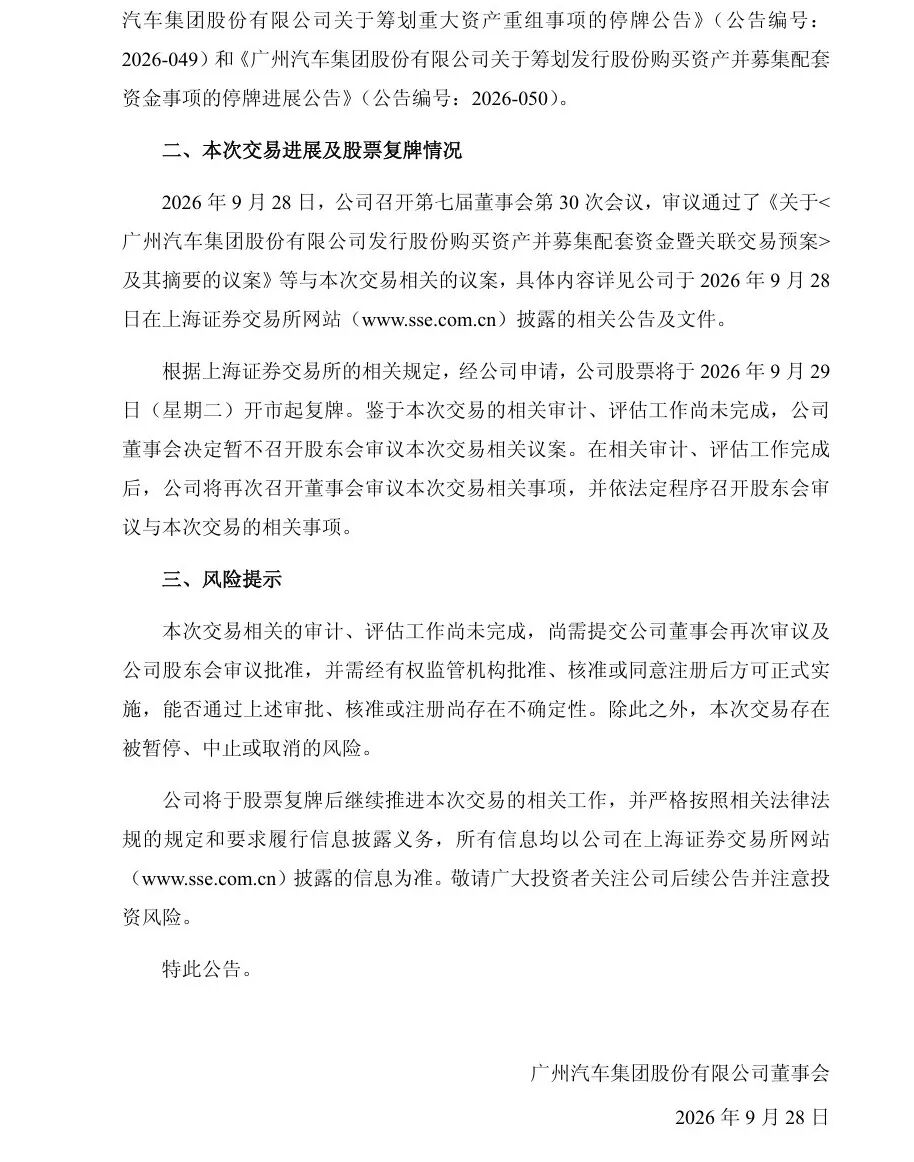
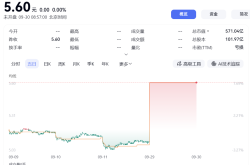
According to the plan, the share price for the asset purchase will be set at RMB 5.75 per share, representing no less than 80% of the average trading price over the 120 trading days preceding the pricing benchmark date. For context, the closing price of GAC Group's A-shares on the last trading day before the suspension (September 11) was RMB 5.09 per share, indicating an approximate 13% premium for the issue price compared to the pre-suspension closing price. However, as of the plan's signing date, the audit and evaluation of the target assets remain incomplete, and the final transaction price has yet to be determined.
FAW Toyota, a joint venture between FAW Group and Toyota Motor Corporation, has long coexisted with GAC Toyota, forming a "dual presence in the north and south" of China. FAW Toyota operates three major vehicle production bases in Tianjin, Changchun, and Chengdu, along with supporting engine plants, and boasts in-house research and development capabilities for both vehicles and core components. Based on unaudited financial data, FAW Toyota reported revenues of RMB 106.57 billion, RMB 108.624 billion, and RMB 40.725 billion for 2024, 2025, and the first half of 2026, respectively, with corresponding net profits of RMB 4.717 billion, RMB 4.234 billion, and RMB 1.009 billion.
Upon completion of the transaction, FAW Toyota's shareholders will consist of GAC Group and the Toyota Group, with GAC Group holding a 50% stake and Toyota Motor Corporation retaining the remaining 50%. FAW Group will relinquish its stake in FAW Toyota. Simultaneously, FAW Group will acquire a significant number of shares in GAC Group, becoming its second-largest shareholder with strategic influence. GAC Group clarified that this transaction will not alter its actual controller, which remains under the control of Guangzhou State-Owned Assets, and does not constitute a reverse takeover.
The rationale behind this transaction is straightforward. For an extended period, FAW Toyota and GAC Toyota have cultivated the market through their independent operational systems, operating in parallel in terms of product layout, supply chain support, terminal channels, and marketing systems. During the automotive market's rapid expansion phase, this model effectively released production capacity and captured market dividends. However, in the current era of market saturation competition and rapid electrification and intelligence advancements, issues such as resource dispersion and redundant investments have surfaced, hindering efficiency upgrades and profit realization in the joint venture segment.
GAC Group has opted to initiate integration at the joint venture business level rather than pursuing a direct group-level merger. FAW Group will exchange its stake in FAW Toyota for shares in GAC Group's listed entity, involving no cash payment. This "share-for-share" approach further aligns the interests and risks of both parties. Guoyuan Securities described this approach as a "light integration" model in its research report.
The impetus for this move stems from practical operational pressures. GAC Group reported a net loss attributable to shareholders of approximately RMB 8.78 billion in 2025 and RMB 4.467 billion in the first half of 2026, representing a 75.98% year-on-year increase in losses. FAW Group sold a cumulative total of 1.518 million vehicles in the first half of 2026, a year-on-year decline of approximately 15.33%, with FAW Toyota experiencing a 27.4% year-on-year decline. Amidst a continuous decline in the overall market share of joint venture brands, domestic brands accounted for 69.8% of the retail market share from January to August this year, while mainstream joint venture brands accounted for only 20.3%. Traditional joint venture automakers are all exploring new paths forward.
At the policy level, an opportunity for this integration has arisen. In early September, nine departments, including the Ministry of Industry and Information Technology, jointly issued the "15th Five-Year Plan for the Development of the Intelligent Connected New Energy Vehicle Industry," explicitly proposing to "increase the intensity of mergers, acquisitions, and cross-regional integrations of automotive enterprises in accordance with the law, and deepen the reform of group management in automotive production enterprises."
GAC Group stated in its announcement that this transaction will facilitate synergistic operations between Toyota's northern and southern operations. By integrating and coordinating resources such as localized research and development, supply chain systems, production bases, and market expansion, the transaction aims to amplify scale synergies, reduce redundant investments, and share the costs of technological innovation. According to data from the China Association of Automobile Manufacturers, the combined sales volume of Toyota's northern and southern operations accounted for 17.03% of joint venture passenger vehicle sales in 2025, ranking among the top in market share among joint venture brands.
However, the challenges of implementing the transaction are just beginning. The transaction requires further review by the company's board of directors, approval by the shareholders' meeting, and authorization from the competent regulatory authorities before it can be implemented. The audit and evaluation of the target assets also remain incomplete. Moreover, integrating the sales channels, product planning, and supply chain systems of Toyota's northern and southern operations will not be a swift process. How to avoid "merging without integrating" and truly achieve synergistic effects remains an unresolved issue.
A source close to GAC Group stated that this strategic cooperation between GAC and FAW represents a pivotal step for GAC Group to actively optimize its joint venture layout and enhance its asset value by leveraging equity in investment companies as a link. From an industrial perspective, this is a pragmatic exploration by a central enterprise and a local state-owned enterprise during a period of profound adjustment in the automotive industry. The ultimate effectiveness of this endeavor will hinge on the actual pace of subsequent integration.
-
![]()
GAC Group Secures 50% Stake in FAW Toyota
-
![]()
Entering a Low-Profit Era, the Auto Industry Starts to 'Squeeze Efficiency'
-
![]()
FAW and GAC Sign Agreement, Ushering in a New Era of Cooperation in China’s Auto Industry
-
![]()
Automakers Dazzle with Spectacular Stunts to Boost Car Sales
-
![]()
Doubao Sets Its Sights on the Travel and Hospitality Sectors
-
![]()
Weekly Report on New Energy Vehicles: Hainan's New Energy Vehicle Penetration Rate Exceeds 66%
-
![]()
Deng Chenghao and Chen Zhuo Spearhead Top-Tier AD Department: Unveiling the Profound Implications of Avatr-Shenlan Integration
-
![]()
GAC Group 'Swaps' Stakes with FAW Toyota, Anticipates Annual Earnings of 4.2 Billion Amid North-South Toyota Integration