Deng Chenghao and Chen Zhuo Spearhead Top-Tier AD Department: Unveiling the Profound Implications of Avatr-Shenlan Integration
 09/30 2026
 534
534
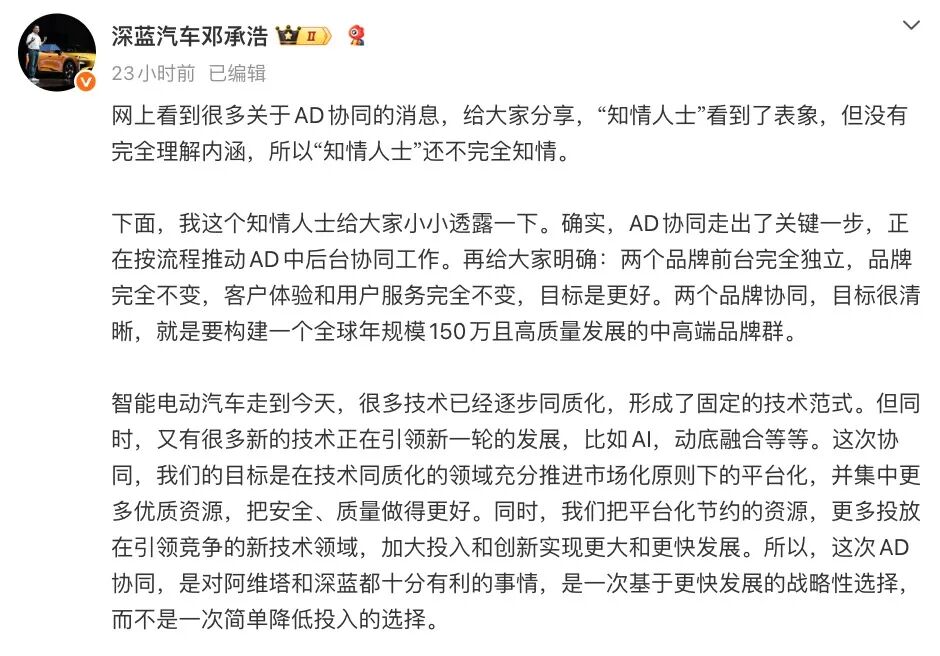
The integration journey of Avatr and Shenlan Automobile has officially commenced. On September 28th, the chairman of Shenlan Automobile took to his personal Weibo to confirm and share the latest strides in the collaborative integration efforts between the two automotive entities. "The AD collaboration has taken a significant leap forward, with ongoing efforts to enhance the synergy of mid- and back-office operations in a structured manner," stated Deng Chenghao.
Media reports reveal that on September 26th, Changan Automobile issued a formal notice to establish the AD (an acronym derived from Avatr and Shenlan) Collaborative Development Department, which will function as a "top-tier department." This premier department will oversee the creation of several subordinate departments, including the Planning and Cooperation Department, Market Product Department, Human Resources Sharing Center, Financial Sharing Center, and Comprehensive Department. These departments will be tasked with managing the respective businesses entrusted by Shenlan Automobile and Avatr.
Furthermore, Changan Automobile has proposed that Avatr set up multiple shared or collaborative centers, such as those for styling design, product development, and platform technology, to handle relevant businesses delegated by Shenlan. Concurrently, Shenlan Automobile will disband several business units and their subordinate organizations. In essence, both entities have collaboratively established a third-party brand division to streamline mid- and back-office operations, with the primary objective of cost reduction and efficiency enhancement. This integration strategy bears a striking resemblance to the prior integration of Zeekr and Lynk & Co.
Post the merger and reorganization of mid- and back-office operations, the front-end departments of both companies, including branding, sales, user engagement, and GTM (Go-To-Market), will maintain their independence. Deng Chenghao further underscored that following the establishment of the AD department, the front-end operations of Avatr and Shenlan will remain entirely autonomous, with their brands, customer experiences, and user services not only preserved but potentially enhanced.
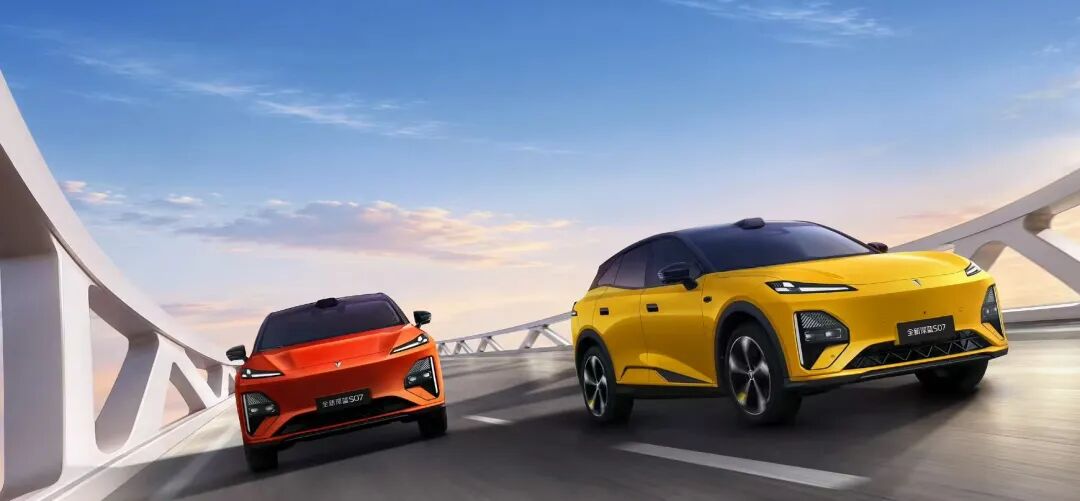
However, when compared to Zeekr and Lynk & Co, the differentiation between Avatr and Shenlan is more pronounced, with minimal historical product overlaps. In the 2024 integration blueprint for Zeekr and Lynk & Co, Geely redefined the product lines to circumvent market overlap: Zeekr focuses on mid-to-large-sized vehicles, while Lynk & Co targets small-to-medium-sized ones. In terms of energy configurations, Lynk & Co's small vehicles predominantly feature pure electric powertrains, whereas its medium-sized vehicles emphasize hybrid systems; Zeekr's medium-sized vehicles concentrate on pure electric, and its large vehicles on hybrids.
In contrast, Avatr is positioned in the high-end market, while Shenlan caters to the mainstream market, with a well-defined and established synergy between the two. This represents a more advantageous aspect of Changan's integration strategy compared to Geely's approach. Beyond product differentiation, Zeekr and Lynk & Co implemented further integration measures, such as team consolidation and channel unification. Zeekr leveraged its technological advancements to benefit Lynk & Co, standardizing research and development as well as procurement processes. These aspects diverge from Changan's current integration strategy.
The rationale behind these differences lies in the fact that Zeekr completed its restructuring with Lynk & Co through delisting, whereas Avatr is pursuing a listing while simultaneously addressing synergy issues with Shenlan. This renders Changan's strategic integration of Avatr and Shenlan more intricate, involving a greater number of compliance requirements. Changan has explicitly stated that this collaborative integration will not impede Avatr's IPO. Consequently, the specific path chosen will pioneer a novel approach to strategic integration for automotive companies and serve as a crucial reference for the reform of central and state-owned enterprises.
In terms of synergistic effects, a parallel can be drawn with Zeekr and Lynk & Co. According to figures released by Geely, post-integration, the two companies achieved a 10-20% reduction in R&D investment costs; a 5-8% decrease in supply chain costs through technological synergy; a 3-5% increase in factory utilization in manufacturing; and a 10-20% reduction in support department expenses. An estimated annual cost savings of approximately RMB 5 billion is anticipated. The synergistic effects between Shenlan and Avatr are expected to be fully evident in the 2027 financial reports.
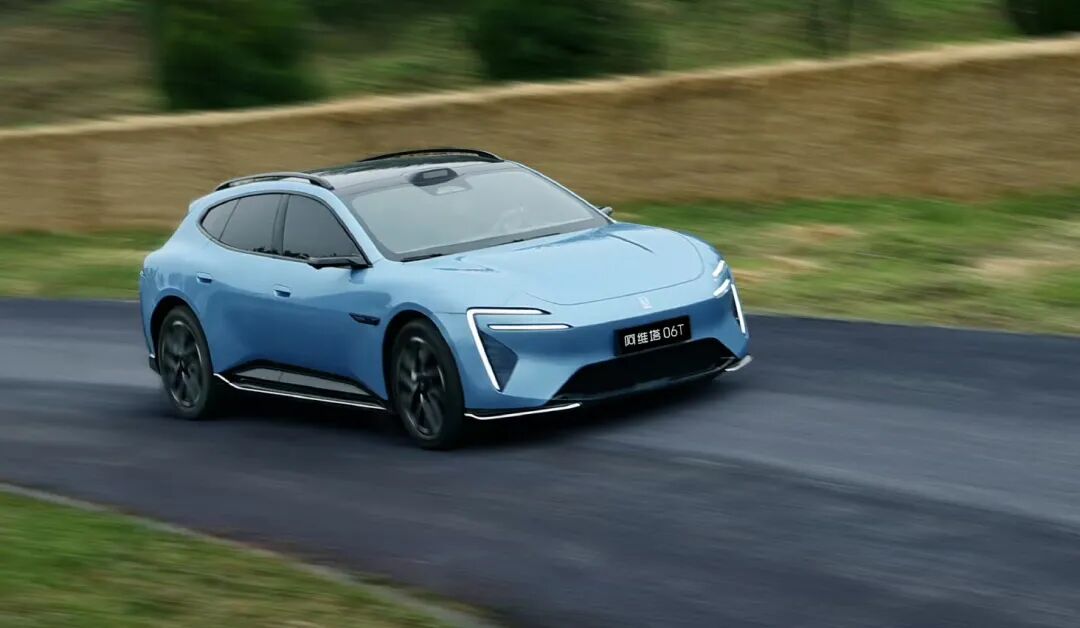
However, cost reduction is merely one facet. "This AD collaboration is immensely beneficial for both Avatr and Shenlan. It signifies a strategic choice for accelerated development rather than a mere reduction in investment," remarked Deng Chenghao. Previously, Zhu Huarong, the chairman of Changan, also emphasized that Changan's integration of Shenlan and Avatr is a decision driven by efficiency.
Interestingly, the newly established AD department is co-led by senior executives from both entities. Chen Zhuo, the president of Avatr, represents his company, while Deng Chenghao, the chairman of Shenlan Automobile, represents his. This partnership may suggest a significant elevation in Chen Zhuo's status within Avatr—although this is merely an observation from Mingjing Pro. Thus, in Changan's grand endeavor of collaborative integration, a new duo, "Deng Chenghao + Chen Zhuo," has been substantively established.
This announcement conveys multiple messages:
Firstly, Changan has refrained from forming a leadership team at the group level, instead entrusting Avatr and Shenlan with autonomy. This reflects a strategy aimed at unleashing their potential while assessing the internal coordination and strategic alignment capabilities of the two core management teams. Secondly, the new partners are both homegrown cadres cultivated by Changan and are outstanding among the company's young leaders. This underscores Changan's commitment to grooming its next generation of core commanders. Throughout its development, Changan has relied on internally cultivated management talent, ensuring a high degree of stability—a significant advantage in the industry.
Nevertheless, specific details regarding the detailed division of responsibilities and implementation plans for the two brands have yet to be disclosed. From a strategic vantage point, following cost reduction and efficiency improvements, the collaboration between the two brands has a clear objective: to establish a globally competitive cluster of 1.5 million mid-to-high-end brands annually with high-quality development. This goal is set for 2030, with Avatr targeting 500,000 units and Shenlan Automobile aiming for 1 million units. Given that only slightly over three years remain, the task is both urgent and formidable.
Once the direction is set, the focus shifts to the pace of progress.
-
![]()
GAC Group Secures 50% Stake in FAW Toyota
-
![]()
Entering a Low-Profit Era, the Auto Industry Starts to 'Squeeze Efficiency'
-
![]()
FAW and GAC Sign Agreement, Ushering in a New Era of Cooperation in China’s Auto Industry
-
![]()
Automakers Dazzle with Spectacular Stunts to Boost Car Sales
-
![]()
Doubao Sets Its Sights on the Travel and Hospitality Sectors
-
![]()
Weekly Report on New Energy Vehicles: Hainan's New Energy Vehicle Penetration Rate Exceeds 66%
-
![]()
Deng Chenghao and Chen Zhuo Spearhead Top-Tier AD Department: Unveiling the Profound Implications of Avatr-Shenlan Integration
-
![]()
GAC Group 'Swaps' Stakes with FAW Toyota, Anticipates Annual Earnings of 4.2 Billion Amid North-South Toyota Integration