OpenAI's $20 Billion 'Revenue Shortfall Shock': The Actual Impact Is Milder, More of a Sentiment Shift!
 10/10 2026
 440
440
The global AI market experienced a pullback following OpenAI's adjustment of its Annual Recurring Revenue (ARR) projection from $70 billion to $50 billion. Dolphin Research will briefly analyze some of the discrepancies in expectations here.
1. The $70 billion and $50 billion figures reflect differing measurement standards; the actual shortfall is not as significant.
It's widely recognized that while leading AI model companies periodically disclose ARR metrics, the measurement standards (e.g., gross revenue vs. net revenue, whether it's an average of the past 28 days multiplied by 12 or the most recent week multiplied by 52) and the timing of announcements (e.g., immediately after launching a flagship model or following a promotion) are critical. Without consistent standards, horizontal comparisons can lead to substantial misunderstandings in expectations.
Anthropic consistently uses gross revenue as its ARR measurement standard, which includes distribution revenue ultimately paid to external channels. In contrast, OpenAI opts for net revenue, excluding various revenue shares. This means OpenAI's ARR does not include the portion taken by $Microsoft (MSFT.US)$ (20% of total ARR) or the portion taken by $Amazon (AMZN.US)$ Bedrock (based on Anthropic's cooperation agreement with Bedrock, the channel takes 50% of gross revenue after deducting inference costs).
Earlier, OpenAI's Chief Revenue Officer Denise Dresser mentioned in an April memo to employees that competitor Anthropic's revenue was 'overstated' because it included cloud channel revenue shares.
Since 2026, OpenAI's new agreement with Microsoft stipulates that for every $1 earned, OpenAI must pay Microsoft 20 cents until 2030, with a cumulative cap set at $38 billion.
Regarding the current proportion of gross revenue taken by Bedrock, assuming inference costs are 35%, the revenue allocated to Bedrock by O&A would be approximately (100%-35%)*50% = 32.5%.
However, this figure is lower than our calculated 32.5% based on 2025 prospectus disclosures, where Anthropic's combined distribution fees paid to Amazon and Google accounted for roughly 16% (= distribution fees of $351 million / distribution revenue of $2.16 billion from the two cloud platforms) of total gross revenue.
The discrepancy arises because IPO materials disclose all revenue routed through AWS and Google Cloud, including distribution through Bedrock and other channels (TaaS, where revenue sharing mainly occurs), as well as direct API sales by Anthropic itself, but with cloud infrastructure provided by AWS and Google. This portion does not include distribution revenue, only cloud hosting costs.
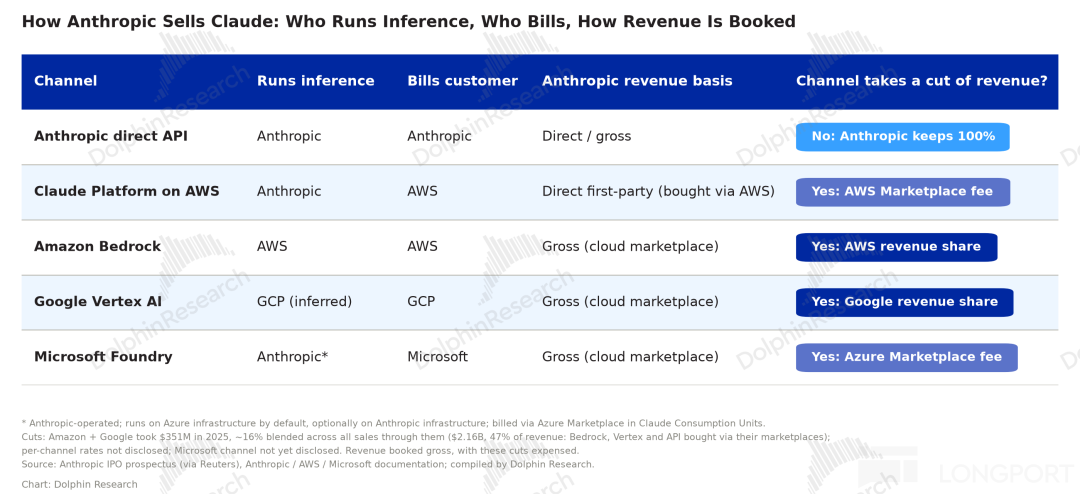
Overall, when comparing OpenAI and Anthropic, the essence of channel revenue share proportions is similar. Therefore, aside from assessing which company relies more on distributors (before the first half of 2026, Anthropic had deeper cooperation with cloud channels and heavier distribution reliance), the main additional factor is the revenue share corresponding to Microsoft's 20% equity stake in OpenAI's early stages.
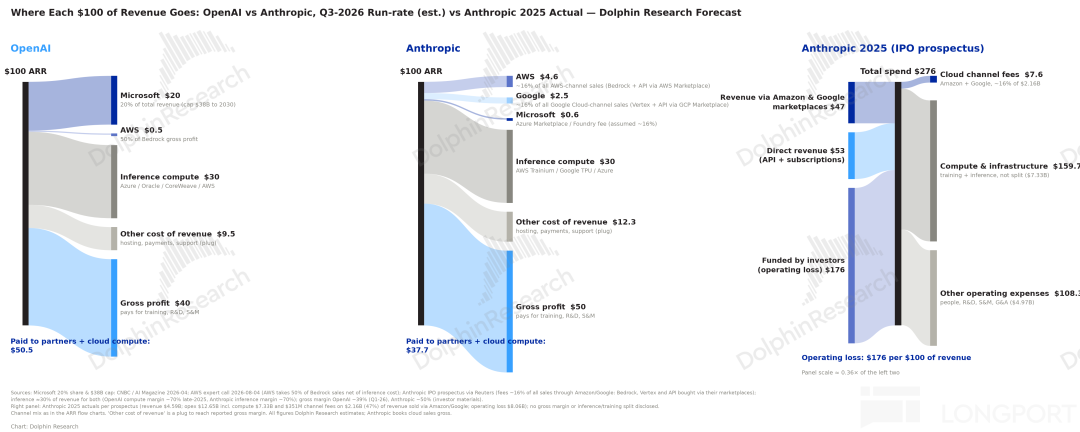
Now, let's examine the measurement standards behind OpenAI's $70 billion and $50 billion figures. Note that neither data source is from OpenAI's official channels.
(1) $70 billion represents gross revenue, not OpenAI's net revenue measurement standard.
The $70 billion figure emerged last month—according to Reuters, 'OpenAI's current ARR is close to $70 billion, having grown by 70% since Q3. In detail, enterprise-side revenue has doubled.' Calculating backward, June's ARR was approximately $40 billion.
However, co-founder Greg Brockman and CFO Sarah Friar's internal statements in July—that ARR would exceed $20 billion by the end of 2025, with July's figure roughly double that of year-end—align with the $40 billion figure for July disclosed by Bloomberg in August, based on insider information.
Since these are statements from company executives, July's $40 billion should represent net revenue. If June's $40 billion ARR, as calculated by the Financial Times, also represents net revenue, it would imply zero month-over-month growth in OpenAI's ARR for July, which is inconsistent with trends from third-party alternative data.
According to TickerTrends, OpenAI's month-over-month growth in July was around 10% (TickerTrends combines trend monitoring with model fitting, incorporating official data in the process, so its prediction standards are likely closer to net revenue). The actual lack of growth occurred in March-April, when Claude Opus 4.6, paired with coding agents, was performing exceptionally well.
With the release of GPT 5.5 at the end of April and its designation as the default model, along with Codex expansions and new product integrations like ChatGPT Mobile, OpenAI began to gain momentum. Combined with price reductions, it started to significantly capture market share from Anthropic, which had released Fable but faced limited penetration due to high costs.
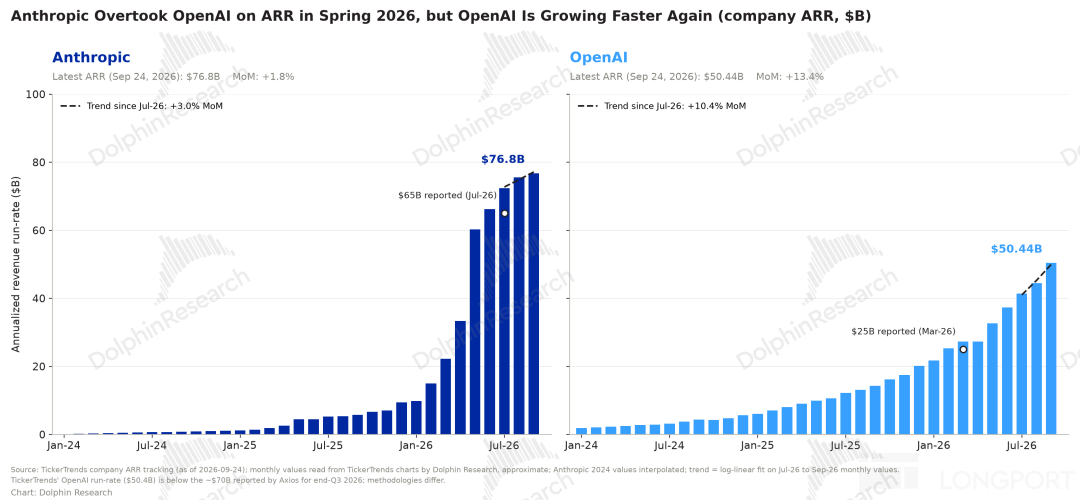
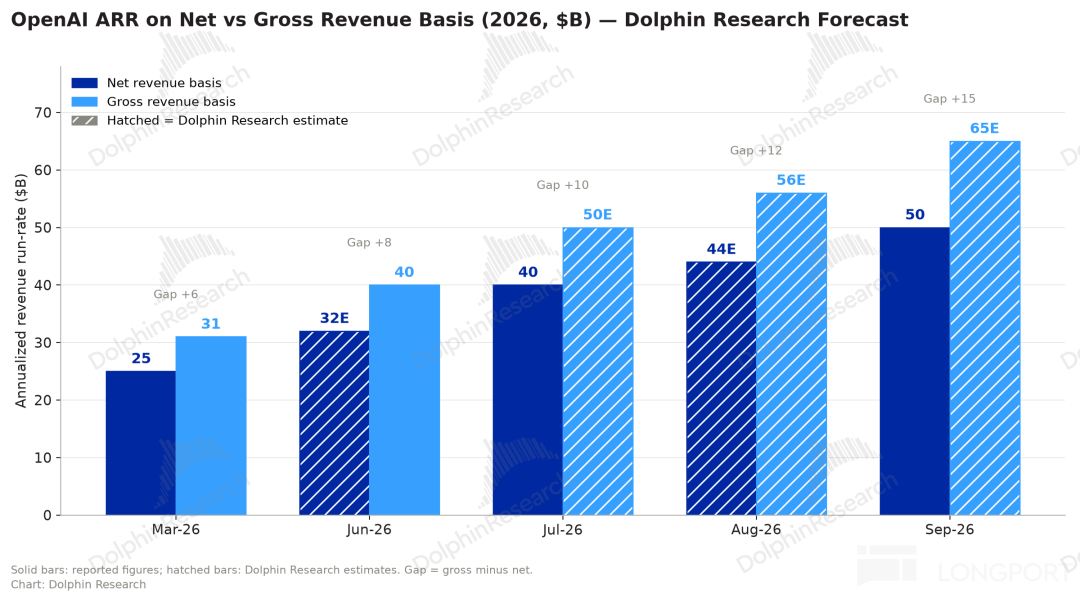
Therefore, the $40 billion figure from late June/early July and the $70 billion figure disclosed last month both represent gross revenue, while the $40 billion ARR for July disclosed in early August represents net revenue.
The 20% difference stems from Microsoft's revenue share. At this point, cloud channel distribution was still very low, as Google and Amazon Bedrock only began gradually distributing ChatGPT in April and June, respectively.
The valuation perspective also indirectly confirms that the $70 billion figure leans more toward gross revenue:
From a P/ARR perspective, OpenAI's latest funding round valued it at $1.4 trillion, corresponding to $70 billion in ARR, a 20x valuation. This is the same as Anthropic's projected $100 billion in gross ARR by year-end, corresponding to a $2 trillion IPO valuation, also at 20x.
(2) $50 billion is likely net revenue.
Now, let's examine the source of the $50 billion ARR figure—reported by the Financial Times, which claimed that OpenAI disclosed to its investors that ARR was close to $50 billion.
This is essentially an official disclosure, so the source is highly reliable. However, OpenAI's official figures typically represent net revenue after excluding Microsoft's share and cloud platform distribution fees.
Nevertheless, in September, OpenAI's cloud platform distribution was still not significant. Gross revenue from cloud channel distributions like Bedrock likely accounted for no more than 10% of total revenue (according to SemiAnalysis, Anthropic's revenue routed through Bedrock accounted for just 15%).
Therefore, the $50 billion net revenue ARR, after adding back Microsoft's 20% share, would be $62.5 billion. Assuming that other external platform distributions like Vertex and Bedrock account for 10% combined, and based on our earlier assumption of a 25% channel share, the channel share portion that can be added back is 10%*25% = 2.5%. Thus, $62.5 billion / (100%-2.5%) ≈ $64 billion.
While this figure still falls short of $70 billion by 10% ($6 billion), it feels much more manageable than the Financial Times' sensational headline—'20 billion less than previously disclosed!'
Although the absolute value difference affects short-term performance expectations for companies in the industry chain, from a long-term perspective, Dolphin Research still prefers to focus on growth trends—OpenAI's recent momentum is healthy (average month-over-month growth of 10% in Q3), while Anthropic faces some minor challenges (average month-over-month growth of 3% in Q3). The entire industry continues to grow.
In summary, Dolphin Research has roughly reconstructed OpenAI's figures over the past few months under different measurement standards, for reference only.
2. The actual AI penetration rate is still very low; short-term cooling does not hinder long-term prospects.
After coding scenarios achieved over 50% penetration, the industry is exploring a second scenario to continue driving AI monetization and the growth narrative of the underlying industry chain.
The Co-Working scenario, an extension of self-developed coding scenarios, has been heavily emphasized since June. However, Dolphin Research must pour some cold water on this: while the Co-Working market space is larger, its rollout is expected to be less smooth than coding.
AI coding is seamless primarily because AI's effectiveness in programming scenarios is very easy to verify and quantify—whether the code works or the application can be developed can be automatically verified by AI itself.
In terms of quantifying AI's cost-effectiveness, it can be directly compared to IT development labor costs. Over the past 20 years of robust internet development, IT personnel hourly wages have generally been high. For enterprises, the economic case for AI substitution is clear.
The Co-Working scenario has a significantly larger Total Addressable Market (TAM). Gartner predicts that by 2030, agents may influence approximately $234 billion in enterprise application software spending, accounting for about 20% of SaaS spending. However, Dolphin Research believes that the development process for Co-Working will be more complex than coding.
This complexity is not only reflected in verifying AI's effectiveness but also requires enterprises to retain more internal data assets on agent platforms, which involves more challenging enterprise security issues. Balancing security risks and cost-effectiveness is a decision that enterprise clients need time to consider.
In the short term, economic calculations are still primarily focused on improving human efficiency, but AI's greater value should lie in how it helps enterprises increase top-line revenue, not just compress costs. Dolphin Research will delve deeper into the analysis of AI in office scenarios soon—stay tuned if you're interested.
However, within the broader context of AI development, this is a short- to medium-term issue. From a long-term perspective, AI still has significant growth potential. A16Z's latest report on AI market development, released a few days ago, shows:
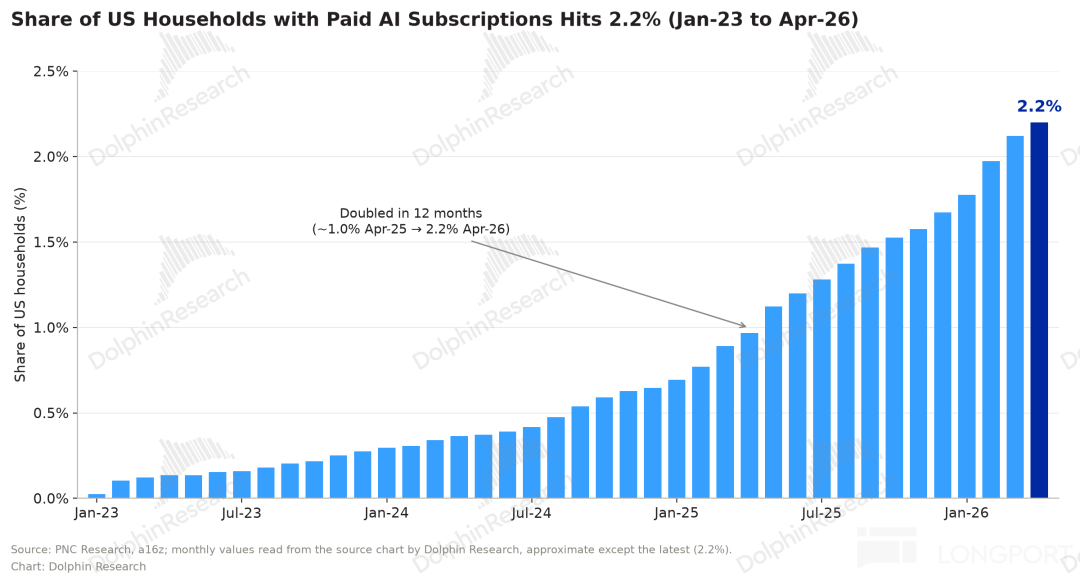
Among U.S. users, while the general penetration rate of AI (having used AI at least once) has reached 50%, only a quarter of users actually use AI daily, and the paid conversion rate is less than 3% (varying between 2-4% across different statistical sources).
This means that despite frequent iterations in AI technology, where AI can assist in researching various cutting-edge scientific challenges, AI's stickiness (frequency and duration of use) remains very low in the lives of most ordinary people. From a long-term perspective, this also represents a vast amount of untapped application value.
Summary: Ultimately, the focus on numbers reflects a decrease in market risk appetite.
The Financial Times' $20 billion AI shortfall 'bomb' is not as powerful as it seems. Last night's U.S. stock market and today's Hong Kong and A-share market openings were still turbulent (South Korea and Taiwan were closed today, and the Chinese market also has concerns about U.S. restrictions on industry chain materials), but Asian market sentiment has since recovered somewhat.
However, the market's sensitivity to ARR figures from O&A and other leading model companies, along with its tendency to overreact, reflects significant expectation divergences and a cautious mood, with most funds exhibiting decreased risk appetite.
Dolphin Research remains optimistic about AI's long-term prospects, but with the upcoming Q3 earnings season and Anthropic's IPO prospectus disclosure, direct validation of AI's actual demand and business models will emerge. In the current high-interest-rate environment, expectation divergences will lead to greater volatility. Therefore, it may be appropriate to diversify portfolio positions to mitigate volatility risks associated with concentrated holdings.
- END -
// Reprint Authorization
This article is an original piece by Dolphin Research. Reproduction requires authorization.
// Disclaimer and General Disclosure
This report is for general comprehensive data purposes only, intended for general reading and data reference by users of Dolphin Research and its affiliated institutions. It does not consider the specific investment objectives, investment product preferences, risk tolerance, financial situation, or special needs of any individual receiving this report. Investors must consult with independent professional advisors before making investment decisions based on this report. Any person making investment decisions using or referring to the content or information in this report does so at their own risk. Dolphin Research shall not be liable for any direct or indirect consequences, responsibilities, or losses arising from the use of the data in this report. The information and data in this report are based on publicly available sources and are for reference purposes only. Dolphin Research strives to ensure but does not guarantee the reliability, accuracy, and completeness of the information and data.
The information mentioned or the opinions expressed in this report shall not be considered or regarded as an offer to sell securities or an invitation to buy or sell securities in any jurisdiction, nor shall they constitute advice, quotation, recommendation, etc. regarding relevant securities or related financial instruments. The information, tools, and materials contained in this report are not intended for or proposed to be distributed to citizens or residents of jurisdictions where the distribution, publication, provision, or use of such information, tools, and materials would conflict with applicable laws or regulations, or would result in Dolphin Research and/or its subsidiaries or affiliated companies being required to comply with any registration or licensing requirements in such jurisdictions.
This report solely embodies the individual perspectives, understandings, and analytical approaches of the respective contributors, and in no way represents the official position of Dolphin Research or its affiliated entities.
This report is crafted by Dolphin Research, with exclusive copyright ownership resting with Dolphin Research. Without obtaining prior written approval from Dolphin Research, no entity or individual is permitted to (i) produce, duplicate, replicate, forward, or generate any copies or reproductions in any form whatsoever, and/or (ii) directly or indirectly redistribute or transfer them to any unauthorized individuals. Dolphin Research reserves all pertinent rights in this regard.
-
![]()
Dongchedi Tests Zunjie V800: Brake Pedal Fractures in Three Cars—Is This a Design Flaw?
-
![]()
DeepSeek Reportedly Raises 80 Billion in Latest Funding Round, Preparing for IPO
-
![]()
Global AI Consumption Survey: Only 1% of Super Users Are Supporting the AI Ecosystem
-
![]()
Does Meeting Standards Equal Safety? Is the Baseline the Upper Limit? Does Passing Inspection Mean Peace of Mind?丨When Brakes Fail Even While Speeding
-
![]()
AI Home Appliances Shine During Golden Week
-
![]()
Muse Goes Viral: Who Will Be China's Version of Muse?
-
![]()
PE Giant with Hundreds of Billions Excels in Aviation Investment This Year
-
![]()
Brake Pedal Bracket Fractures: Not Isolated Incidents—A Comprehensive Review of Global Recalls by Ford, Porsche, and GM