Does Meeting Standards Equal Safety? Is the Baseline the Upper Limit? Does Passing Inspection Mean Peace of Mind?丨When Brakes Fail Even While Speeding
 10/10 2026
 396
396
On October 8th, Dongchedi released a brake test video that caused a stir.
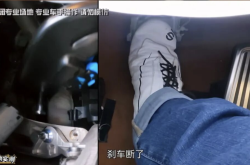
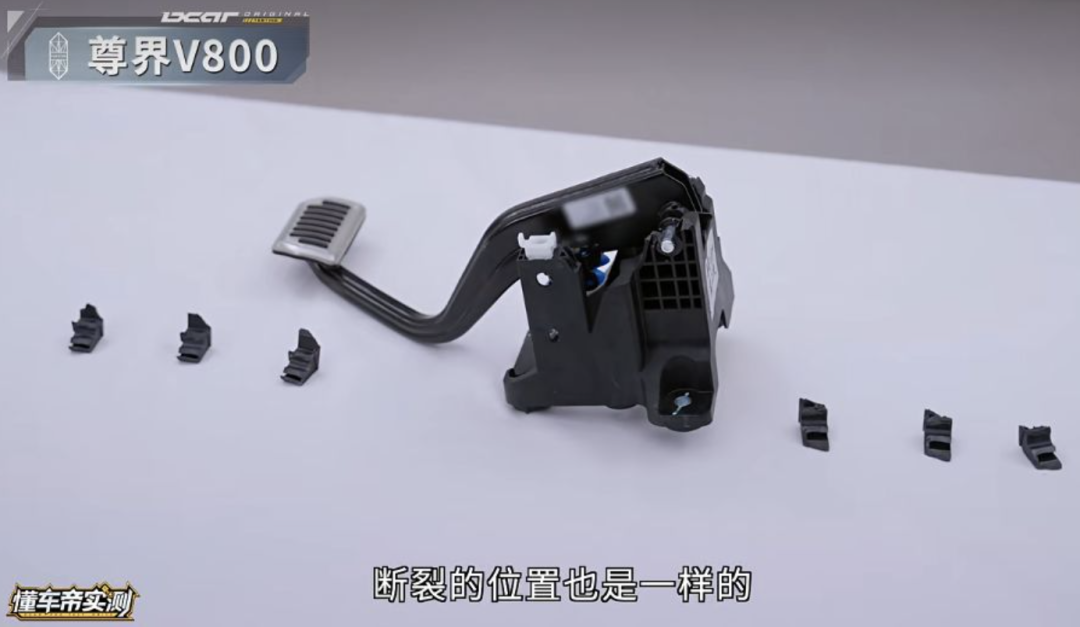
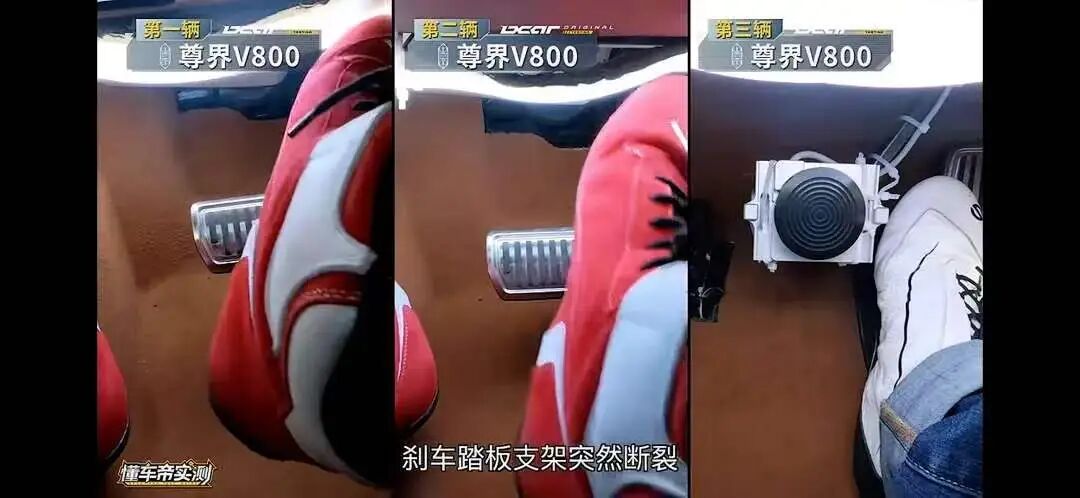
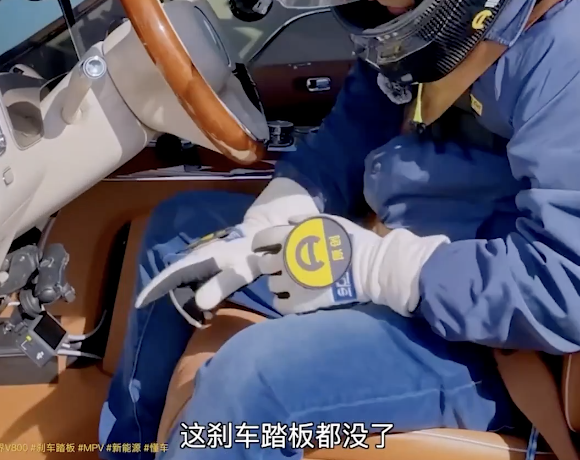
Three Zunjie V800 vehicles underwent a basic brake test from 100 km/h to zero, and all three suffered brake pedal bracket fractures. With no braking, the vehicles only stopped after being shifted into Park.
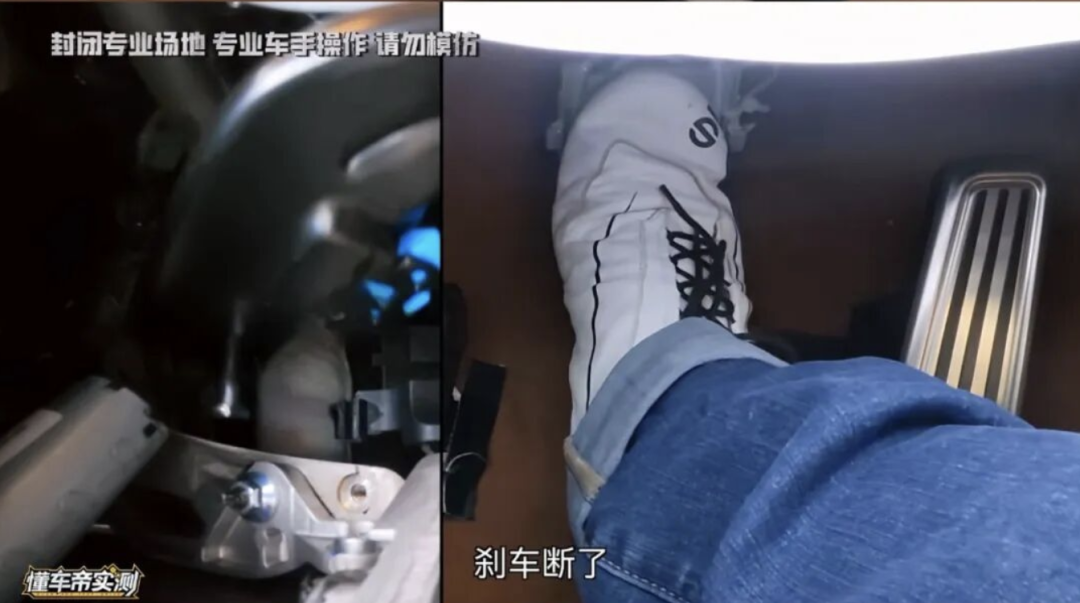
Dongchedi reported a measured peak pedal force of 1,612 Newtons. Zunjie responded the same evening, stating that their braking system was developed and validated to exceed national and industry standards, that no similar failures had occurred in real-world user scenarios, that this was an extreme non-standard condition, and committed to optimizing design and offering free upgrades to delivered vehicles.
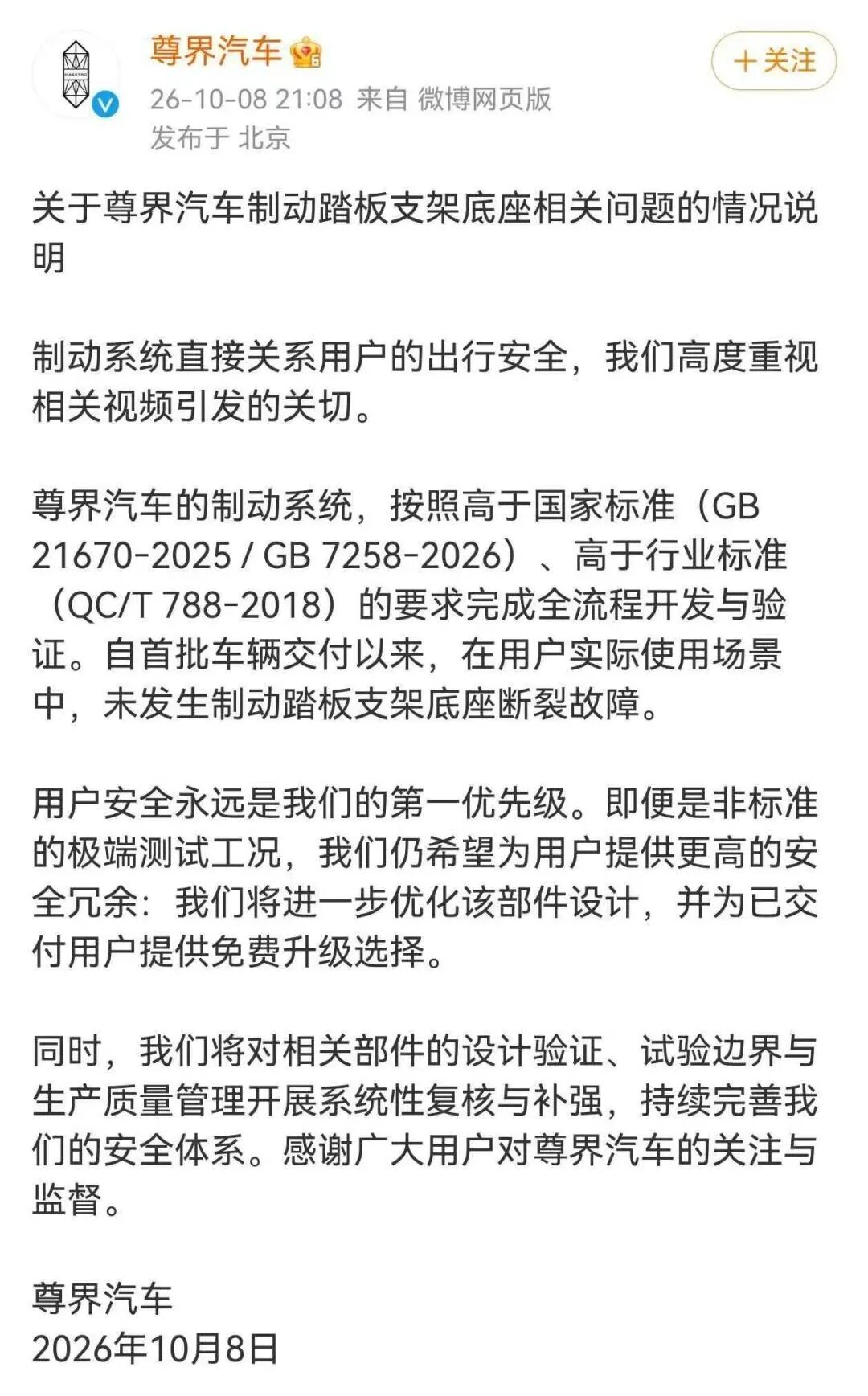
Both sides presented their cases, but one logic kept recurring: compliance with national standards. It seemed that as long as national standards were met, the matter would be closed.
But what exactly are national standards? What do they guarantee, and what do they not?
Frankly, Zunjie's response and attitude thus far have been acceptable, at least committing to free upgrades.
However, around this incident, Huasheng wants to puncture a layer of window dressing and shed light on an issue everyone knows but avoids discussing:
Above national standards, how high should we set our own standards? Under intense competition, how much safety redundancy can be maintained? As Chinese automobiles go global, can standards keep pace with product quality? When consumers buy a car, can they truly know what level of safety they are purchasing?
And an even more fundamental question: When faced with supervision and question (zhìyí, doubts), can we avoid hastily assigning blame and instead clarify the issues?
None of these questions can be answered with just four words: 'compliance with national standards.' More regrettably, each of these issues is like an elephant in the room—everyone in the industry knows they exist. Now is the time to discuss them openly.
This issue is particularly important, not just for car owners who buy and drive vehicles, but also for passengers inside those vehicles, pedestrians on the road, and other traffic participants—everyone has only one life.
01. Three Cars, All Broke in the Same Place

Dongchedi tested the basic braking performance of the Zunjie V800, conducting a full-force brake test from 100 km/h to a complete stop. This is a standard test in all automotive evaluations, not an extreme test.
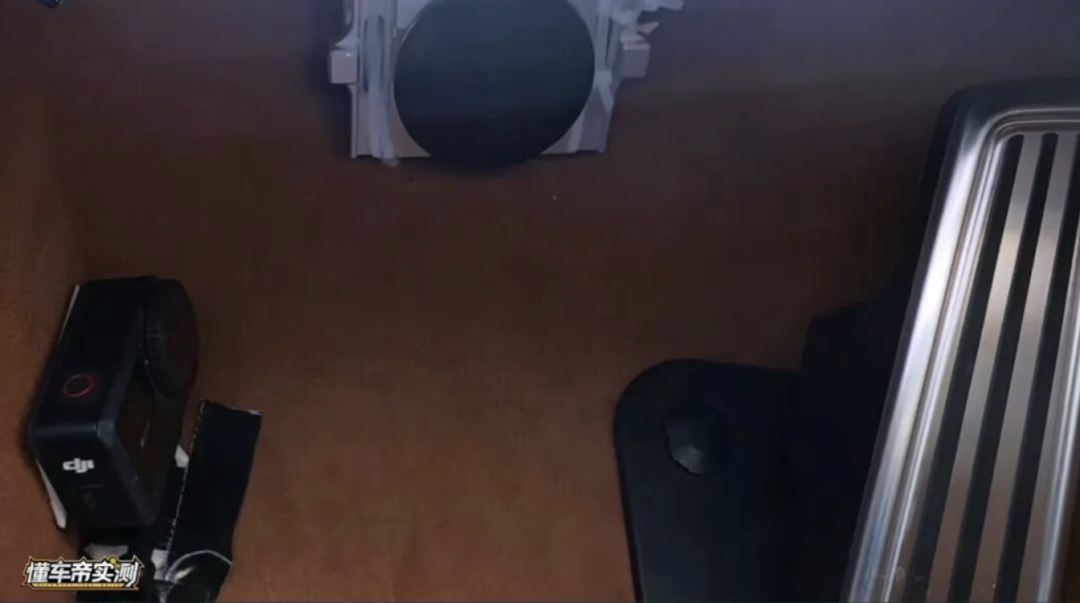
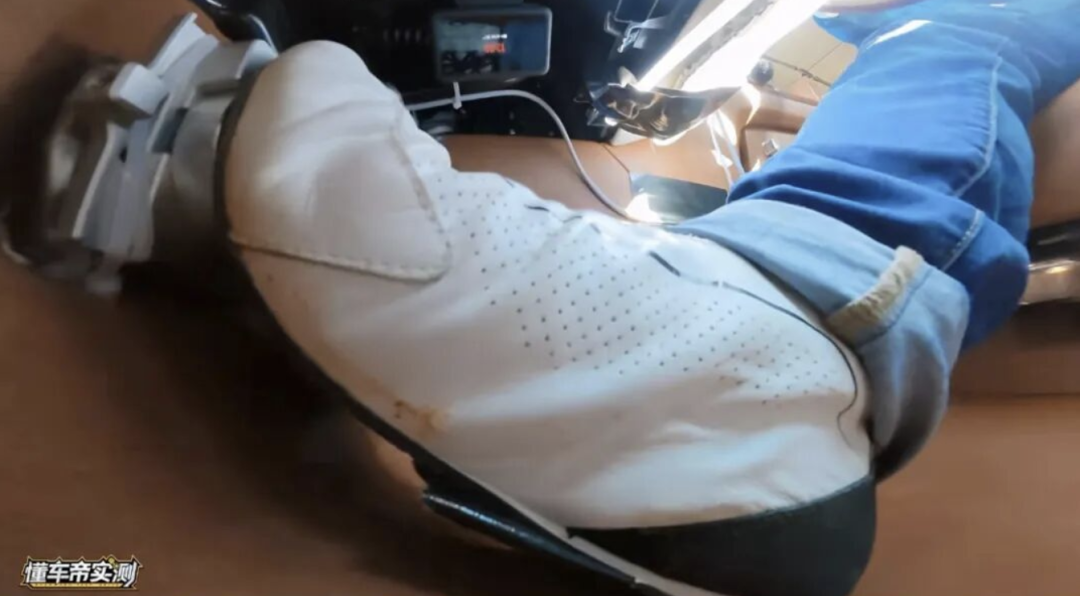
The result: all three test vehicles suffered brake pedal bracket fractures. Once the pedal broke, braking force could not be transmitted, the vehicles lost braking capability, and drivers could only stop the vehicles by shifting into Park to engage the transmission lock.
After the video's release, online reports claimed a pedal force of 4,589 Newtons. Dongchedi later clarified that 4,589 Newtons was a ghost image caused by unsynchronized refresh rates between the filming equipment and the detection screen, and the actual peak force was 1,612 Newtons.
1,612 Newtons is roughly equivalent to 164 kilograms of force. An adult braking with full force in an emergency could potentially reach this level.
Zunjie's response had three layers: the product exceeds national and industry standards, no similar failures have occurred among users, and this was an extreme non-standard condition. They also softened their stance by committing to design optimization and free upgrades.
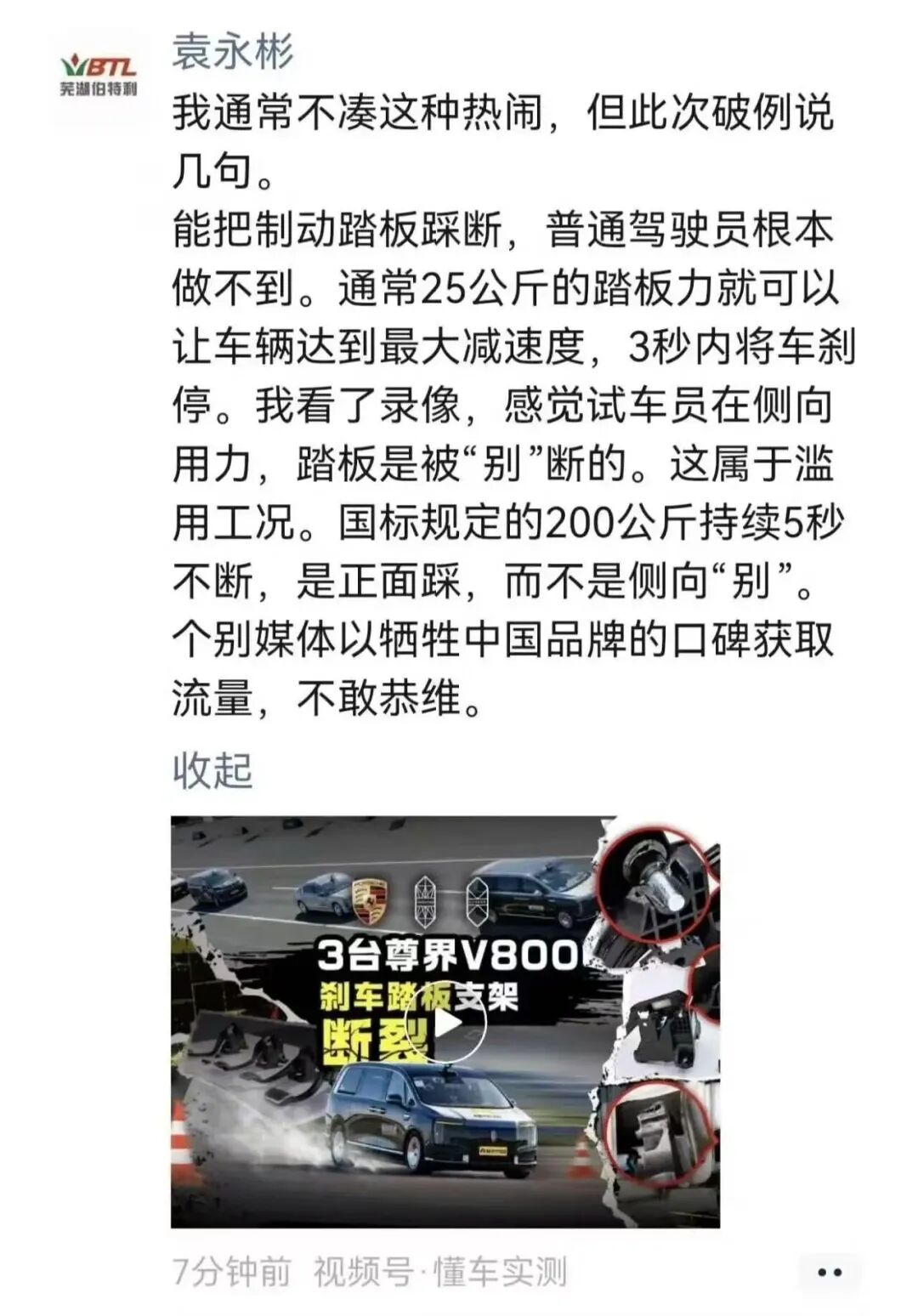
After the incident escalated, another voice emerged in the public discourse. Some industry insiders labeled this test as outright defamation of Chinese automotive brands, while media peers cautioned that writing supervisory content now often leads to complaints under the pretext of 'infringing on national brands and hindering industrial development.'
Such remarks are quite disheartening. Any enterprise that willingly wears such a label seeks only the glory of reputation without accepting corresponding supervisory responsibilities and the duty to improve itself. Enterprises that abuse this rationale and terminology are the true black marks on the industry.
Yet amidst the arguments, one question remains unavoidable: Does exceeding national standards equate to safety?
02. National Standards Are a Baseline, Not a Ceiling
China's automotive standards are tiered. At the base are national standards—mandatory requirements that all vehicles for sale must meet. Above them are industry and group standards, and higher still are a company's internal standards. Well-run companies set internal standards far above national requirements.
Take battery safety, for example. On March 28, 2025, the State Administration for Market Regulation released the updated "Safety Requirements for Power Batteries in Electric Vehicles," standard number GB 38031-2025, taking effect on July 1, 2026. The most significant change was upgrading the thermal runaway test from the old standard of "providing a warning signal five minutes before fire or explosion" to "no fire, no explosion, and no harmful smoke to occupants."
This shift from "five minutes to escape" to "no fire at all" represents a qualitative leap. Yet it remains a baseline—the minimum requirement for all new models, not the highest standard.
The same logic applies to braking systems. GB 7258, "Technical Conditions for the Safe Operation of Motor Vehicles," cited in Zunjie's response, is the most fundamental safety standard for motor vehicles, specifying basic requirements for brake pedal force, braking distance, and braking efficiency. It tests standard conditions—standard pedal force, standard vehicle speed, standard road surface.
But between standard conditions and real-world driving lies an entire realm of complexity.
03. Laboratory Standards Can't Capture Road Complexity
Standardized tests share a common trait: controlled conditions.
Take the most familiar crash tests: fixed angle, fixed speed, fixed obstacle. Brake tests use standard pedal force, standard road friction coefficients, standard vehicle conditions. Battery thermal runaway tests induce failure in a lab using heating plates or nail penetration, observing battery pack reactions.
These tests establish a unified baseline, ensuring all automakers are evaluated on a level playing field. But their limitations are clear—the real world is far more complex than any laboratory.
During emergency braking, a driver might panic and stomp with far greater force than standard tests assume. In a crash, angles may deviate by a few degrees, speeds may be tens of kilometers per hour higher, and obstacles may have entirely different shapes. Battery thermal runaway might not start with a single cell but result from a collision causing coolant leaks, wiring shorts, and simultaneous failures across multiple systems.
This is why I said after Xiaomi's car collision and fire incident: A vehicle that passes national standards is not guaranteed to be safe in all real-world accidents. National standards are a 60-point passing grade—you can't call a student who scores 60 a top performer.
More importantly, automobiles are complex systems. A component that tests fine in isolation doesn't guarantee the entire vehicle will function properly in real-world operation. New materials, new architectures, deep hardware and software (ruǎnjiàn, software and hardware) coupling—any change in one area can trigger unexpected issues elsewhere.
It's like a fuel tank: individually tested, the materials and placement may seem fine. But paired with a specific de-icing fluid, specific piping layout, and a specific collision angle, new risks can emerge. Such systemic risks cannot be detected through single-component standard testing.
04. Standards Slipping Under Intense Competition
If national standards are the baseline, the real concern is that the space above that baseline is being eroded by intense competition.
In my years of industrial research, one trend has become increasingly clear: New energy vehicle companies generally aren't profitable, selling cars at a loss with extremely long payment terms. Cost pressures ripple up the supply chain, ultimately landing in two places: downgrading component selection or shortening validation cycles.
Forces are reciprocal—when you relentlessly cut costs, you can't guarantee what you get in return. Under the accumulation of various issues, problems will inevitably emerge at some point, which also aligns with the laws of thermodynamics.
I've had automakers admit to me that under current competitive pressures, standards are indeed slipping. Requirements aren't as stringent as before. Where a new component once required multiple rounds of validation and tens of thousands of kilometers of road testing, now corners are cut wherever possible.
I won't claim this is universal, but it's at least a structural dilemma facing the entire industry. With price wars this fierce, every company is calculating costs. National standards are a hard constraint that can't be violated, but the safety redundancy above those standards becomes the first thing to be sacrificed.
Why aim for 90 points when 60 will do? This logic becomes perfectly 'rational' under cost pressure. It's not the self-expectation one would expect from a rising industry's leading companies.
05. China Should Lead in Standards, Not Be a Lowland
Intense competition driving standards downward points to a deeper issue: China's new energy vehicle industry status no longer aligns with its standard-setting role.
China has led the world in new energy vehicle production and sales for years, with globally leading intelligent connected technologies and the world's most complete power battery supply chain. Our products lead globally—but what about our standards?
If national standards remain at the 'minimum threshold' level, and companies operate under a '60 points is enough' mindset, China risks becoming a lowland for global automotive standards—where other countries' high-standard products enter easily, but our products must adapt to others' standards when going abroad.
A more rational path is tiered standards: National standards as the safety floor, group standards led by industry associations and top firms to set higher technical norms, and corporate standards striving for excellence, with companies encouraged to public (gōngkāi, publicly disclose) internal standards to build brand trust through high benchmarks.
Chinese companies' technological accumulations in new energy and intelligent connectivity already sufficiently support our participation in, even leadership of, global standard-setting. Rather than chasing within others' frameworks, we should convert our technological advantages into standard advantages.
If not now, when?
06. Compliance ≠ Safety—Who Gives Consumers Choice?
Finally, the most pointed question.
Safety redundancy does vary by vehicle price tier. A ¥200,000 car and a ¥1 million car cannot possibly match in materials, validation, or safety configurations. This fact may not be politically correct, but it objectively exists.
The key isn't to deny this reality but to ensure consumers have right to know (zhīqíngquán, the right to know) and option (xuǎnzéquán, the right to choose). How much safety redundancy does this car model actually have? Under what conditions might problems arise? Consumers should at least know what level of safety they're purchasing and what risks they're assuming.
Overseas, insurance companies handle this. Premiums vary by vehicle safety rating. Insurers have a vested interest in precise safety assessments because it directly affects claim rates. This market-driven tiered system provides consumers with far more valuable choice information than a simple "pass/fail" binary judgment.
What about in China? The relevant testing procedures for new cars after their launch are known in the industry as the 'Five-Star Wholesale Department.' Test one model, it gets five stars; test another, and it also gets five stars. The level of differentiation is extremely low, and consumers simply can't tell which one is safer. Third-party evaluations are supposed to serve this function, but current third-party evaluations are either questioned for being paid off or receive legal letters from companies, leaving them with less and less room to operate.
In the case of Zunjie, DCD has identified issues, while the company claims its standards are higher than national requirements. Consumers are caught in the middle, unsure of whom to believe. This precisely highlights the lack of an independent, credible, and differentiated safety evaluation system in China.
Written by | Li Xiyin · Huasheng
-
![]()
Dongchedi Tests Zunjie V800: Brake Pedal Fractures in Three Cars—Is This a Design Flaw?
-
![]()
DeepSeek Reportedly Raises 80 Billion in Latest Funding Round, Preparing for IPO
-
![]()
Global AI Consumption Survey: Only 1% of Super Users Are Supporting the AI Ecosystem
-
![]()
Does Meeting Standards Equal Safety? Is the Baseline the Upper Limit? Does Passing Inspection Mean Peace of Mind?丨When Brakes Fail Even While Speeding
-
![]()
AI Home Appliances Shine During Golden Week
-
![]()
Muse Goes Viral: Who Will Be China's Version of Muse?
-
![]()
PE Giant with Hundreds of Billions Excels in Aviation Investment This Year
-
![]()
Brake Pedal Bracket Fractures: Not Isolated Incidents—A Comprehensive Review of Global Recalls by Ford, Porsche, and GM