Brake Pedal Bracket Fractures: Not Isolated Incidents—A Comprehensive Review of Global Recalls by Ford, Porsche, and GM
 10/10 2026
 427
427
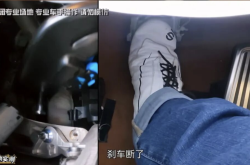
The fractures of brake pedal brackets observed in three new Zunjie V800 vehicles during third-party testing are still under investigation and dispute. The final determination awaits official and regulatory notifications.
Fractures involving brake pedal brackets, pedal arms, or associated connecting structures are not uncommon in the global automotive industry. Manufacturers such as Ford, GM, Porsche, Volkswagen, and Stellantis have all launched formal safety recalls due to such issues.
By reviewing these cases, we can analyze how automakers and regulators typically respond and pinpoint the risks associated with brake pedal structures that necessitate a shift from technical explanations to defect investigations and recall procedures.
I. Overview of the Cases
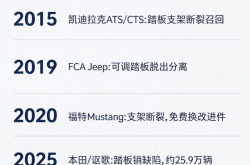
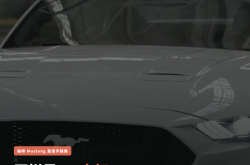
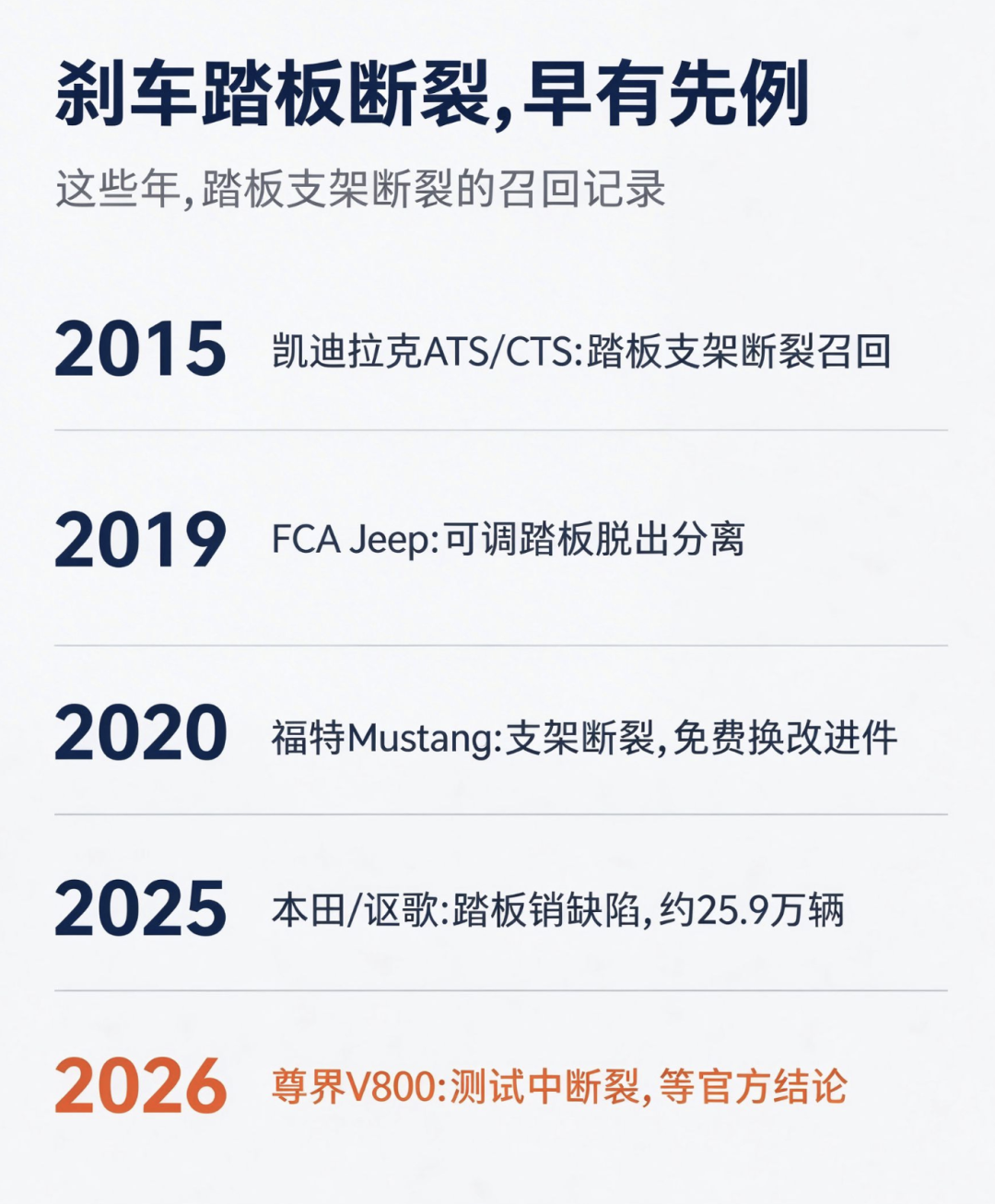
The 2020 Ford Mustang (automatic transmission) in the U.S., involving 38,005 vehicles, experienced brake pedal brackets that could fracture at the pivot area during sudden, forceful braking, resulting in a loss of braking capability. Recall number: 20V573000.
The 2015 Cadillac ATS and CTS in the U.S., encompassing 2,163 vehicles, had brackets between the brake pedal assembly and brake pushrod that could be damaged during manufacturing or fracture during normal pedal operation, leading to service brake failure. Recall number: 15V358000.
The common thread in these cases is evident: both involve the driver's braking operation mechanism, with structures that could fail during pedal use. Manufacturers identified the loss or reduction of braking capability as a safety risk and implemented recall measures, including part replacement or inspection.
Fractures of brake pedal bracket structures, even if not yet linked to widespread traffic accidents, can be sufficient grounds for safety recalls if deemed likely to result in abnormal vehicle braking. This is particularly relevant to the Ford Mustang, where recall conditions explicitly involve sudden, significant brake pedal force application by the driver—highly pertinent to the controversy sparked by Zunjie's testing.
II. Ford Mustang: The Most Relevant Engineering Case
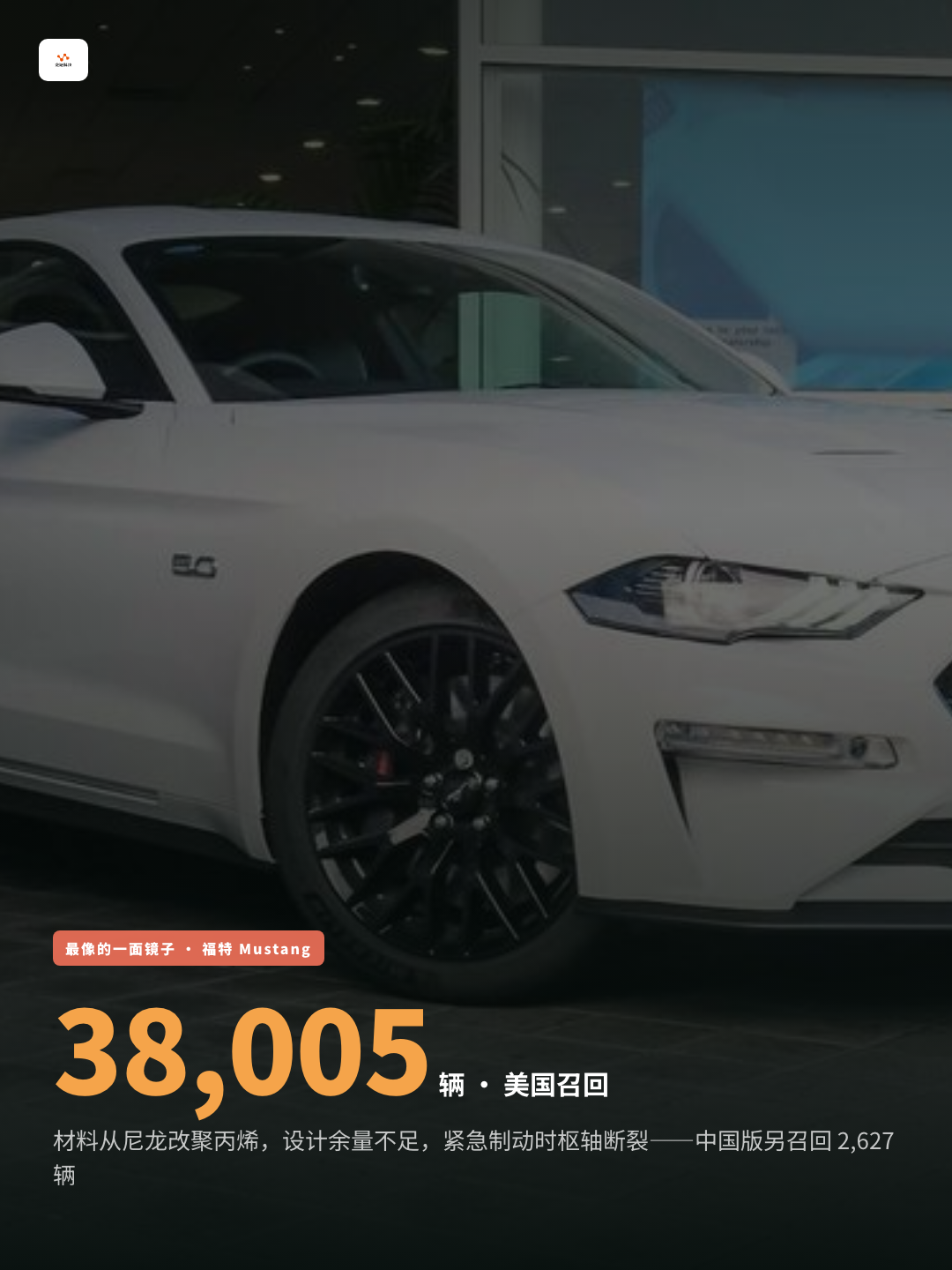
Ford's case holds significant reference value due to three key factors: plastic brackets, emergency heavy braking, and insufficient design margins.
According to formal recall documents from the U.S. NHTSA, the affected part initially used nylon material but was later switched to polypropylene in automatic transmission models. Following this material change, the original structure's ability to withstand instantaneous impact loads during emergency braking decreased. Ford attributed the issue to insufficient design margins for relevant influencing factors in the pedal engineering specifications and design verification procedures. The affected area, near the pedal pivot, could experience brittle overload fractures.
During Ford's investigation, anomalies were detected, and reports of pedal bracket fractures were received. Market failure parts were examined, and failure analysis identified brittle overload damage, with fractures concentrated near the pedal pivot. The common cause was traced by comparing material changes, part design, production dates, and verification procedures, confirming insufficient design margins. A recall was initiated in September 2020, requiring dealers to halt the delivery of affected new vehicles and replace pedal bracket assemblies in relevant vehicles.
Ford recalled not only factory-installed vehicles but also addressed replacement parts that had entered the aftermarket repair channel through independent part recalls, with part recall numbers 20E069 and 20S55, involving 62 units. This was a separate aftermarket parts recall and should not be conflated with the 38,005 factory-installed vehicle recall.
The lessons from this case are clear: even if there are only a few market failure records for brake pedal brackets, if investigations reveal common material or structural design risks, automakers may initiate recalls for the entire affected production range. Ford's material change and structural strength investigations were formally documented. Importantly, at the time of the recall initiation, Ford reported no known traffic accidents or injuries resulting from this defect.
III. Similar Recalls in the Chinese Market
The imported Ford Mustang also underwent a formal recall in the Chinese market. According to announcements from the Defective Product Recall Technical Center of the State Administration for Market Regulation, this involved 2020 Mustang models produced between March 4, 2019, and August 13, 2020, totaling 2,627 units. Due to insufficient strength margins reserved during design verification, the pedal bracket's ability to withstand peak braking loads decreased after the material change from nylon to polypropylene, potentially fracturing at the pivot during emergency braking and causing a loss of braking performance. The recall measure involved free replacement with improved brake pedal bracket assemblies, while production reverted to nylon material on August 13, 2020.
This official Chinese record carries more weight than overseas media reports. It clearly demonstrates that under China's current automotive defect recall system, there is a precedent for formal recalls due to insufficient design margins in brake pedal plastic brackets and fracture risks during emergency pedal operation.
It should be emphasized that Ford's material change and root cause have been confirmed through official investigations. Zunjie V800 has not yet completed the same technical evaluation, so while both can serve as investigative references, they cannot be directly identified as having the same defect.
IV. Porsche Cayenne and Volkswagen Touareg: Over 210,000 Vehicles Recalled in China in 2016
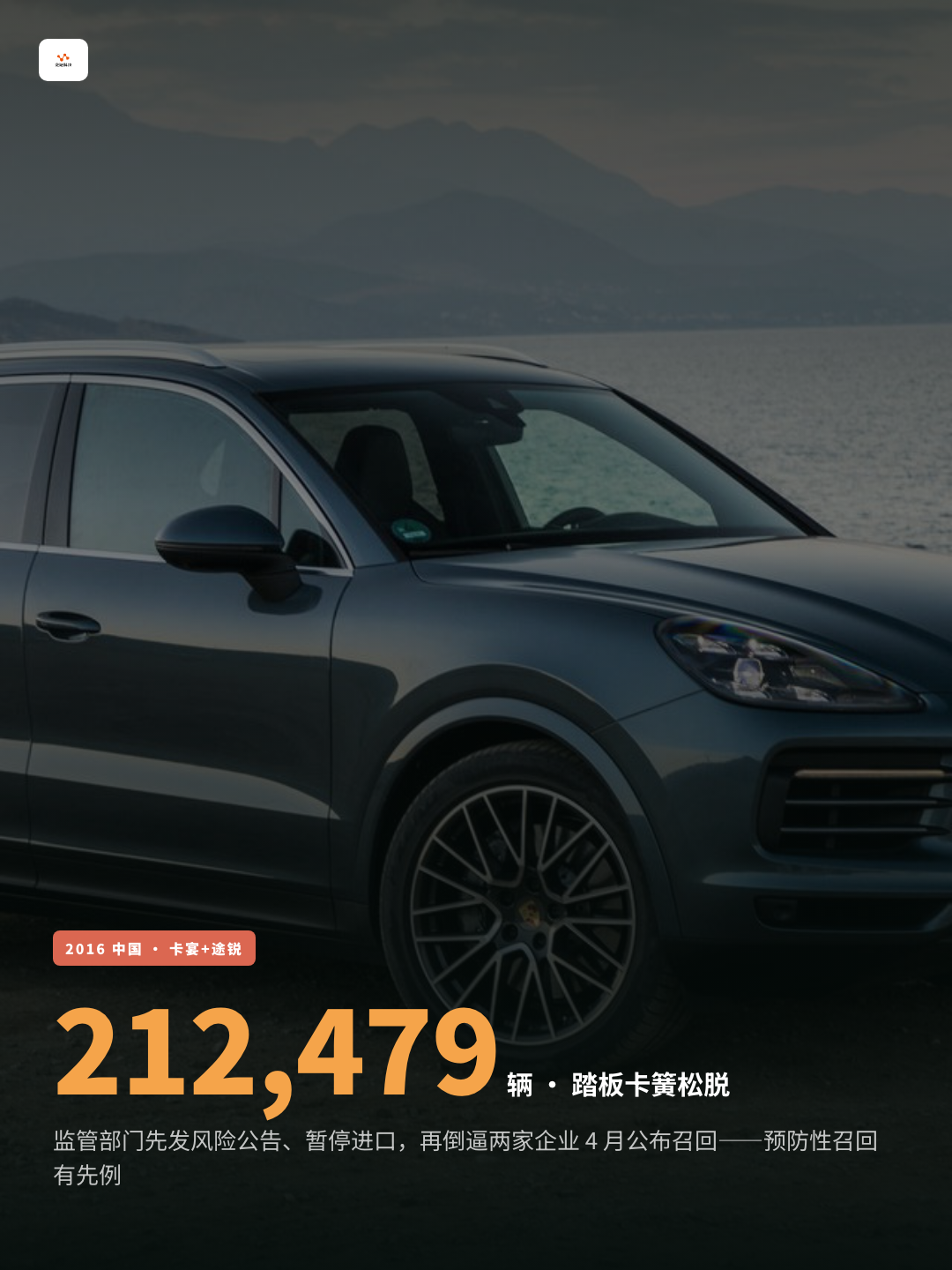
This incident involved two luxury SUVs from the Volkswagen Group sharing a technical platform, with a failure mechanism different from Ford's but also involving the brake pedal's mechanical structure. The retaining clip on the brake pedal hinge could become loose, causing the pedal pivot pin to gradually shift. If use continued, the pedal shaft could fracture or the pedal could move out of its normal operating position, potentially preventing the driver from effectively braking. In April 2016, two recalls in mainland China involved a total of 212,479 vehicles, including 108,910 Porsche Cayenne and 103,569 Volkswagen Touareg models. Volkswagen and Porsche ultimately checked the pedal bearing retaining clips, installed new ones if necessary, and added inspections for retaining clip installation status on the supplier's production line.
On March 31, 2016, the former General Administration of Quality Supervision, Inspection, and Quarantine issued Risk Bulletin No. 35. At that time, relevant recalls had already been announced in overseas markets, but Chinese regulatory authorities had not yet received recall plans from the companies for the Chinese market. After preliminary assessments identifying significant quality and safety risks, regulators required the two companies to promptly submit technical reports and implement recalls while suspending imports of the relevant vehicle series until risks were further addressed. Subsequently, the companies announced recall plans for the Chinese market in April.
In domestic automotive product defect management, regulatory authorities can initiate investigations based on overseas recalls, common structural defects, and potential safety consequences, without necessarily waiting for numerous domestic accidents to occur before taking action.
V. Stellantis: Pedal Arm Collapse in 2024, Expanded Recall in 2025
In October 2024, Stellantis initiated a recall for the Alfa Romeo Tonale and Dodge Hornet due to brake pedal arms potentially collapsing during normal braking operations, preventing drivers from activating the service brake system via the pedal. The initial U.S. recall involved 21,069 vehicles, with recall number 24V752000. In 2025, an additional 5,974 U.S. vehicles were recalled, with recall number 25V846000.
According to NHTSA documents, as of October 1, 2024, the initial investigation had identified 12 potentially related market reports, including one accident, with no injuries reported. On October 16, 2024, Stellantis disclosed 15 known global cases. The repair method is noteworthy: bolts and nuts were added to the pedal arm to reinforce structural connections, rather than relying solely on software adjustments. In 2025, additional complaints emerged, prompting Stellantis to investigate and include another batch of previously unrecalled vehicles, implementing the same structural reinforcement measures.
Risks associated with pedal mechanical structures sometimes require re-examining earlier production ranges and expanding recalls based on subsequent failure records. When pedal failure occurs, the electronic parking brake can be used for emergency deceleration, and the automatic emergency braking system may intervene if activated.
Data sources include NHTSA, Volvo Japan recall announcements, and corresponding regulatory documents, with quantities reflecting the specified markets rather than global cumulative totals.
The 2019 RAM case also involved plastic structural components. Although the damaged part was the travel nut of the adjustable pedal mechanism rather than the bracket bearing bending moments from pedal operation, the manufacturer did not simply replace software but added mechanical limits to prevent the mechanism from completely disengaging after exceeding normal travel. The 2023 Ford Mustang case involved only 66 vehicles, but NHTSA's formal documents still recorded the recall and advised affected owners not to drive their vehicles before completing repairs.
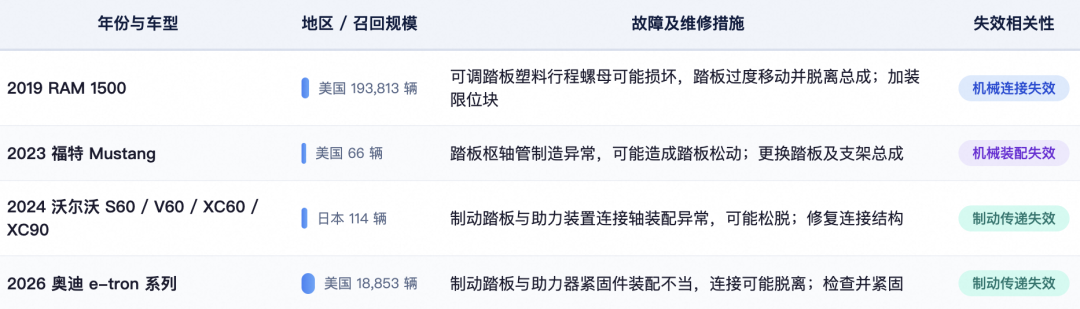
These two cases demonstrate that recall volume is not the sole criterion for assessing risk severity. For braking operation mechanisms, whether a failure could cause drivers to lose normal braking capability remains the critical safety determinant.
All cases mentioned above have involved formal recalls or official submissions for safety recalls.
Conclusion
Clear records now exist of multiple global automakers initiating recalls due to brake pedal bracket fractures, pedal arm collapses, or potential failures of connecting mechanisms, with official cases in the Chinese market. This is a significant issue, and we will continue to monitor developments!
References: Defective Product Recall Technical Center of the State Administration for Market Regulation (Ford China Mustang 2020 recall, AQSIQ 2016 Risk Bulletin No. 35), U.S. NHTSA (recall documents 20V573, 15V358000, 24V752000, 25V846000, 19V067, etc.), and official recall notices from automakers. Testing information remains disclosed by third parties and has not yet undergone independent technical evaluation.
-
![]()
Does Meeting Standards Equal Safety? Is the Baseline the Upper Limit? Does Passing Inspection Mean Peace of Mind?丨When Brakes Fail Even While Speeding
-
![]()
AI Home Appliances Shine During Golden Week
-
![]()
Muse Goes Viral: Who Will Be China's Version of Muse?
-
![]()
PE Giant with Hundreds of Billions Excels in Aviation Investment This Year
-
![]()
Brake Pedal Bracket Fractures: Not Isolated Incidents—A Comprehensive Review of Global Recalls by Ford, Porsche, and GM
-
![]()
The 2026 Flagship Imaging Ranking Race Kicks Off: Who Will Be Crowned the National Champion of Imaging Smartphones?
-
![]()
Controversies Surrounding Dongchedi and Harmony Intelligent Auto, Zunjie V800 Pedal Fracture, and Ford Recall
-
![]()
Bentley, Maserati, Rolls-Royce: The Ebb and Flow of Seven Ultra-Luxury Foreign Brands in China, From 21,000 Annual Sales to a Mere 3,000 Now