Global AI Consumption Survey: Only 1% of Super Users Are Supporting the AI Ecosystem
 10/10 2026
 542
542


The AI traffic empire is sustained by a tiny fraction of users spending real money
Image Source | Internet (Please contact for removal if infringing) Partially AI-generated
Recently, renowned venture capital firm a16z released the seventh edition of its 'Top 100 AI Consumer Apps' ranking. After three years of tracking, this traffic-based ranking has become largely solidify (solidified), with only 11 new products making the list this time—a record low.
But what deserves more attention than the ranking itself is that a16z, for the first time, incorporated real U.S. consumer credit card spending data into this edition.
When the maps of 'who is using' and 'who is paying' are overlaid, a harsh truth emerges: The AI traffic empire is sustained by a tiny fraction of users spending real money.
And these people may not be visible in your social circle at all.

Many Use AI, but Few Are Heavy Spenders
Survey data shows that nearly half of U.S. consumers claim to have used AI products, but only 25% actually open them daily.
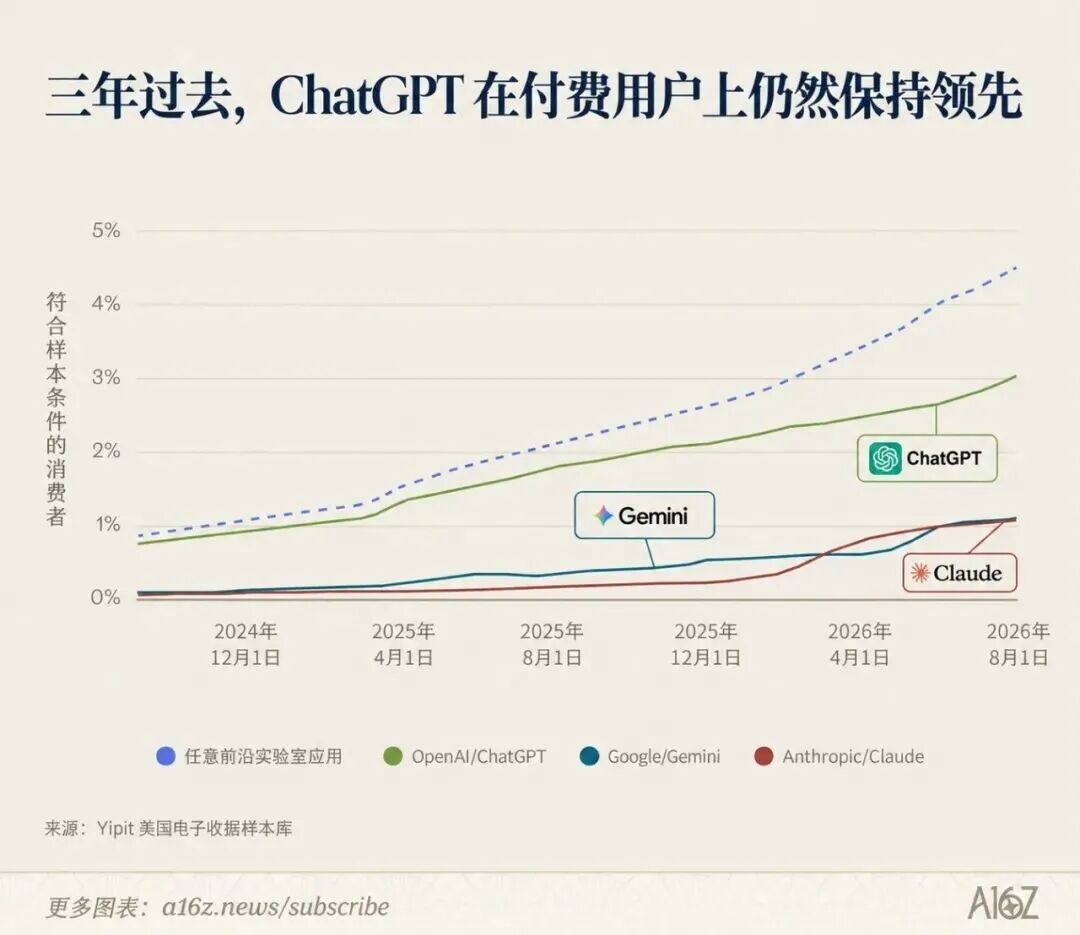
As of August 2026, only 4.5% of consumers have paid for subscriptions to ChatGPT, Gemini, or Claude—double the figure from a year ago but still pitifully low.
In simple terms, for every 100 Americans who have used AI, only about nine are willing to pay long-term.
While more users are beginning to access AI capabilities through desktop applications or traditional software, these behaviors do not enter web traffic statistics.
In other words, traffic rankings only show the tip of the iceberg, while consumption data reveals the less optimistic picture beneath the surface.
So, who exactly is supporting this industry?
a16z's data reveals an extreme power-law distribution: The top 1% of paid users contribute 19.5% of revenue in the consumer AI market, even exceeding the total spending of the bottom 50% of users.
These elite users spend approximately $903 per month on AI tools, with consumption surging by 80% over the past 18 months.
$903, approximately 6,054 RMB at current exchange rates, is equivalent to a month's wages for some. Meanwhile, the median paid user spends about $25 (167 RMB), with little sign of sustained growth.
The data gap is 36-fold—enormous.
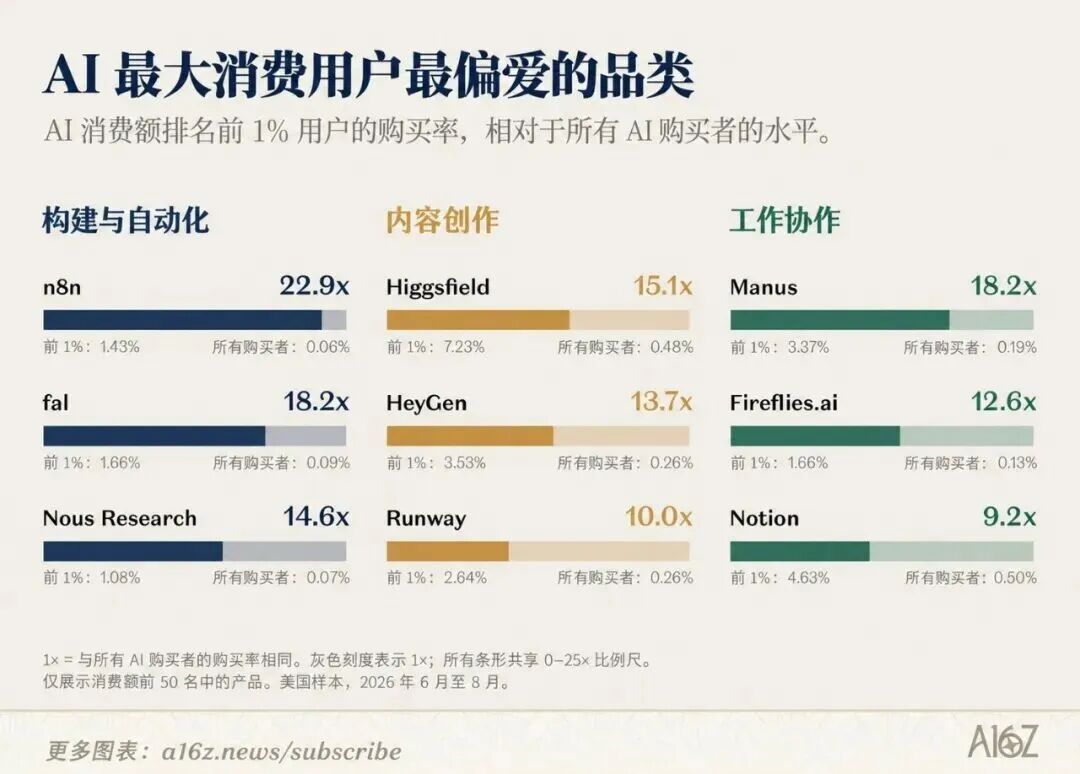
These super users' spending lists are interesting: On one side are automation tools like n8n and Manus, and on the other are creative productivity platforms like Higgsfield, Figma, and HeyGen. All these tools share one thing in common—they are 'work-related' tools.
They spend money on AI not just for casual chat or curiosity but as productivity components genuinely integrated into their workflows.
This is the first 'real market' that consumer AI has found: People willing to pay for AI are those who use it to make or save money.

Monopoly by Giants, Finding Ways to Make Users Pay
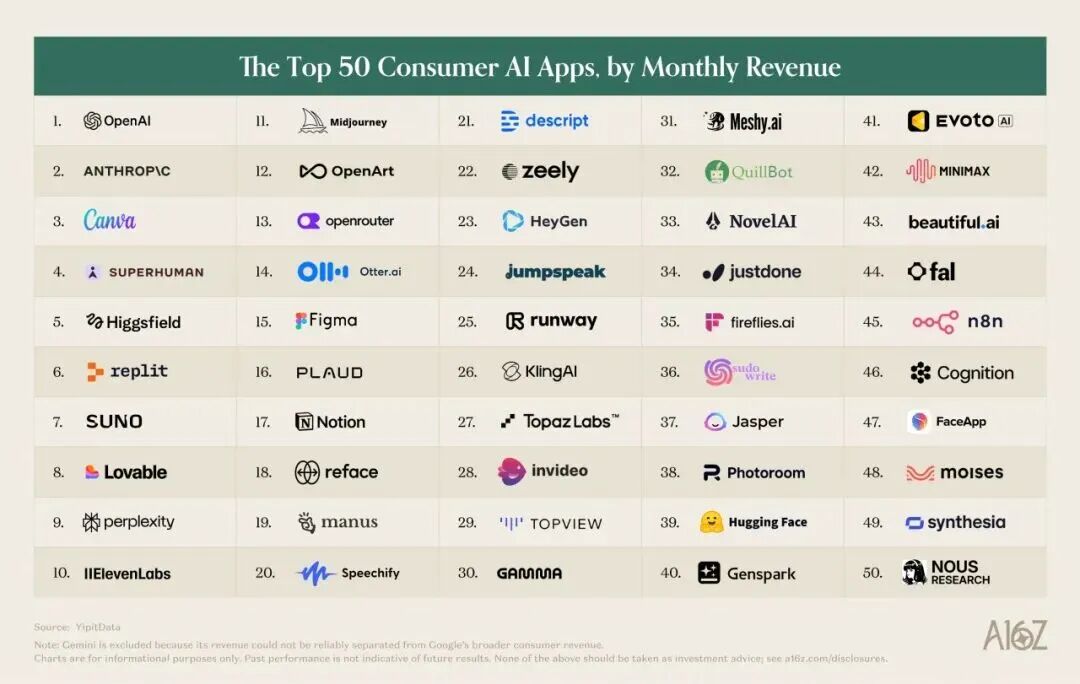
However, there's an interesting phenomenon here: Among the top 50 AI vendors ranked by real spending, 29 do not appear on the traffic rankings at all.
You may have never heard of these products, but they are sustained by continuous payments from a small group of heavy users. Their users do not chase 'download counts' but care only about 'whether the job gets done.'
Conversely, only seven companies appear on all three rankings—web traffic, mobile monthly active users, and real revenue: ChatGPT, Claude, Suno, Perplexity, Photoroom, Canva, and Notion.
Most 'star products' boasting about free traffic cannot even make it to the table of real spending.
Yet the competitive landscape in the mass market is quietly changing.
ChatGPT remains the absolute traffic king, with 14 times the mobile monthly active users of Claude and three times the paid subscribers compared to both Gemini and Claude.
But the real variable is Claude. In the first edition of the ranking in September 2023, Claude was not even on the list.
Now, not only has its traffic surged, but it has briefly surpassed Gemini in total paid users across the U.S.
The key lies in its subscription structure: About 7.5% of Claude's subscribers purchase high-tier plans priced at $100 or more per month, compared to just about 1% for ChatGPT and Gemini.
Here's an interesting phenomenon: Claude follows a 'purification' route. It does not chase the largest user base but the most willing-to-pay users.
In the subscription game, this is precisely the smartest strategy.
But here lies a very contradictory phenomenon that exists in almost all leading AI companies.
RevenueCat's 2026 subscription report shows that AI apps have an 8.5% trial-to-paid conversion rate, 52% higher than non-AI apps. Paid users also have significantly higher lifetime value than traditional apps.
Yet retention rates are extremely low: AI apps have an annual retention rate of just 21.1%, compared to 30.7% for non-AI apps. Users cancel annual subscriptions 30% faster than with traditional apps.
Simply put: AI products excel at getting users to pay but struggle to keep them.
The logic behind this is not hard to understand. Users are lured in by new features, pay up, use the product for a while, find it underwhelming, or discover cheaper alternatives, and then promptly unsubscribe.
The AI app market is still in its 'experimental phase,' with users rapidly switching between products in search of the latest and strongest tools.
Frankly, most AI products have not yet made users feel 'indispensable.'

I Didn't Pay Money, But I Paid Something Else
There is always a cost behind 'free lunches.'
A survey targeting college students illustrates the issue well: 45% believe the free version suffices, 30% say they would only consider paying during specific scenarios like exam weeks or essay seasons, and about 70% would not pay immediately.
These young users have very clear core needs—literature summaries, resource searches, and essay outlines—all of which are largely covered by the free version.
So what truly prevents them from paying? 40% say that usage limits after payment are the biggest source of dissatisfaction. 25% worry about privacy, especially being unwilling to grant browser access or file-reading permissions.
This actually points to a deeper issue with the freemium model. Users are not unwilling to pay for good products but do not trust that 'payment will truly solve the problem.'
In reality, free users pay far higher hidden costs than imagined. ChatGPT's free version has only half the context window of the paid version, with ads enabled by default and conversation content used for model training by default.
Gemini's situation is even more extreme: Starting October 9, 2026, free users will only have access to the lowest-performing Flash-Lite model, with both Flash and Pro removed from the free tier.
Free users are 'paying' for AI through convenience and experience trade-offs. The problem is, many do not even realize what they are paying for.
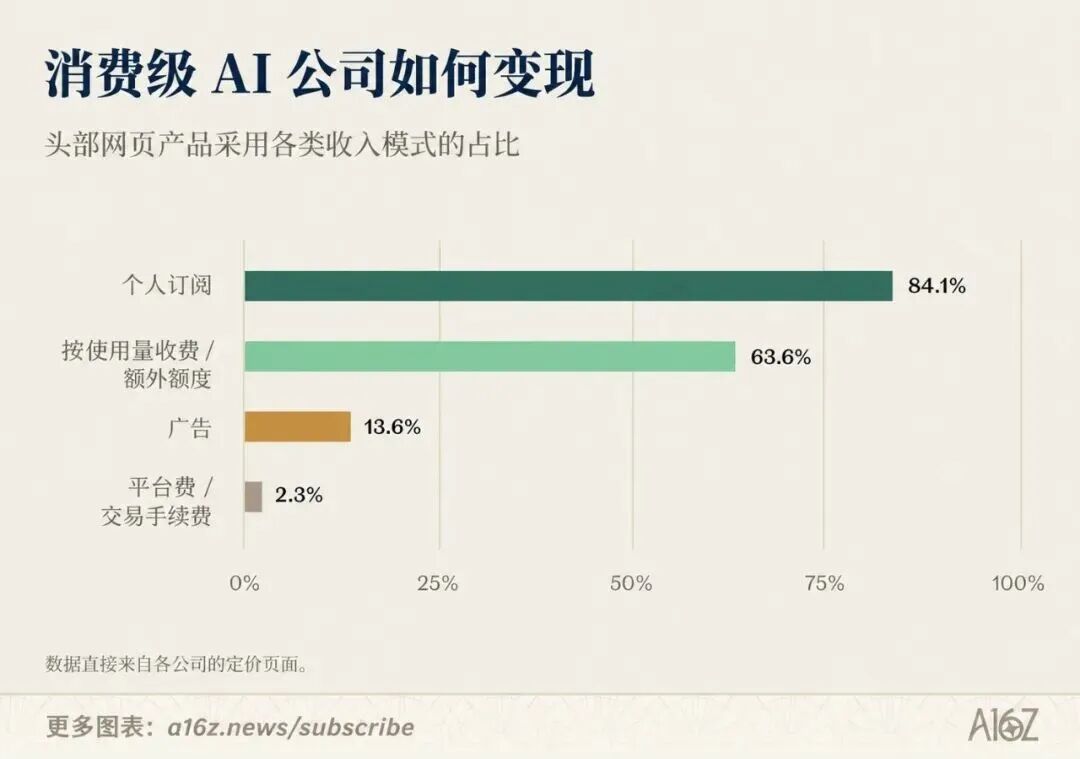
a16z's report also reveals a key statistic: About 85% of revenue from web-based AI products comes from subscriptions, with only 13-14% from advertising.
This means nearly all revenue in the consumer AI space comes from 'direct user payments.'
This logic is entirely different from the pre-internet era of search, social media, and e-commerce, where consumers were indirectly monetized—free usage funded by advertisers.
a16z investment partner Olivia Moore raises a sharp critique: Subscription models may fundamentally not be a business model capable of reaching the mass market.
Her reasoning is persuasive: Google's average annual ad revenue per user is about $460. If AI products could achieve the same level through advertising, the U.S. market alone could generate about $152 billion in annual revenue.
And OpenAI is already testing this approach. As of August 2026, its advertising business has reached an annualized revenue scale of $1 billion. Free and low-tier users see ads, while high-tier subscribers enjoy an ad-free experience—a logic identical to streaming platforms' 'tiered memberships.'
In this frenzy, some who believe 'free means no cost' are being eroded.
The beneficiaries are the super users. Those spending $903 per month on a stack of AI tools are using them to replace outsourcing teams, compress labor costs, and amplify personal productivity. For them, AI is not consumption but investment.
Those being eroded are the 'believers in free.' They trade data for convenience and attention for services. When conversations are used for model training, when ads infiltrate every interaction, when free-tier models are gradually downgraded...
They realize that the cost of 'free' is actually 'being commoditized.' In the ruthless internet era, if you do not pay for a product, you are the product.
The most awkward are the 'median payers.' Spending $25 per month on one or two AI tools, they neither receive the productivity returns of super users nor enjoy the zero-cost benefits of free users. Stuck in the middle, they are neither deeply engaged nor saving money.

Looking back at this a16z ranking, a clear conclusion emerges:
The current consumer AI market is essentially a professional tools market. Its core users are developers, designers, content creators, and automation enthusiasts—those who can embed AI into workflows and directly generate economic value from it.
For them, monthly subscription fees ranging from tens to hundreds of dollars are reasonable because AI helps them earn far more in return.
But the ceiling of this market is also evident. When subscription fees act as a paywall, keeping out the vast majority of ordinary users, AI remains stuck in the 'professional tools' niche.
The true era of AI for everyone will not be when everyone is paying for AI.
If one day, AI integrates into daily life as seamlessly as electricity and water—when you do not need to think about 'whether to renew this month' or worry about the free version losing features again...
Only then will AI truly achieve universal 'adoption' and recognition.
In fact, a16z's report already hints at the direction: When traffic and revenue rankings are severely disconnected, when 29 high-revenue products cannot even make it onto traffic rankings, it shows that the current AI consumption market is far from 'universal.' It remains an efficient toolbox for a small group.
Only by breaking through that paywall will AI truly begin to change the world.
-
![]()
Xpeng Unveils 'Xpeng Youyou': Chinese Automakers Accelerate into Robotaxi Era
-
![]()
Dongchedi Tests Zunjie V800: Brake Pedal Fractures in Three Cars—Is This a Design Flaw?
-
![]()
Huawei's HarmonyOS Aims for Global Market Competition
-
![]()
DeepSeek Reportedly Raises 80 Billion in Latest Funding Round, Preparing for IPO
-
![]()
Global AI Consumption Survey: Only 1% of Super Users Are Supporting the AI Ecosystem
-
![]()
Does Meeting Standards Equal Safety? Is the Baseline the Upper Limit? Does Passing Inspection Mean Peace of Mind?丨When Brakes Fail Even While Speeding
-
![]()
AI Home Appliances Shine During Golden Week
-
![]()
Muse Goes Viral: Who Will Be China's Version of Muse?