Qianwen GO: Beyond Just Being Alibaba’s Shopping Assistant
 10/14 2026
 429
429
Free Agents Target Merchants’ Profits
Author|Xinjian
Editor|Xiaobai
Illustrations|AI-Generated
Produced by|Qiangdiao Next
This year’s Double 11 shopping festival highlights yet another avenue for AI integration.
On October 13, Alibaba’s personal AI agent, Qianwen Go, opened applications for user trials. During the gray-scale testing phase, users engaged in tasks such as inquiring about and scheduling car maintenance and negotiating flight delay compensation with customer service via ticket booking platforms. Despite the compensation amounting to just a few dozen yuan, these tasks extended beyond the mere purchase of goods or booking of flights.
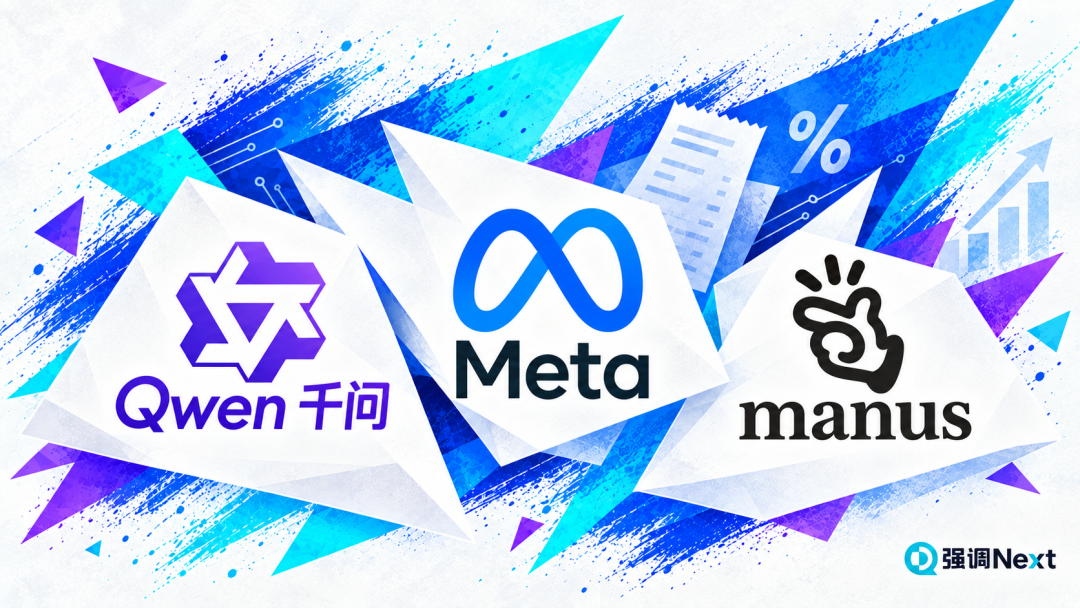
In the past month, ByteDance has accelerated the development of its personal AI agent project, Spell, integrated with Doubao, while Tencent has launched its cloud-based personal assistant, LightVela, currently in the developer experience phase. Abroad, Meta has expanded Muse from handling personal affairs to managing small businesses, while Manus has started separating model costs from its execution service fees.
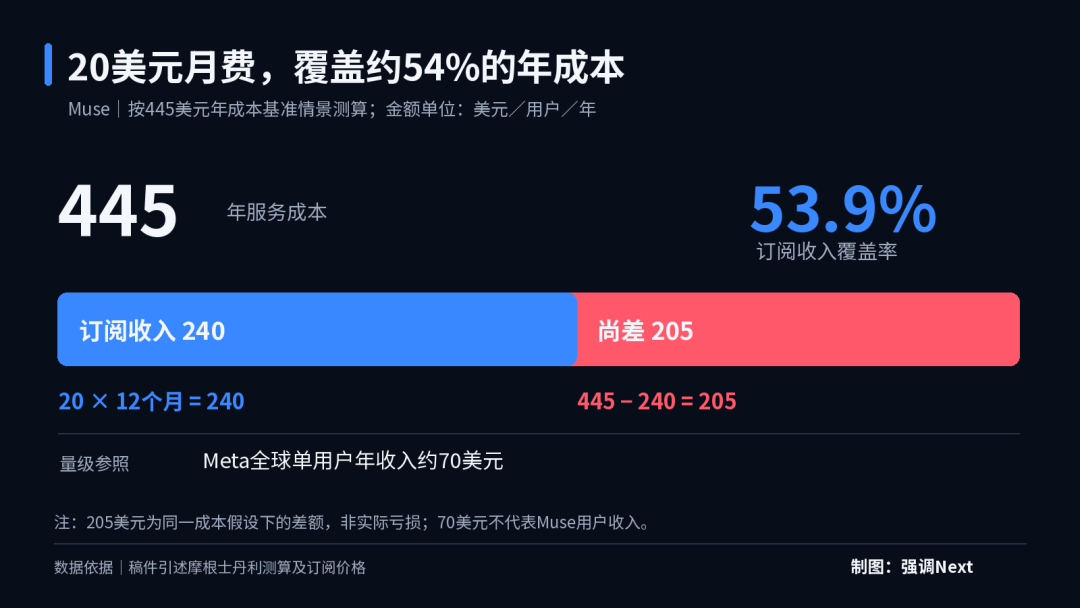
While companies are eager to showcase AI capabilities, Morgan Stanley’s calculations reveal a stark reality: under baseline assumptions, Meta spends $445 annually to serve each Muse user, yet earns an average of only about $70 per user globally each year.
Demonstrating capabilities is straightforward; recovering costs is challenging.
Companies with transaction platforms can bolster their agents with new orders, while those without must choose between charging users or merchants. The challenge arises when a service benefits users but does not drive transactions—or even reduces profits for partner platforms. How much execution cost are agents willing to shoulder?
Alibaba can forgo subscription fees but cannot afford stagnant growth.
The two types of tasks in Qianwen Go’s testing phase generate revenue differently.
Taobao’s price protection feature has established entry points and platform rules, with refunds primarily involving completing existing processes for users. Cross-platform flight compensation involves checking orders, verifying situations, contacting customer service, and negotiating solutions. The former relies on Alibaba’s internal transaction system, while the latter requires external platforms to allow the agent to act.
Alibaba’s strength lies in its extensive transaction capabilities already integrated within the group. On May 11, Alibaba granted Qianwen access to the complete catalogs of over 4 billion products on Taobao and Tmall, along with order, logistics, and after-sales capabilities. Qianwen doesn’t need to simulate operations page by page to find products, check orders, or handle after-sales. It has also expanded outward: on April 23, it integrated with China Eastern Airlines for ticket search, purchase, seat selection, and check-in, which Alibaba hailed as its first open Agent capability to external partners.
These infrastructures provide Alibaba with a pricing advantage that independent agents struggle to achieve. Even if Qianwen doesn’t charge users, it can potentially recover investments through increased transactions, reduced customer service costs, or improved repurchase rates. Independent products cannot count others' transaction profits as their own.
However, internal traffic guidance has its pitfalls. Redirecting transactions for products users would have bought anyway does not increase group revenue when channeled through Qianwen; if shopping guidance and after-sales efficiency improve, value can still be created. Alibaba needs to deduct new reasoning and execution expenses to calculate net gains, rather than attributing all transactions passing through Qianwen as AI-created.
Alibaba can subsidize users but cannot prop up a stagnant business.
More challenging than costs is the recommendation logic. When cheaper or more suitable options exist outside the group, how should Qianwen choose? The more it resembles a personal assistant, the more it needs to explain why it selected a particular option for the user; the more it resembles a transaction platform, the greater its incentive to prioritize its own supply.
Thus, while the ecosystem lowers Qianwen’s execution costs, it also increases the cost of proving recommendation credibility. Ultimately, Alibaba must demonstrate not just how many platforms Qianwen can connect to but also its ability to fulfill demands outside the group and how commercial partnerships influence recommendations.
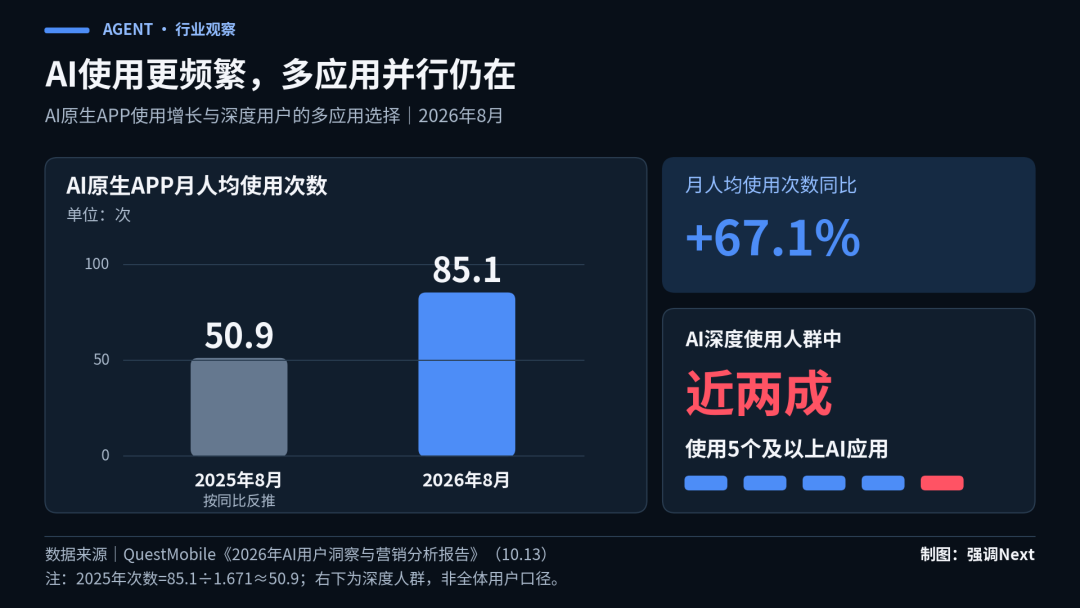
Users show no inclination to rely on just one AI. QuestMobile’s latest report reveals that in August, the average monthly usage of AI-native apps reached 85.1 times per user, a 67.1% year-on-year increase; nearly 20% of power users engaged with five or more AI applications. While this data covers broad AI applications, it at least shows that deep and wide usage can coexist.
Alibaba’s service access advantages can help Qianwen scale, but its sustainability would be severely compromised if it could only find answers within Alibaba’s inventory.
For third-party service platforms like Ctrip and Meituan, the pressure lies in redefining service value. If AI can cross-platform inquire, filter, and combine options, some service revenue previously derived from information organization and convenience will face pressure. Exclusive inventory, negotiated prices, and fulfillment guarantees will still hold value, but the mere act of presenting information together will inevitably decline in worth.
Meta Wants to Shift Acquisition Costs Toward Transactions
Companies without transaction-based cost recovery need to calculate their finances carefully.
Muse launched on September 8, surpassing 5 million downloads in 22 days (estimated by Sensor Tower in the U.S. and Canada), at one point accounting for half of Meta's own ad inventory exposure—meaning Meta used its highest-efficiency monetization resource to drive traffic to Muse.
Morgan Stanley’s October 12 cost model revealed the magnitude of the revenue gap. Muse costs $445 per user annually, with the bulk going toward a dedicated cloud computer for each user. Meanwhile, Meta earns about $70 per user globally per year, making the former more than six times the latter.
Subscriptions cannot bridge this gap. Muse offers $20 and $100 subscription tiers. At $20 per year, users cover only 54% of costs; the $100 tier suffices but remains niche.
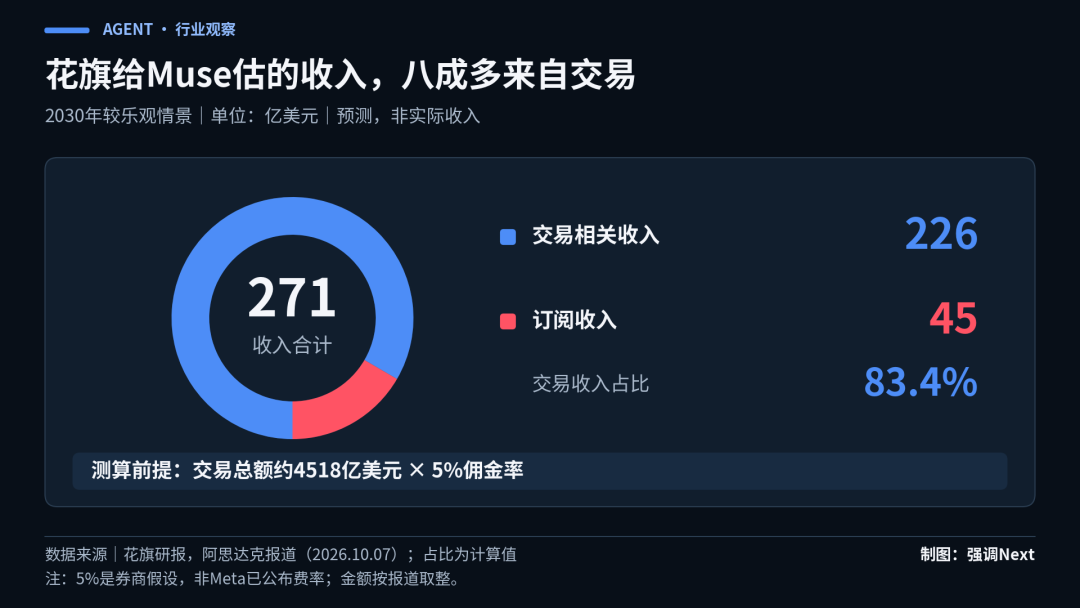
However, this is more of a short-term pressure, as Meta’s real revenue hopes lie with merchants. Citi predicts Muse will generate over $27 billion in revenue by 2030, with about $23 billion from transaction-related income and commissions accounting for over 80%.
Meta CEO Mark Zuckerberg mentioned charging small fees for transactions, though the rate remains unspecified. Morgan Stanley envisions a format similar to ad bidding, where businesses compete in real-time to pay for transactions completed by agents, with implementation potentially starting by late 2027. This, in a sense, extends search bidding ads, albeit with fewer competing ad slots.
Citigroup's optimistic scenario projects Muse could generate about $27.1 billion in revenue by 2030: approximately $22.6 billion from transactions and $4.5 billion from subscriptions. Transaction revenue would account for 83.4%, based on about $451.8 billion in total transaction volume and a 5% commission assumption.
Meta’s simultaneous entry into merchant management backends complicates matters further. In late September, Meta launched Muse for Small Business, integrating with tools like Shopify and Stripe to analyze data and draft promotion plans for merchants. Meta aims not just to sell ads to merchants but to become their advisor before they spend.
Service providers are not monolithic. On September 20, Amazon cut off Muse’s purchasing access; three days later, Meta announced partnerships with retailers like Walmart, Best Buy, and Sephora; on October 6, Walmart reappeared on Meta's Personal Agent Protocol partner list led by Sierra.
Amazon resorts to blocking, while Walmart participates in rule-setting. Morgan Stanley interprets these blockades as negotiation tactics: merchant record rights, Prime benefits, and retail media revenues could be bypassed if agents handle orders.
Muse’s supplementary terms clarify: users bear full responsibility for all actions and transactions executed by Muse, including financial losses; Meta and users do not constitute an agency or fiduciary relationship; liability is capped at the higher of $250 or fees paid by the user in the past 12 months.
This agent, which plans to charge merchants, first legally disclaims any obligation to "secure optimal outcomes for users."
Meta also promises not to use conversation data for ad targeting but remains silent on recommendation order. Selling ads while helping merchants review ad spending raises an interesting question: would Muse dare to advise clients to buy fewer Meta ads when necessary?
Manus Must Sell the Value of Execution Itself
While tech giants can leverage existing customer and transaction relationships, Manus lacks such assets and must itemize bills for users to justify revenue clearly.
On September 29, Manus Flex allowed users to bring their own API keys from model providers, with model inference costs paid directly to model companies, while other services continued to consume Manus credits.
Since users already pay for inference, Manus must justify its fees through planning, execution, operating environments, and ongoing maintenance: what exactly are users buying with their monthly payments?
Only by retaining projects can this revenue last. If users merely generate a document temporarily, they might take the result and leave. Manus 2.0 keeps projects running continuously in the cloud, with running websites and triggered workflows creating modification and maintenance demands. Users can switch models, but project configurations and collaboration habits won’t migrate automatically.
However, the reference price for this layer of charging is being pressured downward.
In September, Microsoft included everyday AI in Copilot subscriptions and charged advanced AI work via Credits; Muse’s small business capabilities offer free and paid tiers in parallel. Independent agents face reference prices based on functionalities already included in clients' existing software.
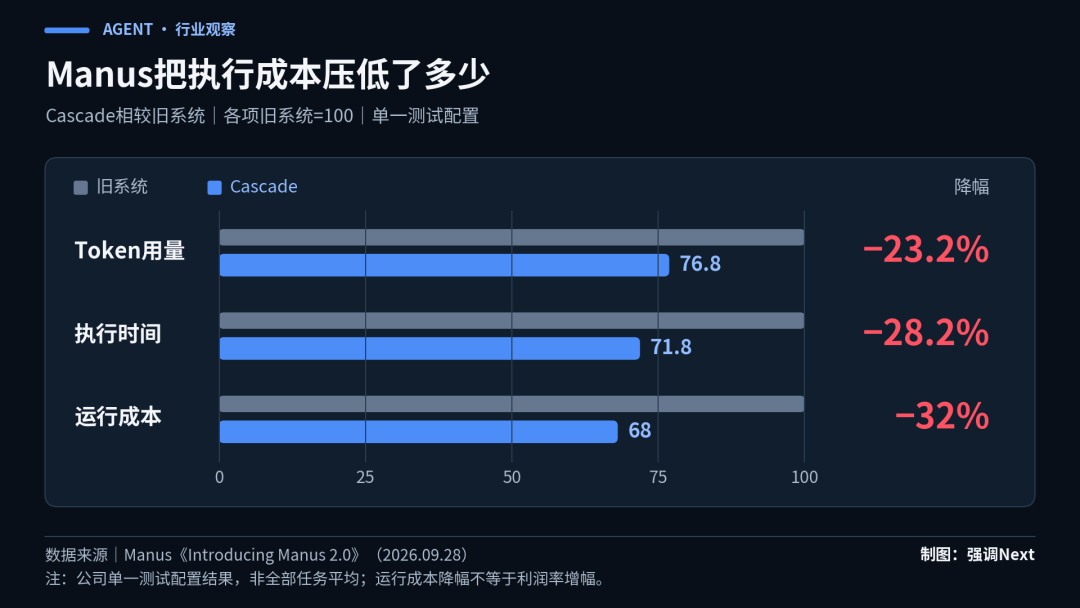
Manus disclosed that under one test configuration, Cascade reduced operational costs by 32% compared to legacy systems. While not an average reduction across all tasks, it demonstrates that application companies can minimize waste beyond model optimization. Tech giants can recoup agent investments through related businesses, but independent products lack this path and must make execution and maintenance services worth repurchasing.
At this point, the differences among the three agent types become clear.
Alibaba recovers investments through increased transactions and cost reductions, provided orders are truly incremental; Meta’s $445 per-user gap must be filled by merchants, likely through transaction bidding that may only materialize after 2027; Manus has no retreat and must justify charges solely through execution and maintenance.
This is also the test for Qianwen Go: incremental revenue or cost savings must sufficiently cover new expenses. An order processed by AI should not automatically count as an AI-created order.
More noteworthy is the agents' consensus on another issue.
Ant Group's agent payments have exceeded 300 million transactions, with "You Dare Pay, I Dare Compensate" referring mainly to unauthorized use, as explained by its security head; disputes over incorrectly chosen authorized items fall under transaction disputes. Muse’s terms cap liability at $250.
While the charging party changes, the principle of "users bear errors within authorization" remains unchanged.
It took nearly two decades for search engines to formalize rules distinguishing paid and organic results. Personal agents, skipping display and acting directly for users, still operate under industry rules stuck at v0.1, with payment listed as unresolved. Before rules are codified, users entrusting AI with money and tasks can only rely on platforms' terms for safeguards.
Free agents must ultimately prove not just their ability to secure transactions for users but also their willingness to act on users' behalf when no transaction occurs.
If revenue primarily comes from sales, sustaining help with returns, cancellations, and cost savings requires alternative income streams. Qianwen Go’s several tens of yuan refund demonstrates execution results once but has yet to prove how such services will persist under varying prices, authorizations, and liability arrangements.
Note: Data in this article comes from public sources and does not constitute investment advice.
- END -
-
![]()
Alibaba, ByteDance, and META Are Fully Committed! Personal Agents Are on the Rise, and Only Those with Robust Models Can Compete
-
![]()
Memory Price Hike Triggers Aftershocks: Ultra Models Axed One by One, Making Flagship Phones a Tougher Sell
-
![]()
Yiwu: Emerging as the Shenzhen of Yesteryears
-
![]()
China Scales Back Support: Chinese Automakers Embark on Global Journey, Tesla Feels the Heat
-
![]()
Qianwen GO: Beyond Just Being Alibaba’s Shopping Assistant
-
Lei Jun Faces Immense Pressure as Xiaomi Phones Witness Largest Sales Decline for Three Straight Quarters!
-
![]()
September Sales Rankings for Boxy Cars: Warship 700 Secures Tens of Thousands of Pre-orders! Shenlan G318 at 99 Units, Xiangjie G9 at 234 Units? | Mingjing Pro
-
![]()
XPENG Motors had 33,752 vehicles insured in September, with Mona L03 surpassing 12,700 and Mona M03 exceeding 7,000!