Apple, the 'Latecomer,' Initiates Limited AI Rollout
 10/21 2026
 347

Apple AI for the Chinese Market is Finally on Its Way.
Recently, I observed a small print at the bottom of official press releases and the Apple Intelligence (hereafter referred to as 'Apple AI') product page: Certain AI functions that rely on server-side models will be subject to daily usage limits, with the potential for additional access through paid services in the future.
This marks Apple's initial move to position AI as a limited resource, indicating that after over two years of delays, Apple AI is finally poised for launch. Apple's Executive Chairman Tim Cook recently disclosed that the Chinese version of Apple Intelligence (hereafter referred to as 'Apple AI') will commence testing in late October.
However, he only confirmed the launch of the 'first-generation' Apple AI, with the latest iteration of Siri AI still pending.
Treating Apple AI Like a Supply Chain
Meanwhile, AI giants are collectively slowing down.
Public data reveals that Microsoft canceled data center leases with capacities of hundreds of megawatts; Meta laid off approximately 8,000 employees in the first half of the year; at Anthropic's Investor Day on October 14, attendees reported that its latest valuation stood at $1.5 trillion, a 25% decrease from its previous peak of $2 trillion.
The underlying cause is an oversupply of AI. Markets and investors are genuinely concerned that some tech companies have overextended themselves with debt to finance AI infrastructure.
S&P estimates that six major U.S. hyperscale cloud providers—Amazon, Microsoft, Alphabet, Oracle, Meta, and SpaceX—will collectively spend over $7 trillion on data centers and other AI-related capital expenditures from 2025 to 2030, remaining in negative free cash flow until at least next year.
Over the past two years, the valuation logic for AI has been driven by the belief that 'investment equals faith': The more companies invested in GPUs and data centers, the higher their valuations in capital markets.
However, with rising financing costs and unsustainable revenue growth, market sentiment has shifted from who can burn cash to who can generate profits and maintain stable cash flow.
Apple, often criticized as an 'AI latecomer,' appears to have turned its tardiness into an advantage, reaping unexpected benefits. Its annual AI-related expenditures are estimated at $11-13 billion, in stark contrast to competitors' capital expenditures that exceed $100 billion each.
Some analysts argue that due to its relatively modest AI capital spending, Apple has been perceived as a 'safe-haven asset' amid tech stock sell-offs. Strong demand for its first foldable smartphone further boosts investor confidence.
This has propelled its stock price up by about 25% in 2026, with its market cap nearing $5 trillion, just $148 billion behind Nvidia. In contrast, other members of the 'Magnificent Seven' have experienced mixed stock performances, with Tesla, Microsoft, and Meta still declining year-to-date.
While competitors focus on AI infrastructure investment, Apple controls AI supply through functional limits, regional restrictions, and even daily usage quotas.
Its most direct approach involves procurement. Over the past decade, Cook has established a robust supply chain system, ensuring at least two suppliers for every component, deepening partnerships to guarantee stable supply, reduce inventory, and maintain bargaining power.
Apple applies the same supply chain expertise to manage its 'AI brain,' setting specifications and managing deliveries for model providers.
Google is at the forefront of Apple's AI supplier list. At WWDC26, Apple unveiled five third-generation Apple Foundation Models (AFM), with some running locally and others deployed in the cloud.
The most powerful cloud model, Cloud Pro, operates on Google servers powered by NVIDIA chips—marking Apple's first foray into outsourcing AI computing to a third-party cloud.
For the Chinese market, Apple partnered with Alibaba for model capabilities (including Tongyi Wanxiang and Qwen) and Baidu for search and Siri functions.
Take Alibaba as an example: It cleared three hurdles—qualification, adaptation, and boundary compliance—before joining Apple's supply chain. Apple imposes stringent rules on model providers, dictating which apps models can access, what data they can read, and which chips they run on.
However, Apple's supply chain management dictates that core components cannot rely entirely on external procurement. Apple focuses its self-developed efforts on on-device AI. Among the five models, Apple invests most heavily in on-device solutions, treating cloud models as secondary.
For instance, the on-device flagship model AFM 3 Core Advanced boasts 20 billion parameters with a sparse architecture, storing the model in flash memory and activating only a small portion per request.
This flash-for-memory approach cannot be directly replicated by Google or OpenAI, as it requires deep chip integration—Apple's forte.
As a short drama might put it: 'With core components in hand, outsourcing the AI brain feels less risky.'
Limited Supply as a Business Tactic
Apple also recruited Microsoft AI Vice President Amar Subramanya to lead its model business. Subramanya, who spent 16 years at Google and led the Gemini team, exemplifies Apple's strategy: If you can't acquire the best model, hire the people who build them.
As some observers note, Apple AI's competitive edge lies not in computational scale but in its hardware and software ecosystem and user data.
Under Apple's precise segmentation, free and paid experiences differ significantly. Real-time translation, writing tools, and notification summaries run locally without usage limits. However, cloud-dependent functions like photo editing and expansion have usage quotas, requiring payment for excess use.
This follows Apple's longstanding business model: Scarcity drives willingness to pay. For example, iCloud offers 5GB free, charging for more; Apple Music provides three free months before charging $10 monthly.
AI becomes another commodity on the shelf, representing a billion-dollar business opportunity.
Apple's Q1 2026 financial results (ended December 27, 2025) show total revenue of $143.756 billion, with iPhone sales contributing $85.27 billion (nearly 60%) but only 40.7% gross margin. Software services generated $30.01 billion with a 76.5% gross margin.
However, the largest contributor to service revenue—the 'Apple Tax' (App Store commission)—is shrinking due to global pushback against its strict commission rates, leading to policy-driven price caps.
Starting March 15, 2026, China's standard commission dropped from 30% to 25%, with reduced rates for small developers and auto-renewing subscriptions after the first year. The U.S. was even harsher: In April 2025, a court ruled Epic Games' external link commissions at zero in one case.

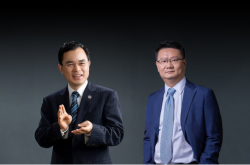
Tim Cook and Johannes Tönnes Image Source: Internet
In my view, selling limited AI adds a new revenue stream to services. This represents a more reliable charging model than the Apple Tax, as selling tokens aligns with AI industry norms, enjoys higher user acceptance, and gives Apple greater pricing flexibility.
Apple is already testing this approach: Apple Creator Studio costs 38 RMB monthly, while Numbers' previously free Magic Fill now charges per use.
As the Chinese Apple AI launch approaches, Cook and Tönnes aim to sell more iPhones and other hardware while rapidly defining AI as a controllable commodity for user devices.
Current progress suggests Apple is 'winning' again. According to tech industry bloggers, the iPhone 18 Pro series sold approximately 4.08 million units from October 5-11, marking the fastest sales growth for a recent Apple flagship launch.
This underscores Apple's enduring influence in the AI era.
Moreover, Apple's 'slow is fast' AI strategy has proven effective amid AI oversupply: By leveraging iPhone sales, even limited AI functionality commands premium pricing.
-
![]()
Apple, the 'Latecomer,' Initiates Limited AI Rollout
-
![]()
Yutong Bus: Selling 2,600 Fewer Units Yet Boosting Gross Profit by 600 Million Yuan, with Overseas Sales Fueling Profit Surge
-
![]()
GM's Q3 2026: Pickup Trucks Mint Money, Buybacks Provide Support, EVs on Pause
-
![]()
Fuel-Powered Vehicles: Shifting to a 'Niche' Role
-
![]()
Pure Electric Vehicles Dominate the RMB100,000 Market, and the Shift from Fuel to Electric is Unstoppable
-
![]()
September's Top 10 MPV Sales: Joint Venture MPV Regains Leadership
-
![]()
MIIT Unveils New Car Lineup: Multiple Series 9 Models Make Their Grand Entrance
-
![]()
Zhu Huarong Steps Down, Zhao Fei Takes the Helm: Changan Automobile Unveils Its 'Two-Phase' Governance Strategy