GM's Q3 2026: Pickup Trucks Mint Money, Buybacks Provide Support, EVs on Pause
 10/21 2026
 329
General Motors released its Q3 2026 financial results: revenue of $50 billion, up 2.9% year-over-year;
Adjusted EBIT of $4.1 billion, up 21.6%;
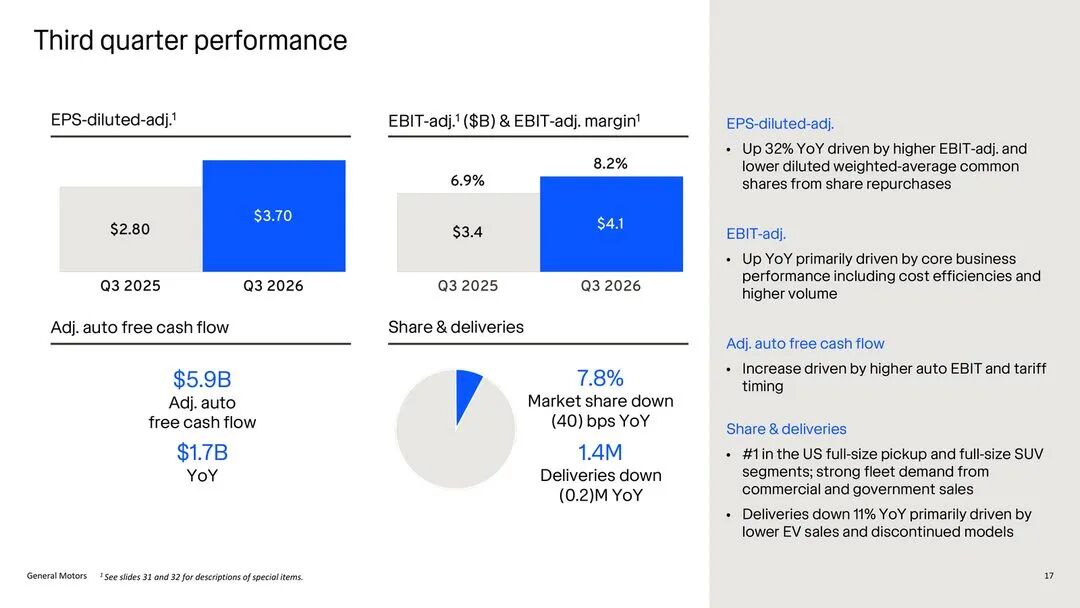
Adjusted earnings per share of $3.70, up 32%;
Quarterly adjusted automotive free cash flow of $5.9 billion, the highest in four years.
Revenue, profit, and cash flow all exceeded Wall Street expectations, leaving Chinese automakers envious. However, GM's stock price still fell by 6-7%.
Moreover, GM disclosed that inflation driven by commodities, logistics, and memory chips was revised upward to around $2 billion. CFO Paul Jacobson stated in a CNBC interview that Q4 would be worse than Q3.
We previously wrote about the 'Ice and Fire' situation of North American auto giants GM and Ford. GM remains in a similar state, now with added revenue and future uncertainties.
North America contributed 87% of the company's adjusted EBIT, with U.S. EV quarterly sales dropping to just 25,000 units, while each vehicle sold by Chinese joint ventures brought GM less than $100 in equity profit.
The company's profit structure increasingly resembles that of a North American pickup and SUV specialist, far from the 'full electrification' vision it outlined a few years ago.
However, today's GM earns money from large North American fuel-powered vehicles and, in a conscientious move, returns profits to shareholders through buybacks.
Below, based on GM's official releases, we analyze Q3 2026: where the generous profits (generous profits) came from, how far the EV strategy has been rolled back, what remains of the China business, and what GM is betting on.
Key Takeaways in One Sentence
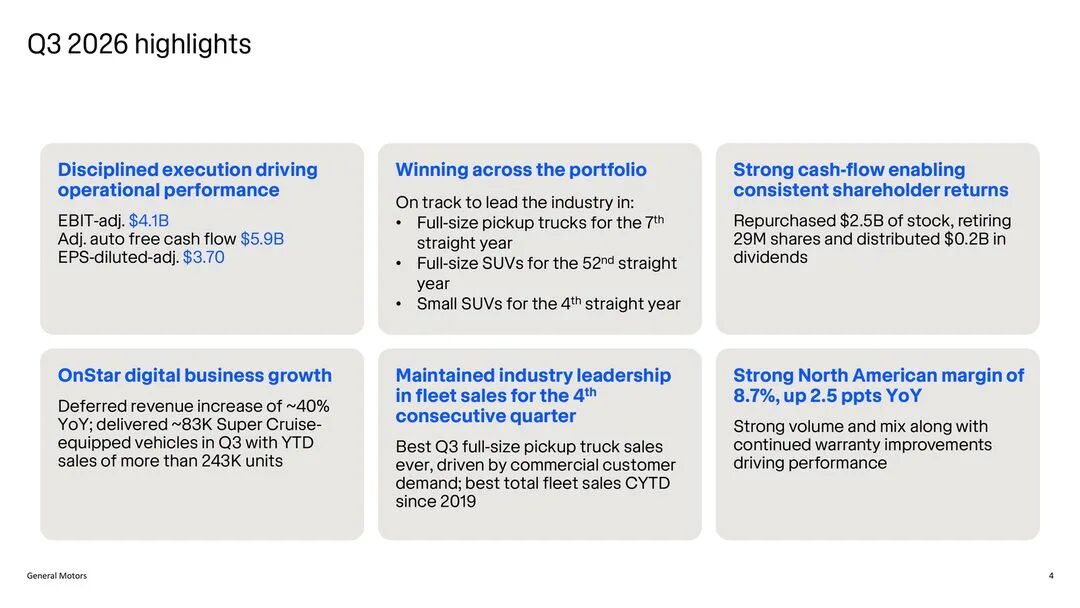
Q3 revenue of $50 billion, adjusted EBIT of $4.1 billion (+21.6%)
Adjusted automotive free cash flow of $5.9 billion, the highest in four years
North America contributed 87% of profits, with only 25,000 U.S. EVs sold
Each vehicle sold by Chinese joint ventures brought GM about $89 in equity profit
New $20 billion buyback approved, full-year profit guidance midpoint unchanged
01 Three Core Numbers
Selling Less, Earning More · Q3 2026 Highlights
Adjusted EBIT reached $4.1 billion, up 21.6% year-over-year, with a profit margin of 8.2%, compared to 6.9% last year.
Free Cash Flow: Adjusted automotive free cash flow was $5.9 billion, up 40% year-over-year, partly due to timing differences in tariff payments.
Global Deliveries: 1.39 million units, down 170,000 units or 11% year-over-year, mainly due to declining EV sales and the discontinuation of some models.
Together, these numbers paint a picture of 'selling less, earning more.'
U.S. sales totaled 671,000 units, down 5.5%, with market share dropping from 16.8% to 16.1%;
Chinese sales totaled 358,000 units, down 23.7%.
Despite declining sales, profits rose by 20%, indicating that earnings came from structural and cost factors rather than scale.
Earnings per share increased by 32%, 10 percentage points higher than the 21.6% increase in adjusted EBIT, largely due to buybacks: diluted shares outstanding fell from 964 million to 887 million, an 8% reduction.
Net income attributable to shareholders was $3.3 billion, more than double last year's $1.3 billion. However, this increase must be viewed in context: Q3 last year included $1.6 billion in EV-related charges, compared to only $240 million this year.
This was a quarter of declining volumes but rising profits, with profit elasticity coming from product mix, warranty costs, and buybacks, rather than sales scale.
02 Where Profits Came From
North American Large Vehicles and Fewer EVs · EBIT-adj Bridge
GM provided a clear breakdown of its profit drivers.
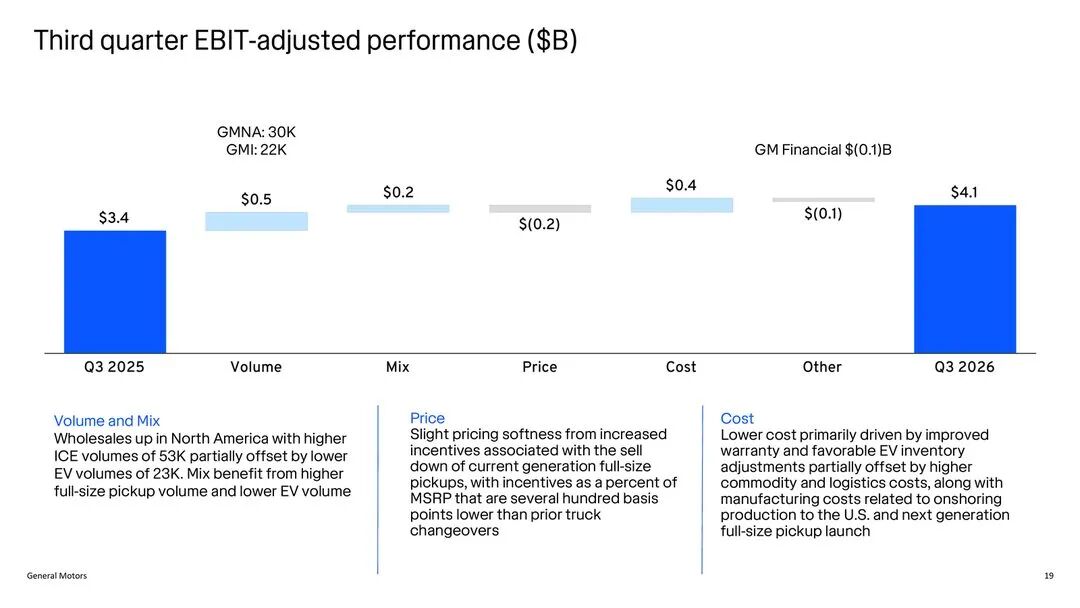
From $3.4 billion last year to $4.1 billion this year: volume contributed $500 million, product mix $200 million, costs $400 million, while pricing dragged by $200 million and other items (including GM Financial) dragged by $100 million.
Within the $500 million volume contribution: North American fuel-powered vehicle wholesale volumes increased by 53,000 units, while EV wholesales decreased by 23,000 units.
In other words, selling one fewer EV and one more pickup truck had a dual positive impact on profits.
The $200 million product mix improvement followed the same logic: more full-size pickups sold, fewer EVs.
The $400 million cost improvement mainly came from lower warranty expenses and favorable EV inventory adjustments, partly offset by higher costs for commodities, logistics, U.S. production reshoring, and new pickup truck launches.
The $200 million pricing drag reflected higher incentives to clear current-generation pickup inventory, though GM emphasized that incentives during this model transition were several hundred basis points lower than previous transitions.
North American operations (GMNA) reported Q3 adjusted EBIT of $3.59 billion, with a profit margin of 8.7%, up 2.5 percentage points year-over-year, accounting for 87% of the company's total adjusted EBIT.
We roughly calculated per-unit profit based on wholesale volumes: in Q3, GM earned about $4,130 per vehicle wholesaled in North America, compared to about $2,980 last year, a nearly 40% increase in one year.
Best-selling models were concentrated:
Light-duty pickup sales rose 9%, with the Chevrolet Silverado Light Duty selling over 100,000 units, up 13%;
Entry-level small SUVs like the Trax and Envista set quarterly sales records, up 27%;
Fleet sales rose 10%, maintaining industry leadership.
Fleet orders generally yield lower margins than retail sales. In Q3, fleet sales accounted for 19.2% of total sales, up from 16.7% last year—a trend worth monitoring.
A gap remained between wholesale and retail volumes: North American wholesales reached 870,000 units, up 3.6% year-over-year, while U.S. retail sales fell 5.5%, with dealer inventory rising from 511,000 units at the end of Q2 to 568,000 units.
GM stated it would return to a 50-60-day inventory target by year-end, but inventory building ahead of new pickup launches raises questions about whether Q4 incentives can be maintained—answers will come in the next earnings report.
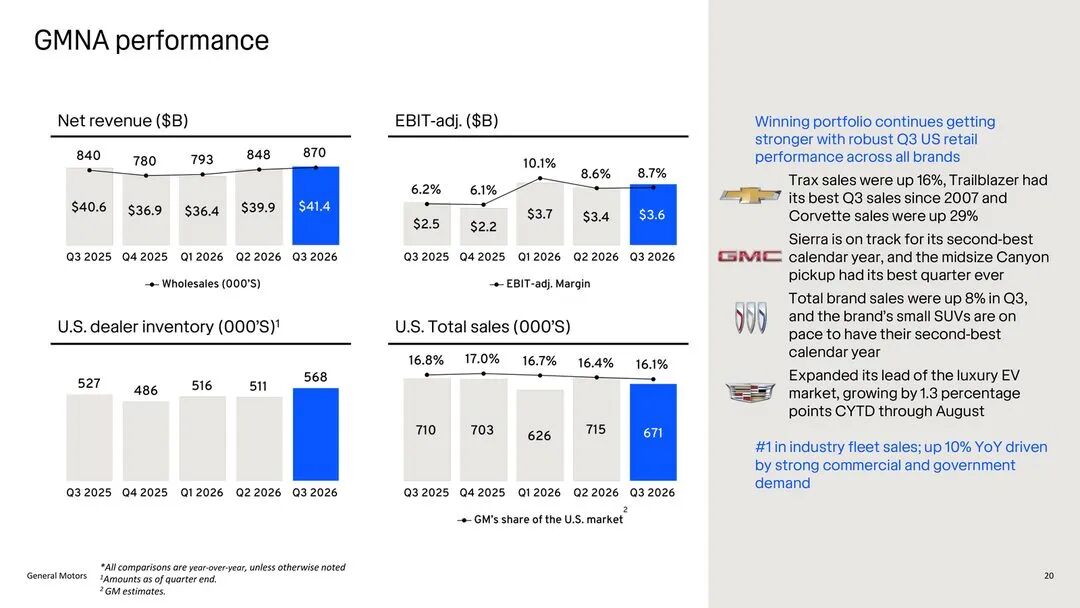
GMNA's revenue, adjusted EBIT, and profit margin over the past five quarters, U.S. dealer inventory, U.S. sales, and market share. Source: GM Q3 2026 Earnings Deck, Page 20
Another pillar supporting North American profitability was reduced discounting.
In Q3, GM's incentives accounted for just 4.8% of suggested retail prices, compared to the industry average of 6.6% and nearly 12% at the highest competitor (Stellantis?).
The average transaction price was $52,000, roughly RMB 370,000 at an exchange rate of $1 = RMB 7.1.
Viewing this amid successive price cuts by Chinese automakers evokes mixed feelings: GM has maintained profits over the past three years by controlling inventory and reducing discounts, the opposite of China's price-for-market-share approach.
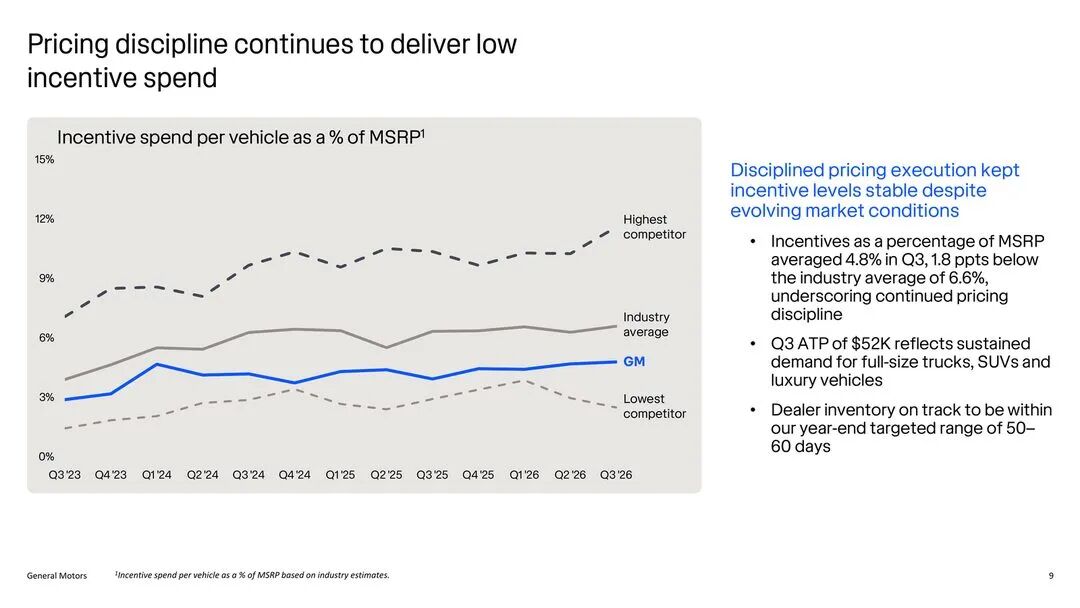
GM's North American profit formula is simple: reduce discounts, sell more large vehicles, and exclude EV losses from financial statements.
03 EVs on Pause
The Books Are Mostly Closed, and Vehicles Are Barely Sold · EV Charges
One year after the removal of U.S. federal EV purchase incentives, GM sold only 25,473 EVs in the U.S. in Q3, down 62% from 66,501 units last year, accounting for 3.8% of GM's U.S. sales (9.4% last year).
The once-best-selling Equinox EV sold just 1,905 units, down 92%.
Nearly half of remaining EV sales came from Cadillac, with four models totaling 12,358 units.
On the financial side, GM used the term 'substantially complete.'
From H2 2025 through Q3 this year, GM has recognized $11.2 billion in EV-related charges, including $7.4 billion in cash expenditures. By the end of Q3, $4.6 billion had been paid, with about $1 billion more expected in Q4 and the remaining $1.8 billion deferred to 2027.
Q3 saw only $240 million in new EV-related charges, mainly for downsizing battery supply chains with joint venture partner LG Energy Solution.
The Ultium Cells JV with LG Energy Solution, which contributed $213 million in equity income to GM in Q3 last year, was now deemed 'immaterial.'
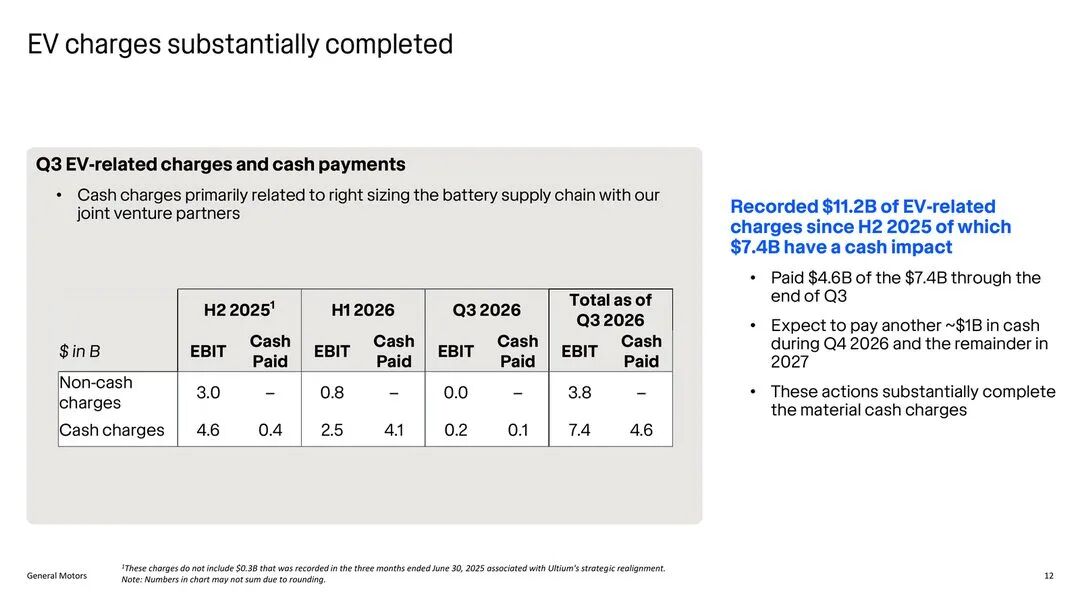
Ironically, EV contraction became one of this year's profit sources.
GM's full-year guidance includes $1-1.5 billion in EV loss improvements. The Orion plant, originally planned for electric pickup production, has switched to fuel-powered vehicles, with management stating in Q2 that Cadillac Escalade production would shift to Orion in Q4.
Technically, GM has not abandoned EVs. Mary Barra mentioned lithium-manganese-rich (LMR) batteries in her shareholder letter, with management previously stating that Mass production verification of battery cells (mass-production-validated cells) would be developed at its in-house cell centers by 2027-2028, with mass production before 2030.
For GM, EVs have shifted from a growth narrative to a loss-reduction project. Financially, this is sound, but the pace of next-generation technology now depends on U.S. policies and competitors.
04 Software as the Second Curve
OnStar and Super Cruise, Still Small · Digital Business
If there's a line item in the earnings report that resembles a tech company, it's OnStar's deferred revenue.
Deferred revenue reached $6.8 billion at Q3-end, up about 40% year-over-year; current-quarter recognized revenue exceeded $800 million, up 15%.
Super Cruise advanced driving assistance revenue rose about 60%, with a full-year target of around $400 million;
About 83,000 new vehicles were equipped with Super Cruise in Q3, exceeding 243,000 in the first three quarters, with subscription users expected to surpass 850,000 by year-end.
After the three-year free trial ends, 30-40% of owners continue to pay for the service.
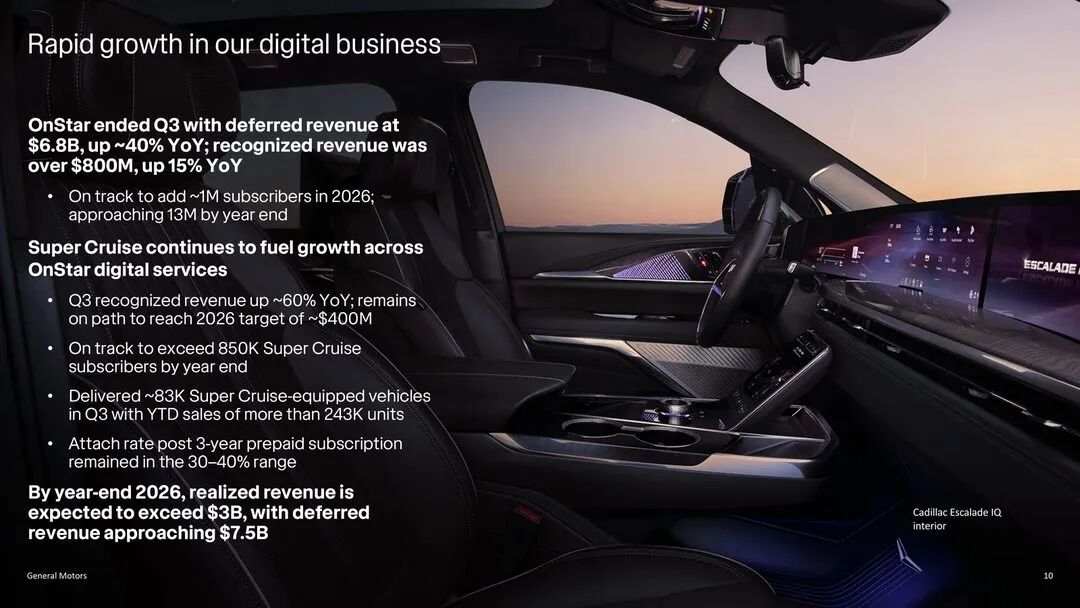
Next year's plans are detailed in the shareholder letter: Super Cruise will become standard on high-trim Silverado and Sierra models, optional on most other trims, with GM expecting Super Cruise penetration in pickups to increase 4-5x;
The 2028 Cadillac Escalade IQ will offer eyes-off driving on highways.
However, scale remains limited.
Full-year digital business recognized revenue is expected to exceed $3 billion, but this segment accounted for less than 2% of GM's Q3 revenue.
For comparison: most Chinese automakers include urban NOA as standard or even offer it for free, with management admitting in Q2 that China's intelligent driving price competition is 'unsustainable.'
The willingness of U.S. users to pay monthly fees for advanced driving assistance is a key variable in GM's software story.
Deferred revenue is GM's most tech-like line item, but at less than 2% of revenue, it cannot yet support valuation—only the narrative.
05 China: Just Surviving
Thin JV Profits, Momenta Stake Becomes a Variable · GM China JV
GM delivered 358,000 vehicles in China in Q3, down 23.7% year-over-year.
By GM's industry definition, the Chinese market contracted 22% year-over-year, so GM's market share only dipped slightly from 6.8% to 6.6%.
By joint venture: SAIC-GM sold 90,000 units, down 31%; SAIC-GM-Wuling sold 269,000 units, down 21%.
New energy vehicles accounted for over 60% of sales, a quarterly record.
Joint ventures have remained profitable for eight consecutive quarters, a result of the late-2024 restructuring.
However, profits are thin: Q3 equity income from Chinese JVs was just $32 million, down from $80 million last year.
We roughly calculated that GM earned about $89 in equity profit per vehicle sold in China, equivalent to around RMB 600.
Nine-month equity income totaled $280 million, up slightly year-over-year but far from the $2 billion annual peak in the mid-2010s.
Jacobson was candid at the J.P. Morgan conference in August: China may not return to $2 billion annually, and self-sufficiency post-restructuring is sufficient.
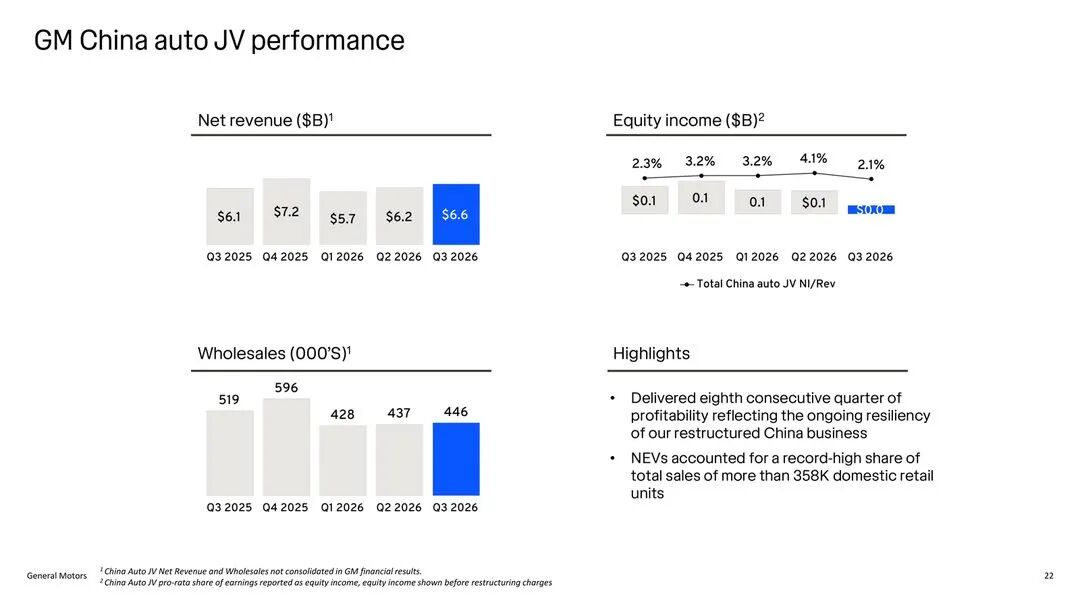
GM China JV's net income, wholesale volumes, and equity income over the past five quarters (JV data not consolidated)
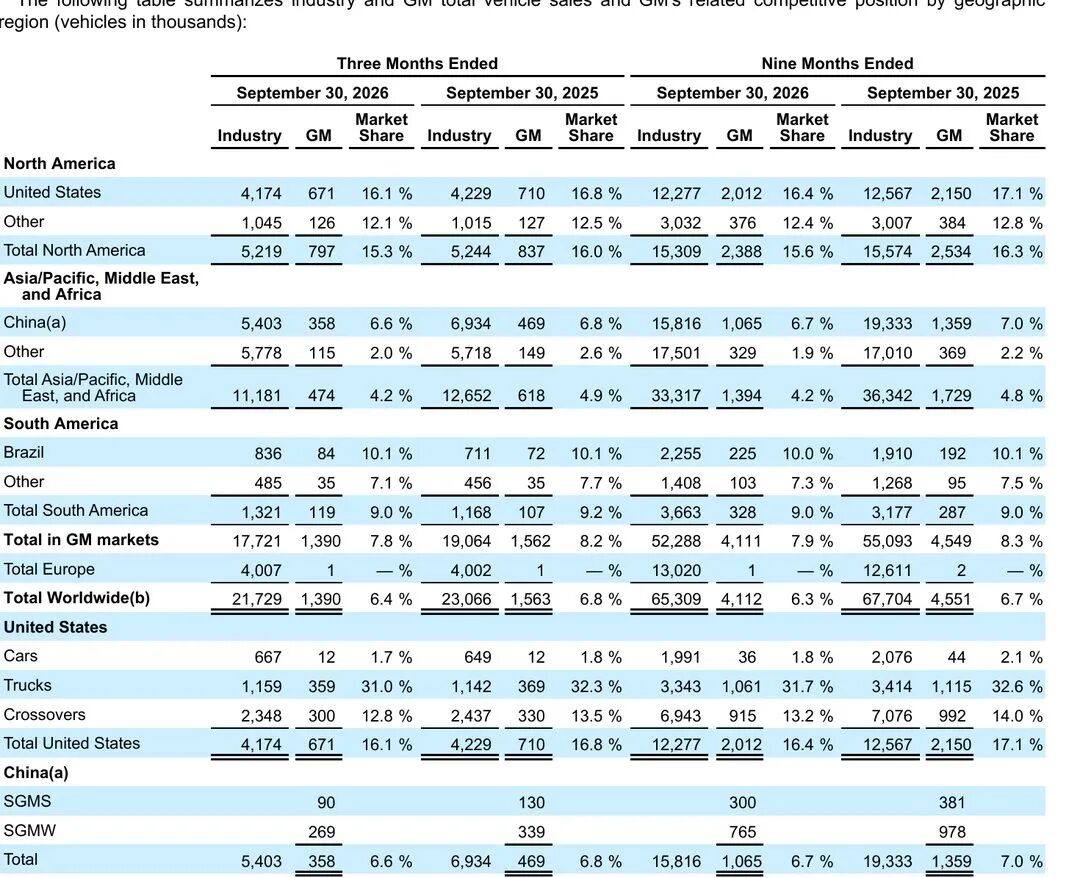
Regional industry sales, along with General Motors' deliveries and market share, including breakdowns for SAIC-GM and SAIC-GM-Wuling (in thousands of vehicles).
In terms of models, those that dominate are mostly new energy vehicles and China-exclusive models.
The Buick GL8 family delivered over 22,000 units in the third quarter, while the Buick E7 plug-in hybrid exceeded 13,000 units.
For Wuling, the Starlight L plug-in hybrid sold nearly 19,000 units, the Binuo series over 57,000 units, and the Hongguang MINI EV over 34,000 units.
The Cadillac XT5 plug-in hybrid, launched in September, utilizes Momenta's R7 world model intelligent driving solution.
Speaking of Momenta, there is a detail in the third-quarter financial report.
The EBIT-adj for General Motors International (GMI) dropped from $226 million to $28 million, with one of the reasons cited by GM being the "negative fair value adjustment" from its investment in Momenta.
Momenta went public on the Hong Kong Stock Exchange on July 8th of this year. According to post-IPO equity disclosures, GM holds approximately 8.58% of the shares, making it one of Momenta's largest external shareholders.
After the IPO, this equity stake is valued at market price. Every time Momenta's stock price rises or falls, GM's international business profits fluctuate accordingly.
Excluding the $32 million equity earnings from its Chinese joint ventures, GMI actually incurred a slight loss in the third quarter.
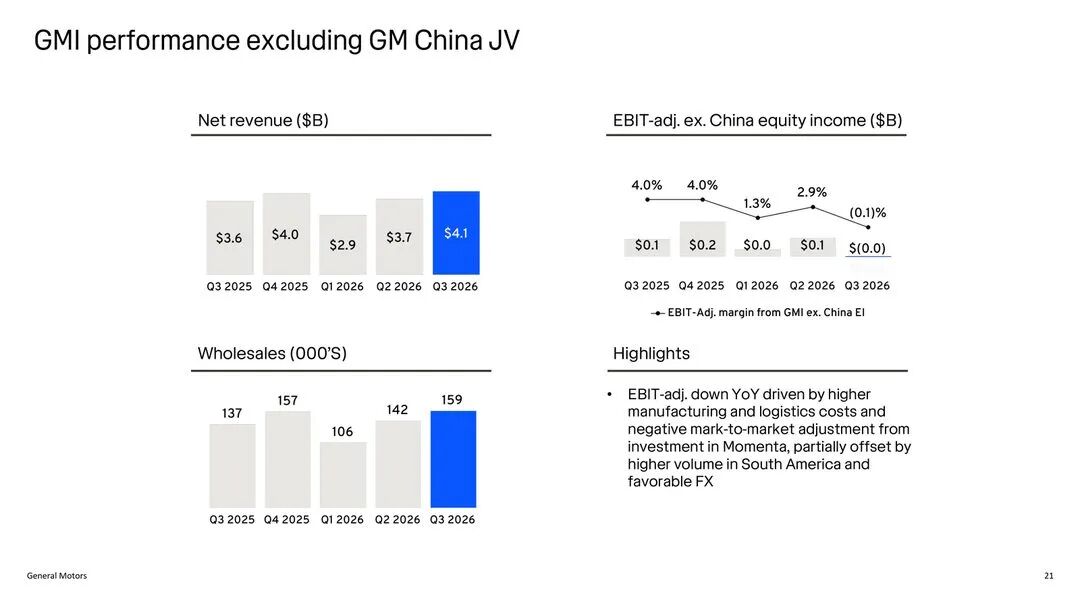
GMI's revenue, wholesale volume, and EBIT-adj, excluding Chinese joint ventures, were dragged down by Momenta's fair value adjustment in the third quarter.
China has transformed from a cash cow for GM to an asset that no longer drags down its performance. The most flexible asset GM has in China might be the stock of a Chinese intelligent driving company.
06 Distributing Cash to Shareholders, Leaving Pressure for Next Year
Repurchases and Full-Year Guidance · Capital return & guidance
GM's capital allocation strategy can be summed up in one sentence: a significant portion of the cash earned is used for share repurchases.
In the third quarter, $2.5 billion was spent on repurchases, with 29 million shares retired.
In the first three quarters, $5.3 billion was spent on repurchases, and an additional $1 billion was spent in October. The $6 billion repurchase plan announced at the beginning of the year has been fully utilized, and the board has approved a new $20 billion plan.
Since 2015, GM has repurchased a cumulative $42.7 billion worth of shares, reducing its outstanding shares from 1.543 billion to 849 million, a decrease of 45%.
At the end of the third quarter, the automotive business had $23.1 billion in cash, well above GM's self-set average target of $18 billion.
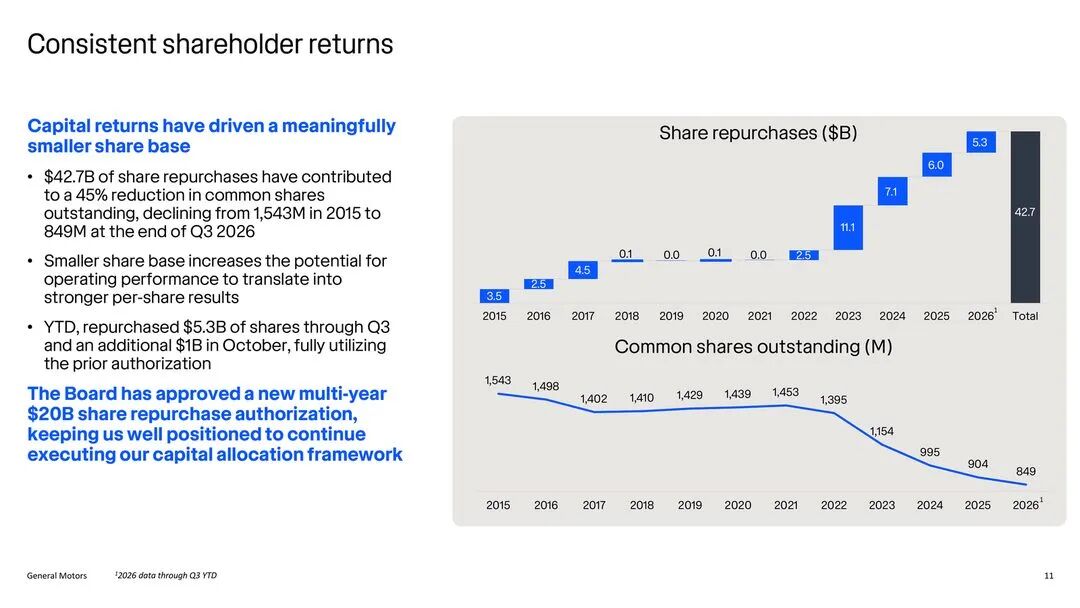
Annual repurchase amounts and outstanding shares since 2015 (data for 2026 covers the first three quarters).
Regarding guidance, changes are concentrated on several assumptions. The full-year U.S. new vehicle sales forecast has been revised upward from the low end of 16 million units to the midrange.
Warranty cost savings are expected to be at the high end of the $1 billion to $1.5 billion range. Tariff-related gross costs are projected to be at the low end of the $2.5 billion to $3.5 billion range.
The bad news is that inflation for commodities, logistics, and memory chips has been revised upward by about $2 billion, while emissions regulation-related benefits have been revised downward from a maximum of $750 million to about $500 million.
Balancing the good and bad news, the median profit guidance remains unchanged, while the free cash flow guidance has been revised upward by $2 billion.
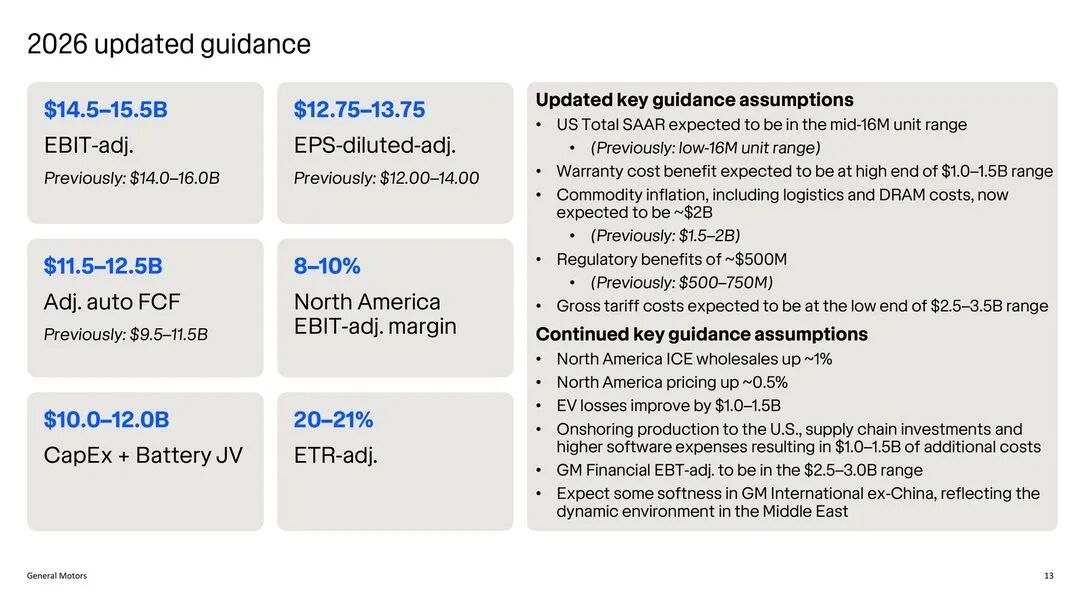
Updated full-year guidance and key assumptions for 2026.
By subtracting the actual results of the first three quarters from the full-year guidance, we can infer the expected performance for the fourth quarter.
EBIT-adj for the first three quarters has already reached $12.3 billion, implying $2.2 billion to $3.2 billion for the fourth quarter, compared to $4.1 billion in the third quarter and $2.8 billion in the fourth quarter of last year.
The free cash flow is even more telling. With $12.2 billion already generated in the first three quarters and a full-year guidance of $11.5 billion to $12.5 billion, the fourth quarter implies a range of negative $700 million to positive $300 million, effectively zero.
Management has actually mentioned the reasons: the third-quarter cash flow benefited from timing differences in tariff payments, which will reverse in the fourth quarter.
The new pickup truck replacement will lead to a sales decline of about 35,000 units in the fourth quarter, as mentioned in the second-quarter earnings call.
The cost of transitioning the Cadillac Escalade to Orion production is concentrated in the fourth quarter. Additionally, about $1 billion in cash expenditures related to electric vehicles remains to be paid.
Jacobson told CNBC that maintaining guidance amid end-of-year inflationary pressures demonstrates strong execution by the team.
He also noted that vehicle prices are currently stable, and next year's pricing strategy will depend on consumer affordability, considering whether to raise prices more than usual.
Thus, GM's profit expansion in previous quarters was largely built on stable prices and declining costs. If costs continue to rise and prices dare not increase next year, profit margin expansion will come to a halt.
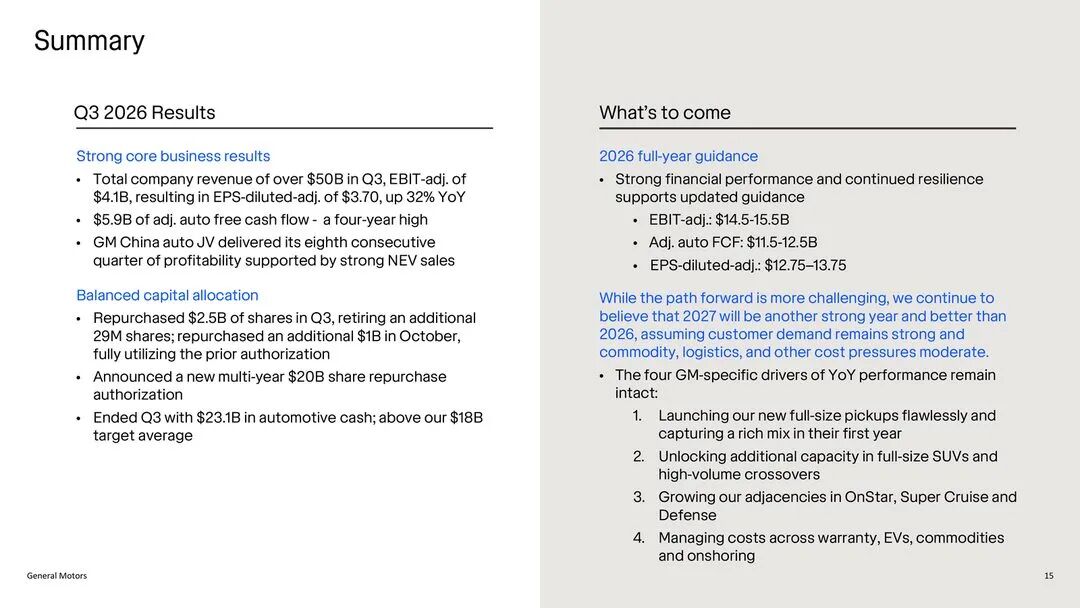
Q3 summary and outlook for 2026-2027, with "more challenging times ahead" but expectations for 2027 to be better than 2026.
GM has identified four drivers it can control for 2027: the successful launch of the next-generation full-size pickups and selling a high-configuration mix in the first year.
Ramping up production capacity for full-size SUVs and high-volume crossovers. Expanding OnStar, Super Cruise, and defense businesses.
Continuing to reduce warranty, electric vehicle, commodity, and U.S. reshoring costs.
The prerequisites are clearly stated: sustained strong demand and easing pressure on commodities, logistics, and other costs.
GM has delivered the certain parts (cash and repurchases) to shareholders, while leaving the uncertain parts in the assumptions for 2027. The stock price decline indicates that the market has noticed the latter first.
07 All Bets on 2027
Next-Generation Silverado and Sierra · Next-gen pickups
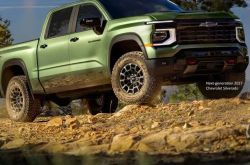
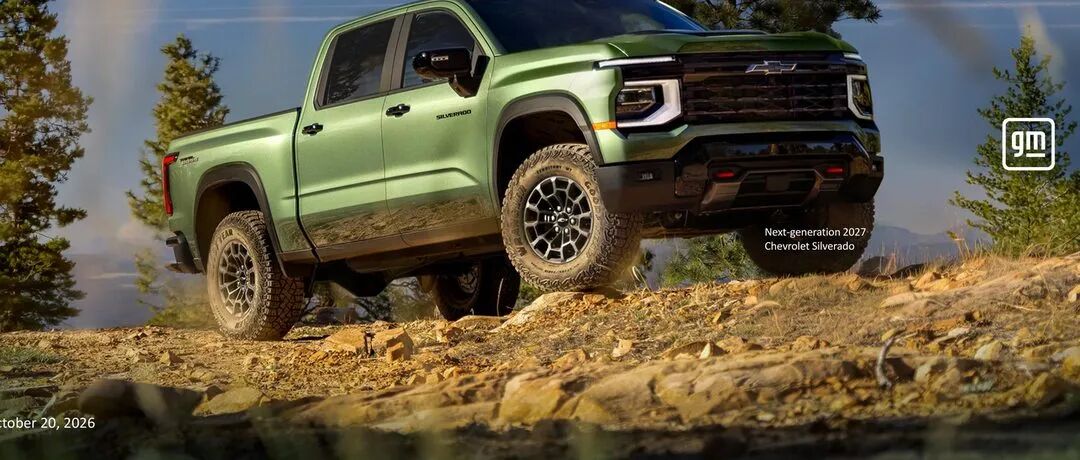
The 2027 Chevrolet Silverado and GMC Sierra light-duty pickups will begin arriving at dealerships in the fourth quarter, marking GM's most important event next year.
The new trucks feature sixth-generation 5.7-liter and 6.6-liter small-block V8 engines, along with upgraded 2.7-liter turbo and 3.0-liter Duramax diesel options, all paired with a standard 10-speed automatic transmission.
An optional 34-gallon fuel tank allows the diesel version to achieve over 900 miles of highway range.
The two new V8 engines have undergone over 100,000 hours of bench testing, aiming to accumulate over 1.5 million actual miles before delivery.
Over 630,000 miles of North American roads support hands-free driving in towing mode.
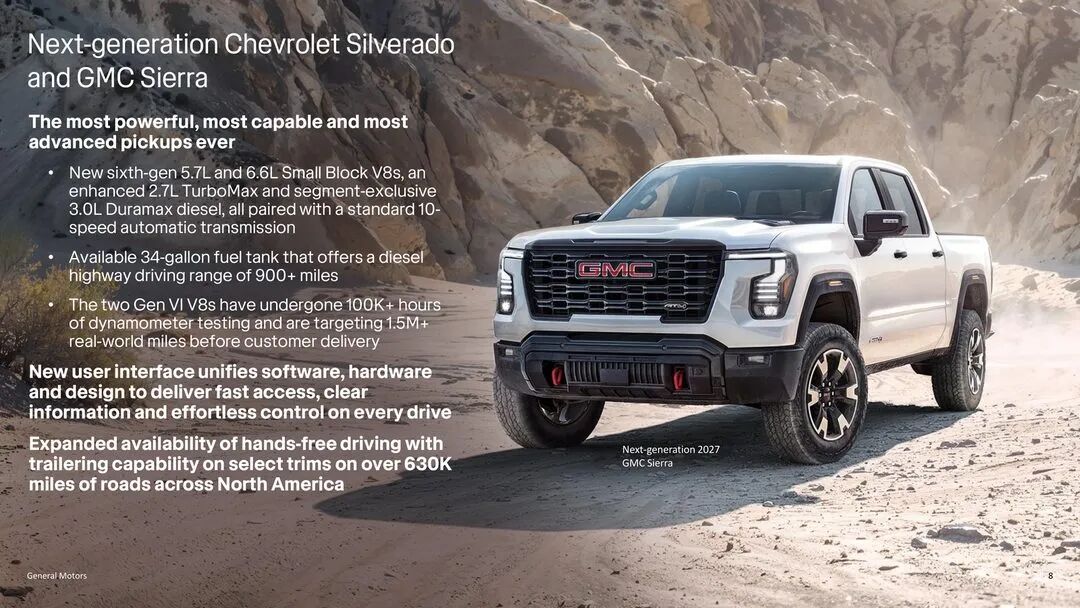
Powertrain and technology configurations for the next-generation 2027 GMC Sierra and Silverado.
According to management's second-quarter statements, new pickup sales next year will roughly maintain this year's record levels, with significant sales growth not expected until late 2027 to 2028, after all engine plants are operational and Orion's production capacity is in place.
Thus, the main contributions from the new pickups next year will be in terms of price and configuration mix, rather than sales volume growth.
For a global automaker, having a V8 pickup as its biggest growth engine in 2027 highlights that China and the U.S. are now two distinct automotive worlds.
08 Implications for Chinese Companies
OEMs, Intelligent Driving, Components, Batteries, Investors · So what
OEMs: North America is a high-margin market protected by tariffs and regulations, with an average transaction price of $52,000 and incentives below 5%. It's an attractive market, but Chinese brands cannot enter in the short term.
However, Chinese automakers can learn from GM's operating approach: control inventory, maintain prices, and not chase market share.
GM lost 0.7 percentage points of market share in the U.S. in the third quarter, yet its profits still increased by 20%.
Intelligent Driving Suppliers: Momenta entered the Cadillac XT5 plug-in hybrid through SAIC-GM, and GM is one of its major shareholders. This provides a ready path for Chinese intelligent driving companies to enter the supply chains of foreign automakers.
Conversely, GM's financial statements will fluctuate with Momenta's stock price, as their interests are now tied together.
Component Suppliers: Memory chip price increases have already been factored into GM's financial guidance, with full-year inflation for commodities, logistics, and memory chips estimated at about $2 billion. GM has previously mentioned signing long-term agreements with Micron and Samsung to secure supply.
Domestic automakers also heavily use DRAM in their smart cockpits and intelligent driving domain controllers. Cost pressures next year will not fall solely on U.S. automakers, making advance volume and price lock-ins a practical issue.
Battery Companies: GM is scaling back its battery joint venture capacity, with its in-house LMR technology not expected to mass-produce until before 2030.
This article infers that slowing EV demand in North America will put pressure on Korean battery makers' capacity utilization in the U.S., potentially intensifying their price competition with Chinese battery companies in Europe and other markets.
Investors: GM's valuation relies on cash and repurchases, with less emphasis on growth.
Despite fully exceeding expectations in the third quarter, the stock price still declined, as the market is already pricing in 2027. Simply exceeding quarterly expectations is no longer enough to drive the stock price higher.
09 Final Thoughts
Lying Flat and Winning Big?
A few years ago, when writing about Toyota, I said its transition was like an elephant dancing in shackles.
GM, another elephant, has chosen not to dance. Instead, it has returned to its most familiar pasture, feasting on North American pickups and SUVs while distributing the saved money to shareholders.
Financially, this approach has been highly effective: North American profit margins have returned to the target range of 8% to 10%, free cash flow has remained stable above $10 billion for several consecutive years, and outstanding shares have decreased by nearly 40% since the end of 2022.
The trade-off is a narrower path for growth.
EV adoption in the U.S. has nearly stalled, profits in China are thin, software revenue accounts for less than 2% of total revenue, and next year's biggest highlight is a gasoline-powered pickup.
GM has proven that traditional automakers can still make money today without relying on electrification. Whether this approach can sustain them into the next decade may depend on external factors beyond their control.
This article is based on publicly disclosed information and media reports from General Motors, including forward-looking statements from management and the author's judgments. It is for reference only and does not constitute any investment advice.
References and Images
【PDF】General Motors Q3 2026 Financial Report
*Unauthorized reproduction or excerpting is strictly prohibited.-
-
![]()
Apple, the 'Latecomer,' Initiates Limited AI Rollout
-
![]()
Yutong Bus: Selling 2,600 Fewer Units Yet Boosting Gross Profit by 600 Million Yuan, with Overseas Sales Fueling Profit Surge
-
![]()
GM's Q3 2026: Pickup Trucks Mint Money, Buybacks Provide Support, EVs on Pause
-
![]()
Fuel-Powered Vehicles: Shifting to a 'Niche' Role
-
![]()
Pure Electric Vehicles Dominate the RMB100,000 Market, and the Shift from Fuel to Electric is Unstoppable
-
![]()
September's Top 10 MPV Sales: Joint Venture MPV Regains Leadership
-
![]()
MIIT Unveils New Car Lineup: Multiple Series 9 Models Make Their Grand Entrance
-
![]()
Zhu Huarong Steps Down, Zhao Fei Takes the Helm: Changan Automobile Unveils Its 'Two-Phase' Governance Strategy