China’s Premier Provincial Capital, Guangzhou, Stages a Remarkable Comeback!
 10/27 2026
 547
Source: Shenzhen Finance
Guangzhou, China’s foremost provincial capital, is indeed making a notable resurgence.
As of today (October 27), eight of the top ten cities in China have published their GDP figures for the third quarter. Among them, Guangzhou has achieved a growth rate of 5.7%, marking another peak in five years.
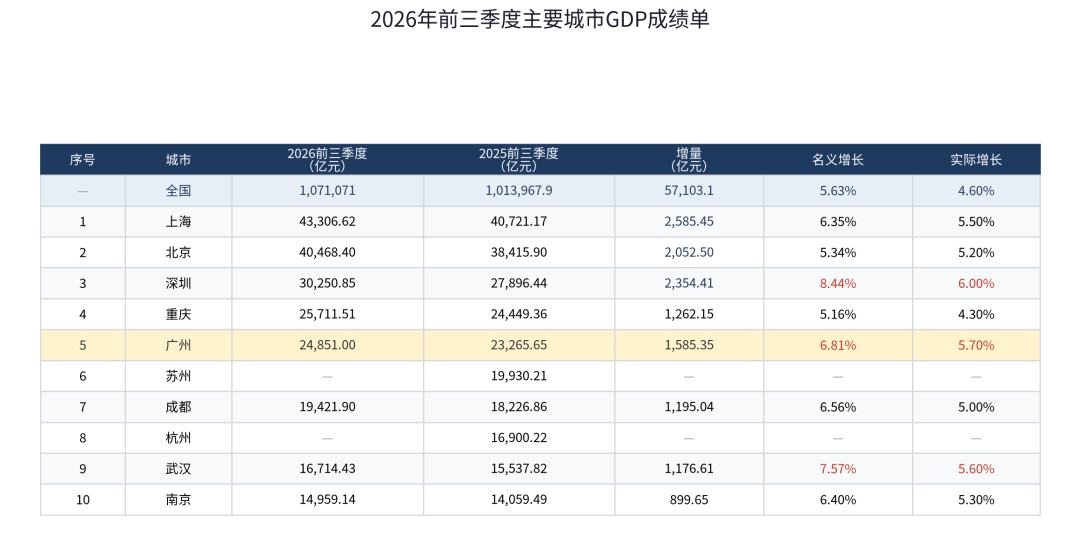
Note the emphasis on 'again.' This is because Guangzhou has maintained robust performance throughout the year: a 5.8% growth rate in the first quarter, leading among the top ten cities; maintaining 5.8% in the first half, tying with Shenzhen for the highest growth rate among the top ten and setting a five-year high for the same period; and achieving 5.7% in the first three quarters, consistently outpacing both provincial and national averages.
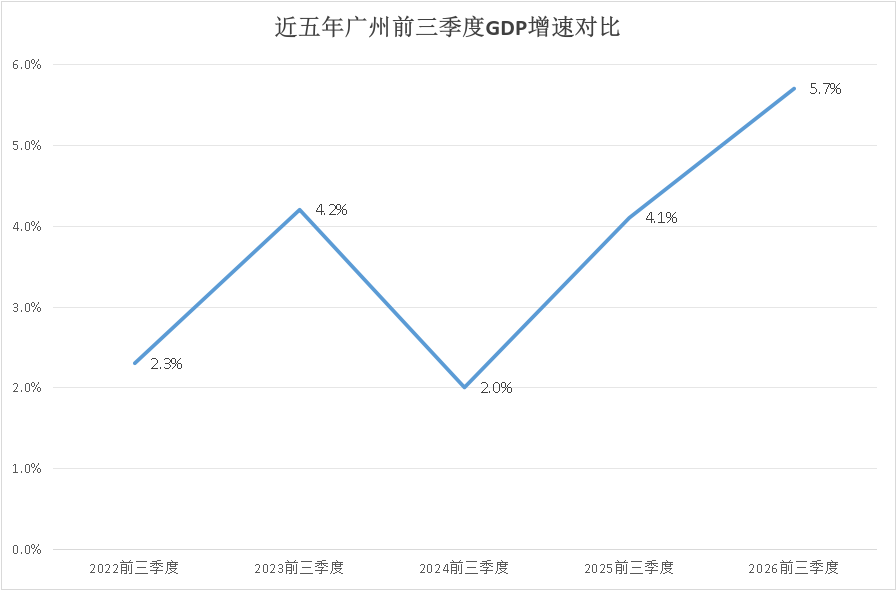
 Data Source: Public Reports
While a single rebound might be dismissed as a fluke, sustained strong performance cannot be attributed to luck alone.
Historically, Guangzhou relied on three key industries: automobiles, electronics, and petrochemicals. Three years ago, the city embarked on a 'second entrepreneurship' initiative, fostering three new pillars: next-generation information technology, intelligent and new energy vehicles, and biopharmaceuticals and health. Today, the city’s advanced manufacturing sector has been further refined into six specific domains: 'land, sea, air' and 'chips, displays, pharmaceuticals.'
Judging by this year’s indicators, Guangzhou’s industrial transformation can be deemed largely successful. The concepts of 'second entrepreneurship' and 'creating a new Guangzhou' are no longer mere slogans but tangible achievements for the nation’s premier provincial capital.
1. Why is Guangzhou Performing So Strongly?
The answer is straightforward: Guangzhou has no significant weaknesses.
In terms of its key industries, Guangzhou’s three major sectors performed steadily in the first three quarters: automotive manufacturing grew by 5.4%, electronics manufacturing by 10.7%, and petrochemical manufacturing by 5.3%.
Regarding the 'three engines' of growth—consumption, investment, and exports—while national foreign trade exceeded expectations this year, domestic demand faced pressure, and investment contracted. However, Guangzhou was one of the few cities where consumption, investment, and exports all experienced positive growth.
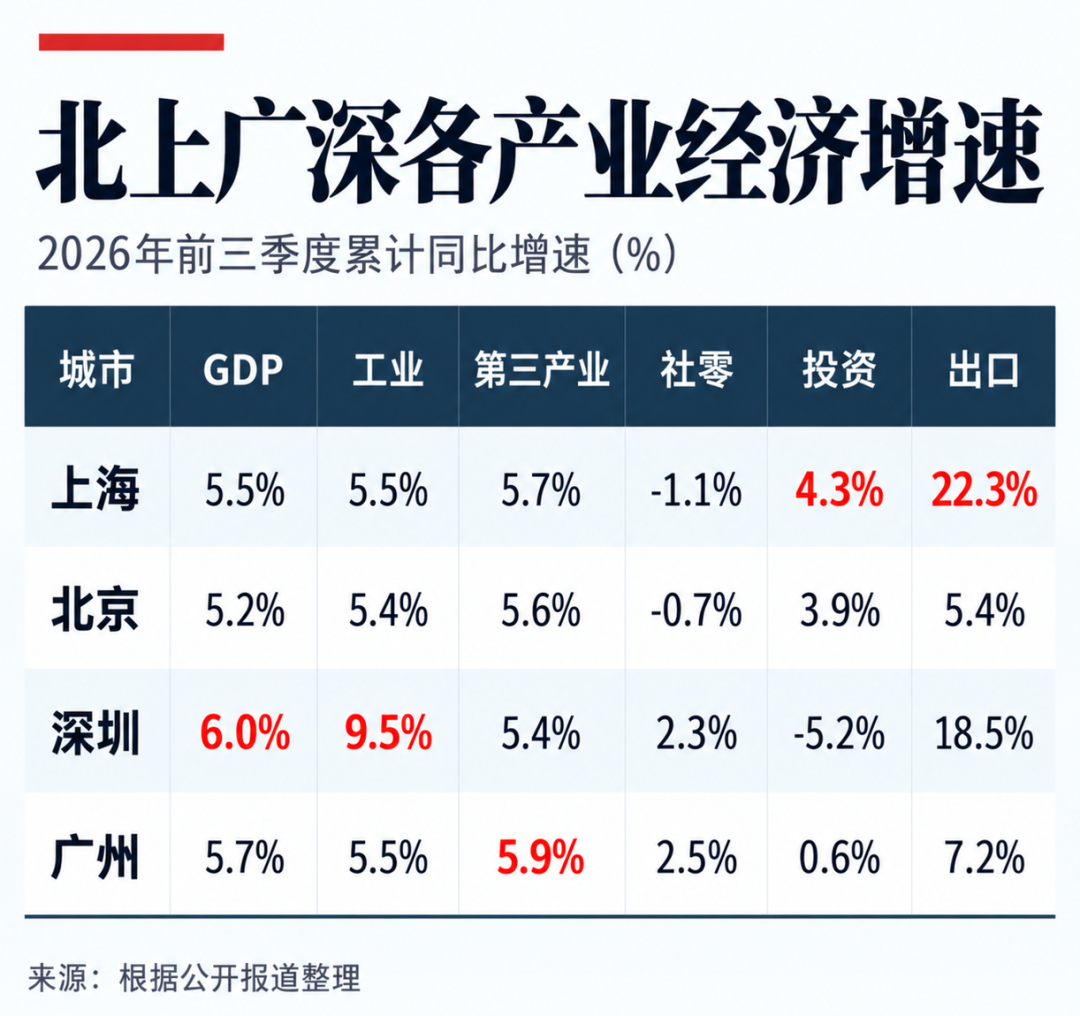
Delving deeper, the core reason lies in the successful transformation of its key industries.
The automotive industry serves as a prime example. Due to its successful transformation, Guangzhou has capitalized on the national export boom this year.
Automobiles are Guangzhou’s largest industry, but it previously faced challenges such as over-reliance on a single vehicle type and a weak presence in the electric vehicle market. Following its 'second entrepreneurship' initiative, the local automotive industry rapidly shifted from fuel-powered vehicles to new energy and intelligent connected vehicles.
However, the transition from fuel to electric vehicles is not unique to Guangzhou, nor is it the only city undergoing rapid transformation. So, what sets Guangzhou apart? The answer lies in its balanced approach to domestic and international markets.
This year, China’s overall automotive production and sales contracted. In the first three quarters, both production and sales declined by 4.5%, primarily due to weak domestic demand. In contrast, automotive exports surged: domestic sales were around 15 million units, down 22.4% year-on-year, while exports exceeded 8.2 million units, a 65.8% increase.
Against this backdrop, a city’s automotive brands, domestic and international strategies, and globalization efforts almost directly determine its economic performance this year.
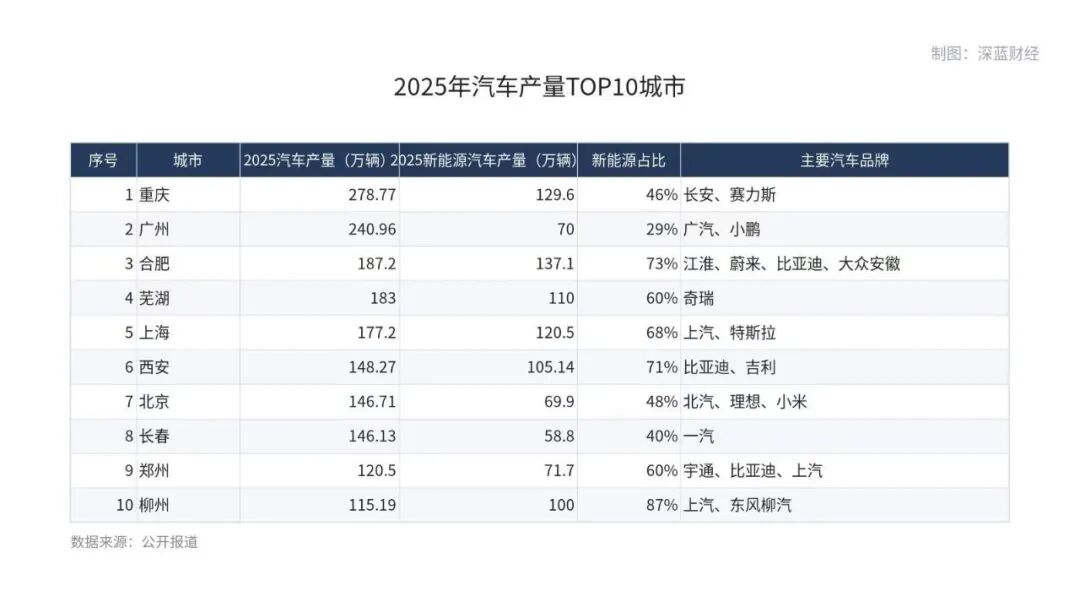
For instance, Chongqing also heavily relies on the automotive industry, with leading local companies like Changan and Seres. However, Chongqing’s automotive sector is primarily domestically focused, with Changan and Seres mainly operating within China. Consequently, the local economy faced significant short-term pressure: GDP growth in the first half was only 4.2%, the lowest among the top ten economies and below the national average; in the first three quarters, it remained 0.3 percentage points below the national level.
In contrast, Guangzhou’s data is overwhelmingly positive. In the first three quarters, Guangzhou’s new energy vehicle production increased by 54.6%, and lithium-ion battery production for vehicles grew by 57.8%. Exports of electric vehicles, lithium-ion batteries, and photovoltaic products—the 'new three'—increased by 82.5%.
This success is attributable to a diversified brand portfolio and a deepening global strategy.
Take GAC Group as an example. In 2024, GAC’s overseas sales totaled around 90,000 units. In just three years, its global footprint has expanded significantly: exceeding 130,000 units in 2025 and reaching nearly 200,000 units (197,701) in the first three quarters of this year, a 138.9% year-on-year increase.
The accelerated global sales of Guangzhou’s vehicles, now entering a 'boom phase,' are supported by multiple brands.
For instance, GAC’s portfolio includes joint venture brands like GAC Honda and GAC Toyota, as well as independent brands like Aion, GAC Trumpchi, and Everus. In the first three quarters, GAC’s independent brand sales exceeded 530,000 units, a 27.88% increase, with cumulative exports reaching 197,700 units, 1.5 times the 2025 export target. In September alone, exports surged by 160.9% year-on-year.
Another example is XPeng, which generated over a quarter of its revenue from overseas in the first half of the year and exceeded 10,000 overseas sales in September alone. Its sales have grown by double digits for seven consecutive months.
Diversifying risk during downturns and leveraging gradient growth during upturns—not putting all eggs in one basket—is likely a key reason for Guangzhou’s strong automotive sales this year.
Based on this, the transformation of Guangzhou’s automotive industry alone demonstrates that its 'second entrepreneurship' has delivered exceptional results.
2. Distinctive Approach: Industrial 'Chain Transformation'
Another sector where transformation has paid off is the next-generation information technology industry.
Upgrading Guangzhou’s electronics industry has been no small feat. Fortunately, the city has adopted a strategic approach: considering several key industries as part of a unified ecosystem, where they complement and reinforce each other.
Take the 'automotive-chip synergy' as an example.
Guangdong is China’s largest electronics province and a major consumer of chips, accounting for over 40% of national chip consumption, with downstream markets covering consumer electronics, communication equipment, and new energy vehicles. Guangzhou is one of the core regions for chip consumption.
However, for a long time, Guangzhou faced a dilemma: its integrated circuit (IC) industry had low added value, relying heavily on foreign investment and branded processing trade, with no high-end manufacturing presence and not a single IC fabrication line established.

Image Source: Guangdong Province’s '14th Five-Year Plan' for the Integrated Circuit Industry
Cultivating local IC manufacturing leaders became crucial to addressing this supply-demand imbalance and meeting the industrial needs of building Guangzhou into a 'world display capital' and an 'international software hub.'
The challenge was how to carve out a niche and development opportunities after lagging behind, and how to compete with early movers like Beijing, Shanghai, Hefei, and Wuhan.
Some analysts pointed out that as Guangzhou’s automotive industry shifts from fuel to new energy and intelligent connected vehicles, it may be more advantageous to focus on niche sectors with high certification barriers and strong customer loyalty, such as automotive-grade chips, rather than competing with Beijing, Shanghai, and Shenzhen in high-computing-power chips for intelligent driving. Thus, automotive-grade chips, as a key technology and core component, represent a critical entry point for Guangzhou to evolve from an 'automotive manufacturing city' to a 'smart vehicle city.'
And this is precisely what Guangzhou has done. By upgrading its electronics and automotive industries together, the city has focused on automotive-grade chips.
CanSemi, Guangdong’s first independently cultivated and volume-producing 12-inch wafer foundry, is also known as 'Guangzhou’s first chip.' On October 13, CanSemi went public on the ChiNext board of the Shenzhen Stock Exchange. Its stock price surged on the first day of trading, closing at 38.80 yuan, a 233.06% increase from its IPO price of 12.01 yuan.

Image Source: Web Screenshots
Even before the company’s listing, Guangzhou had used CanSemi as a springboard to cultivate a cohort of local IC industry players, aiming to build a 'core supporting zone for the national integrated circuit industry’s third pole.'
Thanks to similar industry-linked upgrades, while Guangzhou’s new energy vehicle production grew by 54.6% in the first three quarters, it also successfully drove a 37% increase in the added value of the intelligent in-vehicle equipment manufacturing sector. Additionally, the added value of the IC and optoelectronic device manufacturing sectors grew by 64.8% and 21.1%, respectively, with analog chips increasing by 27.6%.
The impressive growth of high-tech manufacturing has collectively boosted Guangzhou’s industrial and economic expansion. In the first three quarters, the added value of Guangzhou’s high-tech manufacturing sector grew by 10.3%, with advanced manufacturing contributing nearly 70% to the growth of industrial enterprises above a designated size. The secondary industry grew by 5.1% year-on-year, significantly outpacing the national average of 3.8%.
These factors underpin Guangzhou’s complete reversal.
3. Biggest Highlight: Surging Investment Against the Trend
An even rarer phenomenon in the third-quarter reports is Guangzhou’s surging investment despite adversity.
Currently, China’s economy is characterized by 'strong external demand and weak investment.' In September, while national fixed-asset investment saw month-on-month growth for the first time in six months of negative growth, and the monthly decline in manufacturing investment narrowed from -6.1% in August to around -1%, overall investment in the first three quarters still fell by 7.2% year-on-year, with manufacturing investment down 2.1% and private investment down 10.4%.
Guangzhou, however, bucked the trend: in the first three quarters, its fixed-asset investment grew by 0.6% year-on-year, with industrial investment up 5% and high-tech manufacturing investment surging by 31.5%.
Private investment is particularly noteworthy. Excluding real estate development investment, private industrial investment in Guangzhou grew by 26.0% year-on-year in the first three quarters, accounting for 52.4% of total industrial investment. Some analysts argue that private capital’s willingness to continuously invest in real industries is the most tangible proof of market confidence. The combined support of 'industrial investment + private investment' has become a 'dual cornerstone' for Guangzhou’s economic resilience.
Capital has been flowing into Guangzhou for some time.
In 2025, about one-sixth of China’s newly established foreign-invested enterprises chose Guangzhou. That year, Guangzhou saw 11,000 newly established foreign-invested enterprises, with actual foreign capital usage growing by 9.1% year-on-year, outpacing the national average.
2026 was designated as Guangzhou’s 'Investment Attraction Year.' In the first half, newly signed investment projects in the city exceeded 670 billion yuan in total value, a year-on-year increase of over 50%. The average scale of foreign-invested projects reached 550 million yuan, doubling from the previous year.
A review shows that the major cross-border projects Guangzhou attracted this year are primarily concentrated in high-end manufacturing, big health, and green and low-carbon environmental protection.
For example, in August, Veolia Group from France signed an agreement in Guangzhou’s Development District and Huangpu District for a zero-carbon project worth over 100 million yuan. In September, Schneider Electric and Aton Industrial Development Group from France advanced the 'Guangzhou Green Smart Industrial Park Project' in Zengcheng, aiming to address regional gaps in the Pan-semiconductor industry chain.
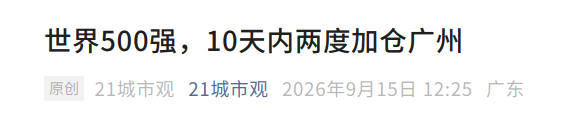
Image Source: Web Screenshots
Notice how these align closely with Guangzhou’s current industrial transformation priorities.
On October 9, Guangdong Province held a provincial conference on advanced manufacturing. During the event, Guangzhou unveiled its latest strategy, breaking down its advanced manufacturing sector into six more specific areas: 'land, sea, air' and 'chips, displays, pharmaceuticals.'
Thanks to Guangzhou’s systematic approach and intentional guidance, investment is flowing into the city’s key industries. This is what we call a targeted strategy.
Today, with a clear transformation path and a solid industrial foundation, data from the first three quarters indicates that the leading provincial capital is swiftly reclaiming its position.
Generally speaking, owing to a combination of factors such as exports, exhibitions, and capacity utilization, coastal cities often experience a higher proportion of GDP contribution in the latter half of the year. This trend is particularly pronounced in Guangzhou, a city renowned for hosting the Canton Fair. When coupled with robust investment figures, Guangzhou's economic growth trajectory appears to be firmly on track.
The economic "report card" for the entire year of 2026 is indeed something that piques considerable interest and anticipation.
-
![]()
Is the Inner Screen of the 16,000-Yuan iPhone Duo Cracking After Less Than 20 Folds?
-
![]()
Apple’s Priciest Model Fails to Impress
-
![]()
Foxconn Worker Claims Apple Eased iPhone Duo Quality Checks; Insider Denies Reduction in Yield Rate Standards
-
![]()
How can a company that lost $80 billion in six months justify a valuation of nearly $2 trillion?
-
![]()
FAW and GAC Strengthen Ties, Outlining Six Pivotal Cooperation Domains
-
[Insight] The airbag control unit (ACU) is a core component of automotive passive safety systems, with numerous market participants in China.
-
![]()
Grassroots Actors, the First Casualties of AI | Wave Trends
-
![]()
China’s Premier Provincial Capital, Guangzhou, Stages a Remarkable Comeback!