Nebius: The "Cool Kid" of New Cloud — Glossy on the Outside, Crawling with "Lice" Beneath
 11/13 2026
 553
AI neocloud Nebius (NBIS.US) released its Q3 earnings before the U.S. market opened on November 12, Eastern Time. At first glance, the quarter's results looked quite good — growth and profitability both clearly beat expectations, and GAAP operating profit turned positive for the first time.
But after CoreWeave's strong earnings, NBIS had already risen about 15% the next day, pricing in ahead of time the expectation that this quarter's results would be good. A closer look, however, reveals several not-insignificant problems in the quarter:
The most, most, most critical point: delays in compute capacity coming online pushed Q4 revenue guidance significantly below expectations, RPO barely grew QoQ, and the 2027 guidance was not much of a surprise either.
Specifically:
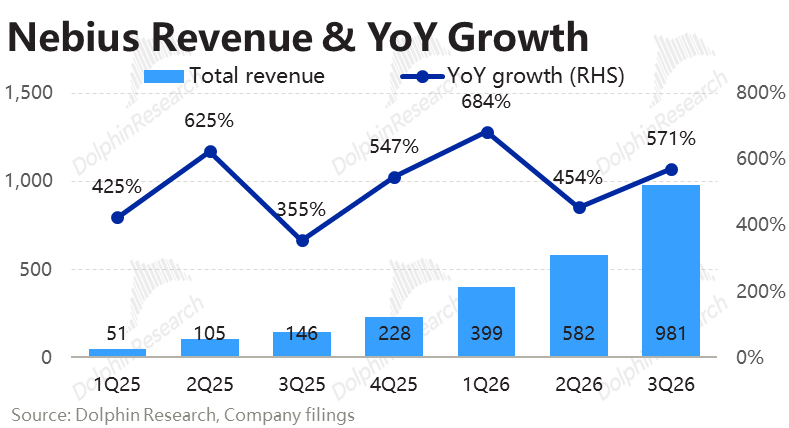
1. Revenue: +68% QoQ, but about $330 million was one-time revenue
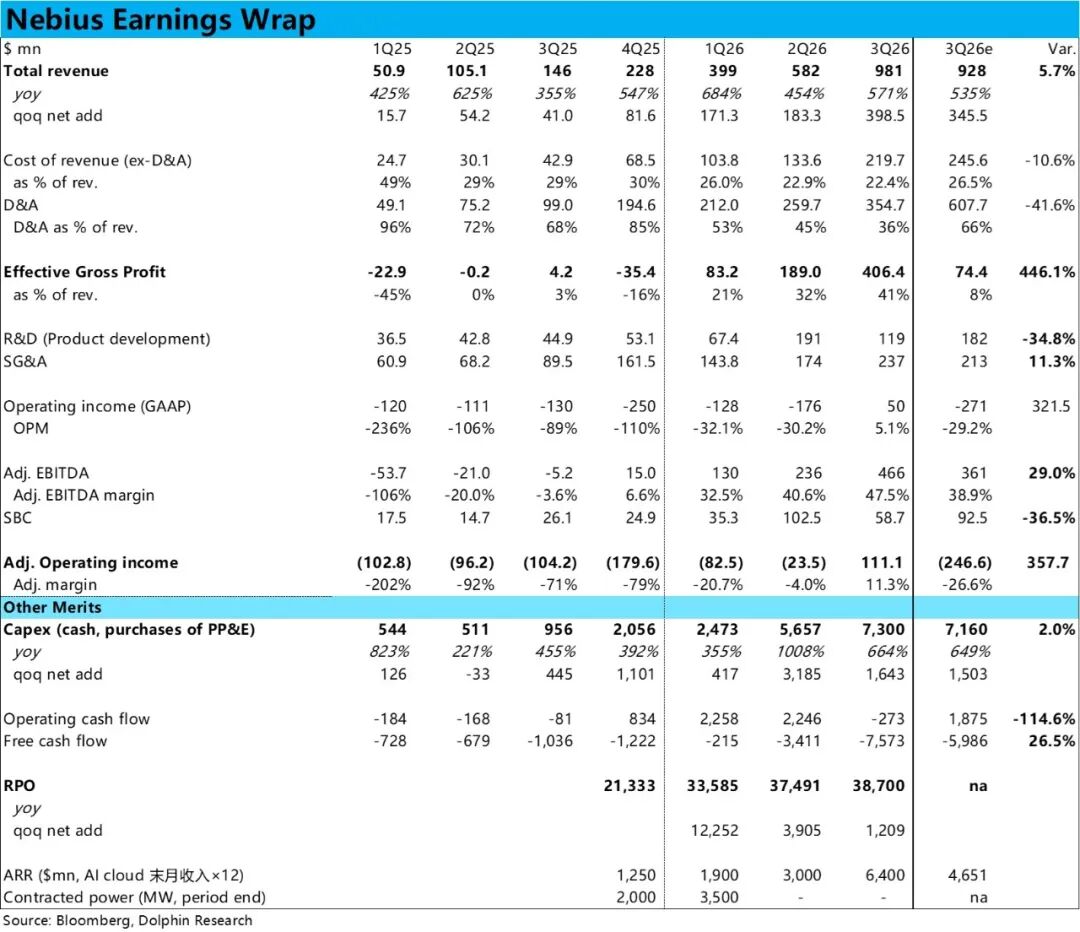
3Q26 revenue was $980 million, a single-quarter net increase of about $400 million, slightly above the consensus estimate of $930 million. Of this, AI cloud revenue was $970 million, accounting for about 99% of the group.
However, about $330 million of that was one-time activation revenue from the first phase of cooperation under the asset-light model, and the company expects this type of revenue to become more regular going forward.
And in fact, compute capacity construction progress was somewhat delayed this quarter; revenue appearing to beat expectations may have been more affected by this one-time revenue, so the quality is not high.
ARR at quarter-end was about $6.4 billion, double the $3 billion at the end of June and nearly 40% above consensus; but it is inferred that this also includes the "misleading" effect of that one-time revenue.
The company announced this quarter that it will no longer use ARR to measure the business going forward, and the original target of reaching $7–9 billion in ARR by year-end has also been delayed to exceeding $7 billion in February next year.
2. Orders and pricing: unit prices and prepayment ratios continued to rise, but RPO barely grew
The annualized revenue per MW of newly signed contracts in 3Q exceeded $25 million, versus more than $20 million last quarter, and the price per GPU hour was more than 20% higher than the 2Q average. At the same time, the company again emphasized that short-term cluster prices for 3–6 months are more than double the signed contract prices.
However, the market has basically digested the rise in compute leasing prices during the stock price recovery over the past two days, so it is not incremental good news.
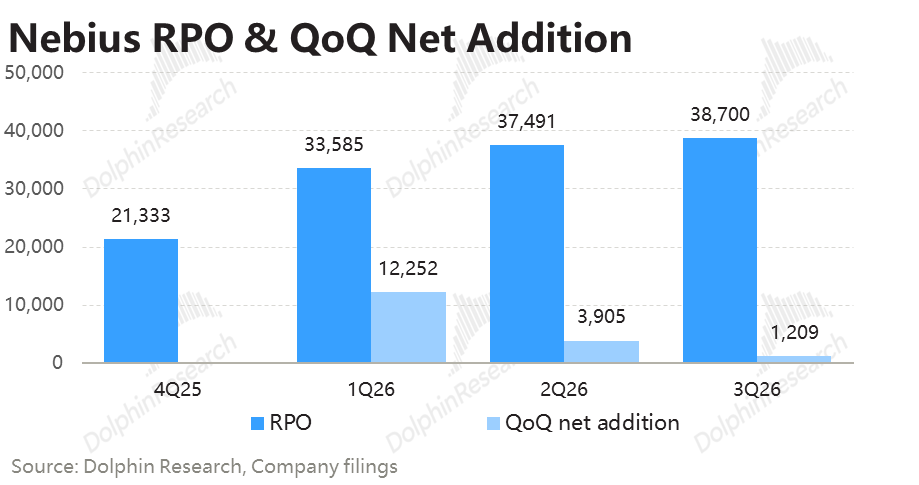
Meanwhile, order volume growth slowed markedly this quarter: quarter-end RPO was about $38.7 billion, up only 3% QoQ (about $1.2 billion). This indicates that either the company left more compute capacity for short-term contracts with flexible pricing, or the company encountered problems in signing orders in 3Q.
Fortunately, the company said that new contract signings since 3Q have exceeded $12 billion (including several billion dollars of 5-year contracts), most of which were signed after quarter-end and will be reflected in 4Q RPO, so order signings have somewhat recovered.
3. Compute capacity coming online and Capex: coming online slowly, Capex continues to increase
Delivery at multiple third-party hosting sites this quarter was delayed to the first half of 2027. Among them, for the New Jersey project built for Microsoft, more than half of the contracted capacity will be delivered before year-end, with the remaining batches scheduled for 2Q27. The company said progress at self-built sites is on schedule or ahead of schedule, and the U.S. election does not affect its self-built and hosted sites.
The company cut its 4Q revenue guidance and the timing for ARR to reach $7 billion, which should be behind the delay in compute capacity construction. For a neocloud company that must race against time and efficiently complete the journey from financing to production and revenue generation, this is a major issue.
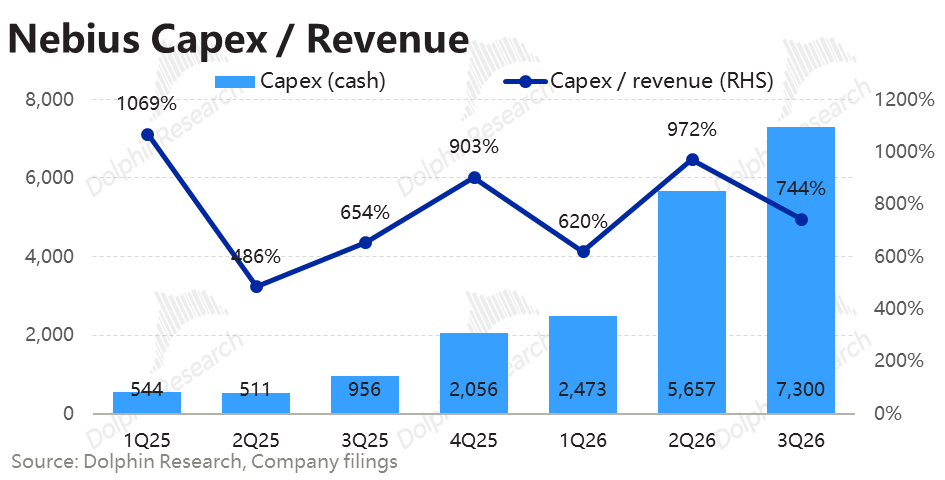
On Capex, this quarter was about $7.3 billion, up nearly 30% QoQ but basically in line with consensus, about 7x revenue. As a multiple of revenue, Capex intensity appears to be declining, but excluding the one-time revenue from the asset-light model, it actually reached about 11x cloud leasing revenue.
That is, even as the pace of bringing compute capacity online was delayed, Capex spending intensity did not slow down but instead rose further.
4. Cash flow and financing: operating cash flow turned negative, shifting to net debt
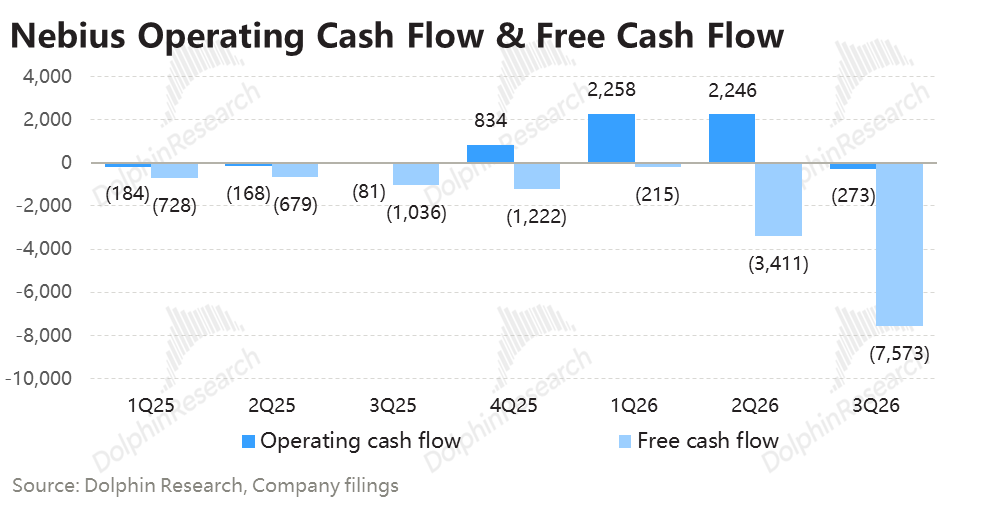
Due to high Capex, and with operating cash flow this quarter at $270 million (vs. net inflows of about $2.25 billion in each of the previous two quarters), free cash flow this quarter was an outflow of about $7.6 billion, significantly below expectations.
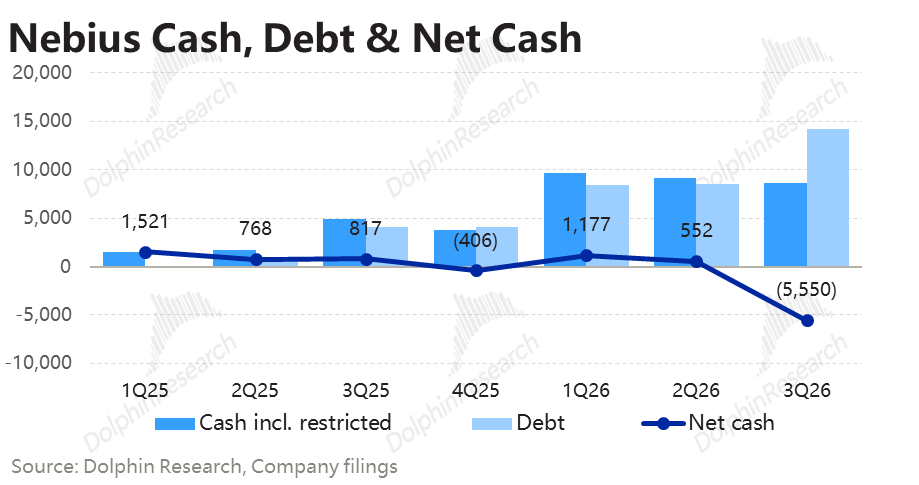
As cash declined and the company added about $5.7 billion of new liabilities this quarter, its balance sheet structure shifted from net cash to net debt of about $5.5 billion. Although the company had previously relied mainly on equity financing, under enormous spending pressure its balance sheet structure still showed an inflection point of deterioration.
The relatively low operating cash flow this quarter was mainly due to a marked increase in accounts receivable of about $3.8 billion, meaning actual cash payments from customers were somewhat delayed.
Fortunately, similar to CoreWeave's situation, the company said that more than 90% of contracts signed in 3Q with terms of more than one year include prepayments, and prepayments can already cover 100% of the Capex required for the corresponding contracts (50%–60% last quarter). This can substantially alleviate future cash flow pressure.
At the same time, the company announced it had signed its first 5-year AI cloud contracts (all expansions by existing customers onto new capacity), and added multi-year contracts with non-AI Lab customers such as Databricks, Datadog, and Snowflake. The customer structure continues to diversify.
5. Margins: far above expectations, but one-time revenue and low depreciation "propped up" profit
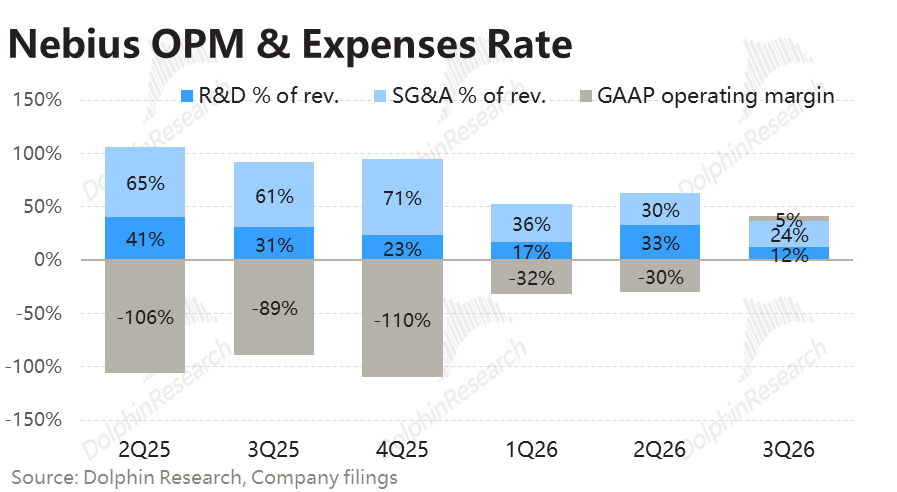
Group adjusted EBITDA was $470 million, with a margin of 47.5%, about 9 percentage points above consensus, rising for three consecutive quarters; among this, the AI cloud segment's adjusted EBITDA margin was 53.2% vs. 49.7% last quarter. At the same time, GAAP operating profit reached $50 million, also turning positive for the first time.
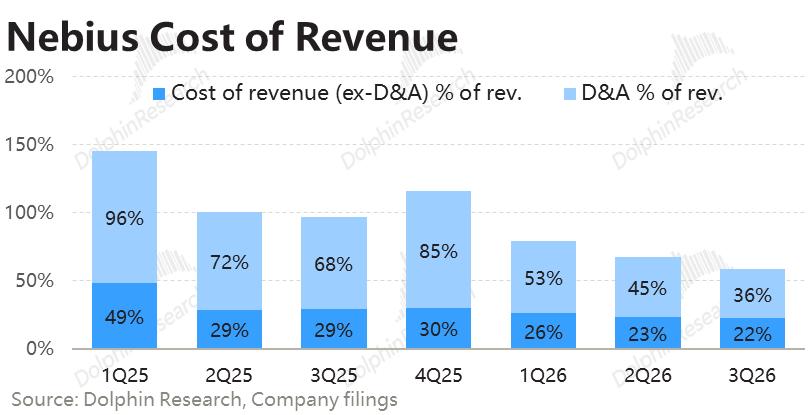
But there were two "inflated" factors behind the beat. First, about $330 million of asset-light one-time revenue: when introducing this model in 2Q, the company said it has high margins and requires almost no capital investment. Second, depreciation: this quarter was $350 million, about 40% below consensus, and as a share of revenue fell from 44.6% last quarter to 36.2%.
It is inferred that this was mainly because delays in compute capacity construction left a large number of assets not yet put into use and not yet subject to depreciation, and most of the GAAP operating profit beat came from this; therefore, once the delayed capacity comes online, depreciation will jump significantly.
The CFO said 4Q will first bear rent, power, and personnel costs before new sites come online, and the full-year margin guidance of about 40% implies a decline to around 35% in 4Q.
6. 4Q and full-year guidance: this year's revenue guidance cut, next year's capex far above expectations
Because some third-party capacity was delayed to the first half of 2027 (the company said the corresponding contracts remain), full-year 2026 revenue guidance was cut from $3.0–3.4 billion to $3.0–3.2 billion, implying 4Q revenue of about $1.04–1.24 billion, about 17%–31% below consensus.
Based on the guided full-year EBITDA margin, implied 4Q margin is about 35%–36%, also below expectations.
Full-year capex, however, was raised to about $27 billion, implying 4Q Capex of about $11.6 billion, about 27% above consensus; revenue growth is slowing while investment must continue to accelerate; the year-end target of 5GW of contracted power remains unchanged.
7. 2027 guidance:
Revenue of $12–13 billion (about 4x this year), with the midpoint about 1% below consensus; the company said its assumptions for the construction pace are conservative;
Capex of $40–45 billion, with the midpoint about 34% above consensus; again, no revenue growth surprise, but increasingly higher investment;
Fortunately, customer prepayments are expected to be $17–20 billion in 2027, which together with financing secured by long-term contracts can cover 75%–85% of capex, so subsequent investment will basically be borne by customers.
It expects to achieve pre-tax break-even in 4Q27 (including interest; it did not specify whether on a GAAP basis), with the margin turning positive faster than expected.
8. Below are the core metrics at a glance:
Dolphin Research View
1. This quarter: the key issue — delays in bringing capacity online
At first glance the quarter's statements look bright, but there are actually quite a few problems. The positive of using collections and contract-backed loans to cover Capex had already been learned from CoreWeave's earnings and fully digested by the market, and the stock price had already risen in advance, so this quarter's report was a combination of known good news landing + unknown bad news shocking the market.
2. Core issues to watch
Core issue one: price increases are known; the key is volume pace + order-winning ability
a. Volume pace:
From financing and construction to production and revenue generation, everything must race against time; delays mean capital is idling. What can already be seen:
The large amount of newly added PPE investment last quarter did not translate into revenue this quarter. The direct reason was power problems at third-party hosting sites such as New Jersey — the owner withdrew temporary power generation ahead of schedule, and the replacement fuel cells could not ramp up fast enough.
Since late October, Microsoft said some third-party capacity deliveries were delayed, and there were also reports that the New Jersey project was delayed and that Microsoft was shrinking its neocloud partner list; management said it was only a delay of a few months, Microsoft participated in schedule adjustments, and the contracts remain.
But starting in 2027, new capacity will shift to self-built sites, and construction risk will be borne entirely by the company itself; the pace of coming online will be the most important thing to watch every quarter going forward.
b. Order pace:
Not many new orders were booked in 3Q, and several large orders were signed only after quarter-end; 4Q revenue and margins will again be dragged down by delays in coming online.
Next year's revenue guidance should not be difficult to achieve: management's assumptions for timing of coming online are very conservative and do not include asset-light revenue; management said prices for capacity delivered in 2027 are rising, and customers are already looking for 2028 capacity.
But financing and revenue targets all presuppose that compute capacity remains in short supply and that large customers remain willing to sign with neoclouds. Management also acknowledged this time that supply and demand will eventually balance, and once conditions loosen, orders, prepayments, and financing will contract at the same time.
Core issue two: financing — customers help "advance funds," but at what cost?
Prepayments have become the main source of construction funding: prepayments on newly signed long-term contracts can cover the corresponding investment, and next year prepayments plus financing secured by long-term contracts can cover most capex, with subsequent investment largely borne by customers, consistent with the change CoreWeave showed this quarter.
Management also said on the call that it will adjust the mix of long- and short-term contracts according to the financing environment: when financing is difficult, sign more long-term contracts and collect more prepayments; when financing is cheap, leave more for high-priced short-term contracts and spot. This shows that in the current market environment, it is increasingly difficult for neoclouds to obtain funding on their own, and they can only rely on orders and prepayments from long-term contract customers to obtain secured loans.
And having to rely on long-term contract customers also means NBIS cannot leave more capacity for short-term orders with high price elasticity, and when constrained by others it is difficult to have much bargaining power when negotiating with long-term contract customers.
In other words, Nebius's original neocloud business model based on equity financing is increasingly resembling CoreWeave's "contractor" model.
3. Forecast adjustments and investment logic
Earnings forecast adjustments: after these results, Dolphin adjusted 4Q and 2027 revenue, Capex, customer prepayments, and other indicators according to guidance, and raised the pace of coming online for 2027–2030 based on management's "more than 1GW added each year."
On financing, it is assumed that 80% of capex in 2027–29 corresponds to long-term contracts, covered by customer prepayments and borrowings secured by long-term contracts, with the remainder first using operating cash flow and the gap filled by equity issuance.
For 2029, the valuation year, revenue is about $40.2 billion and adjusted EBITDA about $31.4 billion, about 3% and 26% above consensus, respectively.
Investment Thesis: To date, cloud compute capacity remains in short supply and leasing prices continue to climb, so neoclouds' financial results are naturally strong. NBIS leases out a larger share of its compute capacity under short-term contracts, giving it more flexible pricing power. As a result, price increases flow through to revenue more quickly, and its earnings elasticity during a price upcycle is greater than CRWV's. This is also why Dolphin believes NBIS is the top pick among neoclouds in a rising-price environment.
From a medium-term perspective, however, once the compute supply-demand balance reverses, NBIS carries greater risk than CRWV: lacking long-term contract guarantees, its short-term contracts will need to be repriced at market rates upon expiry, leaving both revenue and the valuation premium it currently enjoys more exposed to downside.
Previously, NBIS commanded a significantly higher valuation than CRWV thanks to its greater proportion of short-term contracts (more flexible pricing, greater performance elasticity) and lower debt levels.
However, as new cloud players' own financing capacity deteriorates, NBIS will also need to rely more heavily on long-term contracts with major customers, prepayments, and loans secured by long-term contracts. These two advantages relative to CRWV are diminishing, and the valuation gap between the two will narrow accordingly.
Therefore, with the stock price decline weakening financing capacity, we primarily adopt a wait-and-see approach toward NBIS. If one must allocate to new cloud players, CRWV is temporarily superior to NBIS at this stage.
- END -
// Reprint authorization
This article is an original piece by Dolphin Research. Authorization is required for reprinting.
// Disclaimer and general disclosure notice
This report is intended solely for general comprehensive data purposes, aimed at providing general reading and data reference for users of Dolphin Research and its affiliates. It does not take into account the specific investment objectives, investment product preferences, risk tolerance, financial situation, and special needs of any person receiving this report. Investors who make investment decisions based on this report must consult an independent professional advisor for advice. Anyone who makes investment decisions based on the use of or reference to the content or information mentioned in this report must bear the risk themselves. Dolphin Research shall not be liable for any direct or indirect liability or loss that may arise from the use of the data contained in this report. The information and data contained in this report are based on publicly available materials and are for reference purposes only. Dolphin Research strives for but does not guarantee the reliability, accuracy, and completeness of the relevant information and data.
The information mentioned or views expressed in this report shall not, in any jurisdiction, be treated or regarded as an offer to sell securities or an invitation to buy or sell securities, nor shall it constitute advice, solicitation, or recommendation regarding the relevant securities or related financial instruments. The information, tools, and materials contained in this report are not intended or designed for distribution to citizens or residents of any jurisdiction where the distribution, publication, provision, or use of such information, tools, and materials would conflict with applicable laws or regulations, or would cause Dolphin Research and/or its subsidiaries or affiliates to be subject to any registration or licensing requirements in such jurisdiction.
This report reflects only the personal views, opinions, and analytical methods of the relevant creators and does not represent the position of Dolphin Research and/or its affiliates.
This report is produced by Dolphin Research, and the copyright is owned solely by Dolphin Research. Without the prior written consent of Dolphin Research, no institution or individual may (i) produce, copy, reproduce, reprint, forward, or otherwise create any form of photocopy or reproduction in any manner, and/or (ii) directly or indirectly redistribute or transfer it to other unauthorized persons. Dolphin Research reserves all related rights.
Writing articles is not easy. Click "Share" and give me a little boost~
-
![]()
Storage Costs Soar! Even DJI Feels the Pinch: Some Products to See Price Hikes Starting November 18
-
DJI Announces Price Adjustment: Selected Products to See Retail Price Increases Starting November 18
-
![]()
HUD and In-Car Wireless Charging Leader Posts Consecutive Profit Growth, Though Control May Change Hands
-
![]()
Commercial Space Sector Rushes Toward IPOs
-
![]()
Is Big Tech's Ultimate AI Goal to Spin Off and Go Public?
-
![]()
Nebius: The "Cool Kid" of New Cloud — Glossy on the Outside, Crawling with "Lice" Beneath
-
Tencent Isn't Planning to Lay Off 50% of Its Staff—It Wants Half Its Workforce on the AI Battlefield
-
![]()
Sales Plunge 40%, Two Years of BD Bonuses Canceled: What Prescription Will Dong Xiuhui Write for FAW-Volkswagen?