Is Big Tech's Ultimate AI Goal to Spin Off and Go Public?
 11/13 2026
 534
It's not that Google's playbook can't be learned from—separate listings simply offer better value for money.
Author | Xinjian
Editor | Xiaobai
Illustration | AI-generated
Produced by | Emphasize Next
On the evening of November 10, Alibaba announced that T-Head would be listed independently on the Main Board of the Hong Kong Stock Exchange, with the A1 form having already been filed confidentially on September 11. The announcement disclosed no details on the amount raised, the valuation, or how much stake Alibaba will give up. This marks the third internet giant within a year to send core AI assets to be priced separately.
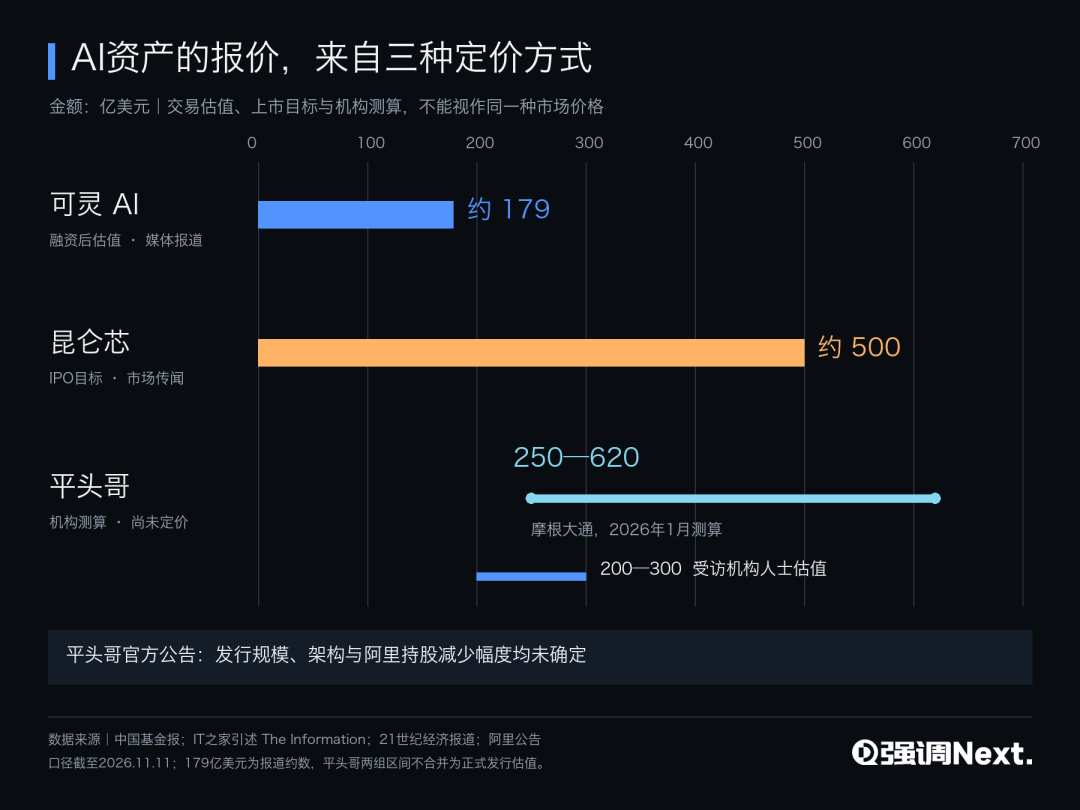
Baidu's Kunlunxin filed with the Hong Kong Stock Exchange in January and in May also launched tutoring for the STAR Market. Kuaishou's Kling completed a 19.8 billion yuan capital increase on October 30, with a post-investment valuation of about US$18 billion, and according to reports has selected CICC, Goldman Sachs, and UBS to prepare for a Hong Kong listing in 2027.
The three deals share one common outcome. Kunlunxin's reported target valuation is US$50 billion—higher than Baidu's market capitalization of about US$38.5 billion at the time; Kling's US$18 billion is higher than Kuaishou's market capitalization of about US$16.3 billion in early October; JPMorgan's estimate for T-Head at the beginning of the year of US$25 billion to US$62 billion is already equivalent to 10% to 24% of Alibaba's latest market capitalization. The subsidiaries are getting more expensive one after another, but the parent companies' stock prices have not kept pace. After T-Head's announcement, Alibaba's U.S. shares in premarket trading only recovered from a drop of more than 2% to flat.
The Full-Stack Story Is Too Expensive; Better to Split It Up and Monetize
The announcement said that after the spin-off, T-Head will remain a subsidiary of Alibaba. As long as it remains a subsidiary, it will still be consolidated: the expenses for every tape-out and every R&D cost will continue to enter Alibaba's consolidated income statement, and the only change is an additional line for non-controlling interests in the financial statements.
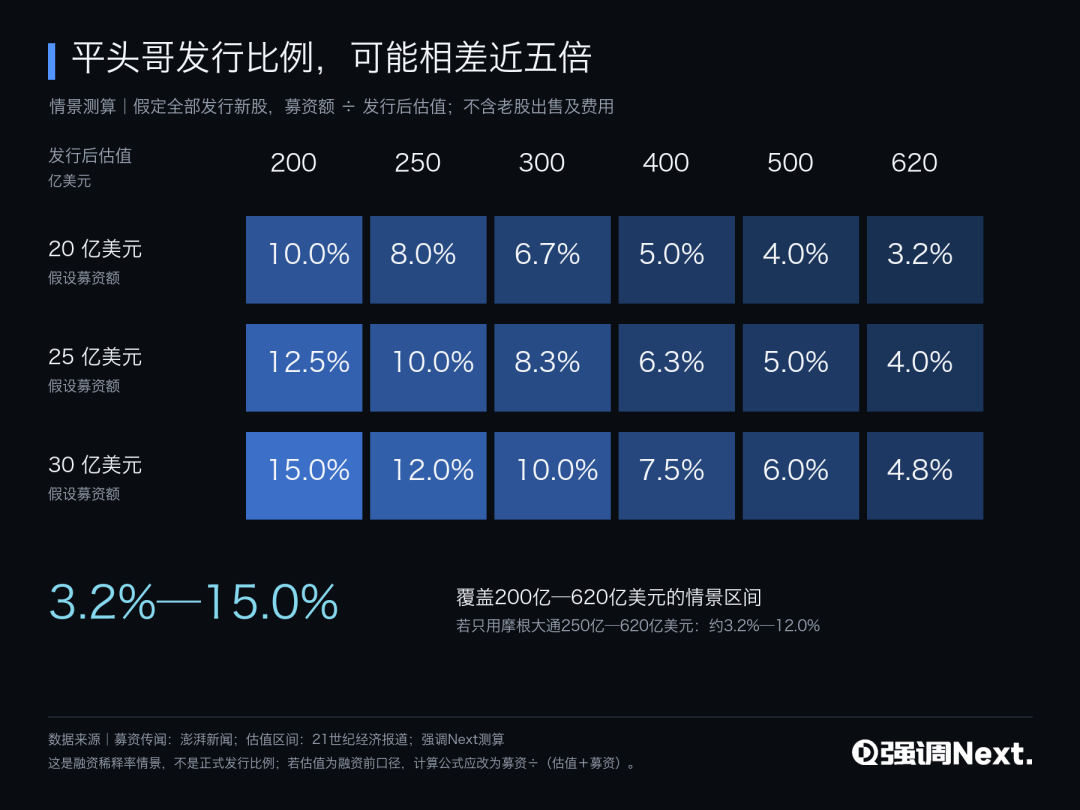
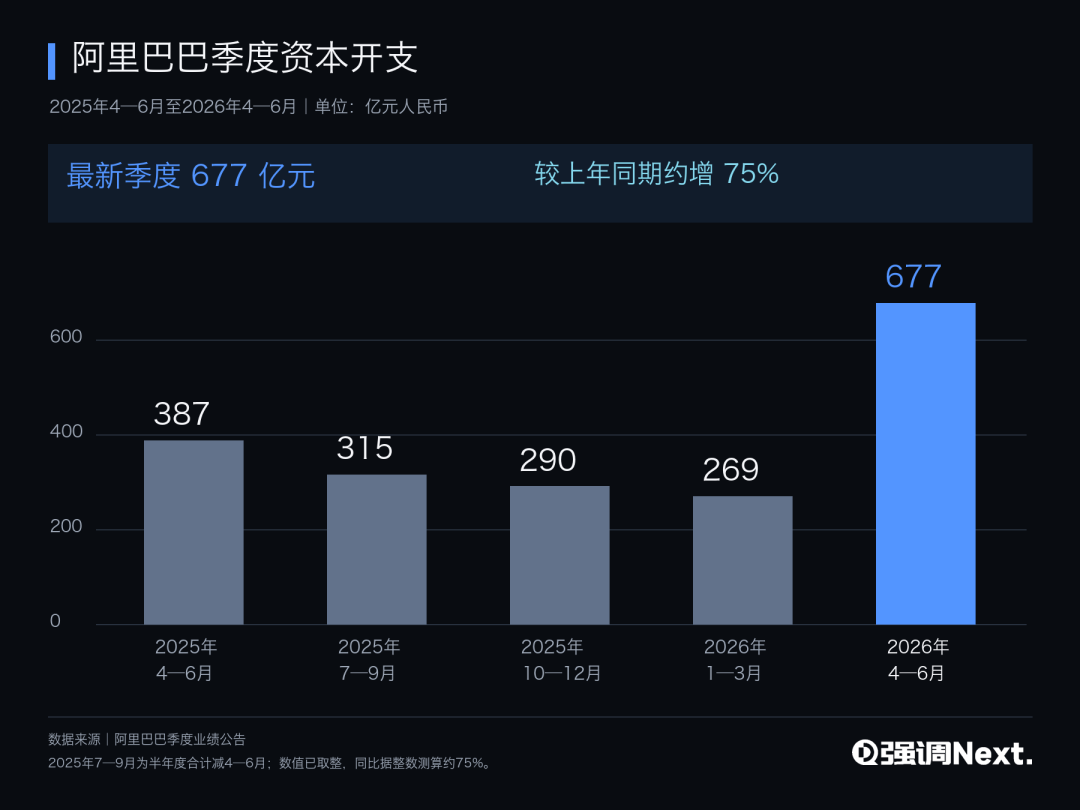
The chip business—this cash-devouring beast—has not left Alibaba's books. The money coming in also cannot change much. The rumored fundraising amount is US$2 billion to US$3 billion, and based on the valuation ranges of various parties, the issuance ratio is between 3% and 12%. Converted into RMB, that is around 20 billion yuan, less than one-third of Alibaba's capital expenditure of 67.678 billion yuan in the June quarter. Alibaba itself characterized the spin-off in the announcement as "not significant" with reference to the group's total assets, revenue, and net profit.
The expenses have not gone away, control has not gone away, and most of the equity has not gone away. Only one thing has been spun off: pricing. An asset previously hidden in Alibaba Cloud's costs will from now on have its own stock ticker and a daily fluctuating quote. The question is how the parent company will be valued. Kuaishou and Baidu, which moved first, have already provided references.
After giving up 16.67% of Kling's equity, Kuaishou holds about 83%, and based on the US$18 billion valuation, this stake is worth about US$15 billion, equivalent to 90% of Kuaishou's own market capitalization; a livestreaming e-commerce platform with more than 3 billion yuan in adjusted net profit in a single quarter is left with only more than US$1 billion in this calculation.
Baidu holds 57.67% of Kunlunxin, which at the US$50 billion target valuation is worth US$28.8 billion, accounting for three-quarters of Baidu's market capitalization at the time, leaving only a tiny fraction for search, cloud, and Apollo Go combined. This calculation can be read in two ways: either the market does not recognize the subsidiary's price, or the market does recognize it but applies a very deep discount to the stake held by the parent company.
Either way, it shows that the high valuation obtained by the subsidiary has not been passed back to the parent company in proportion to the shareholding. This is always how capital markets treat controlling structures. During the years when Naspers held Tencent and SoftBank held Alibaba, there were situations where the value of the stake exceeded the parent company's own market capitalization. JPMorgan's January research report estimating T-Head's valuation also carried another meaning: it was surprised that Alibaba chose to release a spin-off signal at this time, and investors are currently most concerned about whether Alibaba Cloud and AI monetization can be delivered; "value release" is more like a posture of strategic communication.
It's Not That Alibaba Can't Learn from Google—It's That Alibaba Can't Wait
Also holding self-developed chips, cloud, and models, Google took another path. TPU has been in development for more than a decade and has never been spun off. In January this year, Alphabet's market capitalization crossed US$4 trillion, and its forward price-to-earnings ratio rose from about 14 times in mid-2024 to about 28 times. Most of this round of gains came from expansion of the valuation multiple, with earnings revisions contributing only a small part.
Wall Street's reason is that it has a complete chain from chips, cloud, and models to distribution. In April, Pichai announced that TPU would begin being sold directly to customers, and Anthropic and Meta signed large orders in succession. Investment bank Citizens expects TPU sales to be about US$3 billion this year and US$25 billion next year. These numbers are all reflected in Alphabet's stock price, and its shareholders own 100% of TPU. Alibaba tells the same story externally.
In the second quarter of this year, it merged the Cloud Intelligence Group and T-Head into the "AI Cloud and Computing Services" segment, and the financial report emphasized full-stack AI capabilities throughout. But in Alibaba's statements and shareholder structure, full-stack first manifests as an expense. Alphabet's capital expenditure guidance for this year is as high as US$195 billion to US$205 billion, supported by the cash flow from search advertising. Alibaba's free cash flow in the June quarter was a net outflow of 44.670 billion yuan, while the most explicit demand of long-term funds holding Chinese concept stocks over the past two years has been buybacks and dividends. For the market to value chips in the parent company's stock price the way it does for Google, Alibaba cannot wait.
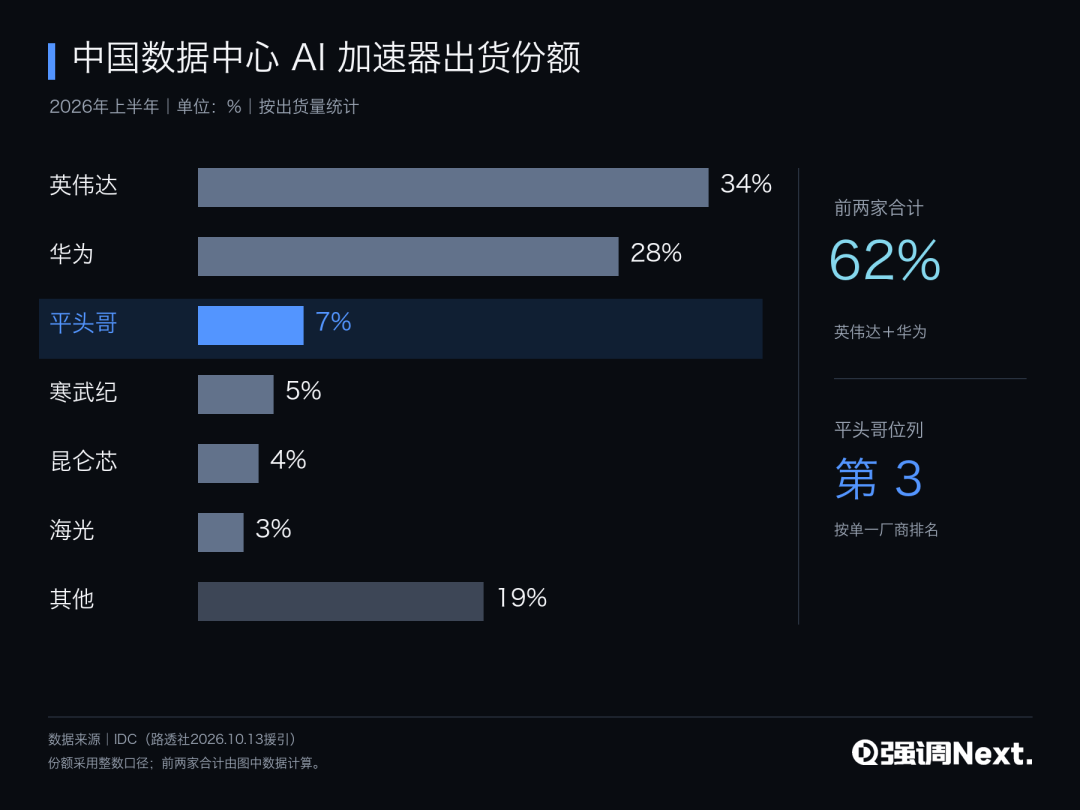
In business terms, T-Head also needs an independent identity more than TPU does. Chip R&D and tape-out are fixed costs that need to be amortized through shipment volume. IDC data shows that in the first half of this year, T-Head shipped 133,000 units in China's data center AI accelerator market, with a 6.6% share, ranking behind Nvidia and Huawei. The volume required by the next-generation architecture cannot be absorbed by Alibaba Cloud alone.
Google sells TPU to Anthropic, which it invested in, and to Meta, which does not do public cloud, so it does not need to change identity. T-Head faces domestic major buyers such as ByteDance, Tencent, and Baidu, all of which are direct competitors of Alibaba in cloud and models. The remaining market consists of government and enterprise customers, telecom operators, financial institutions, and automakers.
On May 26, the security and reliability evaluation included AI training and inference chips in the catalog for the first time, and Zhenwu M530 and M890 were among the first nine products, obtaining admission to procurement by customers such as telecom and state-owned financial institutions. Such buyers are very sensitive to suppliers' equity and governance structures, and a local listed company with a clear structure is easier to sign contracts with than a division within an overseas-listed group. Alibaba Cloud itself also needs T-Head to keep its distance.
The cloud business is a computing power marketplace, and the shelves need to have Nvidia as well as other domestic GPUs; if its own chips are tied too closely, other chip manufacturers will be wary of technology leaks and resource favoritism when adapting and cooperating.
The talent issue also points to a spin-off: Cambricon, Moore Threads, and MetaX have all gone public. Chip engineers hold RSUs tied to the group's stock price, which fluctuates with the cycles of e-commerce and macro consumption. No matter how well the chips are made, it cannot be reflected in their options.
Funding, customers, and talent—all three have practical reasons, and the spin-off is a choice Alibaba can make under its own constraints. The consideration it pays is the path Google has walked: once chips have their own market value, the market will no longer count their value repeatedly into Alibaba's multiple. The possibility of Alibaba being revalued as a full-stack AI company has been exchanged for the high valuation of T-Head alone.
How Do Close Brothers Settle Accounts Clearly?
According to media reports, in September this year, under the leadership of Wu Yongming, T-Head, the Qwen model team, and Alibaba Cloud established a coordination mechanism and set up multiple working committees. An Alibaba insider said at the time that T-Head might go public, but that was only a matter at the company level and would not affect work-level operations at all.
After listing, every decision at the working level will carry a price. The first is the internal settlement price. In August, Wu Yongming promised on an earnings call that capital expenditure on AI computing power would pay back within three years, and he placed hopes of shortening it to 2.5 years on gross margin improvement and a higher proportion of self-developed chip substitution. Alibaba Cloud's "payback" requires T-Head's chips to be cheap.
T-Head's new shareholders need a different income statement: Cambricon's gross margin in the first three quarters was 56.53%, and to command a chip company's valuation, it needs similar profitability. If the settlement price is set high, the money Alibaba Cloud saves becomes T-Head's profit, and the payback period must be recalculated; if set low, T-Head's financial statements cannot support a price-to-sales ratio of dozens of times.
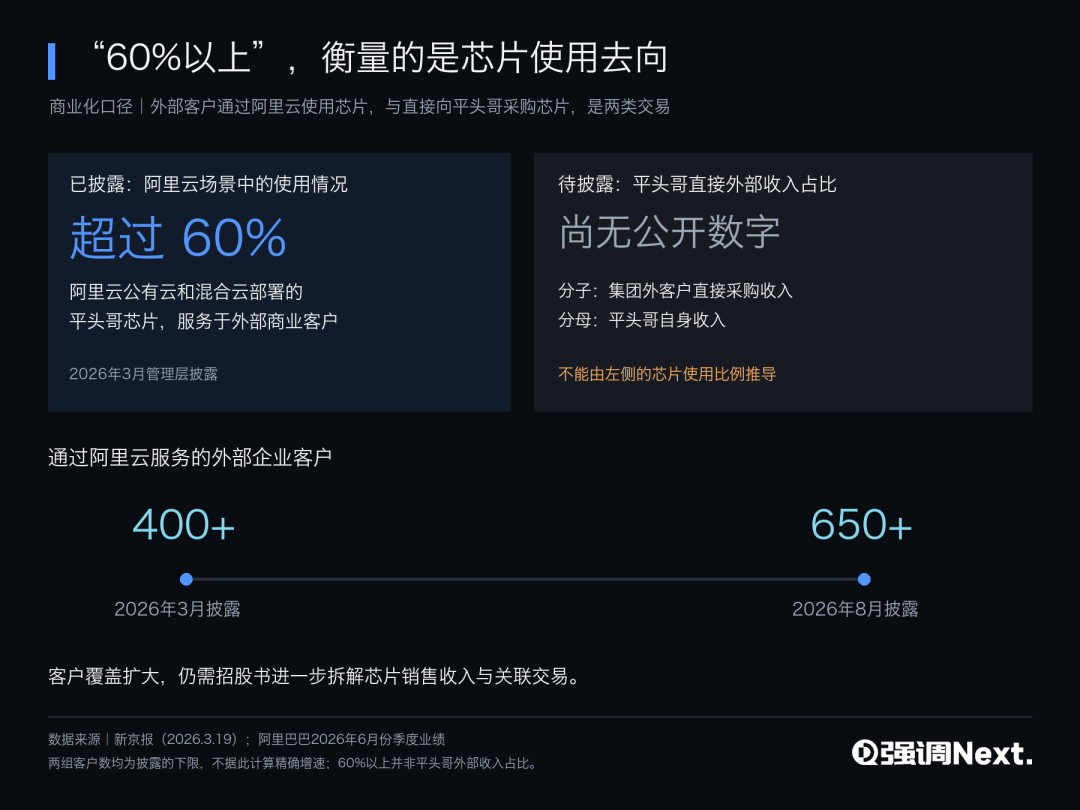
Previously this was the left pocket and the right pocket; hereafter it will be continuing connected transactions between two listed companies, requiring annual caps and disclosure of pricing basis. The weight of this price depends on how much of T-Head's business must go through Alibaba Cloud. The "more than 60%" repeatedly mentioned by management originally meant that more than 60% of T-Head chips in Alibaba Cloud's public cloud and hybrid cloud products are used by external commercial customers. It refers to whom the chips are rented to after being installed in Alibaba Cloud; the more than 650 customers signed contracts with Alibaba Cloud, and the money also first entered Alibaba Cloud's accounts. How much money T-Head directly receives from outside has not yet been made public.
The second is production capacity. Advanced processes, advanced packaging, and high-bandwidth memory are all scarce resources, and Wu Yongming's own judgment is that the computing power shortage will not change significantly before 2030. The supernode instances based on Zhenwu M890 only went online and ramped up on Alibaba Cloud in August. For every additional chip T-Head delivers to external customers, Alibaba Cloud has one fewer. Google has already encountered this situation. Bloomberg reported that after a large amount of TPU capacity was signed to Anthropic and Meta, internal research teams including DeepMind began queuing for computing power.
Google's queue is decided by one CEO. T-Head's queue has on one side T-Head shareholders who want chips sold to the highest bidder, and on the other side Alibaba shareholders who want Alibaba Cloud to get priority and cheap goods. The third is exclusivity. The full-stack advantage Alibaba talks about is the co-design of Zhenwu chips, Qwen models, and the Alibaba Cloud software stack, achieving higher efficiency with the same computing cost.
If chips are supplied only to Alibaba Cloud, this efficiency belongs exclusively to Alibaba Cloud, and T-Head's valuation cannot stand. If chips are sold to everyone willing to buy, the valuation stands, but Alibaba Cloud's exclusivity is gone. Google can weigh these two sides within one company, because no matter how it chooses, the benefits fall to the same group of shareholders.
The Subsidiary Becomes the Standout, While the Parent Company Becomes the Laborer
The three giants chose different spin-off methods. Baidu chose early separation and slow separation. Kunlunxin completed its first round of independent financing in 2021, with its valuation rising from 13 billion yuan to 21 billion yuan in July last year, and its shareholders increased to 44, including BYD and a fund under China Mobile.
Early R&D investment was shared by others, at the cost of having to accommodate the exit expectations of a long list of old shareholders at the time of listing. Arrangements reportedly circulated during the roadshow were that institutions wanting allotments had to first commit to purchasing Kunlunxin chips worth 3 to 7 times the subscription amount.
The main product P800 did not appear in the first batch of the security and reliability catalog in May, and only M100 was selected on September 20. Ten months after filing, Kunlunxin has not yet listed, and Baidu recently denied rumors of a delay in the listing.
Kuaishou took the route of financing first and spinning off later. Kling gave up 16.67% of its equity in exchange for roughly US$3 billion, and the capital increase agreement included a repurchase clause: if an IPO is not completed by October 30, 2031, investors have the right to demand repurchase at 8% simple annual interest. In effect, the valuation was traded for a time-limited listing commitment. Alibaba, by contrast, chose to hold its stake for eight years before pushing the business into the public market all at once.
T-Head remains a wholly owned subsidiary, with no external shareholders, no repurchase clauses, and no experience of market-based pricing in any funding round. That saved the cost of negotiating with early investors, but the trade-off was the absence of any reference price before the IPO: institutional figures interviewed by 21st Century Business Herald put the range at US$20 billion to US$30 billion, while JPMorgan's upper bound reached US$62 billion—a threefold gap between high and low.
The paths differ, but the parent companies look the same at the finish line: they continue to exercise control, continue to consolidate the subsidiary's financials, continue to shoulder investment, and at the same time hold a subsidiary whose valuation is close to—or even exceeds—their own. During the "1+6+N" reform in 2023, Alibaba planned to spin off Alibaba Cloud as a whole, but in November of that year the plan was halted on grounds of uncertainty brought by chip export controls, and the cloud business remained within the group. Three years later, what has actually been spun off is the segment of the cloud chain that the market is most willing to pay a high price for.
On the day T-Head lists, Alibaba's financial statements will include an equity stake with a daily market price. From then on, the price the market assigns to Alibaba will first calculate how much this stake is worth and what discount should be applied, and then value the remaining e-commerce and cloud businesses. The full-stack AI company Alibaba has talked about for two years will from then on be priced under T-Head's stock ticker. Note: The data in this article comes from public information and does not constitute investment advice.
- END -
-
![]()
Storage Costs Soar! Even DJI Feels the Pinch: Some Products to See Price Hikes Starting November 18
-
DJI Announces Price Adjustment: Selected Products to See Retail Price Increases Starting November 18
-
![]()
HUD and In-Car Wireless Charging Leader Posts Consecutive Profit Growth, Though Control May Change Hands
-
![]()
Commercial Space Sector Rushes Toward IPOs
-
![]()
Is Big Tech's Ultimate AI Goal to Spin Off and Go Public?
-
![]()
Nebius: The "Cool Kid" of New Cloud — Glossy on the Outside, Crawling with "Lice" Beneath
-
Tencent Isn't Planning to Lay Off 50% of Its Staff—It Wants Half Its Workforce on the AI Battlefield
-
![]()
Sales Plunge 40%, Two Years of BD Bonuses Canceled: What Prescription Will Dong Xiuhui Write for FAW-Volkswagen?