Sales Plunge 40%, Two Years of BD Bonuses Canceled: What Prescription Will Dong Xiuhui Write for FAW-Volkswagen?
 11/13 2026
 323
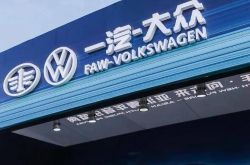
[Text/Deep Review Auto & Finance Three Musketeers] October 2026 retail figures from the Passenger Car Association have pushed FAW-Volkswagen into an unflattering spotlight: among the top ten manufacturers by retail sales, it posted the steepest decline—a 40.9% year-on-year drop. Almost simultaneously, multiple media outlets reported that the company had communicated internally through oral channels that BD bonuses for both 2025 and 2026 would be canceled.
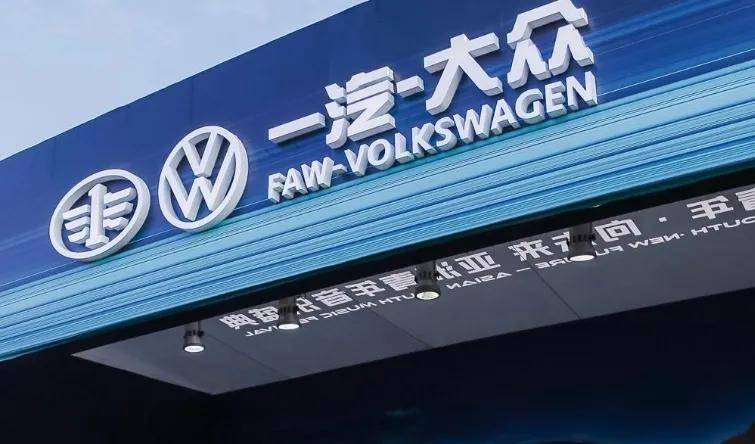
Sales on one side, compensation on the other. The two issues collided in the same month, yet they point to the same underlying problem: as the fuel-vehicle base accelerates its contraction and new energy remains in a "price-for-volume" window, this joint-venture giant is running short on both time and resources.
In October 2026, national passenger car retail sales totaled 1.643 million units, down 27.1% year-on-year and up just 1.5% month-on-month. On the top ten manufacturers by retail sales list, nine posted year-on-year declines; only Leapmotor maintained positive growth.
FAW-Volkswagen suffered the steepest fall: a 40.9% year-on-year decline, with retail sales of about 80,000 units, dropping out of the top five.
The overall market is contracting, but conditions are especially unfavorable for FAW-Volkswagen. In October, fuel vehicle retail sales fell 45% year-on-year, with pure fuel models down 51%—and FAW-Volkswagen's sales base is dominated by fuel models. Over the same period, new energy retail penetration had climbed to 67.5%. The direction of the oil-to-electric shift has not changed, and the pressure of being left behind fell first on companies with a deep fuel-vehicle base.
Over a longer horizon, in the first ten months of 2026, FAW-Volkswagen's cumulative retail sales were about 805,800 units, down 36.4% year-on-year. By comparison, in 2025 it still sold 1.587 million vehicles for the full year (including imported cars), retaining the top spot among joint-venture automakers and in fuel vehicle sales.
Beyond sales, another kind of pressure is surfacing in the company's internal books.
According to multiple media reports, around November 9, FAW-Volkswagen communicated downward through internal oral channels that BD bonuses for 2025 and 2026 would be canceled, affecting engineering and technical personnel and workshop workers in the P and O sequences. As of now, FAW-Volkswagen has made no public response.
Inside the company, the BD bonus goes by a more colloquial name: the "policy guarantee." It is not paid directly into the salary card at year-end. Instead, the company approves an amount each year and deposits it into a group annuity insurance account under the employee's name, which can only be withdrawn after two full years. Multiple employees told the media that this money accounts for roughly 40% to 45% of total annual income, and in good years this single item alone can exceed 200,000 yuan.
That is precisely why "canceling two years at once" stings so much. By convention, the 2025 BD bonus should have arrived around August 2026, but there has been no movement; the 2026 amount was originally scheduled for payment in 2027. With both falling through at the same time, some employees estimate losses of about 200,000 yuan. Several interviewees also mentioned that monthly income has been declining in recent years, by roughly 20% to 30%.
In internal communications, FAW-Volkswagen cited two reasons: operating pressure and policy changes. According to its internal communication documents, FAW-Volkswagen based its position on the repeal of the Law on Chinese-Foreign Equity Joint Ventures and, in accordance with the Foreign Investment Law and relevant Ministry of Finance documents, foreign-invested enterprises have since January 1, 2025 ceased to accrue the "employee incentive and welfare fund."
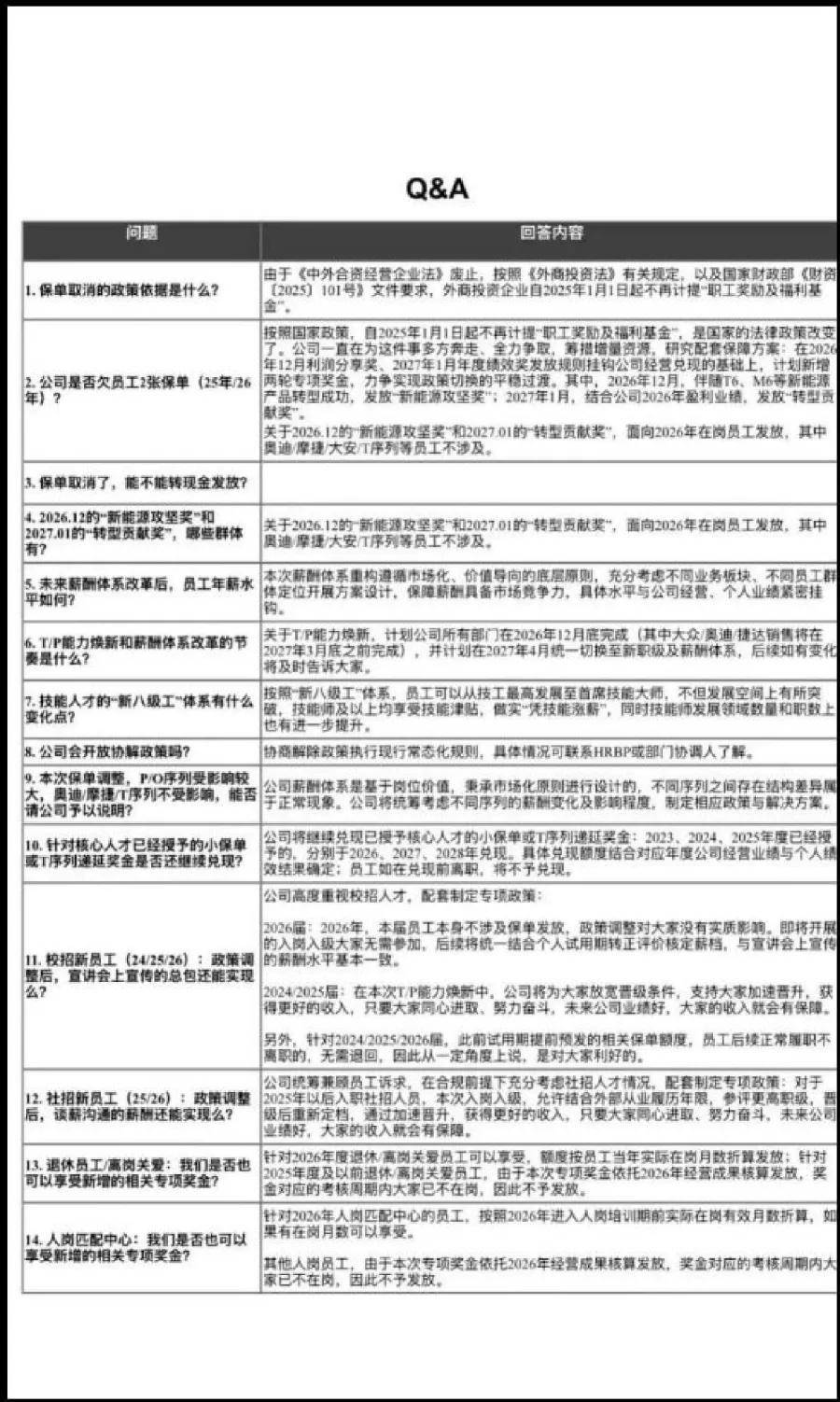
This policy source does indeed exist, but some lawyers believe that directly applying it to BD bonuses is a misunderstanding: reserve funds and welfare funds are financial arrangements involving after-tax profits, whereas BD bonuses are closer to labor remuneration or institutionalized benefits promised by the company to employees.
Transitional arrangements have also been put on the table: the company plans to add a "New Energy Breakthrough Award" at the end of 2026 and issue a "Transformation Contribution Award" in January 2027. However, neither the amounts nor the rules have been clarified, and employees remain wait-and-see.
It is worth noting that this adjustment is not a "one-size-fits-all" cut. According to media reports, the T sequence oriented toward digitalization and new energy transformation, as well as the independently accounted Audi brand and Mojie Mobility, are not within the affected scope. What has been "protected" happens to be positions in the transformation direction. This differentiated treatment itself has also sparked internal discussion about "why different sequences receive different treatment."
There is no lack of bright spots on the new energy side.
The ID. AURA T6 launched on September 20, priced from 129,900 to 166,900 yuan, delivered 12,032 units in October, taking the top spot in retail sales of new energy mid-size SUVs for the month and ranking first in retail sales among joint-venture pure electric models. More noteworthy is the order structure: in the first sales month, about 33,000 orders were locked in, of which the high-level intelligent driving version equipped with lidar accounted for more than 90%, and users purchasing the Volkswagen brand for the first time approached 80%. In the past, most joint-venture pure electric orders came from fuel vehicle owners trading in, but this time was different.
But behind the impressive numbers is price. As a joint-venture mid-size pure electric SUV, a starting price of 129,900 yuan has already reached into the core price band of domestic brands, squeezing per-vehicle profit very thin. For the T6 at present, reclaiming share first and proving that the Volkswagen brand still has a presence in the new energy race is more urgent than contributing profit.
This is exactly where the contradiction lies: the more T6 sells, the more limited its short-term boost to profit, and what FAW-Volkswagen needs most right now is profit to support its transformation.
Putting time and people together makes the company's situation clearer.
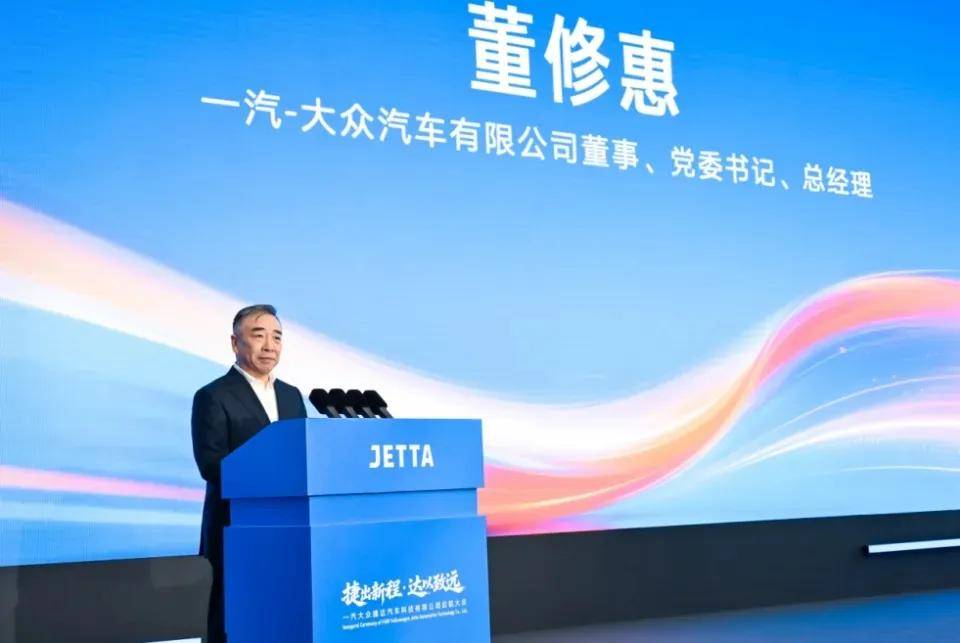
On December 31, 2025, Dong Xiuhui was officially announced as general manager and party secretary of FAW-Volkswagen, ending the previous transitional state in which a group leader concurrently held the post. He previously headed FAW-Toyota sales, achieving three consecutive years of positive growth during his tenure, with annual sales reaching the 800,000-unit level.
In mid-January 2026, Wang Shengli was officially announced as deputy general manager of commerce and general manager of the sales company at FAW-Volkswagen, with the two "forming a team again." Wang Shengli is a veteran who grew up within the FAW-Volkswagen system: he joined the company in August 2002, starting as a field engineer in the final assembly workshop, later responsible for regional sales, service operations, and other positions, became executive deputy general manager of the sales company in 2020, and afterward accumulated independent brand operations experience at FAW Besturn and FAW Hongqi.
At the "Lixin" news communication meeting in January 2026, Wang Shengli's core strategy was "stabilize the base, strengthen intelligent electric, and forge a new landscape": in 2026 the company plans to launch 13 new models, 7 of which are new energy; under the second round of electrification transformation planning, the new energy sales share is to reach about 60% by 2030.
The direction is not controversial; the difficulty lies in speed. Wang Shengli himself has admitted that over the past six or seven years, the company was "slow" in the pace of introducing in-car experience and combined driving assistance, and this is a reality that must be faced. He also offered a judgment: "Only through continuous evolution can one traverse the cycle."
Evolution takes time, and what FAW-Volkswagen is most short of right now is time.
The speed at which the fuel vehicle base shrinks, the speed at which the T6 and its peers ramp up volume and ultimately contribute profit, and the speed at which employees' patience wears down—which of these three lines runs faster is the key to determining whether this joint-venture giant can truly complete its "Lixin." The October ranking and the canceled BD bonuses are merely two newly added readings in this race.
-
Tencent Isn't Planning to Lay Off 50% of Its Staff—It Wants Half Its Workforce on the AI Battlefield
-
![]()
Sales Plunge 40%, Two Years of BD Bonuses Canceled: What Prescription Will Dong Xiuhui Write for FAW-Volkswagen?
-
![]()
Zhang Yiming: ByteDance AI to Catch Up with OpenAI and Anthropic by 2029 at the Earliest
-
![]()
Can Honda Thrive Without Leaning on China?
-
![]()
After Orders Exceed 10,000, It Suffers a Fierce Paid Poster Attack: Whose Turf Did the Second-Generation Blue Mountain Step On? | Mingjing Pro
-
![]()
Land Rover Loses First Round: Dutch Court Rules BYD Raid Was a "Fishing Expedition," Ti7 Copying Allegations Still Unresolved | Mingjing Pro
-
![]()
In October, AITO Sold 21,115 Units: Between the M6 and M9, Who Is Driving the Brand's Sales?
-
![]()
Changan Automobile's Domestic Terminal Sales Hit 104,000 in October: Qiyuan Begins to Drive Volume, Deepal at 20,000, Avatr at 2,858