HUD and In-Car Wireless Charging Leader Posts Consecutive Profit Growth, Though Control May Change Hands
 11/13 2026
 449
Tap "Short, Punchy Analysis" to follow us, and send tips to @editor
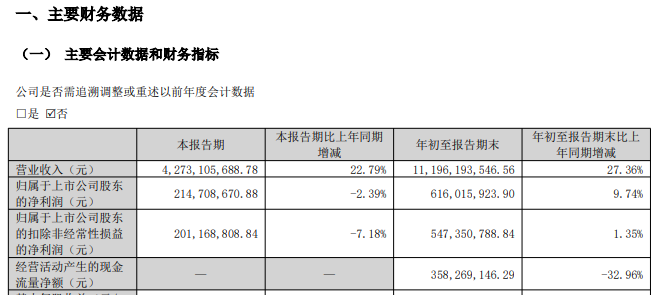
As a major player in China's automotive electronics sector, HuaYang Group has seen its performance rise alongside the rapid growth of new energy vehicles in recent years, with momentum carrying into 2026. In the first three quarters, the company posted operating revenue of 11.196 billion yuan and net profit attributable to shareholders of 616 million yuan, up 27.36% and 9.74% year on year, respectively.
HuaYang Group's two core businesses—automotive electronics and precision die-casting—have both grown substantially, with scale repeatedly hitting new highs. The only blemish: gross margins for both segments have declined amid intense industry competition and rising raw material prices.
Notably, despite HuaYang Group's fairly obvious profit growth, the actual controller intends to cede control. The controlling shareholder, Huayue Investment, and Jiuzhou Group have signed an equity transfer agreement under which Huayue Investment will transfer approximately 149 million shares—about 28.3% of the listed company—to Jiuzhou Group at 38.1011 yuan per share, for total consideration of about 5.66 billion yuan. If the deal goes through smoothly, Jiuzhou Group will become the controlling shareholder, and the Mianyang Municipal State-owned Assets Supervision and Administration Commission will become the actual controller.

Consecutive Profit Growth; HUD Products Rank First in China by Market Share
Consecutive profit growth, though Q3 net profit turned down. From 2021 to 2025, HuaYang Group's performance grew significantly, with revenue of 4.488 billion yuan, 5.638 billion yuan, 7.137 billion yuan, 10.158 billion yuan, and 13.048 billion yuan, respectively—a compound annual growth rate of about 31%. Net profit attributable to shareholders came in at 299 million yuan, 380 million yuan, 465 million yuan, 651 million yuan, and 782 million yuan, respectively, for a CAGR of about 27%.
Entering 2026, performance continued to grow rapidly. In the first three quarters, operating revenue and net profit attributable to shareholders were 11.196 billion yuan and 616 million yuan, up 27.36% and 9.74% year on year, respectively. Q3, however, saw revenue grow without profit growth: revenue was 4.273 billion yuan, up 22.79% year on year, while net profit attributable to shareholders and net profit after deducting non-recurring gains and losses were 215 million yuan and 201 million yuan, down 2.39% and 7.18% year on year, respectively—mainly due to rising prices of memory chips, PCBs, aluminum alloys and other raw materials, as well as higher interest expenses.
Automotive Electronics Business Keeps Growing, in the Second Tier. HuaYang Group is mainly engaged in the R&D, production and sales of automotive electronics and precision die-casting businesses. The company began laying out its automotive electronics business in 2001 and has built a rich product line spanning intelligent cockpits and assisted driving, growing into a platform-based automotive electronics supplier with products extending to two-wheeled vehicles and robotics.
In terms of overall revenue scale, the company sits in the second tier of China's automotive new energy vehicle electronics field. Companies in the same tier include Huayu Automotive, Dongfeng Technology, Tuopu Group, and Keboda, while Desay SV and Joyson Electronics occupy the first tier. In addition, Gasgoo data shows that subsidiary HuaYang General had a 5.3% market share in cockpit domain controllers in 2025, while leader Desay SV commanded a market share as high as 16.1%—a large gap between the two.
It should be noted that HuaYang Group is undoubtedly a leader in HUD (head-up display) and wireless charging. Its 2026 interim report shows that the company's HUD and in-car wireless charging product lines rank among the top internationally and domestically, with the domestic market share of HUD products further rising to 29.8%, continuing to rank first; the domestic market shares of LCD instrument screens and central control screens further increased, ranking second and third, respectively.
From 2023 to 2025, automotive electronics revenue grew continuously, achieving operating revenue of 4.826 billion yuan, 7.603 billion yuan, and 9.675 billion yuan, up 28.85%, 57.55%, and 27.25% year on year, respectively. Gross margins trended downward, at 22.05%, 19.02%, and 16.59%, respectively.
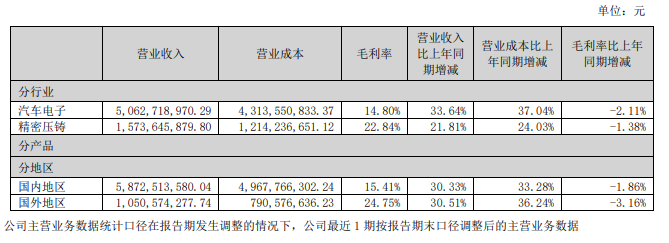
In the first half of 2026, the automotive electronics business continued to grow, achieving revenue of 5.063 billion yuan, up 33.64% year on year, mainly driven by high growth in sales revenue from product lines such as HUD, screen displays, and in-car wireless charging, and significant revenue growth from customers such as Geely, Changan, Seres, Xiaomi, Li Auto, and Leapmotor. However, gross margin continued to decline, to 14.8%, down 2.11 percentage points year on year.
Precision Die-Casting Business Keeps Growing, Gross Margin Declines. HuaYang Group's precision die-casting business began in 2003. Centered on precision mold design and manufacturing technology, the business has key process technologies for die-casting multiple alloys such as aluminum, magnesium, and zinc, and has built comprehensive processing capabilities in high-pressure die-casting, machining, welding, surface treatment, and product assembly, forming an integrated precision mechanical product manufacturing system. Its products are currently mainly used in the automotive field and are being expanded into AI, robotics and other fields.
In the automotive field, the company has built three major product matrices. Among them, the thermal management product line covers multi-in-one motor liquid-cooled housings, on-board charger liquid-cooled housings, domain controller liquid-cooled housings, and on-board water-cooled radiators; the power control system product line covers components for vehicle power, steering, braking, and body control systems; the intelligent automotive electronics system product line covers components for intelligent cockpits, assisted driving and other systems.
HuaYang Group's precision die-casting business scale is not particularly prominent in the industry, lagging behind Aikodi and Guangdong Hongtu, but its profitability is relatively excellent, with higher gross margins. Some brokerage institutions have pointed out that the reason may be that aluminum alloy precision die-casting parts are non-standard products designed and produced according to customers' specific technical parameters. The higher the precision, the greater the processing difficulty and the labor and processing costs consumed—and the greater the added value per unit product.
From 2023 to 2025, the precision die-casting business achieved revenue of 1.66 billion yuan, 2.065 billion yuan, and 2.859 billion yuan, up 25.42%, 24.39%, and 38.47% year on year, respectively. Gross margins trended downward, at 26.11%, 25.67%, and 23.89%, respectively.
In the first half of 2026, the precision die-casting business continued to grow, achieving revenue of 1.574 billion yuan, up 21.81% year on year, mainly benefiting from rising magnesium alloy demand driven by lightweighting of new energy vehicles and robotics, as well as the continuous expansion of the AI computing power industry chain. Sales revenue from the company's magnesium alloy and zinc alloy product lines achieved high growth, and sales revenue from components such as transmission systems, braking systems, display screen brackets, optical communication modules, and high-speed connectors increased significantly year on year. Revenue from customers such as Bosch, Molex, and Nidec grew significantly. However, gross margin still maintained a declining trend, at 22.84%, down 1.38 percentage points year on year.
It can be seen that although HuaYang Group's two core businesses maintain growth, gross margins continue to decline, adversely affecting profits. This is mainly because the current domestic auto market has entered a stage of stock competition. Affected by multiple factors such as price competition, rising upstream raw material prices, and exchange rate fluctuations, industry profitability continues to come under pressure. The company's response strategy is to closely monitor market changes, enhance strategic cooperation with key component suppliers and optimize supply chain management, strengthen production and sales coordination, and reduce the risk posed by the upstream supply chain to the company's production and operations.
Cumulative R&D Investment Exceeds 3.1 Billion Yuan Over Five Years; Control May Change
HuaYang Group adheres to R&D and innovation as its core driving force and has built R&D advantages in fields such as software, hardware, optics, algorithms, integration, precision mechanisms, precision molds, and precision manufacturing. Its product and technology iteration capabilities continue to improve, which is inseparable from high-intensity R&D investment.
Cumulative investment exceeds 3.1 billion yuan over five years. From 2021 to 2025, HuaYang Group's R&D expenses were 347 million yuan, 417 million yuan, 606 million yuan, 764 million yuan, and 926 million yuan, respectively, with cumulative investment exceeding 3.1 billion yuan over five years. R&D expense ratios were 7.74%, 8.35%, 8.49%, 7.52%, and 7.1%, respectively.
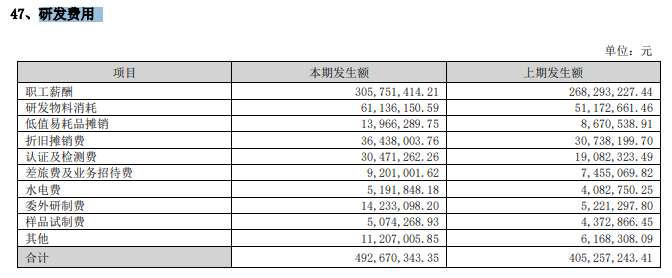
Entering 2026, the company continued to strengthen R&D investment. In the first three quarters, R&D expenses were 767 million yuan, up 16.19% year on year, while the R&D expense ratio fell to 6.85%. Employee compensation is a major expenditure, with the interim report amount and proportion at 306 million yuan and 62.06%, respectively.
As of the end of 2025, the company had 2,926 R&D personnel, accounting for 30.86%. The company has built R&D bases with collaboration across multiple locations including Huizhou, Chongqing, Shanghai, Xi'an, Dalian, and Wuhu, and owns one national-level industrial design center (HuaYang General), multiple high-tech enterprise subsidiaries, and multiple provincial-level enterprise technology centers/engineering technology research centers. As of the end of June, it had 1,034 valid patents, including 464 invention patents, with invention patents accounting for 44.87%. Deep technical accumulation enables products to be iterated and updated in a timely manner to meet downstream demand, while also laying a solid foundation for the company to continuously extend its application fields to AI, robotics, two-wheeled vehicles, and others.
According to disclosures, the company has led or participated in the formulation/revision of more than 40 national standards, industry standards, and group standards, covering multiple key areas such as automotive head-up displays (HUD), camera monitor systems (CMS), in-car navigation and audio-visual systems, information security of intelligent connected vehicle on-board terminals, road traffic information collection, automotive die-casting technology standard measurement, and lightweight technology for humanoid robots.
Good operating quality, rising asset-liability ratio. HuaYang Group's operating quality is acceptable. From 2021 to 2025, operating cash flow was 469 million yuan, 339 million yuan, 442 million yuan, 590 million yuan, and 1.057 billion yuan, respectively, and the cash content of net profit was 157.07%, 89.03%, 95.14%, 90.55%, and 135.28%, respectively.
In 2026, operating quality declined somewhat. In the first three quarters, operating cash flow was 358 million yuan, down 32.96% year on year, mainly due to an increase in cash paid for goods purchased and services received. The cash content of net profit was 58.16%, compared with 95.2% in the same period last year.
It is worth noting that HuaYang Group's asset-liability ratio has generally shown an upward trend in recent years, rising from 35.57% at the end of 2021 to 51.11% at the end of 2025, and further rising to 55.43% in the first three quarters of 2026. At the end of the period, monetary funds and trading financial assets were 597 million yuan and 73 million yuan, respectively, while short-term borrowings and long-term borrowings were 131 million yuan and 677 million yuan, respectively, and non-current liabilities due within one year (mainly long-term borrowings due within one year). The scale of interest-bearing debt is not small, and the resulting interest expenses cannot be underestimated. In the first three quarters, they were 42.7197 million yuan, up 42.36% year on year, accounting for about 6.88% of net profit. Reducing leverage needs to be put on the agenda.
Change of control in progress. HuaYang Group's controlling shareholder is Huizhou Huayue Investment Co., Ltd. (Huayue Investment), with a shareholding ratio of 51.6%. There are multiple actual controllers—Zou Ganrong, Zhang Yuanze, Wu Wei, Li Daoyong, Chen Shiyin, Li Guanghui, Zeng Renwu, and Sun Yongdi, eight people in total. However, the company's control may change.
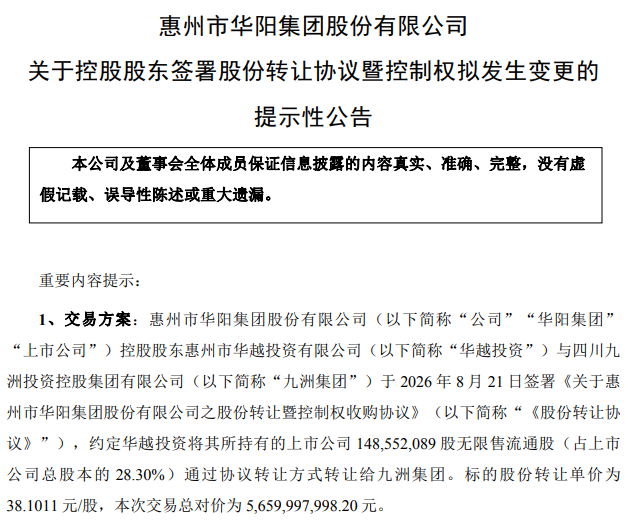
On August 21, Huayue Investment signed an Equity Transfer Agreement with Sichuan Jiuzhou Investment Holding Group Co., Ltd. (Jiuzhou Group), agreeing that Huayue Investment would transfer 148,552,089 shares of the company (accounting for 28.30% of the total share capital of the listed company) to Jiuzhou Group by way of agreement-based transfer, at a transfer price of 38.1011 yuan per share, with total consideration of 5,659,997,998.20 yuan.
If the transaction is completed, HuaYang Group's controlling shareholder will change from Huayue Investment to Jiuzhou Group, and the actual controller will change from Zou Ganrong, Zhang Yuanze, Wu Wei, Li Daoyong, Sun Yongdi, Chen Shiyin, Li Guanghui, and Zeng Renwu to the Mianyang Municipal State-owned Assets Supervision and Administration Commission.
The aforementioned equity transaction is still subject to approval from the competent state-owned assets supervision authority, a compliance confirmation opinion from the Shenzhen Stock Exchange, and share transfer registration procedures with China Securities Depository and Clearing Corporation Limited. There is no certainty that the relevant approvals will be obtained or as to the timing of such approvals, nor is there any certainty that the transaction can ultimately be implemented and completed.
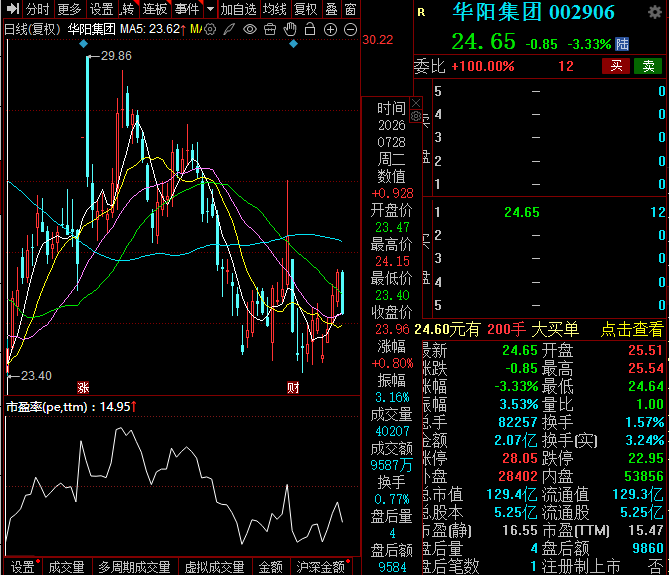
News of the proposed change of control had a relatively limited effect on lifting the company's share price. The stock hit the daily limit on August 24, then fell sharply the following day. Since then, the share price has been highly volatile and has generally trended downward. The closing price on November 12 was RMB 24.65 per share, well below the aforementioned equity transfer price, with a total market capitalization of RMB 12.94 billion and a trailing twelve-month price-to-earnings ratio of 15.47 times.
(Short, Punchy Analysis — original content. Please do not reproduce without permission. PS: If this article infringes any rights or contains inaccurate data, please contact us promptly for correction.)

-
![]()
Storage Costs Soar! Even DJI Feels the Pinch: Some Products to See Price Hikes Starting November 18
-
DJI Announces Price Adjustment: Selected Products to See Retail Price Increases Starting November 18
-
![]()
HUD and In-Car Wireless Charging Leader Posts Consecutive Profit Growth, Though Control May Change Hands
-
![]()
Commercial Space Sector Rushes Toward IPOs
-
![]()
Is Big Tech's Ultimate AI Goal to Spin Off and Go Public?
-
![]()
Nebius: The "Cool Kid" of New Cloud — Glossy on the Outside, Crawling with "Lice" Beneath
-
Tencent Isn't Planning to Lay Off 50% of Its Staff—It Wants Half Its Workforce on the AI Battlefield
-
![]()
Sales Plunge 40%, Two Years of BD Bonuses Canceled: What Prescription Will Dong Xiuhui Write for FAW-Volkswagen?