Revenue Under Pressure and a Quarterly Loss: Can AI Transformation Help Supcon Technology Turn Things Around?
 11/13 2026
 566
By Yang Jianyong
Industries across the board are actively embracing AI large models to drive transformation and upgrading. In industrial manufacturing in particular, large models are fueling steady gains in digitalization, automation, and intelligence—including the deployment of industrial robots—ushering in a new wave of industrial intelligence opportunities.
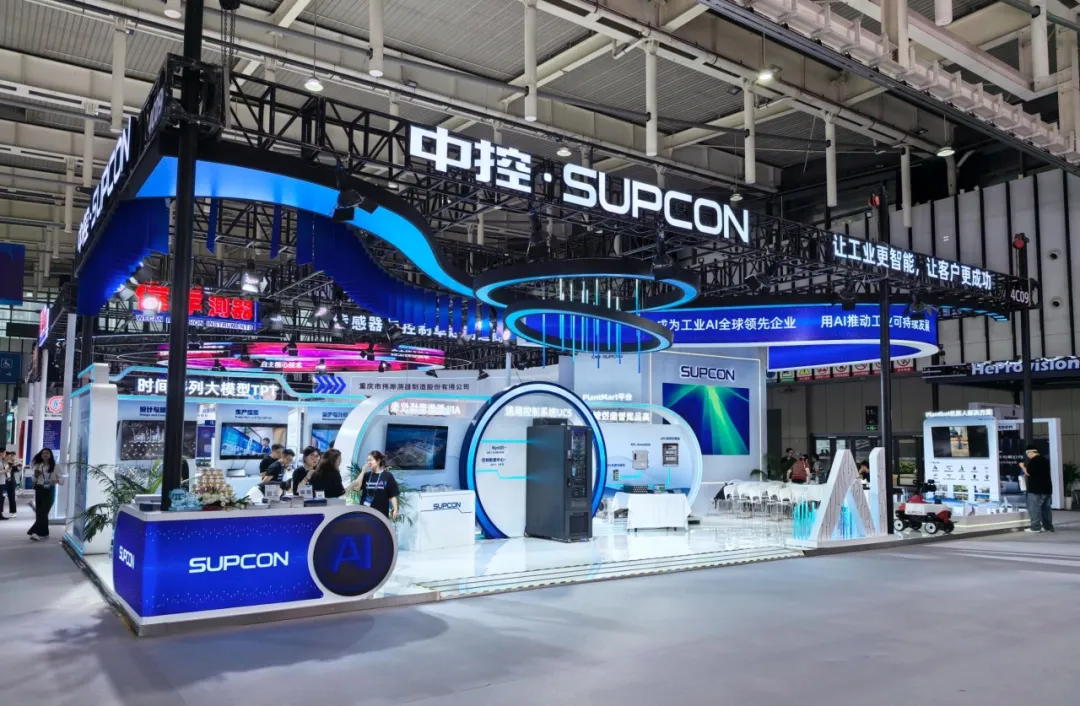
As one of the leaders in process automation, Supcon Technology set out its AI strategy as early as 2024 and launched TPT, a large AI time-series model for the process industry, embarking on a path of AI-driven industrial transformation. Yet revenue growth is currently weak, net profit has fallen sharply, and the company slipped into a loss in the third quarter of this year. Short-term performance is under pressure, placing a heavy burden on its industrial AI transformation strategy.
In the first three quarters of 2026, Supcon Technology reported revenue of 5.5 billion yuan, down 2.62% year on year, and net profit of 146 million yuan, down 66% year on year. To its credit, third-quarter revenue recovered slightly to 1.87 billion yuan, up 2.57% year on year—the first quarter this year with positive revenue growth, pointing to a trend of quarter-by-quarter improvement. Even so, it failed to reverse the profit decline and instead posted a loss of 9.47 million yuan for the quarter.
It is worth noting that the automation industry remains under pressure. Data from MIR Industry shows that in the third quarter of 2026, China's automation market was worth about 86 billion yuan, almost flat compared with the same period last year. However, the integration of industrial automation and industrial AI holds enormous room for market expansion. IDC predicts that by 2029, China's industrial AI market investment will reach 108.72 billion yuan.
Combining AI large models with industrial agents helps build a complete intelligent ecosystem, thereby fully unleashing industrial enterprises' demand for digital transformation and opening up new growth space for the industrial automation and industrial AI markets.
In the process industry automation segment, Supcon Technology has built deep industry expertise over more than 30 years, focusing on the automation, digitalization, and intelligence needs of the process industry. In response to the rise of large model technology, it is accelerating its transformation into an industrial AI company. Its strategy is to use industrial data as the foundation, AI large models as the core, and full-scenario agents as the touchpoints, leveraging AI to promote sustainable industrial development.
Because Supcon Technology has fully committed to developing its industrial AI business, innovative offerings such as the TPT time-series large model have gradually achieved large-scale commercial implementation. Industrial AI products and solutions such as the TPT time-series large model have been deployed at nearly 200 industrial units of leading enterprises, fully entering the stage of large-scale application.
Driven both by the continuous implementation of industrial AI and by the expansion of business scale, the revenue share of Supcon Technology's industrial AI business has risen to 11.2%, generating revenue of 620 million yuan in the first three quarters of this year—a phased achievement in the course of its industrial AI transformation.
The TPT large model is trained on real data that Supcon Technology has accumulated in the process industry over more than 30 years. It can genuinely "understand" the language of industry—for example, determining whether the temperature curve of a distillation column is abnormal and predicting when a compressor may fail. The TPT large model can be thought of as the factory's "brain," responsible for enabling the factory to operate autonomously: perceiving data in real time, analyzing and judging, and outputting control instructions. It is the core decision-maker in the production closed loop.
Most importantly, TPT's capabilities make it possible to build a variety of industrial agents—for example, agents that perceive the status of production units, evaluate operational performance, optimize production decisions, and execute operation control—forming a complete, full-link intelligent application system of perception–recognition–decision–execution. This improves the efficiency of each link in process industry manufacturing and accelerates the process industry's march toward intelligence.
Amid lackluster revenue this year, sharply declining profits, and accompanying losses, the commercialization of the TPT large model will be one of the factors that could help Supcon Technology break the deadlock. In addition, the deep integration of industrial AI and robotics technology—especially advanced technologies such as humanoid robots—is showing huge potential in manufacturing.
Overall, industrial enterprises have strong demand for new technologies. The combination of new technologies such as AI large models and big data, in particular, brings fresh momentum to industrial transformation and upgrading. For manufacturers that have long been deeply engaged in industrial automation and intelligent manufacturing, weathering the short-term pain of transformation is expected to usher in broader development space.
The views expressed are personal only. This article focuses on in-depth observation of technology fields such as large models, artificial intelligence, robots, the Internet of Things, cloud computing, and smart home appliances.
-
![]()
Shenzhen Adds Another 177 Billionaires: Fortunes Above 5 Billion Yuan
-
![]()
Revenue Under Pressure and a Quarterly Loss: Can AI Transformation Help Supcon Technology Turn Things Around?
-
![]()
3.182 Billion Yuan! Changan Lists 10% Avatr Stake for Transfer, Potentially Bringing in a New External Shareholder
-
![]()
Hesai "Crossing the Bridge"
-
Apple Doesn't Want to Keep "Winning by Lying Flat"
-
![]()
Apple's AI Glasses: Confirmed by a Supplier Slip-Up
-
![]()
Does a Higher Megapixel Count Mean Better Photos?
-
![]()
Storage Costs Soar! Even DJI Feels the Pinch: Some Products to See Price Hikes Starting November 18