3.182 Billion Yuan! Changan Lists 10% Avatr Stake for Transfer, Potentially Bringing in a New External Shareholder
 11/13 2026
 390
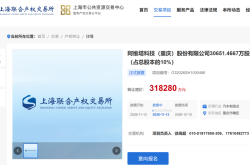
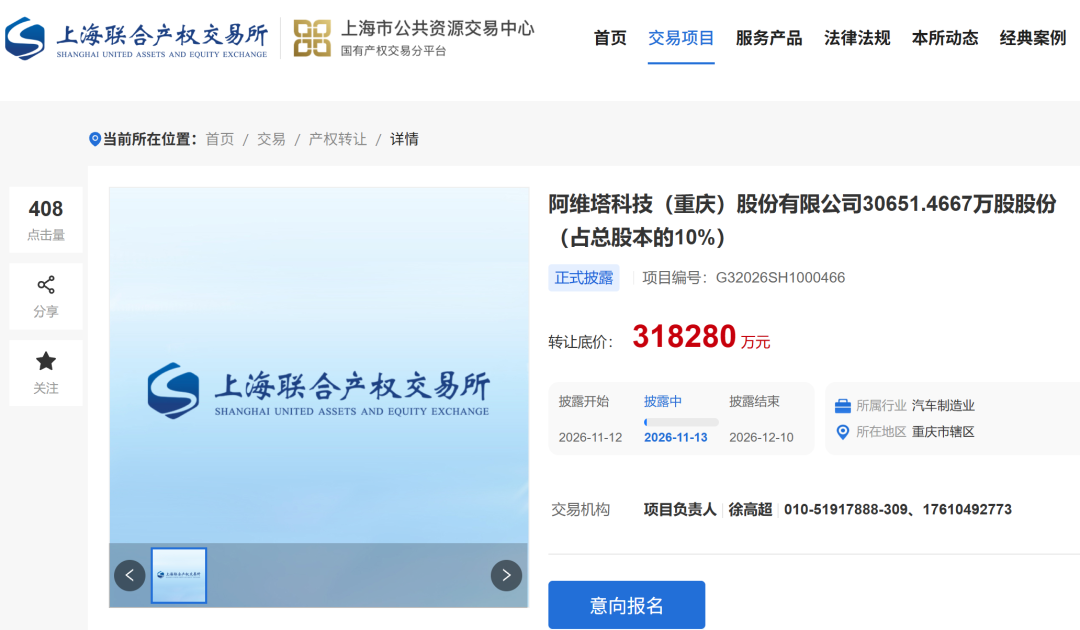
According to the Shanghai United Assets and Equity Exchange, Changan Automobile (000625) officially listed a 10% stake it holds in Avatr Technology (Chongqing) Co., Ltd. (hereinafter referred to as Avatr) for transfer starting November 12, with a listing price of 3.1828 billion yuan and a listing deadline of December 10.
Not long ago, on October 28, Avatr announced the cancellation of the online launch event for the Avatr 07L Max pure electric version and released an internal video explaining the decision. In the video, Avatr Vice President Yong Jun and several other Avatr executives held a meeting to discuss the marketing strategy for the new car. Several executives put forward multiple proposals, but all were rejected by a woman in blue in the video shouting "no money." The incident immediately sparked concerns among netizens about Avatr's financial situation.
The two events, coming one after the other, pushed Avatr further into the spotlight. We cannot help but ask: what exactly is going on with Avatr?
Avatr: Rising with Favorable Winds
As early as 2018, Avatr's predecessor—Changan NIO New Energy Automobile Technology Co., Ltd.—was already registered and established, with a registered capital of 98 million yuan. The shareholders were Changan and NIO, each holding a 50:50 stake. At that time, NIO, as a new force in carmaking, enjoyed high prestige across the automotive sector and was regarded as a representative of the new energy vehicle field, known together with XPeng and Li Auto as "NIO, XPeng, Li Auto." Meanwhile, Changan Automobile and other state-owned enterprises were widely recognized as lagging in the fields of new energy and intelligentization, with insufficiently flexible decision-making and not timely enough market response. The two sides forming a joint venture meant that Changan Automobile initially wanted to leverage the strength of the new carmaking force NIO to jointly develop new energy vehicles.
In fact, it was not only Changan Automobile that had this idea; GAC Group did as well. In December 2017, GAC and NIO announced the establishment of the joint venture GAC NIO, with each side holding 45% and employees holding 10%. In May 2019, the two sides officially jointly released the new brand "Hycan." In December of the same year, Hycan's first car, the Hycan 007, was officially released. Unlike GAC NIO, which officially released a new car, Changan NIO did not release any new car before changing its name to Avatr.
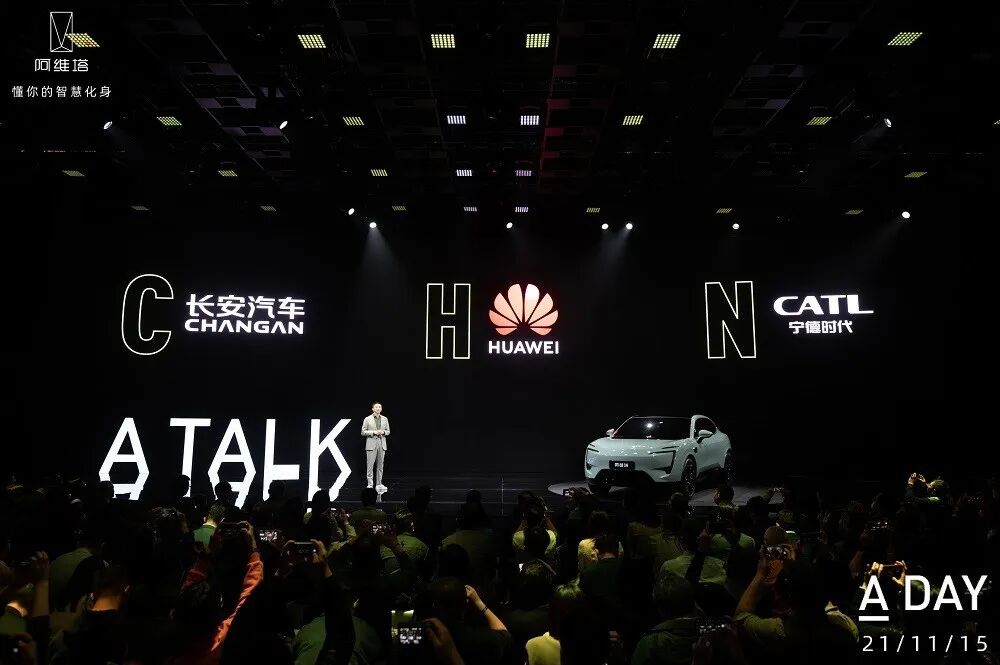
In 2020, Changan increased capital in Changan NIO for the first time, and NIO's equity was diluted to 4.62%, with NIO's Li Bin stepping down as chairman. In May 2021, Changan NIO was renamed Avatr. It was listed in August of that year, and in November it introduced new shareholder CATL. NIO's stake was further diluted to 1.13%, until NIO completely exited in September 2025.
Similarly, GAC NIO also failed to hold on to the end. In 2021, Guangdong Zhu Investment Intelligent (Zhu Yihang / Zhujiang Investment) injected 1.923 billion yuan, taking a 68.56% stake and becoming the largest shareholder. Neither GAC nor NIO followed with additional investment, and their equity was diluted. In 2022, NIO completely exited. In January 2025, Hycan substantively collapsed, and GAC Group, as a shareholder, provided a backstop for employee placement and compensation.
NIO Chairman Li Bin once publicly interpreted the positioning of GAC NIO and Changan NIO: "GAC NIO and Changan NIO can be understood as two other NIOs. Manufacturing will be the responsibility of the parent company's investment entities. For example, GAC NIO is produced by GAC, and Changan NIO is produced by Changan. They are also responsible for the main product R&D and operation and maintenance services. However, the positioning and price range of the products produced by these two entities will be lower than NIO's, because they target the broader mass market."
This also proves that whether it was Changan or GAC, their hasty establishment of joint ventures with NIO had a somewhat forced flavor. In the end, the cooperation between the two sides fell through, mainly because NIO faced its own funding pressure after 2019 and its market performance fell far short of expectations, leaving it with no time to attend to the two joint ventures and forcing it to withdraw midway. As a result, the two companies began to seek their own ways forward.
Unlike GAC NIO's complete "collapse," Changan NIO turned to another storyline. In 2020, Changan took the initiative to increase capital; in 2021, the company was renamed Avatr and introduced CATL as its second-largest shareholder. In the renaming announcement, Changan Automobile stated: Avatr Technology will operate in a fully market-oriented manner, with independent operations and independent development, joining hands with Changan Automobile, Huawei, and CATL to create together.
However, in actual operations, Huawei has its own "Five Realms" and "Two Borders" to manage, and within the automotive industry it still has multiple automotive partners besides Avatr. Among them, for example, Seres has a cooperation model that highly overlaps with Avatr and is the first project of Huawei's "Five Realms," with an obviously high priority.
In addition, Huawei also has multiple partners including Voyah, Arcfox, and Mengshi. Therefore, it would probably be difficult to get Huawei to significantly tilt resources toward Avatr, or even make it "exclusive." CATL, as the industry's largest power battery supplier, supplies a large number of automakers across the entire industry, and it is also difficult for it to make an exclusive tilt toward Avatr alone. Under multiple constraints, Avatr's growth still fundamentally depends on its own product and operational capabilities.
In April 2025, rumors circulated that "Avatr is downplaying Huawei and abandoning Huawei." In response, former Changan Automobile Chairman Zhu Huarong publicly refuted the rumors and explained the origin of the name "Avatr": "Many people ask me why Avatr has a foreign name. In fact, it is a homophone of 'An Wei De' from Changan, Huawei, and CATL—it is 100% Chinese in body, Chinese in heart, and Chinese in soul." This means that Avatr has from beginning to end been unable to change its desire to actively rely on external forces in core technologies and even product definition.
This means that even the later Avatr, just like Changan NIO at the beginning, reflected Changan Automobile's desire to borrow the shine of private enterprises Huawei and CATL to develop Avatr. But the result was that, just as Changan failed to borrow NIO's shine back then, Huawei and CATL's "full support" for Avatr did not make Avatr smooth sailing.
Cumulative Losses Exceeding 13.2 Billion Yuan Over Four Years, with Sales Continuing to Decline
On November 27, 2025, Avatr submitted an application to the Hong Kong Stock Exchange for listing under Chapter 18C for specialist technology companies, planning to complete IPO fundraising by issuing new shares.
According to the prospectus, from 2022 to 2025, Avatr recorded losses of 2.016 billion yuan, 3.693 billion yuan, 4.018 billion yuan, and 3.489 billion yuan for the year, respectively, with cumulative losses exceeding 13.2 billion yuan over four years. Sustained losses have made Avatr's operating conditions highly controversial.
In terms of sales, Avatr's sales from 2023 to 2025 were 20,021 vehicles, 61,588 vehicles, and 122,702 vehicles, respectively. In the first 10 months of 2026, according to data provided by Yiche, Avatr's cumulative wholesale volume was 40,036 vehicles, less than half of the previous year's total sales.
According to Avatr's earlier plan, it aimed to achieve global sales of 400,000 vehicles and annual revenue of 100 billion yuan by 2027; global sales of 800,000 vehicles by 2030; and challenge global sales of 1.5 million vehicles by 2035. But judging from the current actual situation, Avatr will clearly find it difficult to accomplish this task.
Looking at Huawei, the partner Avatr had hoped to rely on, although Avatr has publicly called out to it many times, Huawei has never taken a stake in Avatr. Instead, in August 2024, Avatr spent a huge sum of 11.5 billion yuan to purchase a 10% stake in Huawei's subsidiary Yinwang Information. With real money being invested in Yinwang on one side and sluggish sales on the other, capital returns falling short of expectations further pressured Avatr's cash flow.
According to public information, Avatr is seeking a Hong Kong listing through the Hong Kong Stock Exchange's specialist technology listing channel. This special channel covers five major fields: next-generation information technology; advanced hardware and software; advanced materials; new energy and energy conservation and environmental protection; and new food and agricultural technology. Companies of this type do not need to meet the traditional main board profitability requirements, but the review standards for R&D, technology, cash flow, and customer dependence are stricter.
Now, with Avatr's first listing application having lapsed after its six-month validity period expired and failing to complete the hearing smoothly, and the second A1 application also approaching the end of its validity period, at this critical juncture, Avatr's largest shareholder Changan Automobile announced the listing and transfer of a 10% stake, which inevitably invites much speculation.
According to data from the China Association of Automobile Manufacturers, from January to October this year, China's passenger vehicle production and sales reached 22.688 million and 22.622 million units, respectively, down 6.4% and 6.6% year on year. In terms of profit, in the first three quarters of this year, the automotive industry's profit margin further dropped to 3.3%, compared with 4.1% last year and 7.8% in 2017.
Multiple industry insiders pointed out that the automotive market situation in 2027 will not be optimistic. That is to say, looking at the market trend ahead, not only Avatr but the entire market will face severe pressure.
As for the Avatr brand, its cumulative wholesale volume in the first 10 months of this year was only about 40,000 vehicles (Yiche data), equivalent to only about one month's sales of the privately owned companies NIO, Xiaomi, and Li Auto, which are already listed in Hong Kong. If this sales performance is used as a reference against "NIO, XPeng, Li Auto," which are also listed in Hong Kong, it is clearly difficult to win investors' confidence. This means that whether Avatr can successfully IPO in Hong Kong still carries great uncertainty.
Media reports said that regarding Changan Automobile's listing and transfer of a 10% stake in Avatr this time, Avatr Technology's response was: it is unrelated to Avatr Technology's IPO.
"As the brand enters a stage where premiumization and globalization proceed in parallel, our core demand has shifted from funding support to industrial resource coordination that matches our product lineup and overseas layout," Avatr Technology said. The investor to be introduced this time will focus on providing assistance in areas such as premium brand channel building and overseas market expansion.
-
![]()
Shenzhen Adds Another 177 Billionaires: Fortunes Above 5 Billion Yuan
-
![]()
Revenue Under Pressure and a Quarterly Loss: Can AI Transformation Help Supcon Technology Turn Things Around?
-
![]()
3.182 Billion Yuan! Changan Lists 10% Avatr Stake for Transfer, Potentially Bringing in a New External Shareholder
-
![]()
Hesai "Crossing the Bridge"
-
Apple Doesn't Want to Keep "Winning by Lying Flat"
-
![]()
Apple's AI Glasses: Confirmed by a Supplier Slip-Up
-
![]()
Does a Higher Megapixel Count Mean Better Photos?
-
![]()
Storage Costs Soar! Even DJI Feels the Pinch: Some Products to See Price Hikes Starting November 18