Cerebras: Supply and Demand Are Both Fine — the Fab Is the "Big Headache"
 11/16 2026
 338
Cerebras (CBRS.O) released its Q3 2026 financial report (quarter ended September 2026) after the U.S. market close in the early morning of November 13, 2026 Beijing time. Key points are as follows:
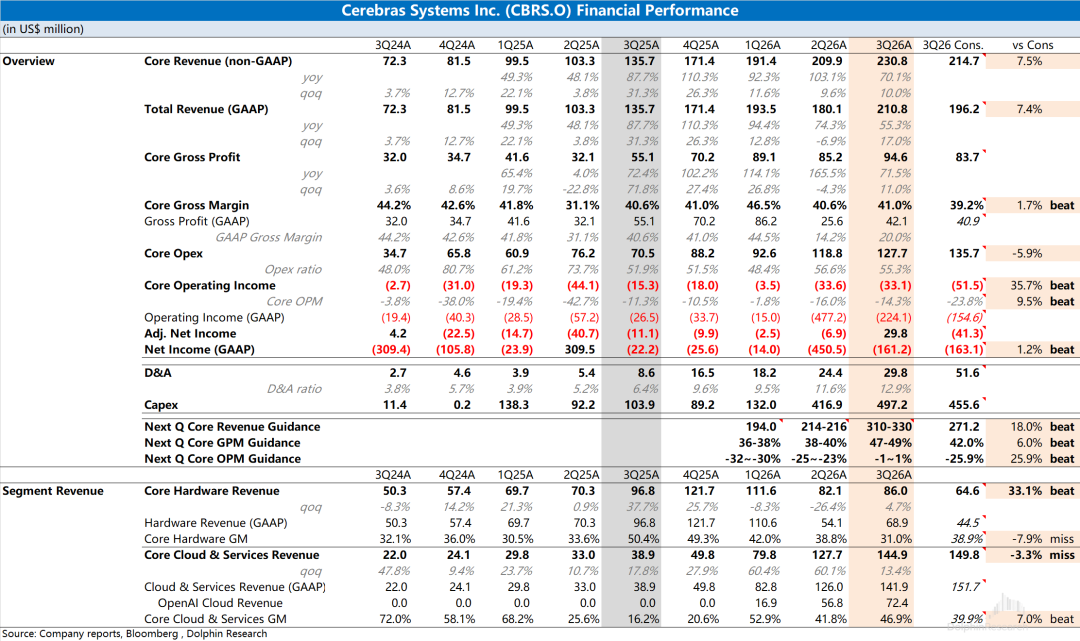
1. Guidance: Cerebras expects Q4 2026 core revenue (definition see below) of $310–330 million, with the midpoint up about 39% quarter-over-quarter, significantly better than market expectations ($271 million);
Core gross margin of 47%–49% (market expectation 42.0%), with the midpoint up 7pct quarter-over-quarter.
Core operating margin guidance is -1% to 1%, with the Core operating level essentially breaking even in Q4.
For 2027, management reiterated that Cerebras revenue will grow to more than 3 times this year's level (based on this year's guidance midpoint of $950 million, roughly corresponding to $2.85 billion, versus market expectation of $2.98 billion), with gross margin moving toward the long-term target of 60% and operating margin progressing toward the long-term target of 40%.
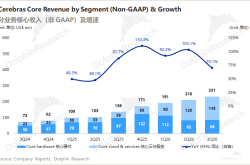
2. Core data: Cerebras' Core revenue this quarter was $231 million, up 70% year-over-year, above the upper end of company guidance ($214–216 million), exceeding guidance for the third consecutive quarter.
By structure, cloud service revenue increased 13% quarter-over-quarter, and hardware revenue increased 5% quarter-over-quarter. The beat this quarter mainly came from hardware, as Core hardware revenue halted its decline.
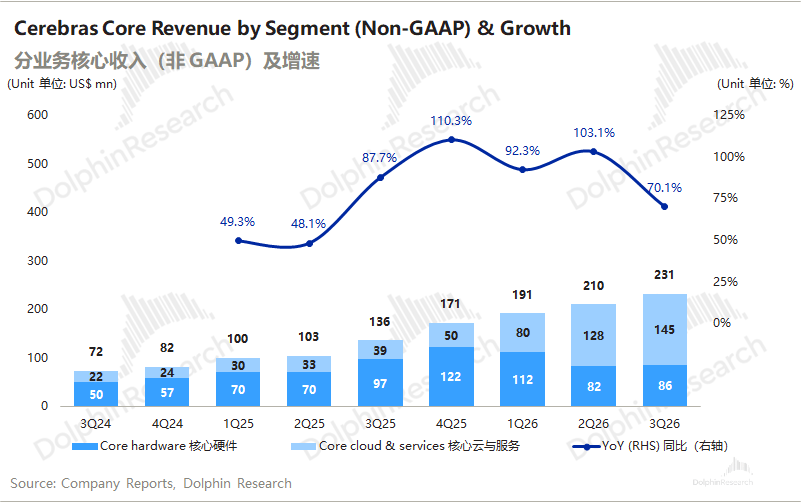
Under GAAP, company revenue this quarter was $211 million, up 55% year-over-year, better than market expectations ($196 million). The difference from Core revenue mainly came from customer warrant amortization (a $36 million reduction to revenue) and OpenAI data center pass-through revenue ($16 million).
Note: Core revenue = revenue (GAAP) + customer warrant amortization - pass-through revenue; pass-through revenue refers to the company selling chips to two Saudi customers, then leasing cloud services based on Cerebras chips from the Saudi customers, and reselling the cloud services to OpenAI.
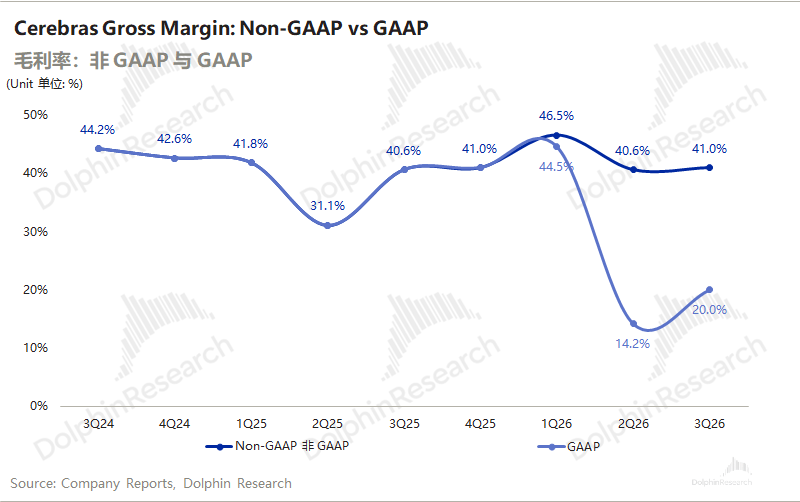
The company's Core gross margin this quarter was 41.0%, up 0.4pct quarter-over-quarter, above the upper end of guidance (38%–40%). The company had previously expected Q3 to be the trough in gross margin (to release inference capacity as quickly as possible, the company leased back its own systems from customers at relatively high leaseback costs). Actual conditions were better than expected, and the gross margin trough arrived early in Q2.
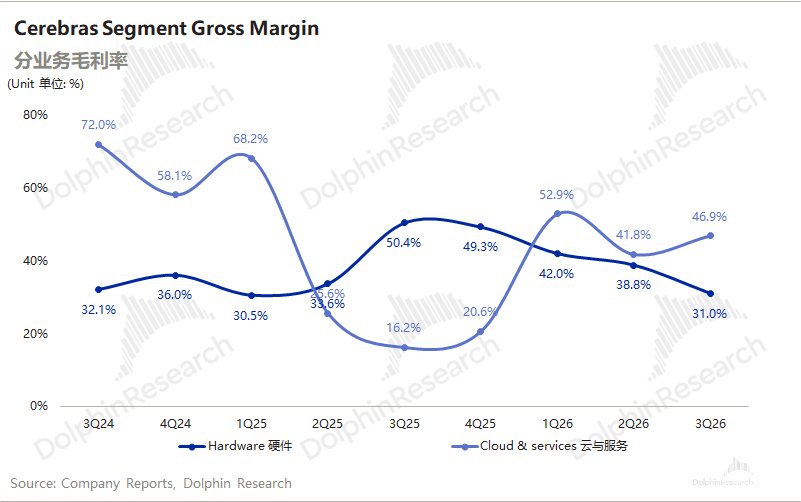
By business, Core gross margin for cloud services was 46.9%, up 5.1pct quarter-over-quarter, mainly due to higher pricing and gross margin on newly signed business; Core gross margin for hardware fell to 31.0%, mainly due to delivery of the last batch of orders under a preferential pricing agreement signed in 2025 with a major customer (MBZUAI or G42), combined with rising raw material costs and inventory impairment.
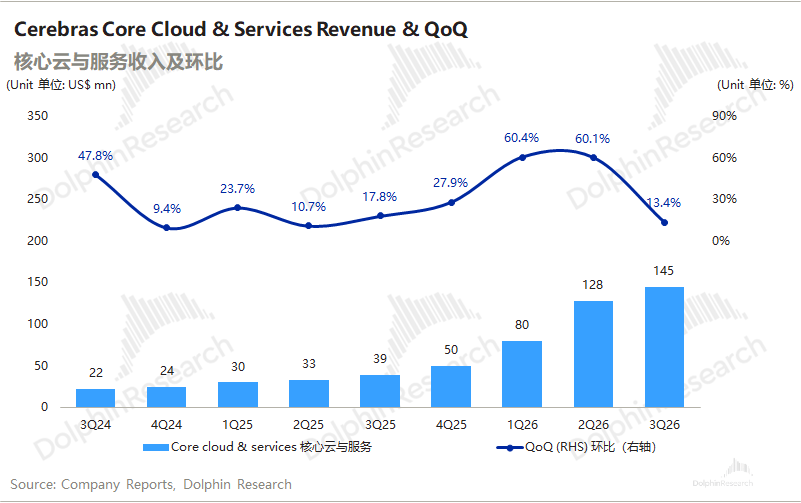
3. Specific business situation: Cerebras' business is divided into cloud services (Cerebras Cloud) and hardware sales (CS series systems). Cloud services have become the largest revenue source, accounting for 63% of Core revenue this quarter.
Core cloud service revenue this quarter was $145 million, up 13% quarter-over-quarter, essentially all from OpenAI's incremental contribution. Management believes cloud revenue growth is entirely limited by data center capacity construction timelines, unrelated to pricing and demand, with current demand far exceeding supply. Newly added data center capacity will only begin ramping in December, with limited contribution to Q4 revenue, so next quarter's cloud revenue guidance is flat quarter-over-quarter.
Core hardware revenue was $86 million, up 5% quarter-over-quarter, better than market expectations ($65 million). Hardware orders signed with several new customers (including Oracle) will begin shipping in Q4 and continue at least through the first half of 2027. Hardware revenue's share will rise to about 50% in Q4 and Q1 next year.
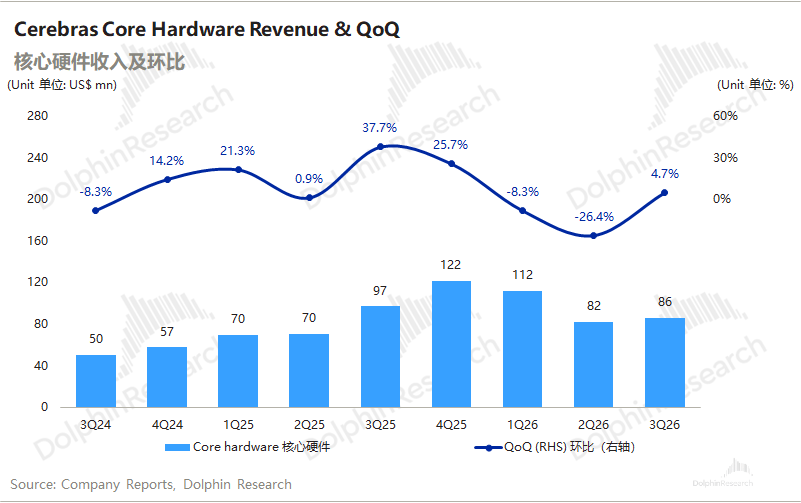
By customer structure, OpenAI contributed $72 million in revenue this quarter (including data center pass-through revenue), up $16 million quarter-over-quarter. Related parties MBZUAI and G42 together accounted for 45% (MBZUAI 38%, G42 7%), and the top three customers together accounted for about 79%, so customer concentration remains very high.
On orders, the company's remaining performance obligations (RPO) were $26.1 billion, up $700 million quarter-over-quarter, most of which still came from OpenAI's 750MW contract ($20 billion+).
Note that ① new orders signed after the end of Q3 (including the relatively large Oracle order) have not yet been included; ② the proportion expected to be recognized within the next 24 months (through September 2028) increased from 22% in 2Q to 33% ($5.6 billion -> $8.6 billion), with 44% recognized in months 25–48 ($10.9 billion -> about $11.5 billion), pulling more orders forward.
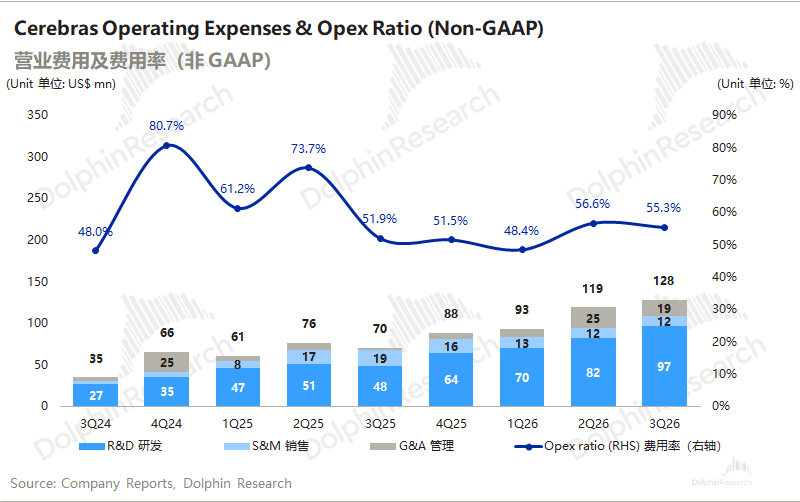
4. Operating expenses and profit: The company's Core operating expenses this quarter were $128 million, up 81% year-over-year, including R&D expenses of $97 million, roughly doubling year-over-year. The Core operating expense ratio was 55.3%, remaining stable.
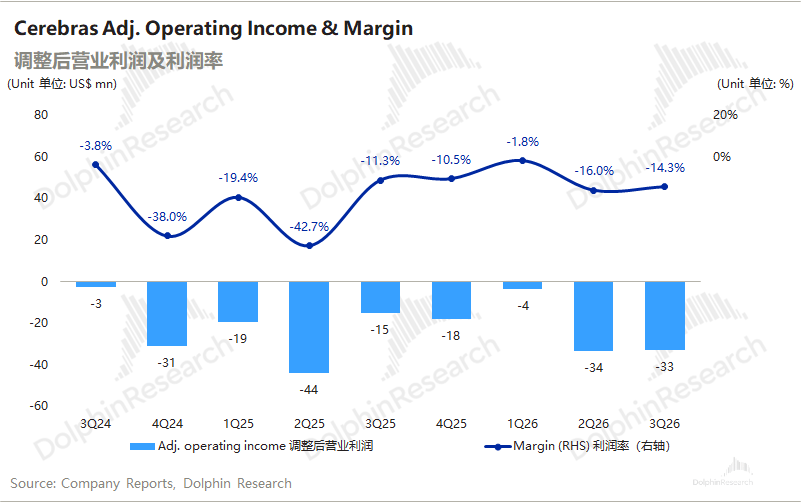
Core operating loss this quarter was $33 million, with an operating margin of -14.3%, improving 1.7pct quarter-over-quarter and better than market expectations (-23.8%).
Supported by interest income from the company's $7.8 billion in cash-like assets (interest and dividend income of $82 million this quarter), Core net profit turned positive to $30 million, the first time the company achieved profitability on a Core basis since going public.
GAAP net loss was $161 million, basically in line with market expectations (-$163 million), mainly affected by stock-based compensation and warrant amortization.
Dolphin's overall view: Chips are not the problem; the bottleneck is data centers
Cerebras' results this quarter and guidance for next quarter are both quite good, with core profitability turning positive and incremental growth mainly from hardware. However, the cloud business was dragged down by delays in data center capacity construction, with next quarter's revenue flat quarter-over-quarter.
Looking at the gross margin trend, from 41% in Q3 to the Q4 guidance of 47%–49%, the company's earlier comment that "3Q is the gross margin trough" has already played out ahead of schedule.
The Q4 gross margin jump, according to the company's explanation, comes on one hand from new hardware orders delivered at current higher prices (Q3 hardware gross margin was only 31.0%, dragged down by the last batch of old orders); on the other hand, newly signed cloud service business has higher pricing. Management expects Core gross margin to exceed 50% in the short term and continue moving toward the long-term target of 60%.
In response to market concerns that "low hardware gross margin indicates yield problems," management specifically explained: TSMC's wafer yield and parametric yield are both very high; the low hardware gross margin was only due to manufacturing capacity ramp-up and early customer preferential-price orders, and hardware gross margin is expected to improve significantly in the coming quarters.
What the market was really focused on this quarter was not the Q3 data, but the following aspects:
a) OpenAI relationship and orders: OpenAI is Cerebras' current largest single customer and main source of RPO. The two parties have signed a 750MW take-or-pay contract, plus another 1.25GW of optional capacity.
Regarding OpenAI, management responded directly this time:
① The relationship has not changed; Cerebras simply lacks capacity and cannot support broader rollout;
② The problem lies in delivery progress. After signing, the time required to secure data center capacity has been longer than expected, and delivery of the initial batches of capacity has fallen behind the contract schedule. The delays mainly come from land, power, and machine rooms. The company says there is no problem with chip and complete-system supply.
The company has already deducted an estimated worst-case offset in RPO, and expects less than 5% of total contract capacity could be cancelable this year. It has not received any cancellations so far and expects to return to the contract schedule in the second half of 2027;
③ Under the contract, OpenAI has the right to switch cloud services to direct hardware purchases, but its own data center progress is also behind; the two parties have not yet begun discussions on the 1.25GW option (going live from 2029).
Management acknowledged that OpenAI will use multiple hardware solutions to build compute, and OpenAI has also announced in-house inference chips and begun preliminary testing, positioned as a low-latency inference solution.
Regarding rumors that "Cerebras systems cannot run large models," management explicitly denied them, saying that CS-3, CS-4, and CS-5 can all support frontier-scale and even larger models.

b) New customers and hardware orders: Over the past six months, the company has won three hyperscale cloud providers, and hardware demand has begun spilling over from OpenAI to hyperscale CSPs and neoclouds:
① Microsoft (new): announced a cloud service partnership (with Cerebras providing cloud inference services), details to be announced in the first half of 2027, with revenue contribution beginning then. The contract includes milestones that must be met before service launch;
② Oracle: purchasing Cerebras hardware to deploy in its U.S. data centers as a fast inference service for OCI, expected to go live in summer 2027;
③ Amazon AWS: purchasing hardware in a finance-lease style. A cooperation agreement was signed in June, starting with leasing Cerebras systems for deployment in AWS data centers, including subsequent purchase options, minimum manufacturing capacity guarantees, and exclusivity clauses. The Trainium+CS-3 disaggregated inference solution is expected to launch on Bedrock in Q1 2027;
④ neocloud: Gimlet Labs plans to deploy 100MW (first shipments in 2026, using CS-4 from 2027), and General Compute has signed a multi-year hardware purchase agreement.
The currently disclosed $26.1 billion RPO is still mainly OpenAI's large order. The company has not disclosed the scale or recognition pace of Oracle and Microsoft orders, nor have they been included in current RPO.
Hardware revenue "follows delivery cadence and is not continuous." Whether new orders can translate into sustained growth in 2027 will depend on subsequent full guidance.
c) Capacity and facility resources: The company previously said, "Demand is not the constraint, chip supply is not the constraint, the constraint is data centers," and this was even more evident this quarter.
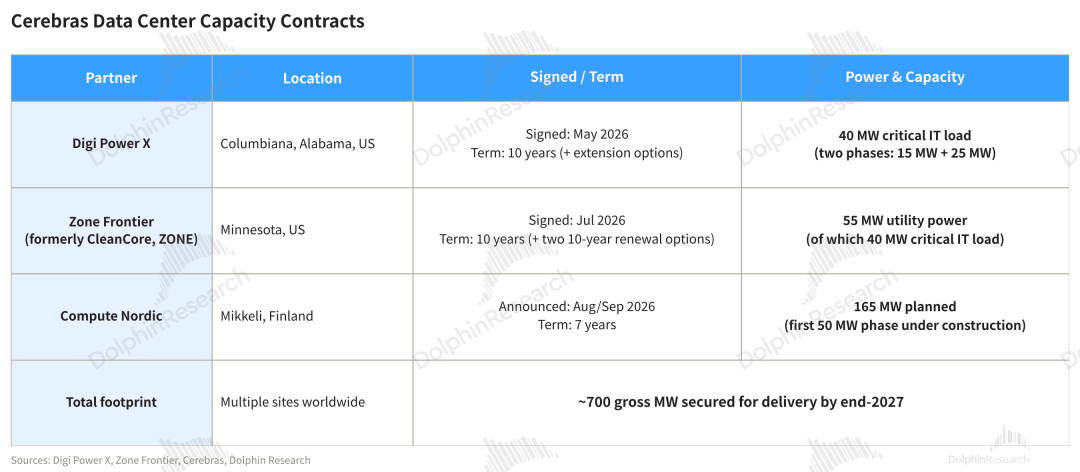
Next quarter's cloud revenue guidance is flat quarter-over-quarter, which the company explains is due to delays in data center construction. The company has now locked in about 700MW (gross capacity) of data center capacity, to be delivered by the end of 2027 (previously more than 600MW).
Considering that the policy environment for U.S. data center construction may tighten, more than 75% of the company's data center capacity going live in 2027 is located outside the United States: new facilities in Canada, France, and Norway will go live in the coming months. This quarter, the company also signed new capacity in Norway and Finland, and its Sao Paulo, Brazil data center has entered the final signing stage.
Because its in-house chips do not require paying a third party about 70% gross margin, nor expensive HBM, the company's capex per MW is lower.
Since the 750MW order signed between Cerebras and OpenAI will be delivered before the end of 2028, we use 2028 as the valuation anchor. Dolphin Research estimates that Cerebras' core revenue in 2028 will be $8.5 billion, of which core hardware revenue will be $2.3 billion and core cloud revenue will be $6.2 billion.
We assign a core OPM of 35% to the hardware business and a core OPM of 28% to the cloud business, with a tax rate of 14%. The hardware business contributes $700 million in after-tax OP, and the cloud business contributes $1.5 billion in after-tax OP.
We assign 25x PE and 20x PE to the hardware business and cloud business in 2028, respectively, considering that by the end of 2028 another $7 billion will need to be borrowed for investment. Adding the two parts together (deducting $7 billion) and discounting back (at a 15% discount rate), the neutral valuation corresponds to roughly $30 billion.
In terms of share supply, the company's IPO lock-up is being released in 11 tranches, most of which had already been lifted by the end of September. Management confirmed on this earnings call that the lock-up expired entirely on November 9. The selling pressure from the phased unlock has been fairly fully reflected in the share price, and the supply-side overhang has largely been removed.
Overall, this is an earnings report featuring a "double beat" on results and guidance: the gross margin inflection point arrived one quarter earlier than the company's guidance, and the Core operating level is about to turn profitable; at the same time, the addition of Microsoft and Oracle has begun to spread customers toward hyperscale cloud, easing market concerns about "relying only on OpenAI."
Of course, there is one slight "blemish": the short-term beat is mainly driven by hardware, whose delivery pace is unstable, while the cloud business is constrained by data center capacity, and deliveries under the OpenAI contract have already been somewhat delayed. The market would rather see the cloud business scale up, as that is more sustainable.
Dolphin Research believes that the after-hours surge is more of a recovery reflecting the double beat on both results and guidance and the clearing of share supply, which can improve the market's outlook on the company's performance.
The company's strategic focus has already shifted to the cloud business, which can also bring greater valuation opportunities. At present, the only major customer the company has landed in the cloud segment is still OpenAI. Securing more large CSP cloud orders going forward could further create opportunities for the company to achieve a double upgrade in both performance and valuation.
- END -
// Reprint permission
This article is an original article by Dolphin Research. Authorization is required for reprinting.
// Disclaimer and general disclosure notice
This report is intended only for general comprehensive data use, aimed at general reading and data reference by users of Dolphin Research and its affiliates, and does not take into account the specific investment objectives, investment product preferences, risk tolerance, financial situation, or special needs of any person receiving this report. Investors must consult independent professional advisers before making any investment based on this report. Anyone who makes investment decisions based on the use of or reference to the content or information mentioned in this report must bear the risk themselves. Dolphin Research shall not be liable for any liability or loss that may arise directly or indirectly from the use of the data contained in this report. The information and data contained in this report are based on publicly available materials and are for reference only. Dolphin Research strives for, but does not guarantee, the reliability, accuracy, and completeness of the relevant information and data.
The information mentioned or views expressed in this report shall not, in any jurisdiction, be treated as or regarded as an offer to sell securities or an invitation to buy or sell securities, nor do they constitute advice, solicitation, or recommendation regarding the relevant securities or related financial instruments. The information, tools, and materials contained in this report are not intended or intended for distribution to citizens or residents of any jurisdiction where the distribution, publication, provision, or use of such information, tools, and materials would conflict with applicable laws or regulations or would cause Dolphin Research and/or its subsidiaries or affiliates to be subject to any registration or licensing requirements in that jurisdiction.
This report reflects only the personal views, opinions, and analytical methods of the relevant creators and does not represent the position of Dolphin Research and/or its affiliates.
This report is produced by Dolphin Research, and the copyright belongs solely to Dolphin Research. Without the prior written consent of Dolphin Research, no institution or individual may (i) produce, copy, reproduce, republish, forward, or otherwise make any form of copy or reproduction in any way, and/or (ii) directly or indirectly redistribute or transfer it to other unauthorized persons. Dolphin Research reserves all related rights.
-
Auto Market News: October NEV Penetration Exceeds 50% Across All Segments
-
![]()
Avatr's Valuation Under the Microscope: Monthly Sales Fall Below 3,000 Vehicles
-
![]()
Big Tech's Hunt for "ByteDance Time"
-
![]()
Mazda's Struggle and Transformation: A Case Study in Survival for Second-Tier Automakers | Cover Story: Japanese Automakers at the Crossroads of Transformation (Part VI)
-
![]()
Top 10 SUVs by Sales Are All Feeling a Bit Nervous Now
-
![]()
Eldest Son Returns with a Price Hike: Is AITO Using the New M8 to Take On the 9 Series?
-
![]()
Cerebras: Supply and Demand Are Both Fine — the Fab Is the "Big Headache"
-
![]()
Waymo vs. Tesla: How Far Has the Robotaxi Battle Come—and Will Automakers Become the Foxconn of Cars?