Big Tech's Hunt for "ByteDance Time"
 11/16 2026
 527
Source | Shenlan Finance
Before the debate over "ByteDance Time" has even settled, JD.com is already preparing to wade into the short drama business.
Recent media reports indicate that JD.com is quietly beta-testing a standalone short drama product called "JD Drama Benefits Club," built on a free-to-watch model. The product description lays out the business model plainly: watch dramas to earn rewards and discounts, and purchase items featured in those dramas directly. This should come as no surprise—JD.com had already begun recruiting short drama operations talent at annual salaries reaching into the millions of yuan, explicitly stating its goal of pursuing IP incubation and user conversion.
Another telling signal: in recent months, top internet players have been entering the short drama arena one after another. In September this year, WeChat launched Green Bubble Short Dramas, going head-to-head with ByteDance in the space. In early November, Alibaba was also reported to be ramping up its short drama investments, beta-testing a video generation Agent.
Looking further back, internet companies have been moving into this space for some time. Content platforms such as Kuaishou, Baidu, Youku, iQIYI, and Tencent Video staked their claims early on; e-commerce and delivery platforms including Taobao, Meituan, Pinduoduo, and JD.com have since joined the fray.
As big tech hunts for "ByteDance Time," a "hundred-group war" over short dramas is quietly beginning to smell of gunpowder.
1 Last year they fought over your meals; this year, over your next episode
As big tech pushes the battlefield toward short dramas and "encircles" ByteDance, a sharper voice has also surfaced: Chinese internet technology companies have been working on AI for so long—so why are they still making entertainment?
A remark that once sparked heated discussion put it this way: "American AI is doing scientific research, while Chinese AI only feeds binge-worthy dramas." The data behind it came from short drama giant Chinese Online: AI short dramas have become the largest Token consumption scenario, with AI short dramas and video generation ranking first among all domestic Token consumption shares, accounting for as much as 55%.
Although this claim is overly one-sided and conflates computing power with token consumption, it is undeniable that AI short dramas are currently the largest application scenario for domestic AI implementation. There is no other consumer-facing scenario in the world that allows video generation models to be invoked, fed back, and monetized at such density.
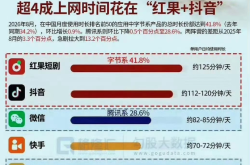
Hongguo has already put this appeal on the table. In the earlier debate around "ByteDance Time," frequently cited QuestMobile data showed that Hongguo Short Dramas had 168 million daily active users—more than the combined total of iQIYI, Youku, Tencent Video, and Mango TV. Hongguo app's average daily usage time per person was 125 minutes, ahead of Douyin, WeChat, Kuaishou, and Xiaohongshu, ranking first.
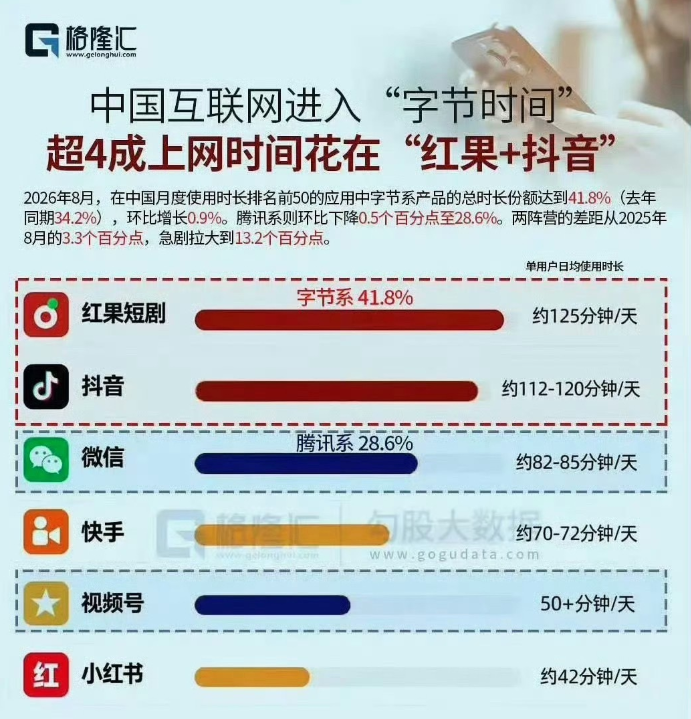
With such a big traffic pie, who wouldn't be tempted?
So when internet giants collectively enter AI short dramas, on the surface they appear to be chasing a new content outlet worth hundreds of billions—but in essence, it is a fight for traffic, a treatment of short dramas as a leverage tool that can simultaneously solve "loss of user time" and "anxiety over transaction conversion."
For internet companies, traffic equals commercial value. Users are not only users of products but also the source of commercial value. From the most basic advertising sales or redirecting to e-commerce, to value-added services such as paid content—all come from platforms converting users' attention and consumption demand into revenue.
Last year's fiercely fought food delivery war was essentially also a fight for traffic. Food delivery is worth fighting over because it is frequent enough: home appliances can be replaced once every few years, but people eat every day. At the time, JD.com admitted that doing food delivery was about using this high-frequency entrance to bring traffic and user growth to JD.com and drive its core retail business.
Short dramas are an even stronger play than the food delivery war because short dramas do not even need to wait for mealtime. You can watch during lunch break and continue before bed. When one episode ends on a cliffhanger, the next episode can start within seconds.
Against the backdrop of overall internet traffic hitting a ceiling, AI short dramas are the most prominent and fastest-growing incremental market in today's internet traffic business. According to DataEye data, in 2025 the domestic market size of micro short dramas and animated dramas reached 100 billion yuan, up 98% year on year, with nearly 700 million users—already surpassing movie box office to become a new track in content consumption.
On the supply side, AI has also given short dramas a push. The emergence of AI has greatly lowered the content production threshold and cost of short dramas. There is no need to hire actors, no need for costumes, makeup, and props, and even less need for special effects and post-production. A few people and a hundred thousand yuan are enough to produce a finely made AI short drama work. Take the recently explosively popular "Armed Into Song" as an example: an ordinary person made it entirely by hand, and the computing cost for ten seasons totaled just over 1 million yuan—about 100,000 yuan per season—yet it brought in tens of millions in revenue. For live-action short dramas, the cost of a single title is usually more than 500,000 yuan.
This also explains why the phrase "Chinese AI only feeds binge-worthy dramas" spread so quickly. AI brought more people to the table, and hit titles brought more viewers into Hongguo. Once the flywheel started turning, it also pushed AI short dramas into a phenomenon everyone could feel—and conveniently turned it into a judgment about the entire industry.
2 Different paths, different calculations
Internet giants are all rushing into short dramas, but this posture still differs from the "hundred-group war" of years past.
Although they are all fighting for traffic, each company's calculations are not the same.
The first type is content platforms, whose calculation is "defense."
WeChat, iQIYI, Youku, Tencent Video, Mango TV, Baidu, Kuaishou, Bilibili, and others belong to this category. This is the core of the short drama battlefield and the group most impacted by Hongguo. For these platforms, making short dramas is more a defensive move than a way to make money from short dramas—in order to keep their own traffic from being siphoned away.
Tencent's path and logic are extremely similar to ByteDance's, both striving for a closed loop across the entire chain of "content production–distribution–monetization." ByteDance uses Tomato Novels to supply IP, Seedream and Jimeng to provide technical tools, and Douyin and Hongguo to ignite traffic; Tencent uses China Literature and public accounts to supply IP, and the WeChat ecosystem and Green Bubble for distribution.
But the difference is that Tencent's short dramas are not made as a standalone app, but use mini-programs embedded directly into the WeChat ecosystem, leveraging WeChat's 1.439 billion monthly active users, social relationship chains, and fragmented scenarios to compete for the immersive drama-watching time that ByteDance occupies with algorithms and content.
The second type is e-commerce platforms, whose calculation is conversion and traffic diversion.
For e-commerce platforms, making short dramas is not about content, but about advertising. Their ultimate goal is only one: transaction conversion.
Take JD.com, which entered this time, as an example. Its purpose in entering short dramas is also very direct: to drive traffic and sales for e-commerce. JD.com's supply chain is its advantage. If it can truly connect the chain of "short drama sales–supply chain fulfillment–warehousing and logistics," its conversion efficiency will be its greatest confidence.
Taobao and Pinduoduo are also taking this route. Pinduoduo launched "Duoduo Has Good Dramas," also using free short dramas to attract users and inserting product-seeding sales videos. Taobao has set up a short drama zone within its site, embedding brand information into stories to drive product exposure and consumer conversion.
The third type is calculating "selling shovels."
In addition to Taobao, multiple business units under Alibaba are actually entering short dramas, but they operate separately, and their short drama layout is not actually that deep.
However, in November, Alibaba made a key move: beta-testing the Looogen video generation Agent. It can not only take a one-sentence request, but also run through script episode breakdown, storyboarding, materials, dubbing and music, and final cut. It can also integrate video analysis, script supermarket, asset design, video generation, film and television post-production, and all other steps into one workflow.
More importantly, unlike other short drama generation tools, it targets an industry pain point: data assets can all be stored locally.

This means Alibaba has begun shifting the battlefield from downstream short dramas to upstream short drama production tools.
As for whether this "selling shovels" business can grow big, it depends on whether characters remain consistent after the team generates more than a dozen episodes, whether repeated revisions will push costs back up, and whether the labor and time saved are worth customers continuing to pay.
3 Behind the bustle, two cold accounts must be reckoned with
Internet companies are crowding into short dramas, but behind the bustle, the numbers do not look good:
Short drama traffic has exploded, but few have actually made money.
DataEye data shows that among the 221,900 new AI dramas on the Douyin side in the first half of 2026, only 1,055 had playback volume exceeding 100 million—a rate of 0.48%—and only 1.3% reached the break-even reference line. In other words, 98.7% of AI micro short dramas cannot recoup their costs within half a year. On average, only 1 out of every 77 AI dramas can be profitable.
Has all the money been earned by platforms? That does not seem entirely true either. Although it was previously rumored online that Hongguo earned 40 billion yuan a year, Hongguo denied the data as inaccurate, saying most revenue continues to be used for revenue sharing with content creators, copyright minimum guarantees, and support for high-quality content.
The content side is also beginning to face tests. Formulaic and homogenized content, and the flood of low-quality content, have led to endless criticism of short dramas as "intelligence-lowering" and "electronic swill."
Zhejiang Propaganda also raised sharp questions about Hongguo itself: "Content with informational value is being squeezed out, while 'digital swill' produced on assembly lines instead gains the upper hand in distribution." "Making money by exploiting human weaknesses is harvesting; creating value by responding to human needs is business."
At present, regulators have already noticed the chaos in short dramas. According to Xinhua News Agency, the National Radio and Television Administration recently reiterated "support for live-action micro short dramas and regulation of AI micro short dramas," meaning it intends to improve the content quality of AI micro short dramas and prevent bad money from driving out good.
Platforms are also self-correcting. Starting in October, Hongguo phased out its coin function and launched rest reminders and sleep reminders.
4 Conclusion
When it comes to "ByteDance Time," besides Douyin, Hongguo Short Dramas deserves much of the credit. The debate about "ByteDance Time" initially asked how much time ByteDance—especially Hongguo—actually takes from users.
Now that the three major domestic e-commerce giants have also started making short dramas, this question should be asked of all the big tech companies entering the field.
Regulatory warning lights have already come on. For content platforms, it means the model of "piling up supply to grab time" is receding; for e-commerce platforms, it means that if trust in short dramas is consumed by bad dramas, shopping conversion will also be discounted.
In the end, the "hundred-group war" over short dramas is about whose app users will open next time. Big tech all want a share of "ByteDance Time," but users only have twenty-four hours a day. Whether the next episode is worth watching must be decided by quality and the audience.
*Cover: Still from *Avengers: Endgame*
*Disclaimer: The content of this article represents only the author's views. Markets carry risks, and investment requires caution. Under no circumstances does the information or opinions expressed in this article constitute investment advice to anyone.*
*The Shenlan Finance new media cluster originated from the Shenlan Finance reporter community and has a history of 16 years. It is a well-known domestic financial new media outlet. Its accounts focus on China's most valuable companies, frontier industry development, and emerging regional economies, providing valuable content for investors, listed company executives, and the middle class. Welcome to follow.*
-
Auto Market News: October NEV Penetration Exceeds 50% Across All Segments
-
![]()
Avatr's Valuation Under the Microscope: Monthly Sales Fall Below 3,000 Vehicles
-
![]()
Big Tech's Hunt for "ByteDance Time"
-
![]()
Mazda's Struggle and Transformation: A Case Study in Survival for Second-Tier Automakers | Cover Story: Japanese Automakers at the Crossroads of Transformation (Part VI)
-
![]()
Top 10 SUVs by Sales Are All Feeling a Bit Nervous Now
-
![]()
Eldest Son Returns with a Price Hike: Is AITO Using the New M8 to Take On the 9 Series?
-
![]()
Cerebras: Supply and Demand Are Both Fine — the Fab Is the "Big Headache"
-
![]()
Waymo vs. Tesla: How Far Has the Robotaxi Battle Come—and Will Automakers Become the Foxconn of Cars?