Waymo vs. Tesla: How Far Has the Robotaxi Battle Come—and Will Automakers Become the Foxconn of Cars?
 11/16 2026
 354
On November 13, Tesla opened personal orders for the Cybercab, priced at $29,990, plus a $299 monthly autonomous-driving subscription fee.
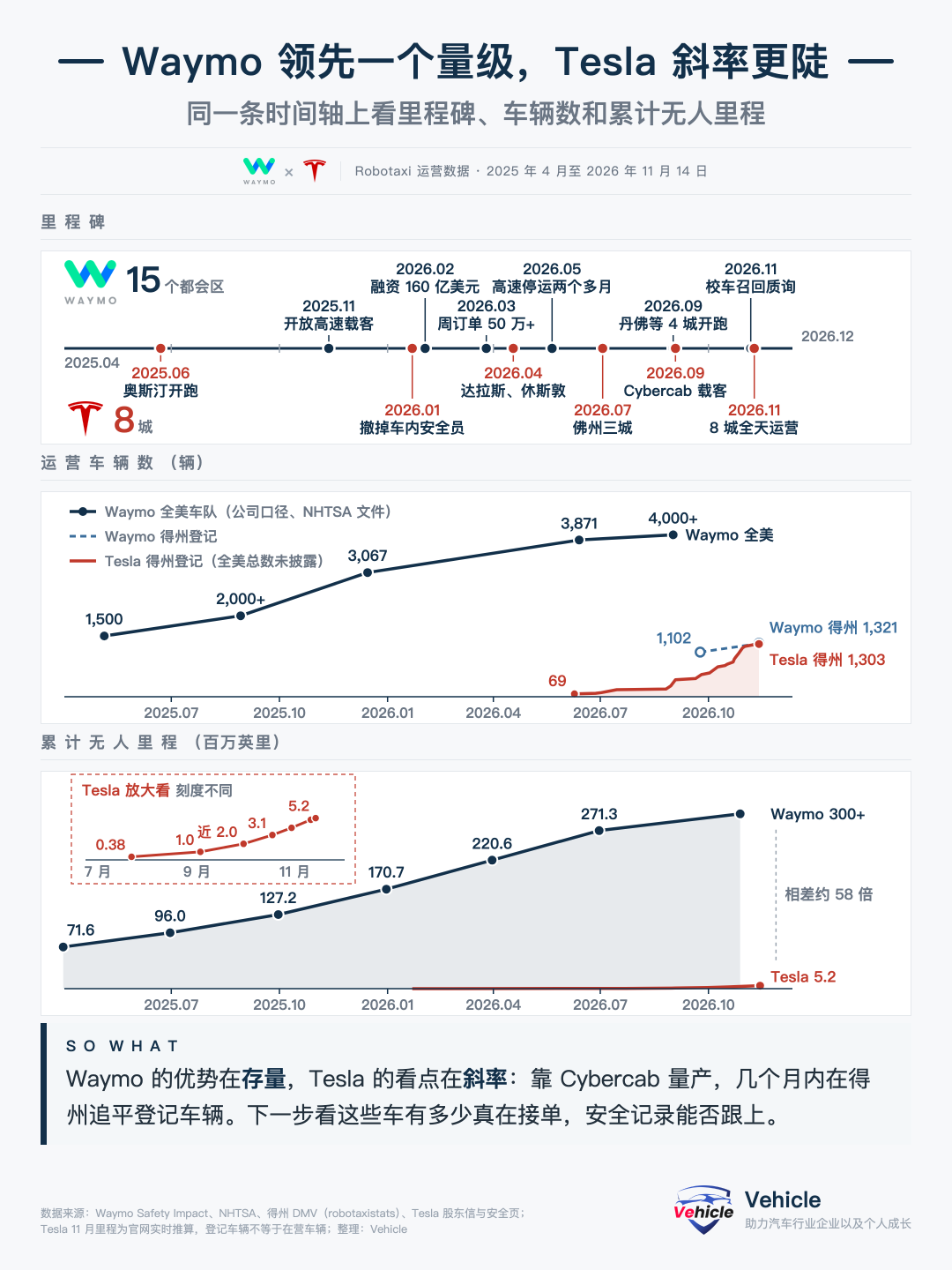
As of publication, Texas vehicle registration data shows 1,321 Waymo vehicles and 1,303 Tesla vehicles—though Tesla had only 69 on June 9.
In the latest update, Alphabet CEO Pichai said Waymo's cumulative driverless mileage has exceeded 300 million miles, while the comparable counter on Tesla's official website shows about 5.21 million miles—a difference of roughly 58 times.
These three sets of numbers capture the fundamentals of the Robotaxi industry at the end of 2026: Waymo leads by an order of magnitude in existing fleet, while Tesla has accelerated its growth rate through mass-produced vehicles and begun selling driverless cars directly to individuals.
So how far has the Robotaxi battle between Tesla and Waymo actually come? Which of these two technology paths is more likely to succeed? How high will Robotaxi penetration be in 2030 and 2035? Will automakers become the Foxconn of cars?
These are the questions of greatest concern in autonomous driving and the automotive industry.
In this article, we attempt to find answers through extensive research and offer some information and inspiration.
Source: Waymo Safety Impact, NHTSA, Texas vehicle registration data, Tesla shareholder letters and safety page; registered vehicles do not equal operating vehicles
Operations: Existing fleet differs by an order of magnitude, but Texas is already even
Waymo currently provides driverless passenger service in 15 U.S. metropolitan areas. Its fleet exceeded 4,000 vehicles on September 1, up from just over 2,000 a year earlier. The company announced more than 500,000 rides per week in March and has not updated since; there is still no evidence of reaching the 1 million rides per week by year-end target mentioned early in the year.
Tesla expanded from one city, Austin, to 8 cities in Texas and Florida in a year, and has operated all of them 24 hours a day since mid-November. Cumulative driverless mileage approached 2 million miles by the end of Q3 and exceeded 5 million miles around November 11. Of the 1,303 vehicles registered in Texas, 573 are Cybercabs that only began carrying passengers in September. Tesla has still not disclosed order volume, total fleet size, or disengagement rate.
Austin is the only city where a same-market comparison is possible. In the week ending October 18, Tesla drove about 438,000 driverless miles there, higher than Waymo's Q2 weekly average of about 406,000 miles.
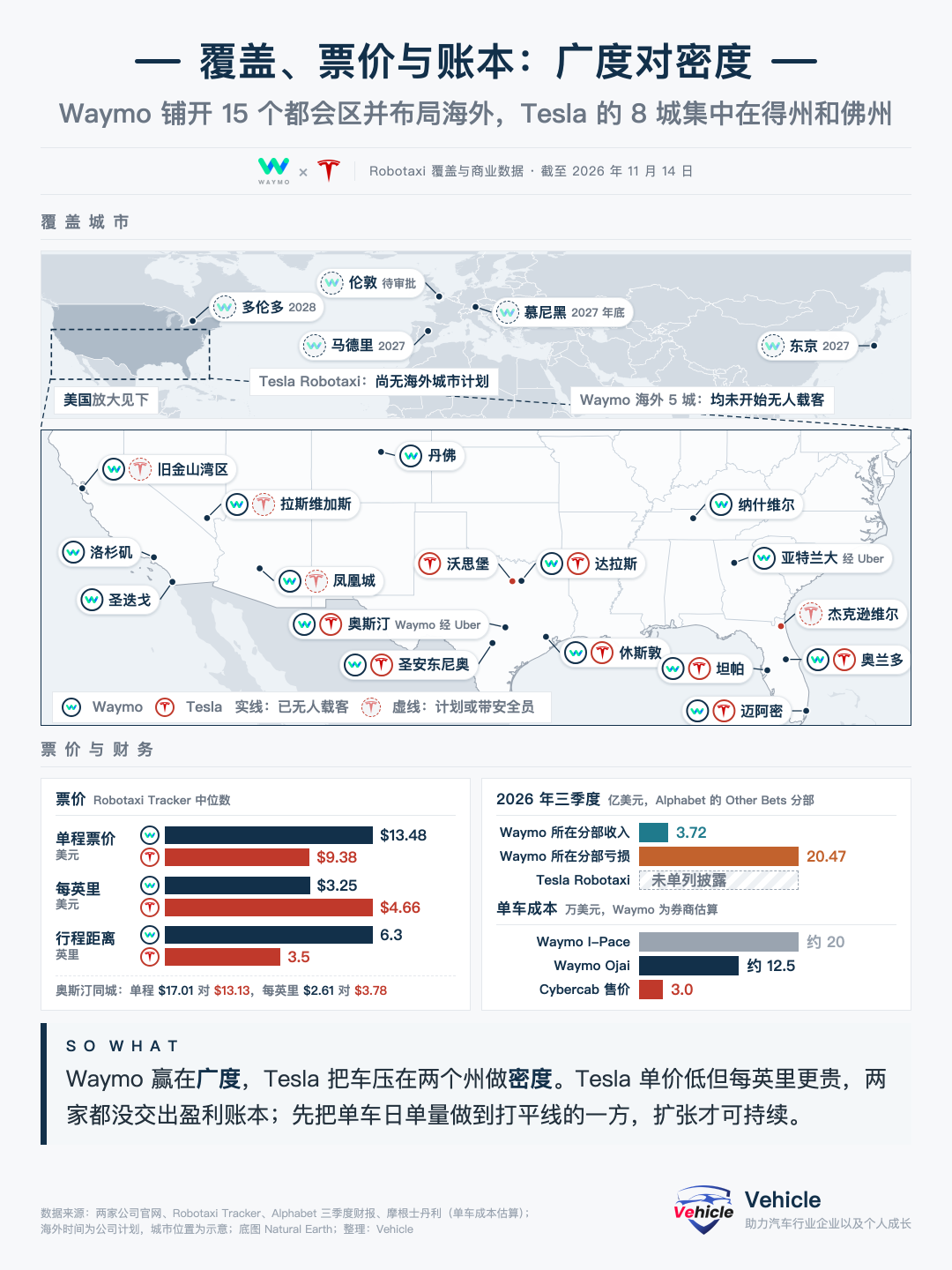
Neither company has opened its books. Waymo's Other Bets segment reported Q3 revenue of $372 million and an operating loss of $2.047 billion; Tesla's Robotaxi revenue is not broken out. Waymo has proven that driverless operations can be rolled out across more than a dozen cities, and Tesla has proven that vehicles can be stacked up within months, but neither has yet proven profitability.
Strategy: One exports a "driver," the other goes full-stack proprietary
Waymo defines itself as a driver that can be installed in different vehicles. Vehicles come from Zeekr, Hyundai, and Toyota; fleet operations are outsourced to partners such as Moove and Transdev; rides are available through both its own app and Uber.
It completed a $16 billion equity financing in February and secured a $5 billion term loan in October, beginning to use debt to finance its fleet. Media reports of internal plans point to 8,000 vehicles by the end of 2026 and 20,000 by the end of 2027.
Tesla takes the other end. Vehicles, chips, software, and operations are all its own, and annual capacity for the Cybercab at its Texas factory already exceeds 125,000 units. Management says most vehicles will remain in its own fleet, with owner vehicles expected to join around Q2 2027.
The personal-edition Cybercab can only drive driverlessly within geofences designated by Tesla; the monthly fee bundles software, cleaning, and remote support—effectively splitting car ownership into three things: hardware, subscription, and scope of use.
Source: company websites, Robotaxi Tracker, Alphabet Q3 financial report, Morgan Stanley; overseas timelines are company plans
Three changes have emerged simultaneously at the autonomous-driving Robotaxi industry level.
Break-even: Pony.ai's per-vehicle break-even point in Shenzhen is 23 rides per day; brokerage estimates put Waymo at about 21 to 22 rides in San Francisco; above 20 rides is the current empirical threshold.
Platforms: Uber has already integrated more than 30 autonomous-driving companies, with commitments to deploy about 120,000 vehicles; aggregator platforms have become a second path besides self-operation.
Regulation: school buses, construction zones, and flooding triggered recalls or suspensions within a year respectively; in early November, Waymo also received a recall inquiry from the U.S. National Highway Traffic Safety Administration (NHTSA) over school bus issues.
The focus of competition has shifted from "can it be driverless" to vehicle supply, daily rides per vehicle, and regulatory incidents.
Technology: From sensors to chips to algorithms
First, the similarities. Both use end-to-end large models, both use generative world models for simulation, and both distill cloud large models onto vehicles—this is also the consensus across the assisted-driving industry. However, the differences between Tesla's and Waymo's technology stacks mainly lie in the following three layers:
Sensors: Waymo's sixth-generation system has 13 cameras, 4 lidars, and 6 millimeter-wave radars, with three principles cross-checking one another; media reports say the entire hardware set has fallen below $20,000. The Cybercab has only 8 cameras, with distance and speed entirely inferred by neural networks; lidar is used only during training to collect ground truth.
Chips: Waymo's self-developed front-end chip has compute power above 1,000 TOPS, supplemented by general-purpose chips from Nvidia and AMD. Tesla does not disclose AI4 compute power; media estimates range from 100 to 500 TOPS, and the next-generation AI5 has been delayed to mid-2027. On the training side, Tesla's Cortex cluster has more than 225 megawatts installed; Waymo uses Google's TPUs, with scale undisclosed.
Algorithms: Waymo's model retains inspectable intermediate results such as objects, maps, and trajectories while training end-to-end, and an independent logic layer on the vehicle can veto trajectories. Tesla uses a single network: camera pixels go in, steering and acceleration/deceleration come out; intermediate outputs are used only for explanation, not in the control loop. Musk says v15's parameter count is about 10 times that of v14, without disclosing absolute figures.
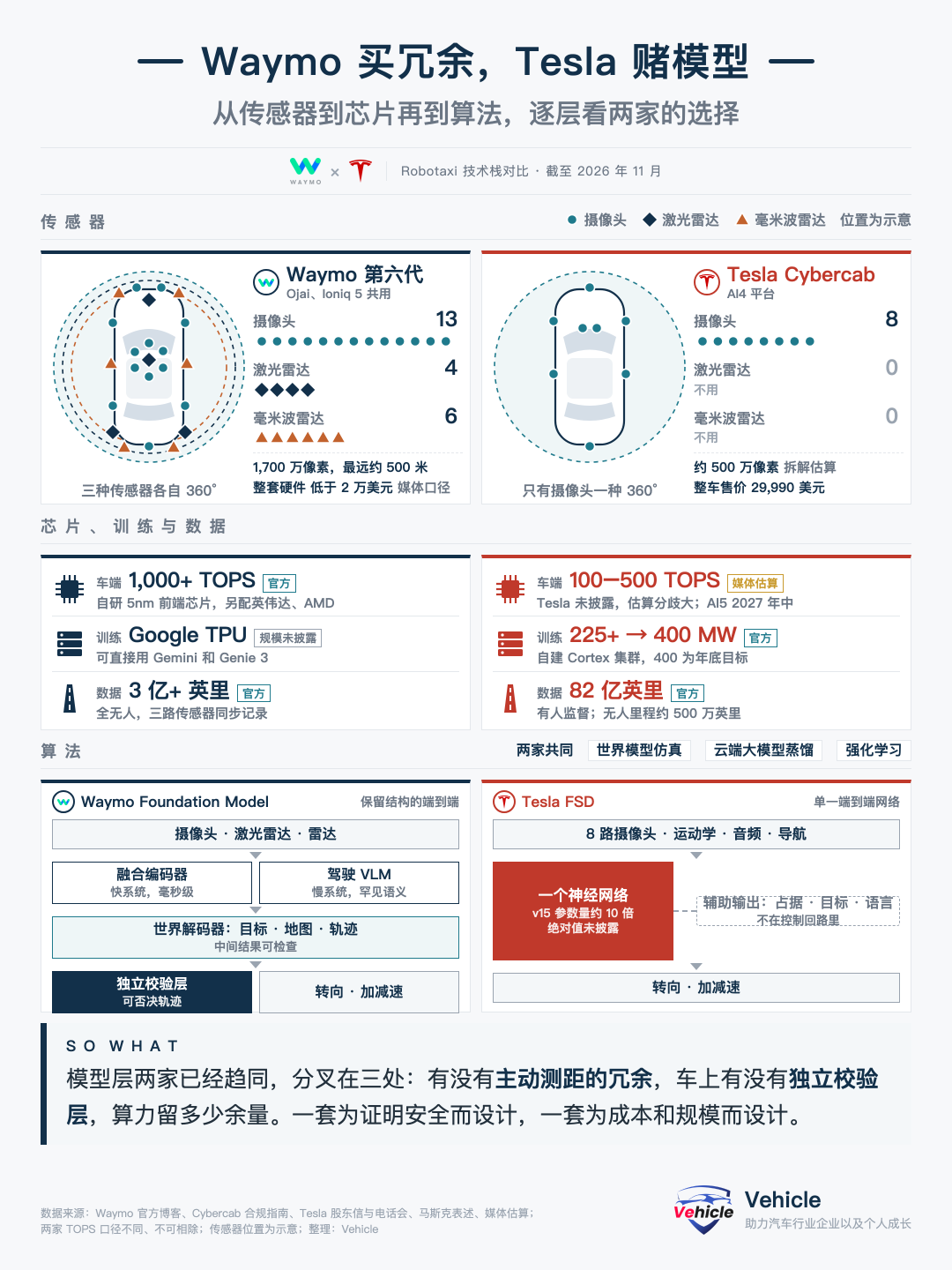
Source: Waymo official blog, Cybercab compliance guide, Tesla Q3 shareholder letter and earnings call, teardowns and media reports; the two companies' TOPS definitions differ
Data is also two kinds of assets. Tesla's supervised FSD has accumulated 8.2 billion miles of driving, with unmatched scenario diversity; Waymo's more than 300 million miles are all in driverless mode and recorded synchronously by three sensor modalities. One technology stack is designed to prove safety, the other to achieve cost and scale; almost all differences between the two stem from this.
Judgment: Waymo faces engineering problems, Tesla faces research problems
Breaking the technology stack into thirteen layers for item-by-item comparison, Waymo leads in perception robustness, compute headroom, verifiability, and safety evidence. Tesla's advantages lie in sensor cost, data scale, chip energy efficiency, and scalability; the two are close in training compute, simulation, and long-tail scenarios.
Lidar is not the decisive factor here. Waymo's three main incident types this year were water immersion, highway construction zones, and school buses; the sensors all saw them, but the system did not handle them correctly.
Tesla says the difficulty lies in intelligence, not perception. That is only half right: glare, fog, and dust fall precisely within the scope of NHTSA's investigation into pure vision solutions.
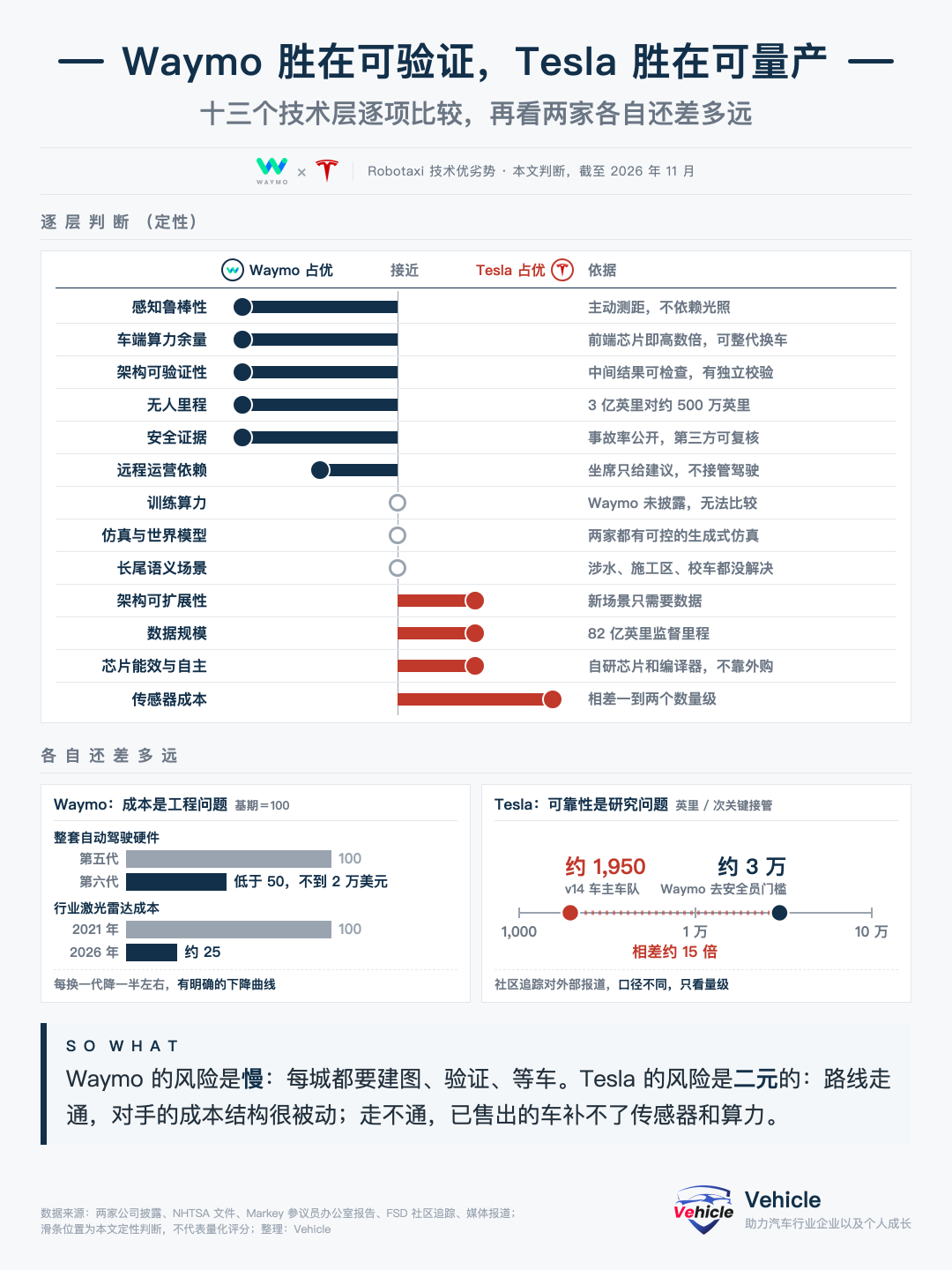
Layer-by-layer judgments are the views of this article; key disengagement mileage comes from community tracking and external reports, with differing definitions
Karpathy, Tesla's former AI head, offered a summary: Tesla has a software problem, Waymo has a hardware problem. This article judges that the difficulty of these two problems has become asymmetric. Waymo's hardware cost is declining along an engineering curve, with the sixth generation more than half cheaper than the previous generation.
What Tesla needs to fix is reliability: public forum tracking shows v14 experiences about one critical disengagement per 1,950 miles on owner fleets, while external reports put Waymo's threshold for removing safety drivers at about 30,000 miles. Although the two figures use different definitions, the direction of a gap of this magnitude is credible.
If Tesla's path succeeds, Waymo's cost structure will become very passive; if it fails, Tesla will need to add sensors or compute, and vehicles already sold cannot be changed. By the standard of achieving regulator-recognized driverless operations in most major U.S. cities before 2028, Waymo has a higher probability of winning; by the standard of lowest cost per mile after 2030, Tesla has a higher ceiling, provided it first passes the reliability test.
Projections: Penetration in 2030 and 2035
First, the fleet. Adding up disclosed figures, there are currently about 10,000 Robotaxis operating globally. For the 2035 scale, this article directly uses forecasts from three institutions as scenarios:
Conservative: 1 million vehicles (McKinsey lower bound),
Base: 2.5 million vehicles (Morgan Stanley, also McKinsey upper bound),
Optimistic: 6 million vehicles (Goldman Sachs).
2030 is a bottom-up estimate by this article, with the three scenarios at 200,000, 500,000, and 1 million vehicles respectively.
The penetration rate depends on what is used as the denominator; take the base scenario as an example.
Vehicle parc: 500,000 out of 1.6 billion in 2030, or 0.03%; 2.5 million out of 1.7 billion in 2035, or 0.15%.
Miles traveled: a Robotaxi drives about 90,000 kilometers a year, seven to eight times that of a private car; measured by miles, it would account for about 0.2% globally in 2030 and about 1.2% in 2035.
Rides: at 20 to 22 rides per vehicle per day, 150,000 U.S. vehicles would provide about 1.2 billion rides a year in 2030, equivalent to 30% of today's annual U.S. ride-hailing volume; 300,000 vehicles in China would provide about 6 million rides per day, equivalent to 18% of today's national daily ride-hailing volume. By 2035, the U.S. ratio rises to about 170% and China to about 73%.
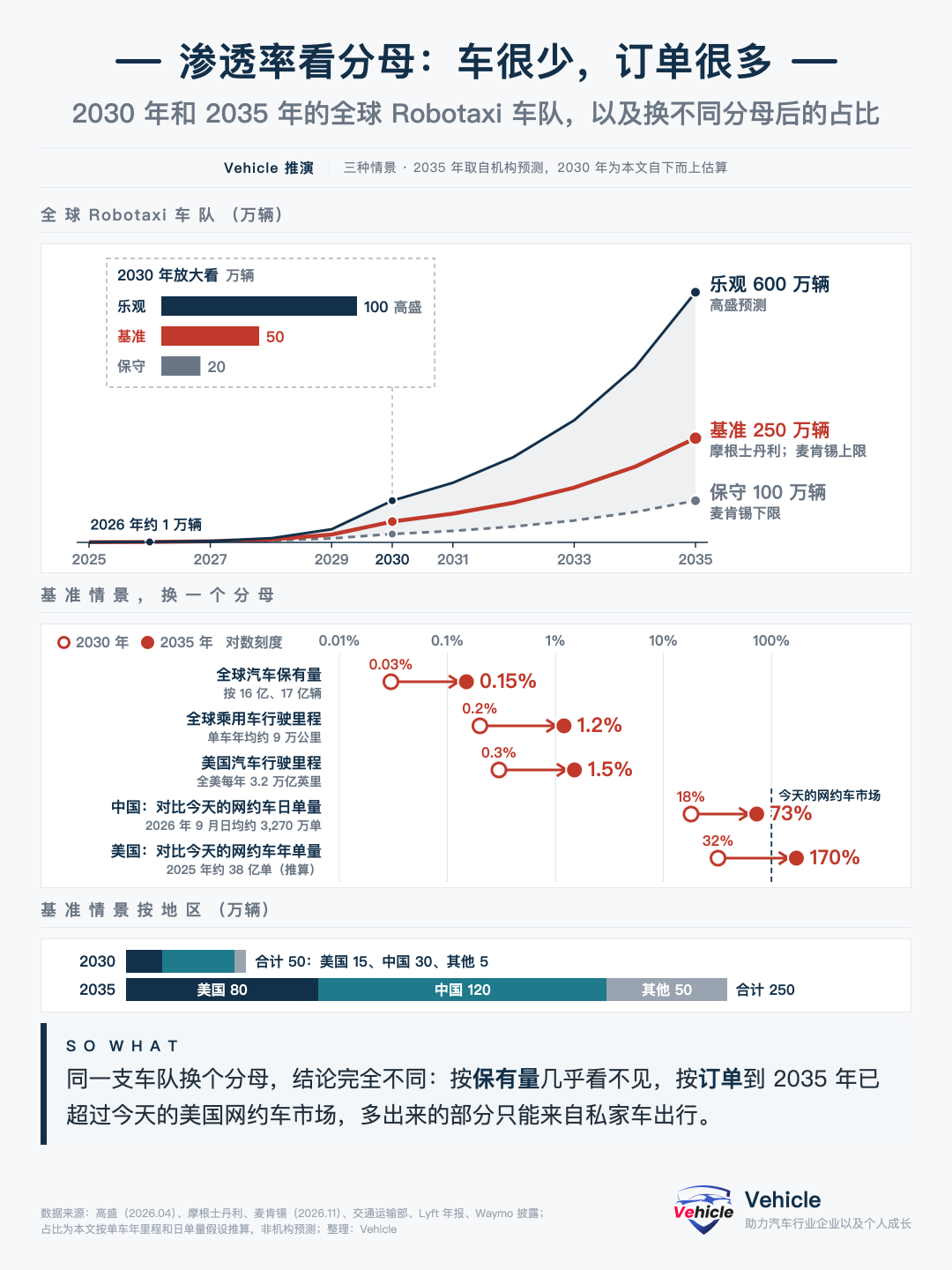
The 2035 fleet is taken from forecasts by Goldman Sachs, Morgan Stanley, and McKinsey; the 2030 fleet and all proportions are projections by this article
Even under the optimistic scenario, Robotaxis would account for only 0.35% of global vehicle parc and 2.8% of miles traveled in 2035. Measured by vehicles, they will be almost invisible before 2035; measured by rides, by 2035 they will exceed today's entire U.S. ride-hailing market and approach China's, with the excess able to come only from trips originally made by private cars.
How the mobility and automotive industries will change
The impact on mobility will come in sequence.
Ride-hailing and taxis are affected first; in June, Waymo already accounted for about 15% of ride-hailing gross bookings within its operating areas in San Francisco and Los Angeles.
Next comes price: Goldman Sachs estimates that the cost per mile for a U.S. private car is $0.77 to $1, ride-hailing is above $2, and driverless cars will fall below $1 by 2035. Once the price approaches that of driving oneself, the next thing to be replaced is the urban family's second car.
The impact on vehicle sales is smaller than intuition suggests.
Under the base scenario, the Robotaxi fleet in 2035 would need about 900,000 new vehicles a year, roughly 1% of global sales of about 100 million units at that time,
and even the optimistic scenario would require only about 2.2 million. Deloitte's estimate for Germany is that urban vehicle parc will fall 20% by 2035, while net new vehicle sales will decline by less than 1%, because shared vehicles are replaced quickly.
What changes greatly is where profits go.
Goldman Sachs estimates that integrated Robotaxi companies that both build and operate vehicles have gross margins of 30% to 50%, with a global gross profit pool of about $150 billion in 2035. By comparison, Toyota, Hyundai Motor Group, GM, and Volkswagen together had operating profit of about $64 billion in 2025; the two measures differ, but the magnitude already illustrates the point. This article judges that before 2035, Robotaxis will not significantly shrink vehicle sales; what they change is who buys the cars and who captures the profits of the mobility business.
Contract manufacturers (OEMs) still exist, but some will become Hon Hai
Hon Hai's operating margin in 2025 is 3.2%, while Apple's fiscal year 2026 is 33%. On the automotive side, Toyota was 8.6% in 2025, Hyundai Motor Group 6.8%, and Volkswagen Group 2.8%. Looking at this item alone, Volkswagen is already lower than Hon Hai.
In the Robotaxi space, the vehicle is already a purchased component. Reports indicate that Hyundai will supply Waymo with 50,000 Ioniq 5 units by 2028, worth approximately $2.5 billion, with Magna installing sensors after the vehicles leave the production line. On the Uber side, Lucid is supplying 20,000 units, Rivian up to 50,000 units, and for Stellantis's 5,000 units, Nvidia is providing the driving system while Hon Hai handles integration. Under these contracts, the OEM delivers a vehicle equipped with redundant steering, braking, and power supply to specification—and the brand passengers see is Waymo or Uber.
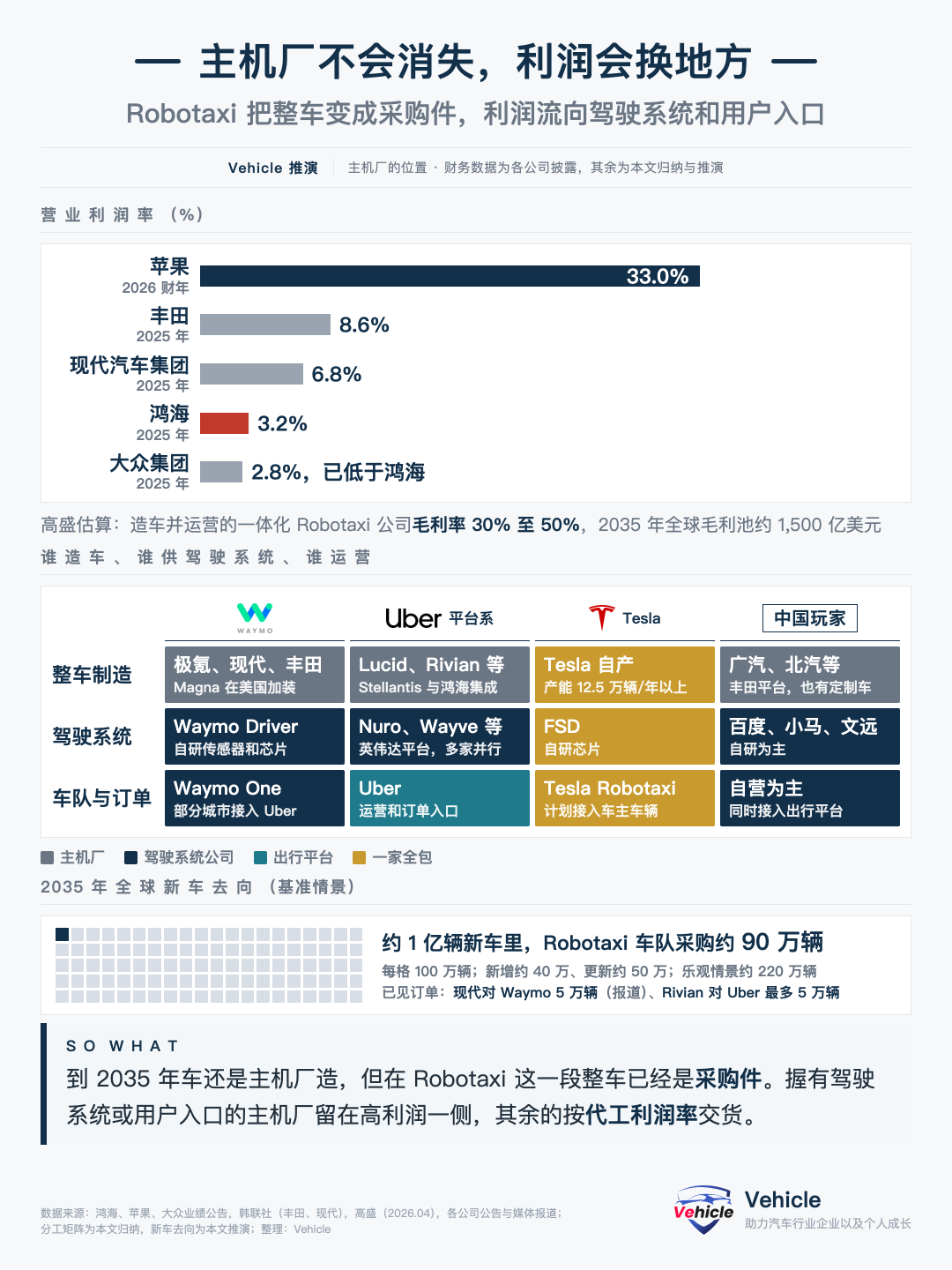
Financial data is drawn from company disclosures and Yonhap News reports; the division-of-labor matrix is summarized in this article, and the destinations of new vehicles are inferred herein.
As for the question "Will automotive OEMs become the next Hon Hai," this article's answer breaks down into three directions.
The contract manufacturing type supplies vehicles only and controls neither the driving system nor the order entry point. This business model has stable scale and low profit margins, and comes closest to the Hon Hai model.
The integrated type owns both the vehicle and the driving system. Tesla is a typical example, and some Chinese automakers developing intelligent driving in-house are also pursuing this path.
The brand type continues to sell vehicles to individuals. Under the standard scenario, by 2035 roughly 99% of new vehicles worldwide will still be sold to individuals and traditional fleets, and the value of brand, channels, and design remains. Risk emerges once personal L4 becomes widespread: if the driving system on the vehicle comes from an outside supplier, subscription revenue will flow away as well.
There are two differences between cars and phones that leave OEMs in a better position than phone contract manufacturers.
First, the engineering accumulation in safety certification, recall responsibility, and redundant chassis cannot be replaced by driving system companies in the short term.
Therefore, the medium- and long-term impact of L4 Robotaxi on OEMs is more likely to hinge on whether users will buy fewer cars and whether automakers' brand entry points will change.
Written at the end
Back to the numbers at the beginning. Waymo's 300 million miles show that autonomous driving is already technically established, and Tesla's 1,303 vehicles show that vehicle supply can ramp up very quickly. But by 2035, the vast majority of vehicles on the road will still be personally owned and manufactured by OEMs. For the Robotaxi industry, the change lies in who captures the profit generated by each kilometer.
Accordingly, this article draws three conclusions:
Technically, Waymo's route is easier to prove safe, while Tesla's route is easier to mass-produce—and the difficulty of what the two sides need to make up for is not symmetrical.
In terms of scale, by 2035 Robotaxis will still account for less than 0.5% of global vehicle ownership, yet the orders they take in the United States may exceed today's entire ride-hailing market.
In terms of industry, OEMs will continue to exist, but in the Robotaxi segment, vehicles are being priced according to the logic of contract manufacturing.
Do you think this derivation and research hold up? Welcome to leave a comment and share your views.
*Unauthorized reproduction and excerpting are strictly prohibited-
-
Auto Market News: October NEV Penetration Exceeds 50% Across All Segments
-
![]()
Avatr's Valuation Under the Microscope: Monthly Sales Fall Below 3,000 Vehicles
-
![]()
Big Tech's Hunt for "ByteDance Time"
-
![]()
Mazda's Struggle and Transformation: A Case Study in Survival for Second-Tier Automakers | Cover Story: Japanese Automakers at the Crossroads of Transformation (Part VI)
-
![]()
Top 10 SUVs by Sales Are All Feeling a Bit Nervous Now
-
![]()
Eldest Son Returns with a Price Hike: Is AITO Using the New M8 to Take On the 9 Series?
-
![]()
Cerebras: Supply and Demand Are Both Fine — the Fab Is the "Big Headache"
-
![]()
Waymo vs. Tesla: How Far Has the Robotaxi Battle Come—and Will Automakers Become the Foxconn of Cars?