Avatr's Valuation Under the Microscope: Monthly Sales Fall Below 3,000 Vehicles
 11/16 2026
 339
Source | Shenlan Finance
Another major development has sent ripples through the auto industry:
Changan Automobile is listing a 10% stake in Avatr for transfer, with a price tag of nearly 3.2 billion yuan.
Based on this price, Avatr's valuation stands at 31.8 billion yuan—roughly in line with its post-investment valuation following the Series C financing in 2025.
Yet in an equity transfer involving PATEO Connect in late 2025, a mere 0.24% stake in Avatr was priced at 62.44 million yuan. At that time, Avatr's implied overall valuation was approximately 26 billion yuan—well below the 31.8 billion yuan inferred from the current listing floor price.
Backed by Changan Automobile, Huawei, and CATL, Avatr was once the industry's earliest high-end new energy brand. But since the start of this year, Avatr's sales have plummeted—from a monthly average of over 10,000 vehicles in 2025 to fewer than 3,000 vehicles in the domestic market in October. Even more concerning is the steady decline in cash reserves: from 19.3 billion yuan at the end of 2024 to 9.687 billion yuan, and then down to 6.249 billion yuan.
Avatr, what on earth has happened to you?
1. Sales Plunge in January—Has Avatr's "High-End Dream" Been Shattered?
Avatr can be described as a "wealthy heir" born with a silver spoon in its mouth, backed by Changan Automobile, Huawei, and CATL. It was once the industry's earliest high-end new energy brand, and its valuation surged all the way to 31.8 billion yuan.
However, because sales never truly took off, the company remains mired in losses. The prospectus shows that from 2022 to 2025, Avatr's cumulative losses exceeded 13.2 billion yuan.
Automakers' valuations are typically tied to sales and profitability. Over the past three years, Avatr maintained a "high-growth persona":
From 2023 to 2025, Avatr's vehicle sales revenue climbed from 5.65 billion yuan to 25.63 billion yuan, a compound annual growth rate of 113%. Over the same period, vehicle sales rose from 20,000 to 123,000 units, a CAGR of 148%.
But entering 2026, the situation changed abruptly. In H1 2026, Avatr's sales plunged 53% year-on-year, and its high-growth persona collapsed. Since July, sales have deteriorated in ways that are hard to put into words. According to China Passenger Car Association data cited by Dongchedi, Avatr's domestic sales fell directly below 4,000 vehicles, and in October they dropped further below 3,000.
That said, the figures officially disclosed by Avatr are not quite so bleak. In October this year, it delivered 7,056 vehicles; in September, 8,183; in August, 8,082; in July, 7,626; in June, 7,459; and in May, 7,336.
But whether one looks at official delivery data or domestic retail data, a common problem emerges: compared with last year's performance of more than 10,000 vehicles per month, Avatr's growth momentum is clearly weakening.
A closer look at Avatr's product matrix also reveals that over the past few years, as sales grew, the brand's sales pillars have shifted.
The first model Avatr brought to market was the Avatr 11, positioned as a mid-to-large SUV. When it launched in 2022, the official guide price ranged from 349,900 yuan to 409,900 yuan, carrying the brand's ambitions of breaking into the high-end market. The subsequently launched Avatr 12, a mid-to-large sedan, was positioned even higher.
These two models helped Avatr establish its early brand image, but in terms of sales, momentum has weakened.
The prospectus shows that the Avatr 11 sold 18,024 units in 2023, dropped to 9,310 in 2024, and fell further to 7,873 in 2025. The Avatr 12 sold 30,785 units in 2024 and dropped to 20,963 in 2025.
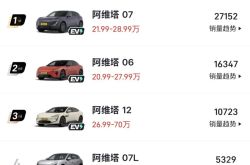
By contrast, the Avatr 07 and Avatr 06, positioned lower in the 200,000-yuan-class market, have gradually become the sales mainstays.
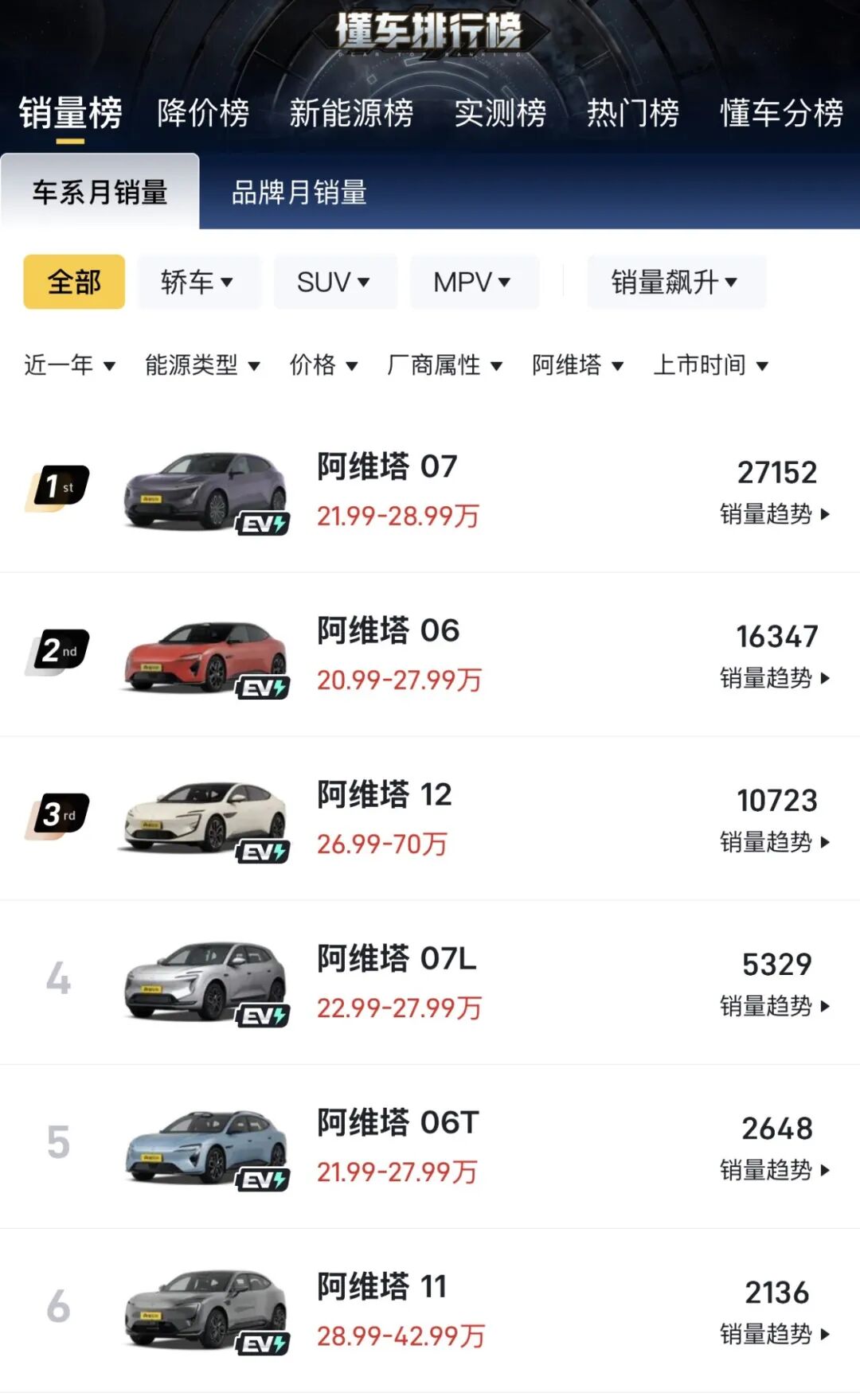
Among them, the Avatr 07, a mid-size SUV, sold 21,493 units in 2024 and grew to 57,338 in 2025. The mid-size sedan Avatr 06, which began deliveries in 2025, sold 36,528 units that year.
Together, the two models sold 93,866 units, accounting for approximately 76.5% of Avatr's total sales in 2025. In other words, last year, for every four Avatr vehicles sold, about three came from the 06 and 07.
Now let's look at the Avatr 07L launched this year.
This new model, positioned as a large five-seat SUV, went on sale in August with an official guide price starting at 229,900 yuan. Targeting family users, it comes equipped with Huawei Qiankun intelligent driving and CATL batteries, and has been highly anticipated by Avatr. Before launch, Avatr Chairman Chen Zhuo expressed hope that the 07L could help the brand return to monthly sales of 10,000 vehicles.
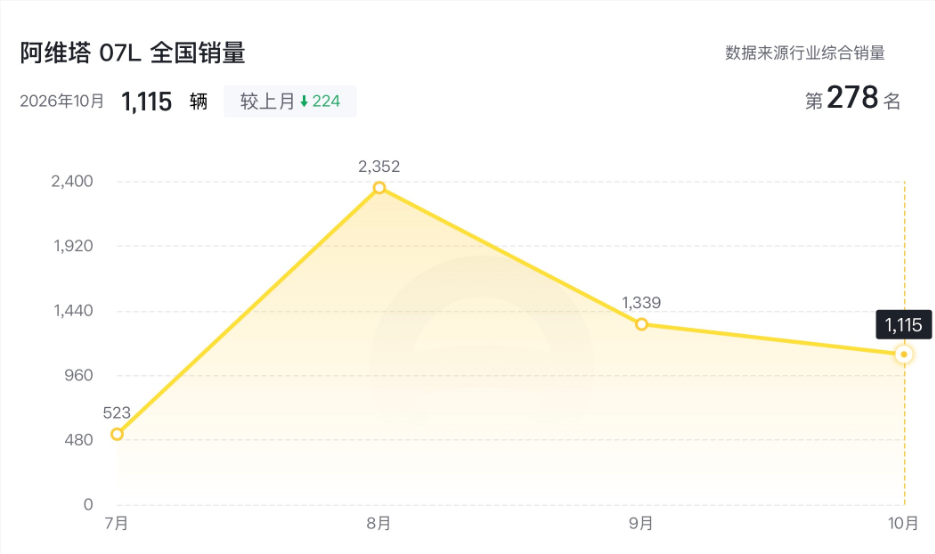
But judging from current domestic retail performance, that goal has yet to be achieved. Red Star Capital Bureau, citing data from a third-party platform, reported that the Avatr 07L had retail sales of 2,352 units in August this year, dropping to 1,339 in September and further to 1,115 in October—a 43% month-on-month decline. Although it remained the only model in the brand to exceed 1,000 retail sales that month, there is still a long way to go before it can drive the entire brand back to monthly sales of 10,000 vehicles...
2. Huawei Intelligent Driving Is No Longer Scarce, but the Money Spent Hasn't Decreased
The dilemma of plummeting sales lies in the fact that Avatr has never been able to carve out an exclusive label in consumers' minds strong enough to drive purchases. It has neither NIO's user-operations moat nor Li Auto's precise product-definition capability.
In Avatr's narrative, Huawei has always played a role in supporting high-end pricing. Avatr is a showcase for Huawei's HI model, and cooperation with Huawei was discussed earlier than with AITO and Luxeed. Compared with AITO, Avatr might be considered Huawei's intelligent driving "legitimate eldest son."
However, with the "expansion" of HarmonyOS intelligent driving and more automakers partnering with Huawei, brands such as AITO and Luxeed within the HarmonyOS Smart Mobility ecosystem have diverted customers from Avatr in terms of price bands and customer groups. Avatr is not a member of the "Five Realms" of HarmonyOS Smart Mobility, and its "exclusivity" has been significantly diluted.
The market is no longer willing to pay an undifferentiated premium for "Huawei content," and has begun to distinguish who is the real monetizer of Huawei's technological dividends and who has merely paid an entry fee.
To increase its "Huawei content," Avatr spent 11.5 billion yuan to acquire 10% of Huawei Yinwang.
But whether this deal is worthwhile is still hard to say. In 2025, Avatr's profit from this investment was 182 million yuan—less than a fraction of the cost.
On the other hand, Huawei has actually made quite a lot from Avatr.
Avatr operates on an asset-light model, with the three giants—Changan, CATL, and Huawei—respectively undertaking Avatr's vehicle R&D and manufacturing, batteries, and automotive solutions.
In August this year, Huxiu pointed out in the article "Awkward Avatr" that in 2025 the average selling price of all Avatr models was 195,000 yuan, CATL batteries accounted for about 40,000 yuan, Changan accounted for 36,000 yuan in total, and Huawei/Yinwang received 26,000 yuan in technology service fees. The three parties took half of vehicle sales revenue.
Among them, Changan Automobile and CATL both hold equity, while Huawei has not taken a stake and spent nothing—yet earned 8.73 billion yuan from Avatr over three years.
3. Overseas Market Shows Promising Signs
Domestic sales are declining, but Avatr is still maintaining strong growth momentum in overseas markets. From January to August 2026, Avatr's overseas sales increased 77.8% year-on-year. It currently sells in more than 70 countries and regions, with an average product selling price exceeding 300,000 yuan and overseas operations already profitable.
In October this year, three heavyweight models—the Avatr T09 concept version, Avatr 07L, and Avatr 06T—made a high-profile appearance at the Paris Motor Show, with the company announcing that it will officially enter the European market in 2027. Among them, the Avatr 07L and Avatr 06T will be the first core products to enter markets such as Norway and Spain.
But how to fund continuous R&D, product iteration, and market expansion has become the practical test Avatr faces next.
Not long ago, Avatr also abruptly canceled the launch event for the 07L Max and, in a leaked "staged" video, said outright, "We have no money."
Although the staged video drew widespread criticism, Avatr's cash reserves are indeed shrinking.
The prospectus shows that Avatr's cash reserves fell from 19.3 billion yuan at the end of 2024 to 9.687 billion yuan at the end of 2025, and further shrank to 6.249 billion yuan by the end of April 2026.
The company explained that the decline in the first four months of this year mainly involved continued R&D and marketing investment, as well as supplier settlements after payment terms were adjusted to within 60 days.
Burning through 13 billion yuan in 16 months means spending more than 800 million yuan per month on average. Against this backdrop, the importance of listing and financing becomes even more prominent.
But the window for Avatr to push for an IPO is almost gone. Since its second filing at the end of June, the new prospectus has less than two months of validity left. Regarding Changan's equity transfer this time, Avatr responded that it is unrelated to the IPO, and the listing conditions also explicitly require that the transferee not affect the company's future listing process.
And Changan Automobile's listing and transfer of 10% of the equity this time may cause major changes in the shareholding structure. With a change in shareholders, IPO-related materials will also need to be re-signed by the new shareholder.
This means Avatr may need to resubmit its prospectus.
Finally, wishing Avatr a smooth listing and great product sales~
*Disclaimer: The content of this article represents only the author's views. Markets carry risks, and investment requires caution. Under no circumstances does the information or any opinions expressed in this article constitute investment advice to anyone.
Shenlan Finance's new media cluster originated from the Shenlan Finance reporter community and has a history of 16 years. It is a well-known domestic financial new media outlet. Its accounts focus on China's most valuable companies, cutting-edge industry development, and emerging regional economies, providing valuable content for investors, listed company executives, and the middle class. Welcome to follow.
-
Auto Market News: October NEV Penetration Exceeds 50% Across All Segments
-
![]()
Avatr's Valuation Under the Microscope: Monthly Sales Fall Below 3,000 Vehicles
-
![]()
Big Tech's Hunt for "ByteDance Time"
-
![]()
Mazda's Struggle and Transformation: A Case Study in Survival for Second-Tier Automakers | Cover Story: Japanese Automakers at the Crossroads of Transformation (Part VI)
-
![]()
Top 10 SUVs by Sales Are All Feeling a Bit Nervous Now
-
![]()
Eldest Son Returns with a Price Hike: Is AITO Using the New M8 to Take On the 9 Series?
-
![]()
Cerebras: Supply and Demand Are Both Fine — the Fab Is the "Big Headache"
-
![]()
Waymo vs. Tesla: How Far Has the Robotaxi Battle Come—and Will Automakers Become the Foxconn of Cars?