Tencent: A Rare Profit "Reversal"—How Long Will This AI Tuition Have to Be Paid?
 11/20 2026
 504
After the Hong Kong stock market closed on November 18 Beijing time, Tencent Holdings (0700.HK) released its Q3 2026 financial report. Overall, Q3 performance once again weighed on shareholders—in a nutshell, more spent, less earned.
Revenue came in slightly below expectations, and profit reversed year-on-year for the first time in four years. Although the core business also missed, that is not where the main problem lies—it lies in the increasingly expensive "tuition" for AI.
Therefore, rather than focusing on current-period performance, investors this time should pay closer attention to the follow-up on this "tuition": under remote computing power restrictions, how prepayments will be handled, how subsequent computing power will be deployed, and whether Capex targets will be adjusted. We recommend following this earnings call.
Specifically:
1. Two striking numbers: profit -6%, free cash flow -70 billion.
Although during an unprecedented investment period like this AI cycle, it is only expected that Tencent, which has always been asset-light, would see a profit "collapse." But most Tencent investors are still value investors who honestly calculate real money profits, along with insurance funds with low-to-medium risk preferences.
Therefore, no matter how the AI story is told, or how the unit economics of the cloud leasing business are calculated, as long as it is not reflected in the final overall accounts, funds will not be in a hurry to believe it. Excluding new AI products, Q3 operating profit was 83.3 billion, still up 8% year-on-year; including net AI investment, it suddenly dropped by 15.2 billion.
2. The more expensive it gets, the more they buy—AI investment becomes even crazier.
Tencent's AI investment has two accounts: one is Capex in cash flow (including computing power prepayments in operating cash flow); the other is Opex in the income statement.
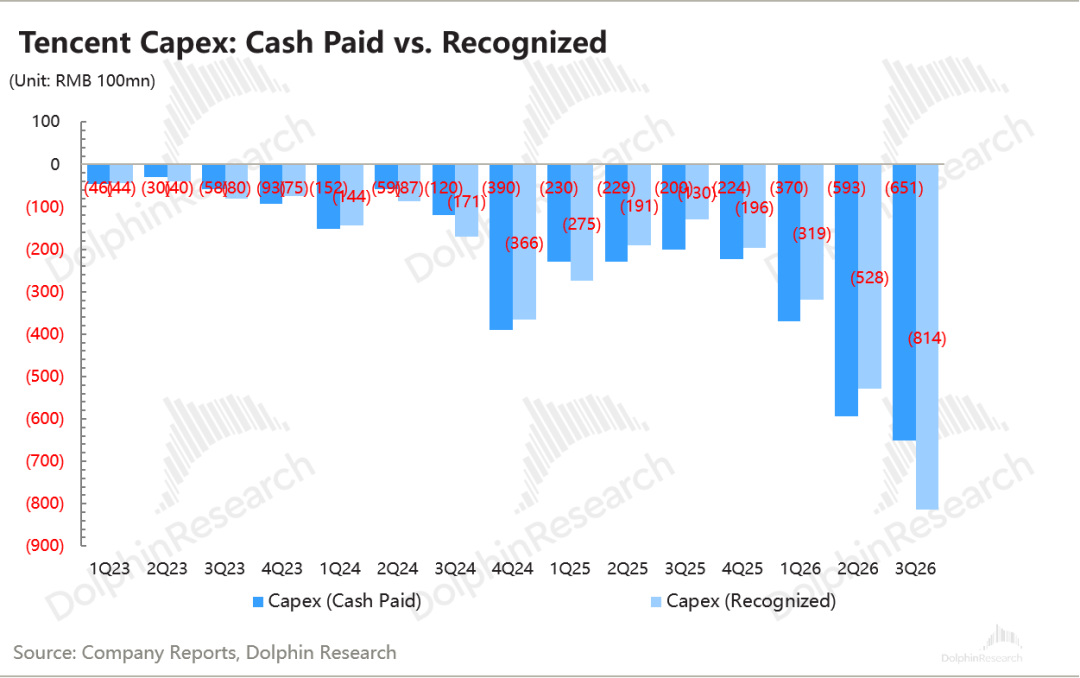
For Q3 Capex, including prepayments, total cash spending reached 151.1 billion (the bulk being hardware procurement related to AI computing power), of which the portion paid in cash in the current period and delivered in the current period was 65.1 billion. Generally speaking, this is the Capex caliber comparable horizontally with other platforms.
But the market generally and habitually chooses the accrual-basis figure of 81.4 billion (the 16.3 billion more than 65.1 billion may have been prepaid previously) for vertical comparison with Tencent. (For a detailed understanding and distinction, see the section at the end.)
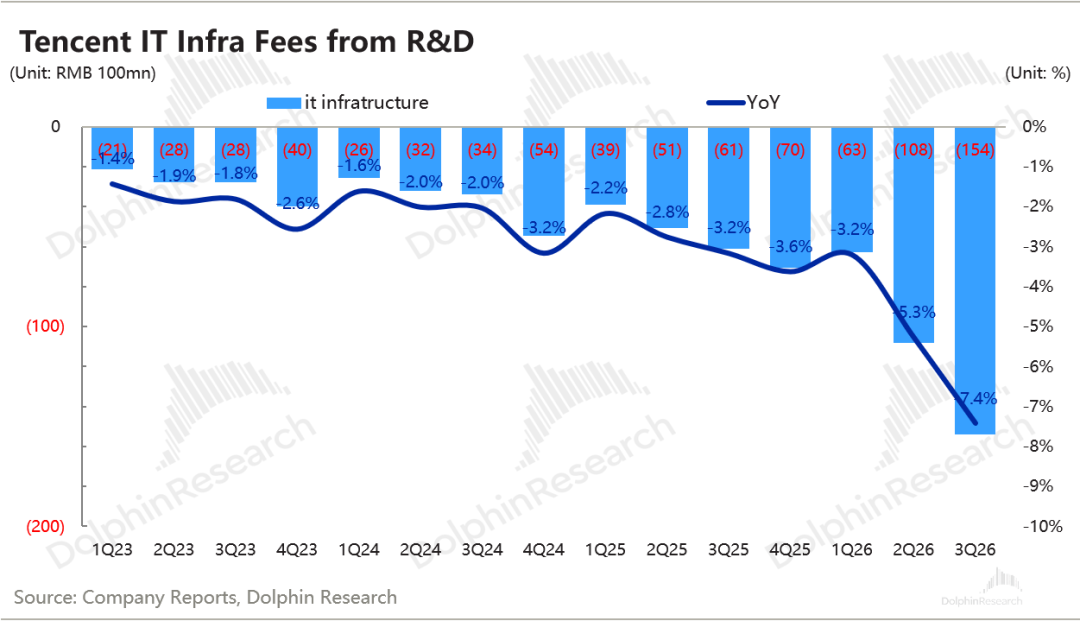
Some leasing computing power and AI product development expenses are generally included in R&D expenses under Opex. In Q3 R&D expenses, non-compensation expenses were 15.4 billion, up nearly 5 billion quarter-on-quarter, similar to last quarter's net increase of 4.5 billion.
Under the current tight group budget, the net increase in spending is basically the increment from computing power leasing and some equipment depreciation.
3. Core business mixed: overseas gaming paused, cloud and advertising okay.
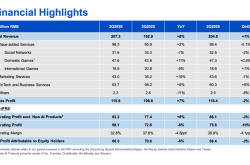
Q3 total revenue was 207.3 billion, up 7.5% year-on-year, 3 billion less than consensus expectations, mainly in international gaming and social network revenue.
Overseas gaming faced last year's high Supercell base, plus fading heat of old games, a lack of new blockbuster games, and currency effects, so revenue fell 9%, dragging down the entire value-added services business.
Domestic gaming, supported by evergreen titles such as Delta Force and Honor of Kings, barely performed okay overall, growing 11%. It also faced a high base, and there were few standalone new games this quarter; the main one was the Honor of Kings IP derivative game Honor of Kings: Chess, launched in September.
The social network segment is mainly related to digital content payments and game channel revenue sharing from QQ and WeChat. Q3 fell 2% year-on-year, likely mainly dragged by Tencent Video, as well as weaker Tencent channel revenue sharing due to the gaming industry decline. Ultimately, deferred revenue fell 4.3 billion quarter-on-quarter, and implied value-added services gross billings fell 3% year-on-year, reflecting weakening content payment consumption power.
Advertising grew 18%. Under a tougher consumption environment in the second half, Tencent's ecosystem still performed relatively resiliently. In addition to the drivers of increased Video Accounts time spent and load rate, this should also include contributions from short drama advertising (advertising monetization in short dramas generally accounts for 70% of the entire short drama market).
After Green Bubble short dramas launched on WeChat mini programs, they ran relatively fast. In October, creation incentives were increased, attracting some short drama producers to switch from Hongguo to Green Bubble. Monthly active users have now reached 150 million.
Cloud business revenue is included in FinTech and Business Services. On a standalone basis, growth accelerated to 35%, at the upper end of sell-side expectations, and was the only point that beat expectations. WorkBuddy's daily active users have exceeded 10 million, accelerating from 6.13 million in September on a quarter-on-quarter basis.
4. Profit pressure comes from IT and rising content costs.
In addition to R&D expenses, the expectation gap on the spending side is also reflected in costs. Sales and administrative expenses were relatively controlled, with expense ratios stable quarter-on-quarter.
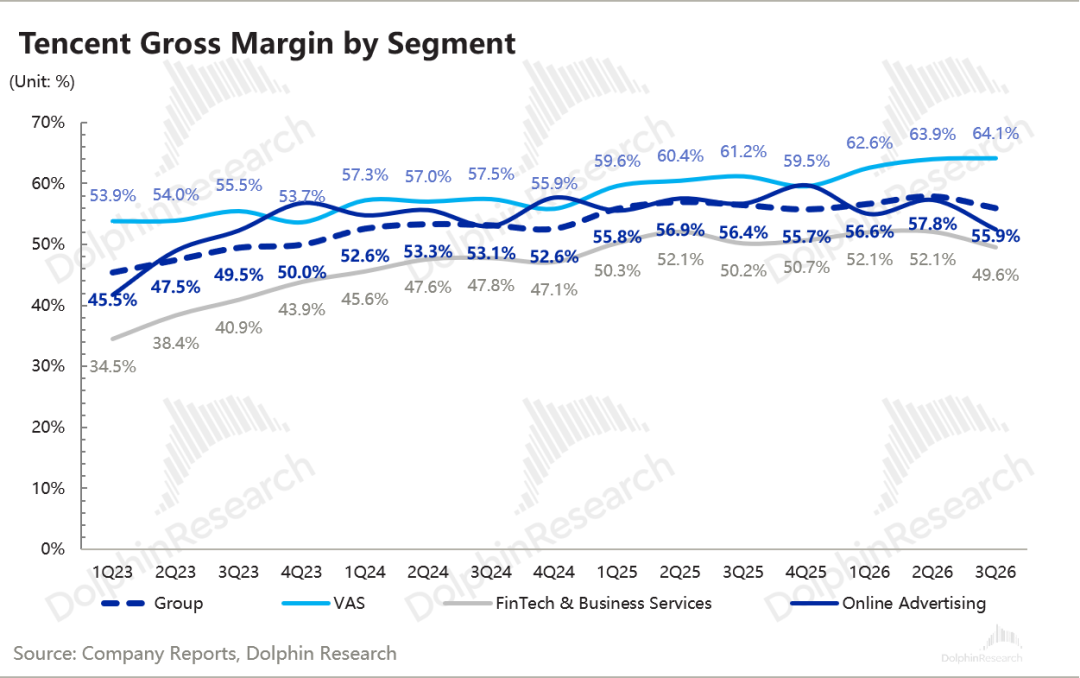
What was more surprising was that advertising gross margin was only 52%, down 5pct directly from last quarter, while normal seasonality is a 1-2pct decline. Dolphin believes this may mainly be due to allocation of AI investment, short drama revenue-sharing costs, and long-audio copyright content costs.
Gaming gross margin continued to improve, mainly because evergreen games have low marginal investment and no IP revenue sharing, so gross margins are relatively high; in addition, PC games like Delta Force inherently have higher gross margins.
FinTech and Business Services gross margin weakened 2pct quarter-on-quarter, possibly due to a change in revenue mix, with the higher proportion of low-margin cloud business. Of course, payments themselves were also dragged on the revenue side by pressure in the consumption environment.
5. Buybacks are cash-strapped: Q3 buybacks spent HK$7 billion, average price HKD443/share, totaling HK$30 billion in the first three quarters. This year will likely be below HK$50 billion. It is unknown whether, if subsequent computing power money cannot be spent, shareholder returns will be increased in turn.
6. Detailed financial data overview
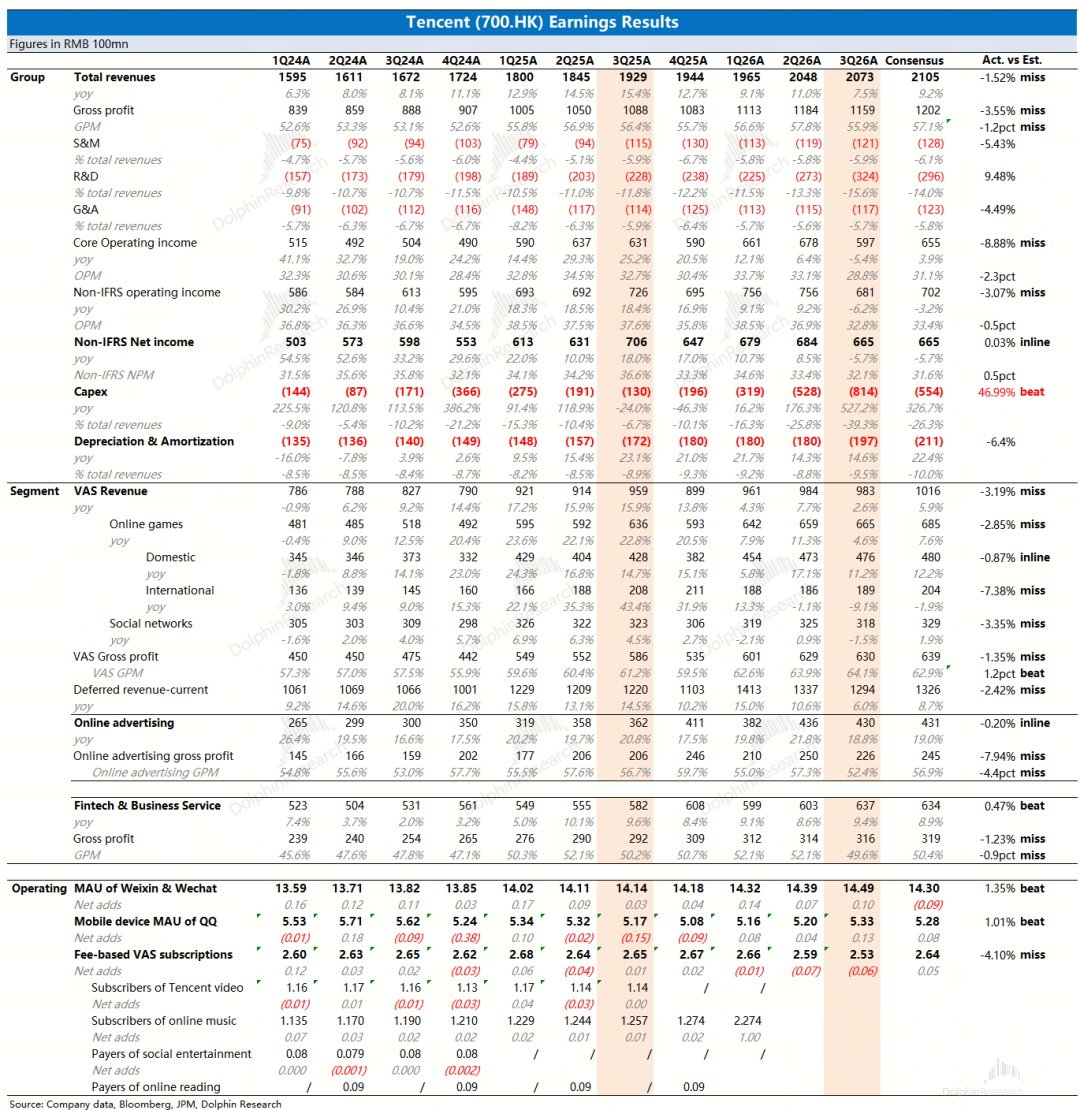
Dolphin's view
Last quarter, although Dolphin had some expectation of profit pressure in the second half, the actual 6% decline was still a heavier burden than imagined.
Under such circumstances, funds are reacting to the company's "contrarian moves"—spending more aggressively (more prepayments to lock in computing power) and buying back less (buying even less as the stock price comes under pressure). And a considerable portion of long-term funds, even if they accept management's embrace of AI strategy, should still feel quite uncomfortable seeing such results.
At present, looking only at the revenue side, Dolphin tends to think Tencent's core business still has no major problems. Under a harsh macro beta environment, core domestic gaming and advertising can still maintain double-digit growth, which is not easy and reflects the synergy of the ecosystem. Of course, subsequent beta pressure may inevitably transmit further, but from the company's own alpha perspective, the core business is still relatively solid.
Some funds may still mind the issue of "ecosystem time being eroded by ByteDance." Dolphin believes the newly launched short drama strategy is expected to continue filling and repairing this, while also increasing effective ad inventory.
The short drama industry, including AI comic dramas in a broad sense, has already reached a scale of nearly 100 billion RMB, of which the IAA advertising monetization model accounts for more than 70% of revenue. But under the flood of supply brought by AI, 80% of short drama revenue needs to be reinvested in traffic acquisition on platforms to gain exposure. Therefore, this industry chain is essentially playing traffic monetization, which is clearly beneficial to channel platforms that own traffic.
Tencent entering short dramas is a defense, and can also be seen as a new offense.
But the real question is how long the massive AI investment will continue. Take this quarter's total Capex cash payment of 150 billion including prepayments and 15.2 billion net AI investment. As investors, the questions may be no fewer than the following:
(1) The company previously guided full-year net investment of 36 billion, and as of Q3 34.5 billion has already been invested. So will Q4 slow down, or will it break the guidance and continue investing?
(2) WorkBuddy's daily active users grew 70% in two months, but it seems to have limited pull on cloud revenue (accelerating from 20% growth in Q2 to 35%, with quarterly cloud revenue net increase possibly only 1 billion+). Yet on the R&D side, non-compensation-related expenses rose by 5 billion quarter-on-quarter in IT server spending.
This shows that most users on WorkBuddy are still taking advantage of free offerings, and the company is still cultivating user habits. So for subsequent paid conversion, are there some relatively clear guidelines and targets?
(3) Last quarter the company guided that 2026 and 2027 would be peak investment years. Then with this Monday's document on remote computing power restrictions, another key question has been added around AI investment—how much of the prepayments for computing power procurement involve restricted overseas GPUs, and after the restriction order takes effect, how will subsequent computing power deployment be planned? Did the sudden increase in prepayments this quarter reflect some forward-looking preparation?
Looking comprehensively at the earnings call and callback communication, management gave some answers to the above questions. From the perspective of financial profit indicators, pressure will continue to increase next year. But from a cash flow perspective, marginal pressure will ease:
a. BIS impact: mainly affects increments; existing cards purchased for overseas data centers can still be used, and next-generation model training will be extended.
b. AI investment: the large short-term investment is mainly to fill out AI Infra. Capex under the cash payment caliber reached a peak this quarter at 151 billion RMB, and there will be no large prepayments in the future; some past prepaid bills may be refunded due to the BIS computing power restriction order.
For 2027 Capex under the accrual caliber, it is expected to be annualized based on Q3, that is, 65.1*4=260.4 billion. The cash flow gap caused by short-term high investment will prioritize selling assets within the investment portfolio.
c. AI monetization: cloud growth is generally upward, with seasonal fluctuations. Workbuddy monetization is accelerating; ARPU is currently low but the growth slope is high.
Xiaowei currently has 30 million daily active users, covering a test of 100 million users, and full rollout will be promoted soon. Because the model is small and it is embedded in WeChat without lacking channels, computing power costs and marketing spending will be far lower than Yuanbao.
The BIS computing power restriction order mainly affects next-generation model training, and the timeline will be lengthened.
d. Other core businesses: macro pressure is very high, with no improvement visible.
Although HY 4 still cannot fully be called domestic TOP, it is already fully ready for the table and can cover ordinary users' needs. HY and Workbuddy can also reach users relatively easily through Tencent's ecosystem.
Of course, the key in the short to medium term still lies in the company giving a path and pace for paid conversion of free users, thereby helping funds judge when the impact of AI investment on profit will bottom out.
Dolphin believes the short-term upside for betting is limited, mainly due to China's macro domestic demand pressure, the drag of Capex depreciation on profit, and Workbuddy still cultivating users with monetization not in a hurry to be released. Especially with current trading sentiment bleak and the risk of fighting volatility high, a concentrated release could absolutely lead to further declines; after all, net profit may continue to decline year-on-year under sustained high investment.
The medium-term inflection point may have to wait until the second half of next year, when high-base performance pressure eases and China's computing power begins to release capacity. Tencent's Enflame has locked in considerable supply chain inventory through Tencent channels (though there may be short-term foundry tape-out restrictions), and mass production from other players such as Ascend and Kunlunxin will adapt sufficient computing power capacity for AI monetization.
The following is a detailed analysis
1. WeChat ecosystem traffic continues to expand, AI protagonist shifts to WorkBuddy
In Q3, WeChat and Weixin monthly active users were 1.449 billion, a net increase of 10 million quarter-on-quarter; QQ monthly active users were 533 million, also recovering by 13 million. There is no problem at all with the social base.
The announcement mentioned that total time spent on Video Accounts increased more than 20% year-on-year, with young users' activity rising noticeably. This is the confidence behind advertising still maintaining high growth.
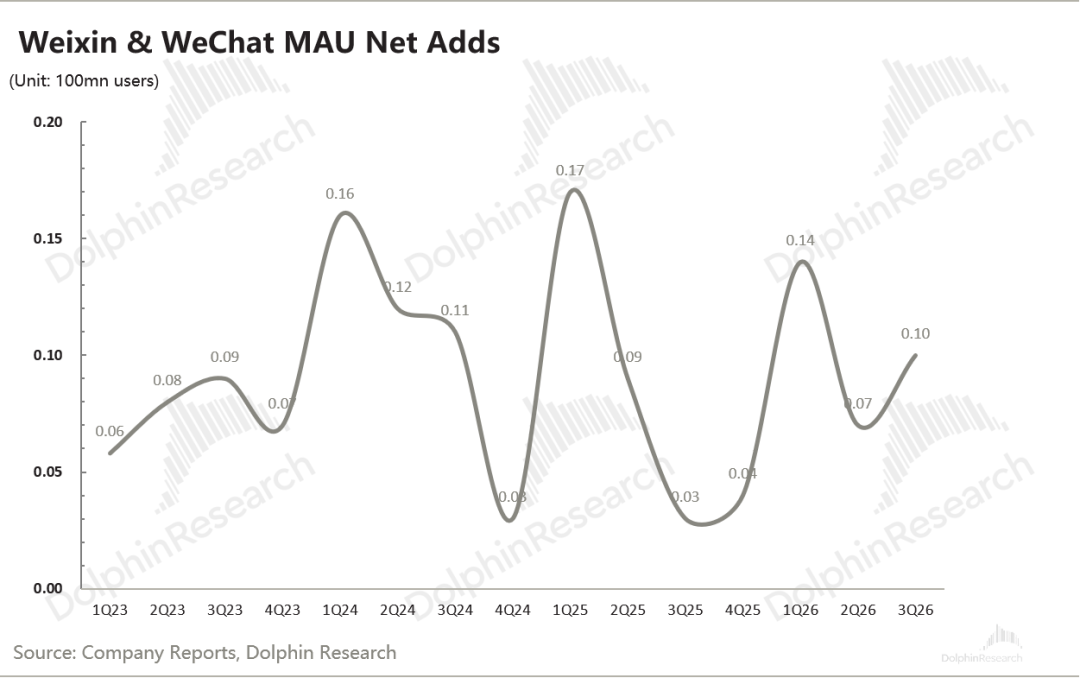
The number of paid value-added service members was 253 million, losing another 6 million quarter-on-quarter, mainly due to the decline in Tencent Video membership revenue, which also caused social network revenue to slip slightly to 31.8 billion.
On the AI side, the protagonist spotlight was all given to WorkBuddy: measured by token consumption, it is already the most-used AI product in China. The To C chatbot did not break out, but Tencent found an important position in productivity scenarios.
On the model side, Hy4 (770 billion total parameters, 49 billion activated parameters) was officially released in November, while Hy4 Flash (224 billion total parameters) is designed to lower inference costs.
WeChat Xiaowei has now reached 100 million users in internal testing, but against the full 1.4 billion user base, this still amounts to little more than a "gray-scale test range." An official launch within the year looks unlikely; instead, the test scope will continue to expand.
WeChat—Tencent's largest entry point and ultimate trump card—will be the biggest thing to watch once it is truly opened up, and also the biggest cost variable. But given the current state of C-end monetization, if a B-end business model that can be connected later has not yet been established, and WeChat is merely turned into a C-end experience entry point, it may do more harm than good.
2. Gaming slows: high base + lack of new games
Q3 total gaming revenue was 66.5 billion yuan, up less than 5% year-on-year—the lowest growth rate since Q1 2024.
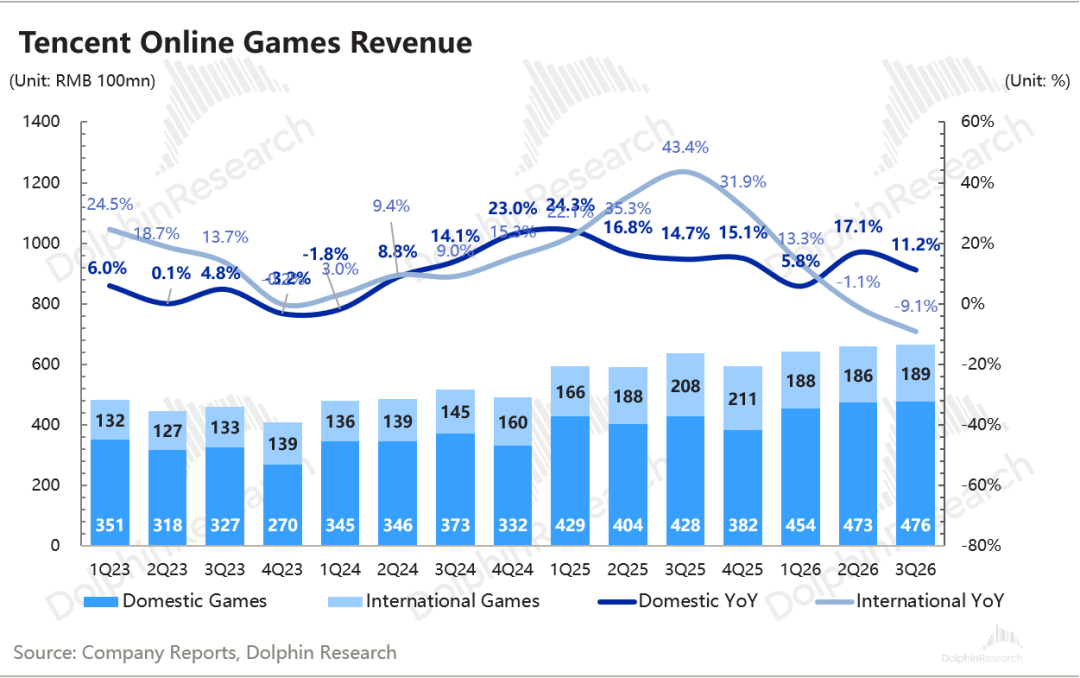
Domestic gaming came in at 47.6 billion yuan, up 11% year-on-year, a marked slowdown from 17% last quarter. Delta Force and Valorant: Source Energy hit record daily active users, and the foundation of evergreen titles remains intact.
Gross billings under the research caliber paint a clearer picture: in Q3, Delta Force still grew 50% year-on-year, Honor of Kings managed only low single digits, and Peace Elite declined slightly. The increment depends almost entirely on Delta Force alone—but it is about to face the high base of its second year online.
International gaming was 18.9 billion yuan, down 9% year-on-year, or down 4% at constant currency. Last year Supercell enjoyed blockbuster momentum and one-time recognition from new game launches, so the base was indeed high—but the decline still exceeded the market's psychological preparation.
Deferred revenue at the end of Q3 was 129.4 billion yuan, down more than 4 billion quarter-on-quarter, with year-on-year growth slowing from 11% last quarter to 6%—a reflection of slowing consumption across digital content, gaming included.
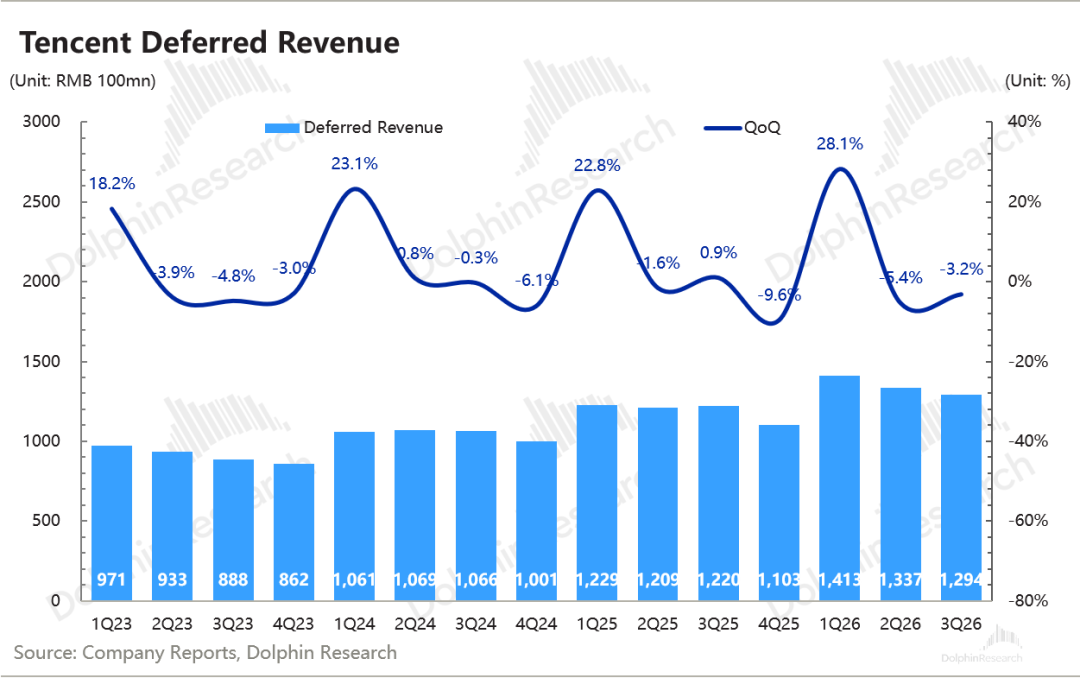
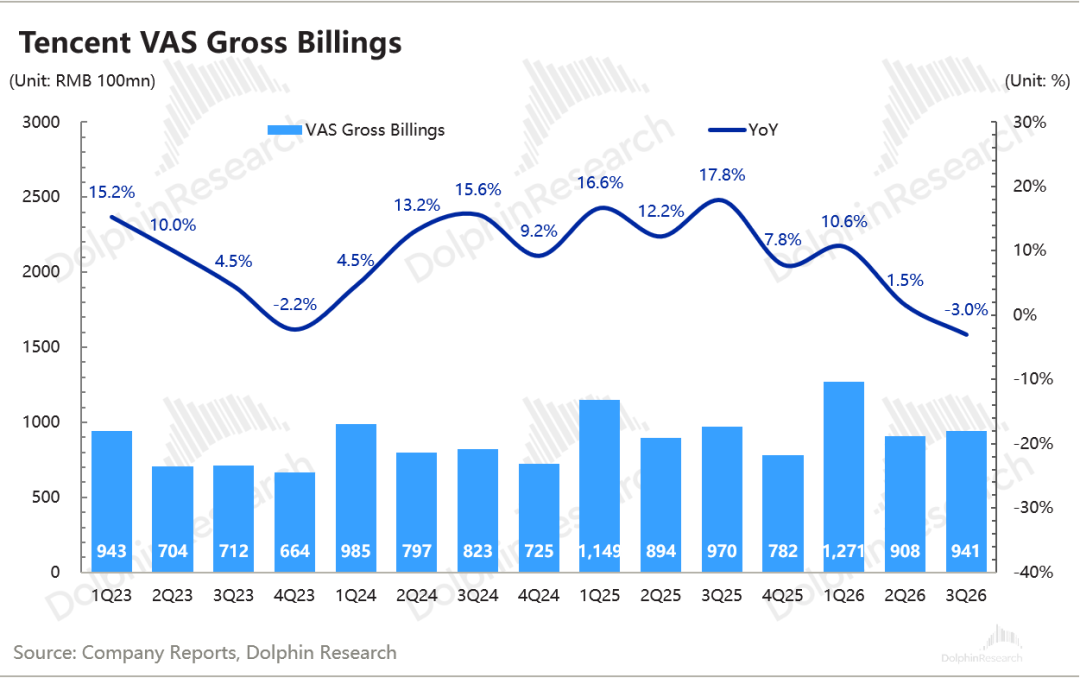
Reverse-calculated value-added services revenue was approximately 94.1 billion yuan, down 3% year-over-year. Excluding the drag from long-form video, gaming revenue growth has also fallen to low single digits.
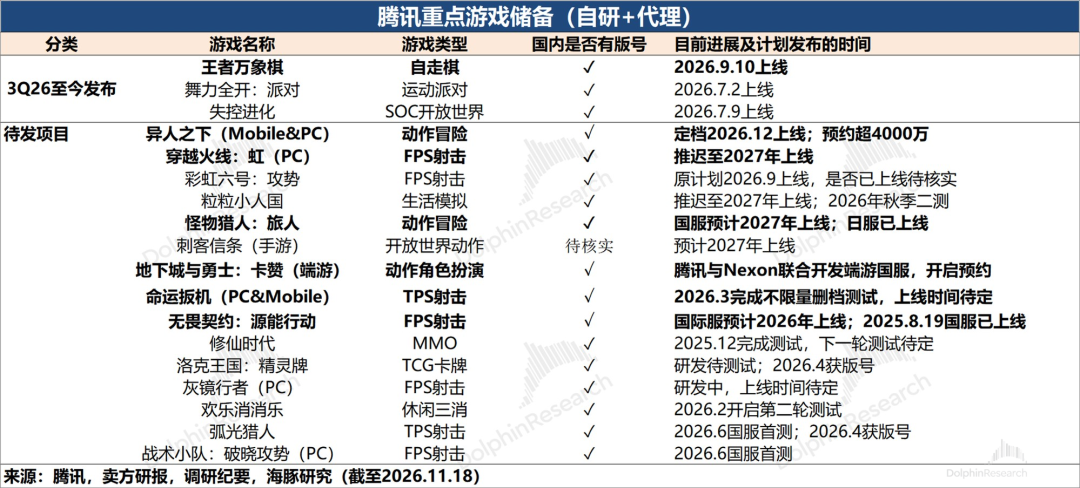
Tencent had new games in the fourth quarter, but none showed blockbuster potential. "Honor of Kings: Chess," released in mid-September, generated good early buzz and may support some incremental revenue—but given the large base, new titles that are neither sustained big hits nor likely to cannibalize playtime from Honor of Kings will contribute limited incremental revenue. Maintaining double-digit growth in Q4 is expected to be difficult.
III. The Growth Pillar — Advertising Remains Stable, but Gross Margin Slips
Third-quarter advertising revenue was 43 billion yuan, up 19% year-over-year, mainly benefiting from WeChat Channels and the Green Bubble short drama mini-program—but the off-season for e-commerce promotions weighed on the performance of other ad placements.
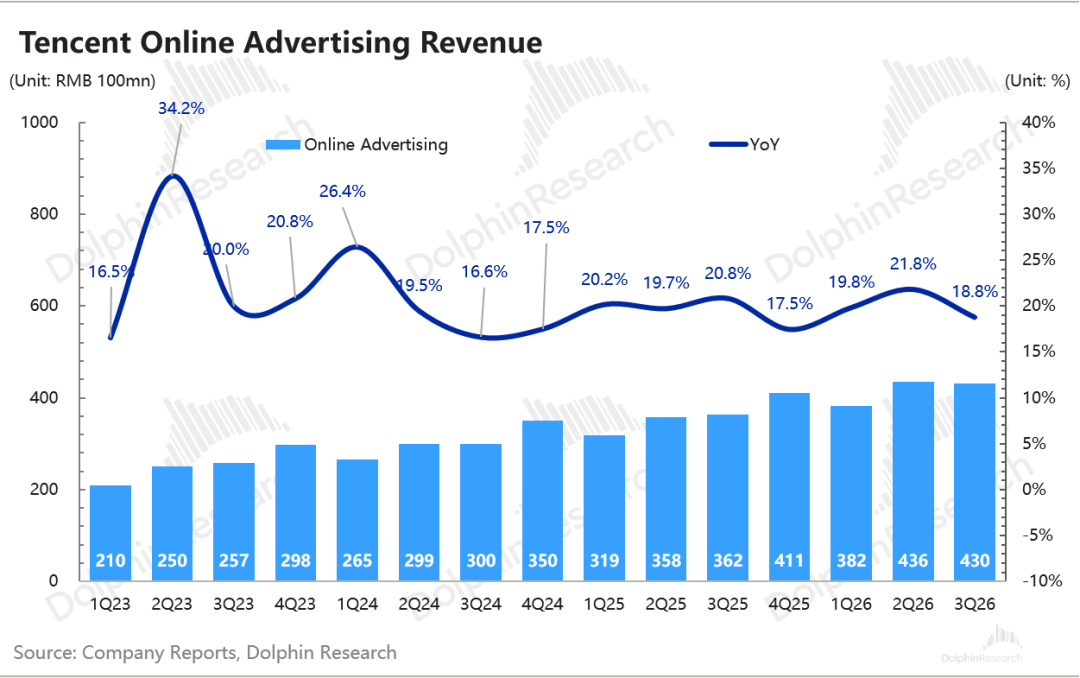
Breaking it down by volume and price: WeChat MAU grew only 2% year-over-year, while ad revenue per user (equivalent to the "unit price" of advertising) grew 16% year-over-year. Growth is almost entirely driven by "price"—that is, loading rate and conversion rate.
According to channel research, WeChat Channels advertising grew nearly 40% in the third quarter, with the loading rate still below 6%, leaving room for improvement. Moments and mini-programs grew 10%+. WeChat Channels therefore remained the main source of incremental growth this quarter, while the Green Bubble, which only launched on WeChat at the end of Q3, is expected to contribute in Q4.
In an environment of worsening consumption, Tencent's advertising growth rate remains among the best among internet platforms. AI recommendations continue to improve conversion and the WeChat Channels loading rate is slowly rising from a low base—both engines are still in place—while new traffic and ad placement sources from short dramas have also been added.
However, the drag from the broader environment is also growing. Dolphin Research suggests one should not be blindly optimistic about whether high growth can be sustained next year.
The gross margin of the advertising segment in Q3 was 52%, compared with 57% in the previous quarter and the same period last year. Seasonal factors typically account for only 2 percentage points, meaning another 3 percentage points stem from additional factors. The company attributed this to increased AI-related operating costs and content costs from short dramas (typically split 50:50), and WeChat's recent launch of a creator incentive program.
Conversely, this also shows that advertising growth is becoming increasingly "expensive." Previously, once the loading rate was turned on, revenue was almost entirely profit; now, computing power must first be spent on recommendations and content must be purchased to cultivate engagement time. As the group's "regulator," advertising can still adjust revenue—but its power to adjust profit has diminished.
IV. Tencent Cloud Accelerates Growth Sequentially
Third-quarter fintech and business services revenue was 63.7 billion yuan, with year-over-year growth slightly faster than the previous quarter, mainly driven by Tencent Cloud's growth accelerating from 20%+ in the previous quarter to 35%.
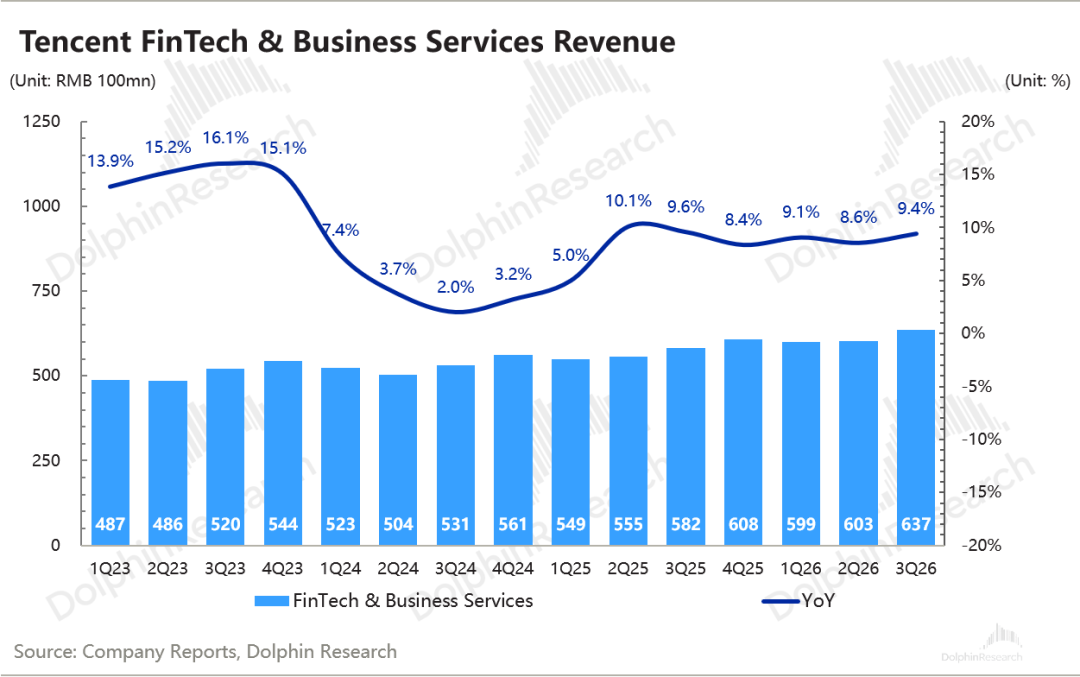
Cloud is the entire bright spot. According to Dolphin Research estimates, cloud revenue accounts for about 7–8% of total revenue, and 35% growth can bring about 4 billion yuan in year-over-year increment per quarter—equivalent to 70% of the entire segment's increment.
Conversely, fintech grew only at a low single-digit rate. The company mentioned growth in consumer loans and wealth management, but commercial payments remain suppressed by the broader consumption environment, and no elasticity is visible in this area in the short term.
The segment gross margin was 50%, down 2 percentage points sequentially. The reason is not hard to understand: the gross margin of GPU leasing and model invocation is lower than that of traditional cloud and payments. The faster cloud grows, the more this segment's gross margin is "diluted" in the short term—but this business trajectory is healthy.
On monetization efficiency, management previously disclosed that the token gross margin of WorkBuddy's paid portion is around 60%, mainly dragged down by too many free users. Among Tencent Cloud's enterprise customers, paid penetration is still below 5%. The room is large, but it also shows that much of the current usage is "given away."
V. Profit and Cash Flow Decline; More Spending on Costs, Capex, and R&D
Q3 core business operating profit (gross profit minus operating expenses) was 59.7 billion yuan, down 5% year-over-year, with a margin of 28.8%, down nearly 4 percentage points year-over-year.
Computing power investment is the biggest drag on profit, including high depreciation after high capex and high R&D expenses from high computing power leasing. Compared with the same period last year, capital expenditure as a share of revenue rose from less than 7% to 39%, and will need to be fully depreciated over a 5-year cycle, dragging 5–8 percentage points per year.
In addition, bandwidth and server hosting fees have also been accelerating at a high rate for nearly a year, with both Q2 and Q3 doubling. Compared with 2023, there is an extra 10–14 billion yuan per quarter in computing power spending. This part is mainly recorded as the computing power cost used by cloud customers, affecting gross margin as inference cost.
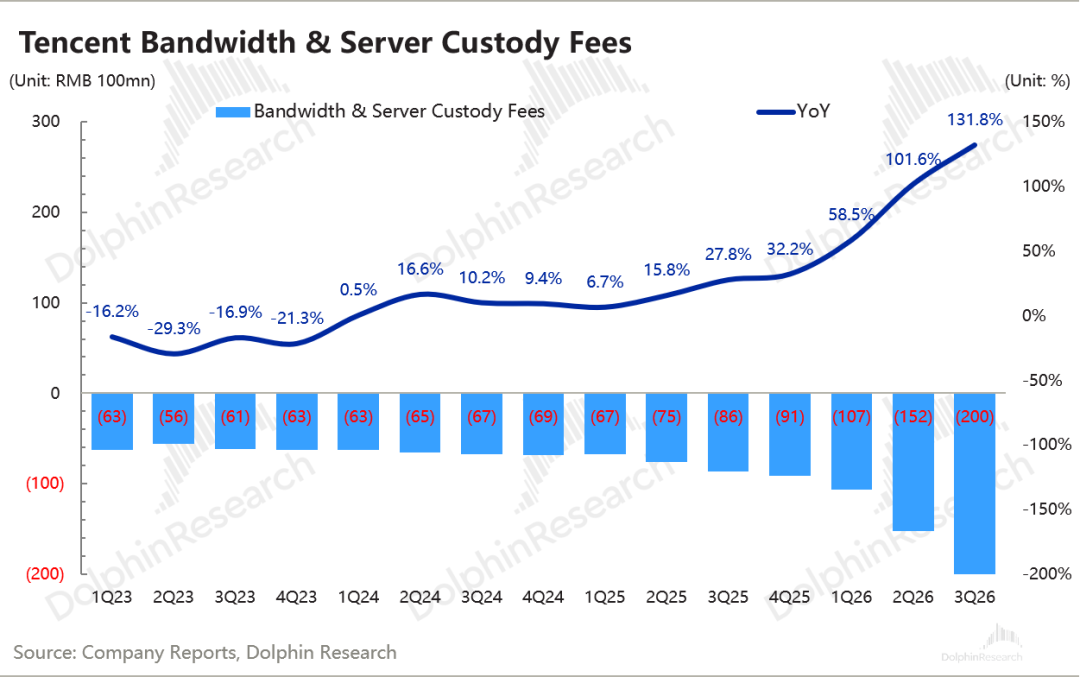
Another part is depreciation and amortization after prior capex equipment investment. Depreciation related to computing power is generally recorded in R&D expenses, used as training computing power expenditure for the Hunyuan model.
Third-quarter R&D expenses were 32.4 billion yuan, up 42% year-over-year. Among them, personnel compensation barely increased; non-compensation investment was 15.4 billion yuan, compared with a typical range of 2–3 billion before AI investment.
This increase can basically be regarded as computing power expenditure for training—that is, depreciation expenses after prior capex purchases of GPUs and other computing power chips—and also includes leased computing power fees.
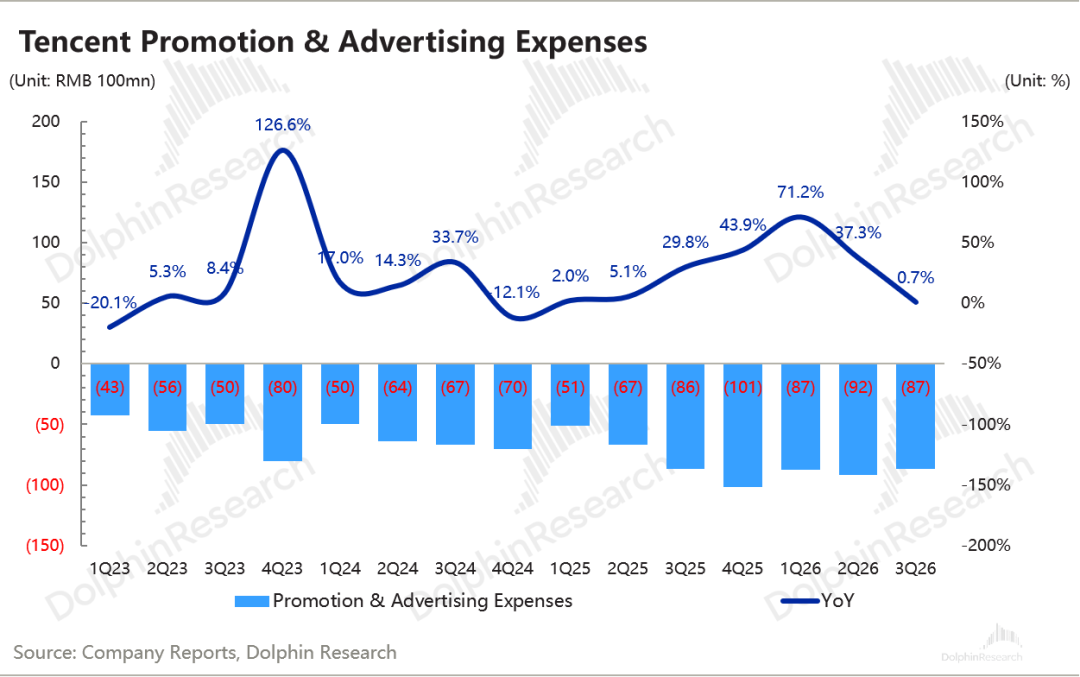
Selling expenses accounted for less than 6% of revenue, growing only 6% year-over-year, with promotion and advertising expenses flat. On one hand, there were few new games this quarter, so less placement was needed; on the other hand, it can be seen that WorkBuddy mainly relies on giving away computing power to acquire users, not on advertising.
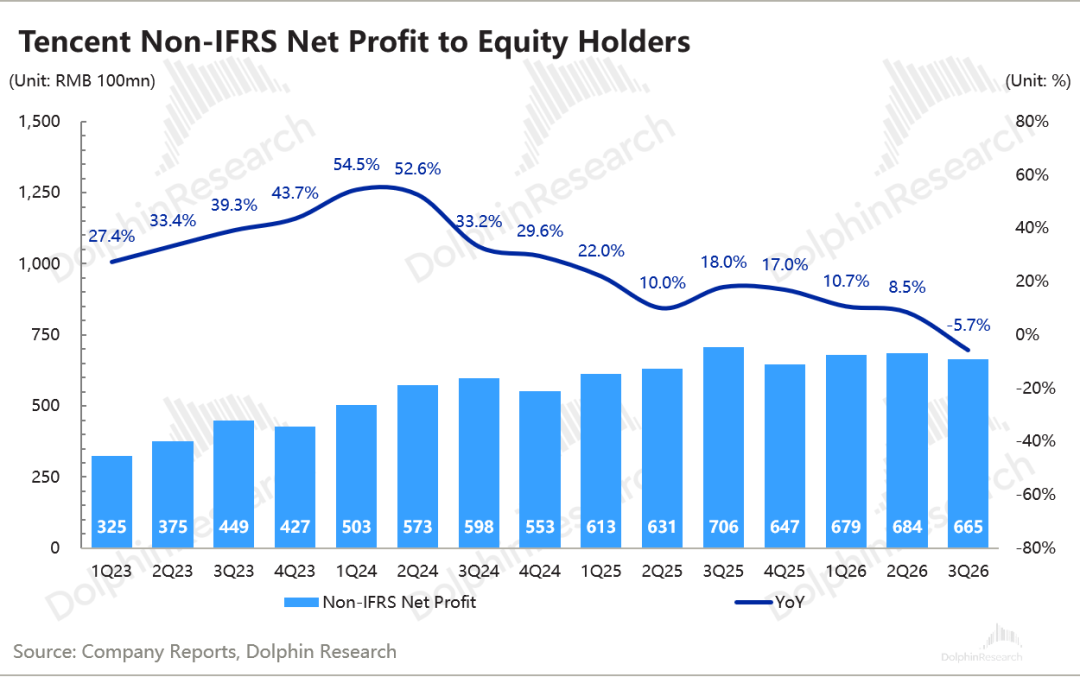
Non-IFRS net profit attributable to shareholders reached 66.5 billion yuan, down 6% year-over-year, basically in line with Bloomberg consensus expectations.
Third-quarter confirmed capital expenditure was 81.4 billion yuan, cash payment basis was 65.1 billion yuan, plus approximately 86 billion yuan in computing power prepayments—meaning on an overall cash payment basis, a total of 151 billion yuan was spent this quarter on equipment. Part was purchased spot, and part was prepayments.
Q3 operating cash flow was only 2.6 billion yuan. Adding back the 86 billion yuan in computing power procurement prepayments, free cash flow would only be positive at approximately 16.9 billion yuan. Since Tencent discloses quarterly capex under three bases, Dolphin Research will explain them here.
(1) One is the cash payment basis—that is, capex paid this quarter and recorded in property and equipment and construction in progress, indicating that the purchased equipment has been delivered.
(2) The other is also the cash payment basis—paid this quarter, but the money was not recorded in property and equipment and construction in progress; instead, it was recorded in non-current prepayments, referring to prepayments to lock in computing power equipment in advance.
(3) The third is the accrual basis—that is, the equipment delivery basis. This refers to equipment assets fully recorded in property and equipment and construction in progress.
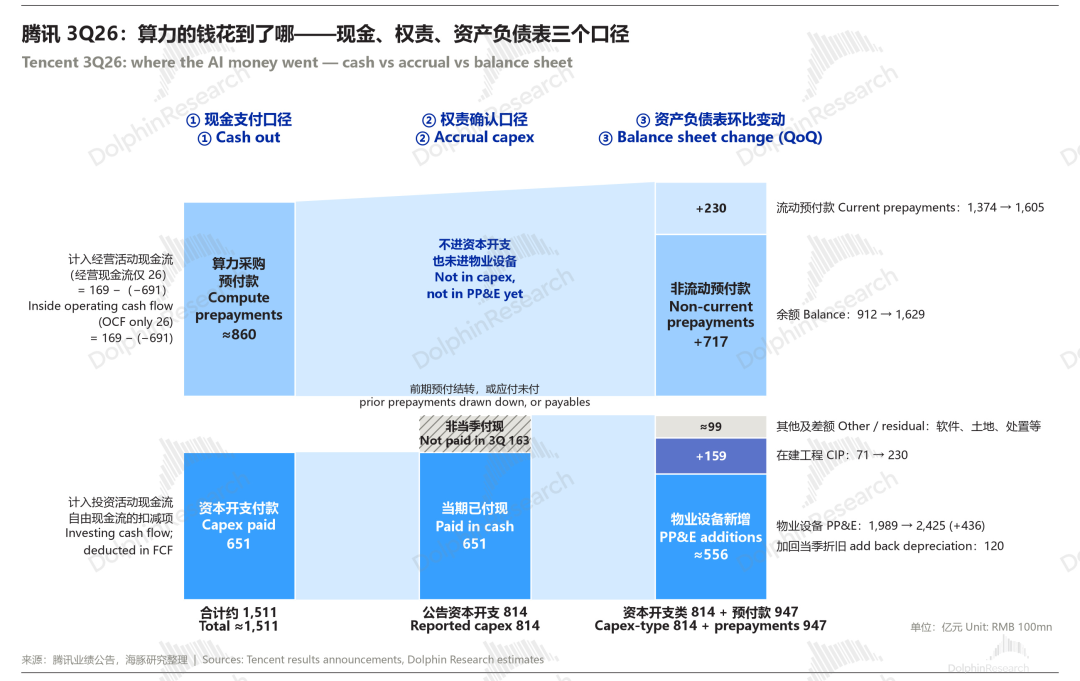
For horizontal comparability, the cash payment and delivered-in-hand basis is generally adopted, so Q3's 65.1 billion yuan is more appropriate. But when discussing Tencent separately, the market tends to look at the accrual basis—that is, Q3's 81.4 billion yuan.
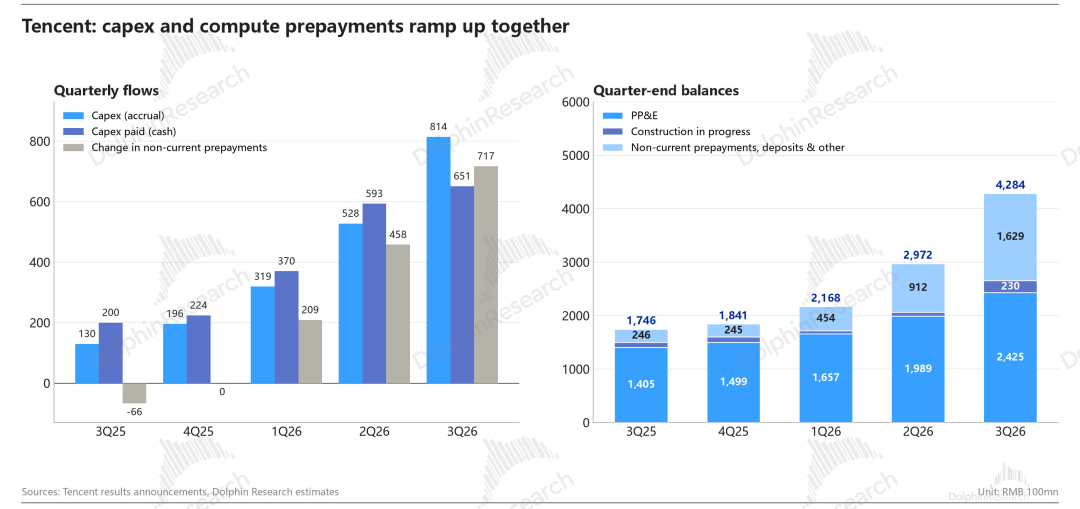
At the end of Q3, property and equipment rose from 149.9 billion yuan at the beginning of the year to 242.5 billion yuan, and non-current prepayments were even more exaggerated—from only 24.5 billion yuan at the beginning of the year to 162.9 billion yuan now. Although the bases differ, these will all become depreciation later, further weakening margins.
In the short term, from a cash flow perspective, Q3 spent a total of 150 billion yuan in capital expenditure cash—equivalent to putting pressure on cash flow in advance (requiring short-term borrowing and financing, etc.). This is Tencent betting heavily to catch up with AI progress and seize the regulatory window, with concentrated investment in a short window, so future cash flow conditions are likely to improve gradually.
- END -
// Reprint authorization
This article is an original article by Dolphin Research. Authorization is required for reprinting.
// Disclaimer and general disclosure notice
This report is for general comprehensive data purposes only, intended for general reading and data reference by users of Dolphin Research and its affiliates, and does not consider the specific investment objectives, investment product preferences, risk tolerance, financial condition, and special needs of any person receiving this report. Investors must consult independent professional advisers before making investment decisions based on this report. Anyone who makes investment decisions due to the use of or reference to the content or information mentioned in this report shall bear the risks themselves. Dolphin Research shall not be liable for any liability or loss that may be directly or indirectly caused by the use of the data contained in this report. The information and data contained in this report are based on publicly available materials and are for reference only. Dolphin Research strives for but does not guarantee the reliability, accuracy, and completeness of the relevant information and data.
The information mentioned or views expressed in this report shall not be regarded or construed in any jurisdiction as an offer to sell securities or an invitation to buy or sell securities, nor do they constitute recommendations, inquiries, or endorsements regarding the relevant securities or related financial instruments. The information, tools, and materials contained in this report are not intended or planned for distribution to citizens or residents of any jurisdiction where the distribution, publication, provision, or use of such information, tools, and materials would contravene applicable laws or regulations or would cause Dolphin Research and/or its subsidiaries or affiliates to be subject to any registration or licensing requirements in that jurisdiction.
This report reflects only the personal views, opinions, and analytical methods of the relevant creators and does not represent the position of Dolphin Research and/or its affiliates.
This report is produced by Dolphin Research, and the copyright belongs solely to Dolphin Research. No institution or individual may, without the prior written consent of Dolphin Research, (i) produce, copy, reproduce, reprint, forward, or otherwise distribute copies or reproductions in any form, and/or (ii) directly or indirectly redistribute or transfer them to other unauthorized persons. Dolphin Research reserves all related rights.
-
![]()
XPeng's Strongest Financial Report Yet — and the Challenges That Lie Ahead
-
![]()
Alibaba Q3 Report: Revenue Beats by 1 Billion Yuan, Profit Falls 6.7 Billion Yuan Short
-
![]()
Is the "Battle for the Entry Point" of AI Office Work Over?
-
BAIC Abandons Independent Battery Swapping Strategy
-
![]()
Tencent's Shareholders Must Bear a Little More Hardship
-
![]()
At 28, Tencent Begins Rebuilding Itself Around AI
-
![]()
Tencent: A Rare Profit "Reversal"—How Long Will This AI Tuition Have to Be Paid?
-
![]()
Managing These 17 Automakers Well Means Managing the Entire Auto Market Well