Is the "Battle for the Entry Point" of AI Office Work Over?
 11/20 2026
 553

The Second Half of AI Office Work
Image source: Internet (contact us for removal if there is any infringement). Partially AI-generated.
On November 18 and 19, Tencent and ByteDance released their respective report cards in the AI office track almost simultaneously.
Tencent WorkBuddy's daily active users exceeded 10 million, with average daily token calls surpassing 100 trillion and seven-day annualized revenue exceeding $500 million—more than twice that of Tencent Meeting.
Almost at the same time, ByteDance's Doubao Work announced its latest progress: just three months after launch, DAU exceeded 8 million, and enterprise customer ARR exceeded 2 billion yuan.
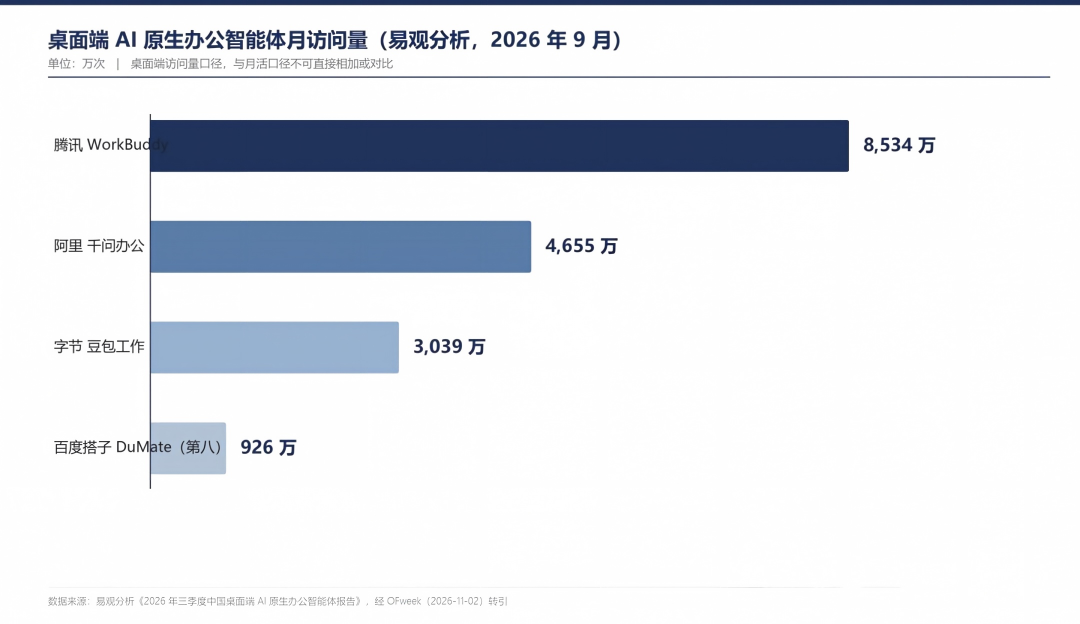
On the other side, Alibaba's Qwen Office is also accelerating its catch-up. Data from Analysys shows that WorkBuddy's user penetration rate reached 55%, with a high-frequency usage rate of 92%; Qwen Office followed closely with a high-frequency usage rate of 88%.
Looking at these numbers alone, it is easy to conclude that China's AI office market is ushering in a new round of traffic wars.
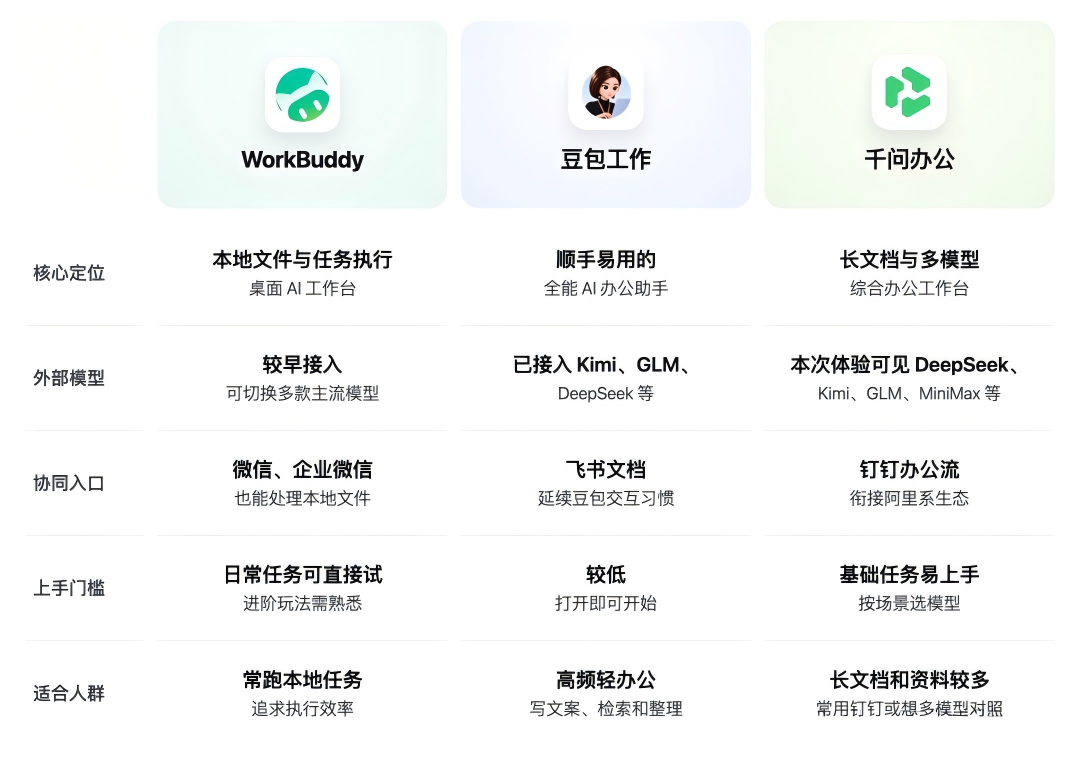
But from an observational standpoint, what is truly noteworthy about these data is not who has higher daily active users or faster revenue growth, but that the three internet giants—Tencent, ByteDance, and Alibaba—are using three completely different business logics to re-compete for a hugely valuable market.
Tencent hopes to make AI the work entry point for everyone; ByteDance hopes to make AI the productivity infrastructure of enterprise organizations; and Alibaba is trying to use DingTalk's enterprise ecosystem to deeply embed AI into organizational collaboration systems.
This means that competition in AI office work has entered a new stage.
In the past, everyone competed over whose model was smarter; now everyone competes over who can truly take over users' work.

Tencent and ByteDance Simultaneously Show Their Report Cards
Let's look at Tencent first.
Among the data released by WorkBuddy this time, three dimensions are actually the most noteworthy.
The first is user scale. Daily active users exceeding 10 million shows that AI office work is no longer just an exclusive tool for tech enthusiasts and programmers, but has begun to enter broader daily work scenarios.
The second is depth of use, with average daily token calls exceeding 100 trillion. Token consumption reflects to some extent the frequency of user-AI interaction and the complexity of tasks. Compared with mere download and registration numbers, it better demonstrates whether a product is truly integrated into the work process.
The third is commercialization capability. Seven-day annualized revenue exceeded $500 million, already more than twice that of Tencent Meeting.
This set of data sends an important signal: AI office work is moving from the traffic acquisition stage to the stage of validating commercial value.
In the past, the core metrics of internet products were user scale and usage duration. But for AI products, having users alone is not enough.
Whether users are willing to continuously call the model, whether they are willing to hand complex tasks to AI, and whether they are willing to pay for a more efficient work experience—these determine whether a product can form a true commercial closed loop.
Tencent WorkBuddy clearly hopes to prove through these three metrics that it not only has traffic, but also depth of use and monetization capability.
Now let's look at ByteDance.
Three months after launch, Doubao Work's DAU exceeded 8 million, and enterprise customer ARR exceeded 2 billion yuan.
Unlike Tencent, which emphasizes personal user scale, token calls, and revenue elasticity, the signal ByteDance released this time leans more toward the enterprise market.
ARR, or annual recurring revenue, is an important metric for measuring the commercialization capability of subscription-based enterprise software. The willingness of enterprise customers to sign contracts means that AI has begun to transform from a novelty tool into a productivity product that enterprises are willing to continuously purchase.
What is especially noteworthy is that such results were achieved only three months after launch, indicating that enterprise demand for AI office work is being rapidly unleashed.
Of course, Tencent's seven-day annualized revenue and ByteDance's ARR are not completely identical statistical calibers, and the two sets of numbers cannot simply be placed together to judge whose commercialization capability is stronger.
But together they prove one thing:
AI office work is no longer just a future story told by internet giants; it has already begun to generate real commercial revenue.
And this is precisely the most important change in the entire industry.

Tencent: First Occupy the Entry Point, Then Seek Monetization Space
Why can Tencent WorkBuddy achieve such a massive user scale in a short period of time?
The answer largely lies in Tencent's ecosystem.
For Tencent, the biggest advantage in AI office work is not necessarily the model itself, but the massive user base represented by WeChat and the natural traffic entry point it forms.
Over the past decade or more, WeChat has become an important infrastructure connecting work and life for Chinese internet users.
From personal communication and file transfer to group chat collaboration, official account content access, and then mini programs and WeCom, Tencent has in fact already grasped a large number of information touchpoints in users' daily work.
The emergence of AI office work has given these touchpoints new room for imagination.
Imagine that in the past a user needed to receive a file in WeChat, then open office software to process the document, and finally send the result to colleagues through a chat tool.
In the future, this series of actions may be reorganized by AI.
Users only need to state their needs, and AI can help them understand files, extract information, generate content, and even assist in completing follow-up tasks.
This is what Tencent hopes to achieve: making AI transform from a standalone tool into an assistant that can be called upon at any time during users' work process.
From a business model perspective, this is a typical entry-point AI route.
Its core is not to first persuade enterprises to buy a whole set of software, but to first let enough individual users form usage habits, and then expand commercial value through high-frequency use, value-added services, and enterprise scenarios.
This logic is somewhat like WeChat in the past.
First establish user connections, then gradually extend into commercial scenarios such as payments, advertising, mini programs, and enterprise services.
Of course, AI office work is not simply replicating WeChat's success.
Because the core value of chat tools is connecting people to people, while the core value of AI office work is helping people complete tasks.
This means that users will not use WorkBuddy over the long term merely because it is backed by Tencent's ecosystem.
What truly determines user retention is whether it can understand work content, complete complex tasks, and continuously reduce users' work costs.
Therefore, Tencent's most important current task is to transform its traffic advantage into a work capability advantage.
If it only has a large number of users but cannot penetrate users' real work processes, then the entry point may just be a traffic entry point rather than a productivity entry point.

ByteDance: Embed AI into Workflows and Make Enterprises Pay for Efficiency
Unlike Tencent, ByteDance's AI office route leans more toward organizations and processes.
An important advantage behind Doubao Work is ByteDance's accumulation in scenarios such as enterprise collaboration, documents, and knowledge management, as well as the enterprise customer base formed by Feishu.
The biggest difference between enterprise office work and personal office work is that individuals can switch tools because they are easy to use, but enterprises find it difficult to completely change their existing organizational systems just because a new tool appears.
An enterprise may have hundreds or even tens of thousands of employees, and daily work involves documents, meetings, approvals, project management, knowledge bases, and internal communication.
There are massive data relationships and process connections among these tools.
If AI is just a standalone chat window, and employees need to constantly copy files, upload materials, and switch applications, then it will be difficult for it to truly change enterprise work efficiency.
But if AI directly enters documents, meetings, knowledge bases, and collaboration processes, the situation is completely different.
It can generate meeting minutes based on meeting content, answer business questions based on the enterprise knowledge base, organize tasks based on project progress, and even help employees complete some repetitive process work.
AI is no longer just a tool waiting for users to ask questions, but becomes a participant in enterprise workflows.
This is the core value of process-oriented AI.
Why does ByteDance place particular emphasis on enterprise customer ARR? Because the business logic of enterprise software differs significantly from that of personal internet products.
Individual users may use AI every day but may not be willing to pay; but as long as enterprises can confirm the efficiency improvements brought by AI, they are motivated to include it in their annual procurement budgets.
For enterprises, what truly matters is not how many sentences employees chat with AI every day, but whether AI can reduce repetitive labor, shorten business cycles, and lower management costs.
Therefore, when Doubao Work announced that enterprise customer ARR exceeded 2 billion yuan, its significance lies not only in revenue scale, but also in proving that AI is entering enterprises' software procurement systems.
Of course, ARR does not mean that all customers have already achieved deep usage, nor can it be directly equated with realized revenue.
But at least it shows that the enterprise market has begun to pay for AI productivity.
From this perspective, what ByteDance is betting on is not a smarter chatbot, but a set of AI work systems that can be embedded into enterprise organizations.

Why Can't Alibaba Be Absent?
In addition to Tencent and ByteDance, Alibaba is also a player that cannot be ignored on the AI office battlefield.
The advantage of Qwen Office comes from Alibaba's long-accumulated enterprise service capabilities and the organizational collaboration network established by DingTalk.
If Tencent is better at connecting individual users and ByteDance emphasizes more the combination of AI and workflows, then Alibaba's advantage lies in the enterprise organization itself.
DingTalk has already penetrated the daily management scenarios of a large number of enterprises—from attendance, approvals, and meetings to project collaboration and enterprise communication—accumulating a large number of organization-level application scenarios.
These scenarios are naturally suitable for AI transformation.
For example, in the past employees needed to manually fill in approval information, look up enterprise policies, and organize meeting records. In the future, AI can directly understand the information and processes within the enterprise and help employees complete corresponding tasks.
More importantly, Alibaba possesses enterprise-level cloud computing and AI infrastructure capabilities.
When enterprises begin to deploy AI on a large scale, model capabilities, computing resources, data security, and system integration will all become important factors in procurement decisions.
This makes Alibaba's competition not just a competition among office software products, but a competition extending from the office entry point to enterprise digital infrastructure.
Data from Analysys shows that Qwen Office's high-frequency usage rate has reached 88%, not far from WorkBuddy's 92%.
This at least shows that the AI office market has not formed a situation of one dominant player.
All three giants are looking for their own advantageous positions.
What Tencent needs to solve is how to turn individual users into long-term paying users; what ByteDance needs to solve is how to transform AI capabilities into enterprise-level productivity; and what Alibaba needs to solve is how to use organizational and infrastructure advantages to promote the large-scale implementation of AI within enterprises.
Their competition paths are different, but they ultimately point to the same goal: to become the work entry point that users and enterprises truly cannot do without.

Big Tech Begins to Redefine AI Office Work
There is another detail worth noting.
For some time in the past, Tencent, ByteDance, and Alibaba all launched multiple AI office-related products internally, exploring the market through different teams and different product forms.
But as the market gradually matures, the three tech giants have coincidentally begun consolidating the capabilities and resources of their various internal AI products into core brands such as WorkBuddy, Doubao Work, and Qwen Office.
Behind this shift lies a highly significant industry transformation.
AI-powered office work is no longer a market where single-point innovation can secure a win.
In the early days, the focus was largely on model capabilities, generation quality, and product experience. Whoever could launch a useful AI assistant first might capture the first wave of users.
But now, market competition has grown increasingly complex.
Because a true AI office product must simultaneously possess model capabilities, product experience, user entry points, data connectivity, workflow integration, and commercialization capabilities.
These capabilities are difficult to achieve separately through multiple fragmented products.
This is especially true in the enterprise market, where customers do not want to purchase five or six AI tools with similar functions, and even less do they want employees to constantly switch between different applications.
What they need is a unified AI work system.
Therefore, big tech consolidating resources into core brands is essentially a shift from the technology exploration stage to the market operation stage.
In the past, the competition was over who could build a better AI product; now the competition is over who can build a complete user, technology, and business ecosystem around a core product.
This also means that the competitive threshold for AI office is rising rapidly.

So, among Tencent, ByteDance, and Alibaba, who is more likely to emerge as the winner of the next generation of AI office?
Based on the current situation, it is still too early to draw a conclusion.
Because the data published by the three companies currently represent different business dimensions, and user scale, token call volume, high-frequency usage rate, and enterprise ARR cannot be directly equated.
More importantly, AI office still has a problem that has not yet been truly solved:
When can personal workflows and enterprise workflows truly be connected?
This is the key to determining the industry landscape in the next stage.
For example.
An employee must handle personal tasks every day while also participating in team projects. They need to read emails, organize documents, attend meetings, query the enterprise knowledge base, and also collaborate with other departments.
If AI can only handle personal files, it cannot truly understand enterprise business; if AI can only run within enterprise workflows, it will be difficult for it to cover the large volume of fragmented personal work needs of employees.
A truly valuable AI office system must understand work relationships at the personal, team, and enterprise levels simultaneously.
It knows not only what the user is doing, but also what the user's team is advancing, and even more what data, policies, and business processes the enterprise has that can be invoked.
This is the real competitive barrier of AI office.
From this perspective, Tencent's advantage lies in personal user entry points, ByteDance's advantage lies in workflows and enterprise collaboration, and Alibaba's advantage lies in enterprise organization and infrastructure.
But all three need to fill in the same missing piece: how to create a true connection between personal AI assistants and enterprise AI systems.
Whoever completes this step first will have the opportunity to upgrade from an AI office tool to the next-generation work operating system.
And this will also change the business logic of traditional office software.
In the past, users opened office software to use a specific function. They opened document software to write documents, meeting software to hold meetings, and project management tools to manage projects.
In the future, users may no longer care about which specific software they should open.
They only need to tell AI what task they want to complete, and AI can, based on permissions and business context, invoke different tools, read different data, and organize the entire execution process.
Office software will still exist, but it may gradually move to the background and become capability components invoked by AI.
What truly stands in the foreground is the AI entry point that understands user intent, grasps work context, and can mobilize various tools to complete tasks.
Therefore, the endgame of AI office is not to replace office software, but to redefine the relationship between office software and users.
In the past, people found software to complete work; in the future, AI understands people's needs and organizes software to complete work.
This is what Tencent, ByteDance, and Alibaba are truly fighting for.
From WorkBuddy's tens of millions of daily active users, to Doubao Work's enterprise ARR exceeding 2 billion yuan, and then to Qwen Office accelerating its catch-up, China's AI office market has already passed the initial product trial stage.
The next competition will not take place only on model leaderboards, nor only on user growth curves.
It will take place in the first minute each person opens their computer every day, in every enterprise meeting, every document, and every business process.
Whoever can become the user's true work entry point will have the opportunity to grasp the initiative in the next-generation office ecosystem.
This war has, in fact, only just begun.
-
![]()
XPeng's Strongest Financial Report Yet — and the Challenges That Lie Ahead
-
![]()
Alibaba Q3 Report: Revenue Beats by 1 Billion Yuan, Profit Falls 6.7 Billion Yuan Short
-
![]()
Is the "Battle for the Entry Point" of AI Office Work Over?
-
BAIC Abandons Independent Battery Swapping Strategy
-
![]()
Tencent's Shareholders Must Bear a Little More Hardship
-
![]()
At 28, Tencent Begins Rebuilding Itself Around AI
-
![]()
Tencent: A Rare Profit "Reversal"—How Long Will This AI Tuition Have to Be Paid?
-
![]()
Managing These 17 Automakers Well Means Managing the Entire Auto Market Well