XPeng's Strongest Financial Report Yet — and the Challenges That Lie Ahead
 11/20 2026
 466
XPeng recently released its Q3 2026 financial report.
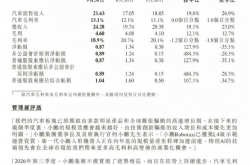
According to the report, XPeng posted total revenue of RMB 24.28 billion in Q3, up 19.1% year-on-year and 23% quarter-on-quarter. It delivered 118,400 vehicles, up 2.1% year-on-year and 14.6% quarter-on-quarter. Both revenue and deliveries hit new single-quarter records, making XPeng's overall performance this quarter particularly noteworthy.
In terms of revenue mix, the automotive business remains XPeng Group's primary revenue source. In Q3, automotive sales revenue reached RMB 21.63 billion, accounting for nearly 90% of total revenue — up 19.8% year-on-year and 26.9% quarter-on-quarter. Services and other revenue came in at RMB 2.647 billion, up 13.7% year-on-year. Automotive sales revenue grew faster than the group's overall revenue, making it the main driver of revenue growth this quarter.
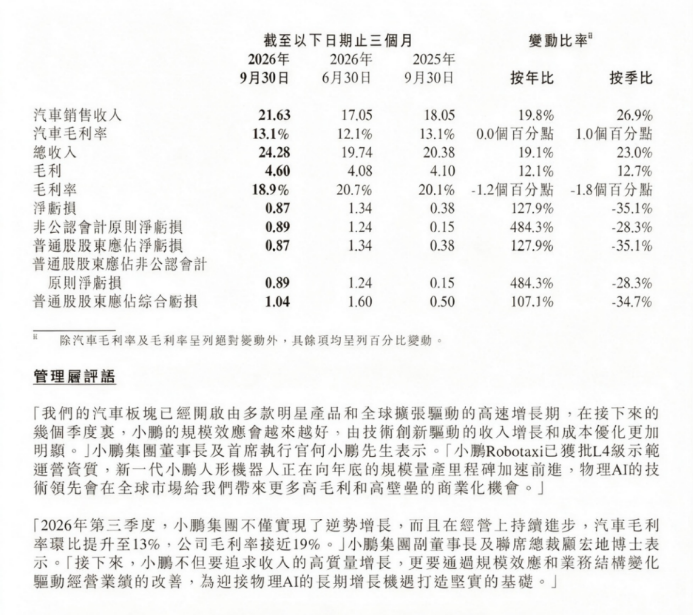
Notably, XPeng's average revenue per vehicle in Q3 was approximately RMB 182,700, up about 17.4% from RMB 155,600 in the same period last year. This means that the growth in XPeng's automotive sales revenue this quarter stemmed not only from higher deliveries but also — importantly — from higher revenue per vehicle.
At the same time, XPeng's profitability in Q3 presented a mixed picture. Automotive gross margin was 13.1%, up 1 percentage point quarter-on-quarter and flat year-on-year. XPeng attributed this mainly to an optimized model mix. However, the group's overall gross margin was 18.9%, slightly down both quarter-on-quarter and year-on-year. During the same period, the group's gross profit reached RMB 4.6 billion, up 12.1% year-on-year and 12.7% quarter-on-quarter; net loss was RMB 870 million — narrower than RMB 1.34 billion in the previous quarter but significantly wider than RMB 380 million in the same period last year. Evidently, although the automotive business's gross margin improved, the group as a whole has yet to turn a profit, and profitability still needs improvement.
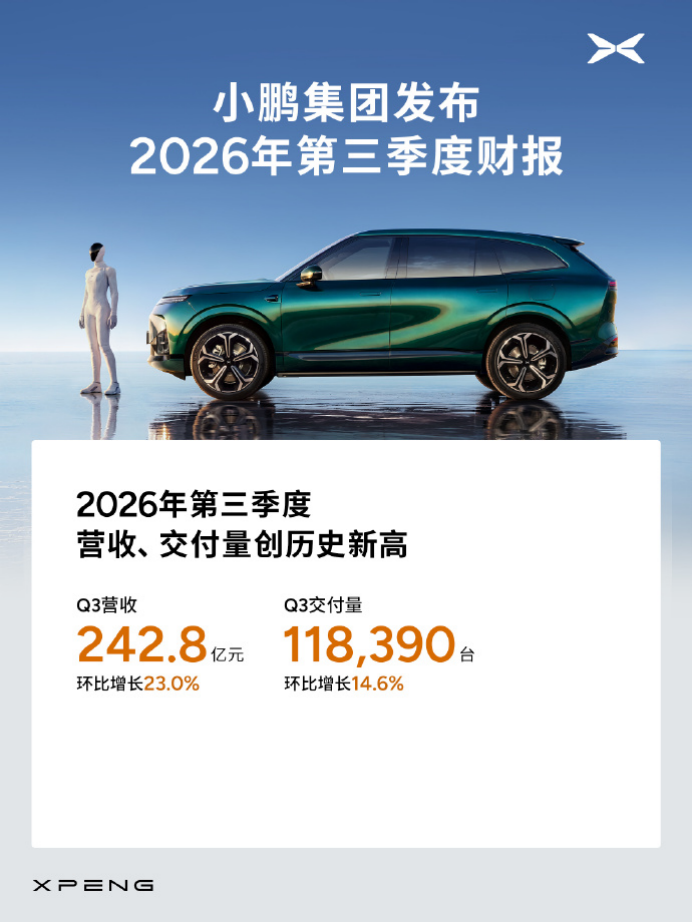
Beyond operating revenue, XPeng's cash reserves are also relatively ample. As of the end of September, XPeng's cash and cash equivalents, restricted cash, short-term investments, and time deposits totaled RMB 45.41 billion, an increase of RMB 4.93 billion from the end of June. Ample funds give it more room for subsequent new model R&D and technological upgrades.
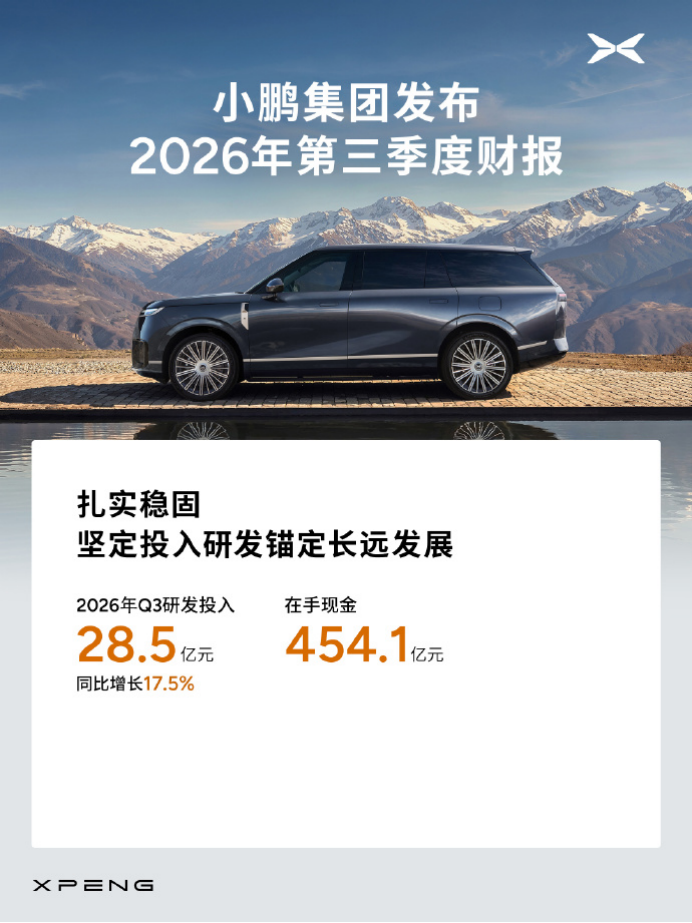
On the R&D front, XPeng's R&D expenses in Q3 were RMB 2.85 billion, up 17.5% year-on-year. The financial report disclosed that the increase was mainly used to expand the product lineup and develop new models and AI-related technologies. During the same period, selling, general and administrative expenses were RMB 2.78 billion, up 11.4% year-on-year, mainly due to increased marketing and advertising investment and higher sales personnel costs. This shows that while expanding the market, XPeng has not slowed its investment in new products and new technologies.
It is worth mentioning that XPeng's overseas market was also a major highlight this quarter. In Q3, it delivered 27,800 vehicles overseas, up 153.4% year-on-year, accounting for about 23.6% of total deliveries. XPeng has now entered 82 countries and regions and established 552 overseas stores. The rapid growth of overseas sales has brought XPeng new incremental growth.
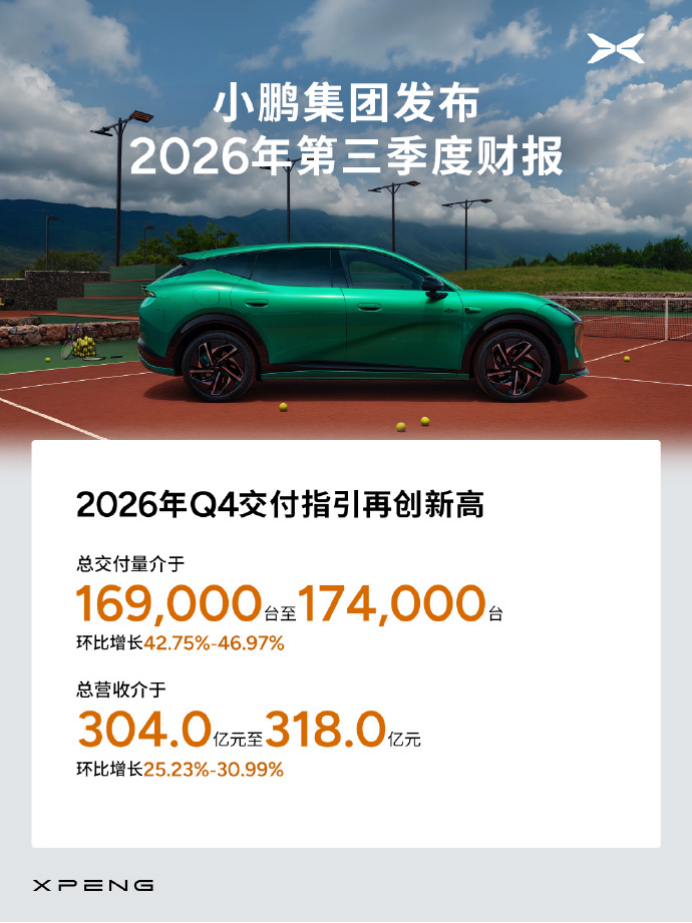
For the fourth quarter, XPeng's outlook is also relatively positive. The company expects vehicle deliveries to reach 169,000–174,000 units, up 42.75%–46.97% quarter-on-quarter; total revenue to be RMB 30.4 billion–31.8 billion, up 25.23%–30.99% quarter-on-quarter. If this target is successfully achieved, XPeng's revenue and deliveries are expected to hit new highs once again.
It can be seen that XPeng's overall performance in Q3 was solid, with positive development momentum. But behind the impressive results, XPeng also has some hidden concerns.
According to third-party data, in Q3, the MONA M03 and L03 together delivered about 47,500 vehicles. Priced at RMB 119,800–151,800 and RMB 123,800–156,800 respectively, the two models are XPeng's undisputed sales mainstays. By comparison, the G7, G6, G9, and G9L together accounted for only 8.3% of total deliveries, and the sales contribution of mid- to high-end models was very limited.
This means that a considerable portion of XPeng's current sales comes from mid- and low-priced models. The MONA series has brought considerable sales to XPeng, but it may also lead consumers to associate XPeng with cost-effective models. Some media have previously raised the question of whether XPeng would become the next Leapmotor. This comparison is not without reason: XPeng, which relies on mid- and low-priced models for volume, does face the realistic problem of its brand positioning gradually becoming fixed in the cost-effective market.

There is nothing wrong with relying on cost-effective models for volume itself. The key is whether XPeng can also achieve good results in the mid- to high-end market. In Q3, the GX, priced at RMB 269,800–349,800, delivered 20,789 units — a remarkable performance that shows XPeng still has certain market opportunities in this price range. However, one model alone is not enough to change the market's overall perception of the brand, and other mid- to high-end models also need to perform better.
XPeng President Wang Fengying previously mentioned that MONA may open independent stores in the future and that the possibility of developing it into an independent brand cannot be ruled out. If this idea is implemented, MONA can continue to take on the volume task, while the main XPeng brand can focus more on the mid- to high-end market and reduce the impact between models with different positioning.
Overall, XPeng delivered a Q3 scorecard with both revenue and deliveries hitting new highs, and with improvements in its automotive gross margin and average revenue per vehicle. However, as sales scale continues to expand, how to keep existing sales stable while also achieving good sales for mid- to high-end models remains a problem XPeng needs to face next.
(Images are from the internet and will be deleted if infringing.)
-
![]()
XPeng's Strongest Financial Report Yet — and the Challenges That Lie Ahead
-
![]()
Alibaba Q3 Report: Revenue Beats by 1 Billion Yuan, Profit Falls 6.7 Billion Yuan Short
-
![]()
Is the "Battle for the Entry Point" of AI Office Work Over?
-
BAIC Abandons Independent Battery Swapping Strategy
-
![]()
Tencent's Shareholders Must Bear a Little More Hardship
-
![]()
At 28, Tencent Begins Rebuilding Itself Around AI
-
![]()
Tencent: A Rare Profit "Reversal"—How Long Will This AI Tuition Have to Be Paid?
-
![]()
Managing These 17 Automakers Well Means Managing the Entire Auto Market Well