Alibaba Q3 Report: Revenue Beats by 1 Billion Yuan, Profit Falls 6.7 Billion Yuan Short
 11/20 2026
 347
Alibaba's Q2 FY2027 financial report can be summed up in one sentence: the direction of investment is clear, but the pace has run ahead of the market's patience.
After the earnings release, US pre-market trading initially surged before quickly pulling back.
The market's disagreement is not over whether Alibaba has growth, but over the cost of that growth.
The revenue beat shows that demand-side resilience remains; the profit miss shows that investment is eating into current-period earnings at a faster clip. Only by reading the two together can one grasp the tension running through this earnings report.
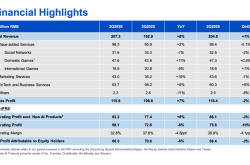
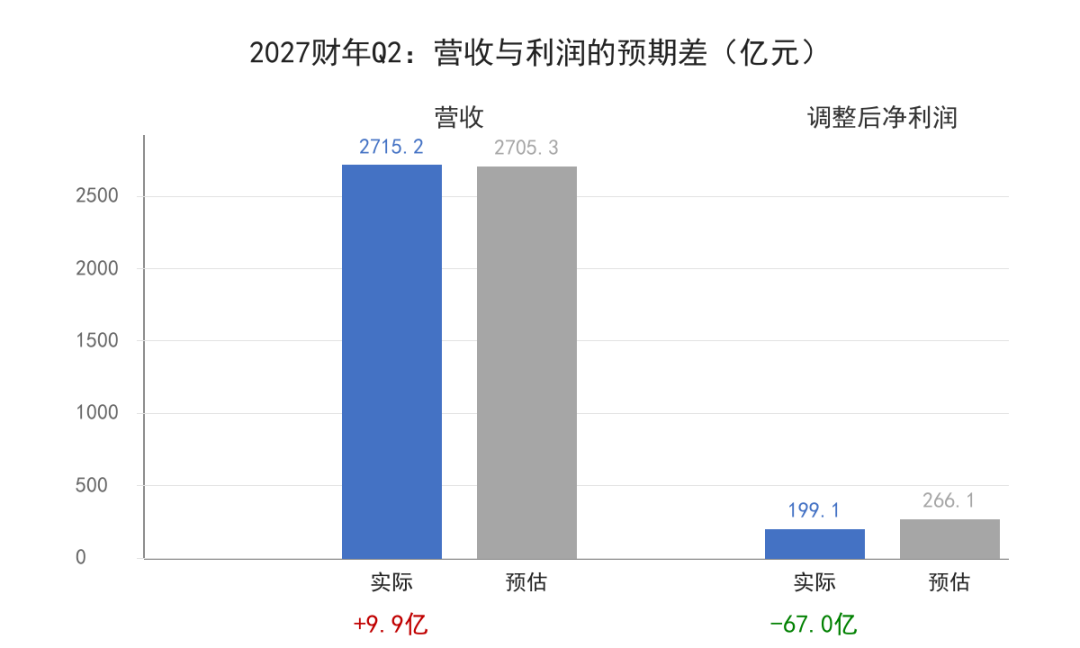
Revenue came in at 271.52 billion yuan, up 10% year over year and above the 270.53 billion yuan estimate; adjusted net profit was 19.91 billion yuan, up 92% year over year, yet 6.7 billion yuan below the 26.61 billion yuan estimate—a gap of roughly 25%.
Revenue beat by nearly 1 billion yuan, while profit fell 6.7 billion yuan short. The market's first reaction was sharp pre-market volatility in the share price.
Revenue deviated from estimates by only 990 million yuan—essentially flat; profit deviated by 6.7 billion yuan—a clear expectations gap. For a company of this scale, the market tends to price not the absolute number, but the deviation from expectations.
1
How should the core data be read?
Adjusted earnings per depositary receipt were 8.10 yuan, compared with 4.36 yuan in the same period last year and a 10.75 yuan estimate—a difference of 2.65 yuan. Operating profit was 29.116 billion yuan, up 443% year over year; net profit attributable to ordinary shareholders was 64.535 billion yuan, up 207% year over year.
Data source: ifind
From an absolute scale perspective, quarterly revenue of 271.52 billion yuan means trillion-yuan-level transaction volume is still running through the platform.
A 10% growth rate is not low in today's macroeconomic environment, but the valuation logic for internet companies shifted long ago from scale to profit margin—which is why merely meeting revenue targets is not enough to reassure the market.
These two high growth rates need to be viewed against the base. In the same period last year, a goodwill impairment and a special provision related to the EU Digital Services Act pushed the base very low.
This year's large profit growth stems more from the fading of one-off factors than from a sudden leap in operating efficiency.
What truly drives market pricing is the gap versus expectations: adjusted net profit came in about 25% below estimates.
The low base also carries a side effect: year-over-year figures lose their horizontal comparability.
Operating profit growth of 443% looks like a leap in magnitude, but if last year's impairment provision is added back, the real improvement would be far smaller. In financial statement analysis, identifying one-off items matters more than memorizing growth rates.
2
Cloud is the only segment that is accelerating
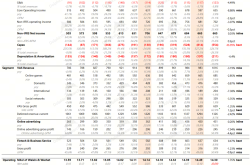
AI cloud and computing power services revenue was 60.97 billion yuan, up 53% year over year and above the 59.77 billion yuan estimate. Last quarter it was 48.437 billion yuan, up 45%—already the fastest in 22 quarters—and this quarter the growth rate climbed another 8 percentage points. AI lab and application revenue was 4.44 billion yuan, up 51% year over year and above the 3.52 billion yuan estimate.
Taking a longer view, the acceleration trend in the cloud business is even clearer. Last quarter's revenue was already a 22-quarter high, and this quarter's growth rate rose another 8 percentage points. With overall revenue growing only 10%, cloud is the only major segment tracing an accelerating curve.

External commercialization revenue grew 64%, external recurring revenue grew 67%, adjusted EBITDA grew 121%, and the margin rose to 14.5%. AI-related product revenue was 17.918 billion yuan, achieving triple-digit growth for the 13th consecutive quarter.
Both external commercialization revenue and recurring revenue grew rapidly, indicating that demand does not come from internal related-party transactions but from real external customer spending. The rise in EBITDA margin to 14.5% means the cloud business is no longer simply burning money; while expanding scale, unit economics are also improving.
The product side is advancing in parallel: Pingtouge released Zhenwu V900, planned for mass production in the first quarter of 2027; the foundation model Qwen4-Max has a parameter scale of 2.4T; Qianwen Office and Qianwen applications are advancing agent implementation in enterprise and consumer scenarios. Cloud has already changed from a cost center into a profit contributor.
At the infrastructure level, Alibaba Cloud already operates 107 availability zones across 31 regions globally and has more than 3,200 edge nodes; in the next 12 months it plans to establish cloud region nodes for the first time in Turkey, Finland, and the Netherlands, and expand data centers in Malaysia, Germany, the UAE, France, and Hong Kong, China. The flow of capital expenditure is highly consistent with this expansion list.
For enterprise customers, cloud vendors' capital expenditure means more ample computing power supply and more stable service capabilities. Alibaba is putting money into infrastructure, suppressing short-term profit, but in the long term what it determines is whether it can capture the demand of the next round of agent applications.
3
What does e-commerce's 2% growth say?
E-commerce group revenue was 197.24 billion yuan, up 2% year over year and slightly below the 197.53 billion yuan estimate; last quarter it was still 4%, and the direction is weakening. Adjusted EBITDA grew 243% year over year, improving on the profit side, while the revenue side showed almost no growth.
E-commerce revenue growth fell from 4% to 2%. The magnitude is not large, but the direction is worth watching.
As the group's cash flow base, e-commerce no longer needs to carry a high-growth narrative, but it must remain stable. Once growth continues to decline, the market's tolerance for AI investment will decline accordingly.
Two details in the structure are worth noting. Instant retail revenue grew 22% year over year, losses continued to narrow, and the unit economic model improved quarter over quarter, but it is still the segment with the heaviest investment. Customer management revenue previously fell 7% year over year at one point; after excluding the offset from the new marketing development plan, it grew only 1% on a like-for-like basis—close to zero growth—indicating that merchants' willingness to advertise did not return in sync with the consumer recovery.
For instant retail, revenue growth of 22% shows demand is real, and narrowing losses show operating efficiency is improving, but the unit economic model is still far from mature. This segment currently looks more like a long-term infrastructure investment than a short-term profit source.

The e-commerce line is already Alibaba's cash source, and it has yielded its position as the growth engine.
As of the end of September, 88VIP members numbered about 66 million, maintaining double-digit year-over-year growth; Xianyu's daily active users and paid orders grew 23% and 29%, respectively; overseas e-commerce reduced losses, and international wholesale remained strong. These figures stabilized the base, but cannot support the market's higher expectations for growth.
The other side of the platform ecosystem is merchants.
Customer management revenue growth close to zero means advertising and commercialization products have not kept up with user-side activity.
For users, staying on the platform does not mean merchants are willing to pay for traffic; the latter's recovery often lags behind the repair of consumer confidence.
-END-
Disclaimer: This article is an analytical study based on the public company nature of listed companies and the information publicly disclosed by listed companies in accordance with their statutory obligations (including but not limited to interim announcements, periodic reports, and official interactive platforms) as the core basis; Poetry and the Starry Sky strives to make the content and views contained in the article fair, but does not guarantee their accuracy, completeness, timeliness, etc.; the information in this article or the opinions expressed do not constitute any investment advice, and Poetry and the Starry Sky assumes no responsibility for any actions taken due to the use of this article.
Copyright statement: The content of this article is original by Poetry and the Starry Sky and may not be reproduced without authorization.
-
![]()
XPeng's Strongest Financial Report Yet — and the Challenges That Lie Ahead
-
![]()
Alibaba Q3 Report: Revenue Beats by 1 Billion Yuan, Profit Falls 6.7 Billion Yuan Short
-
![]()
Is the "Battle for the Entry Point" of AI Office Work Over?
-
BAIC Abandons Independent Battery Swapping Strategy
-
![]()
Tencent's Shareholders Must Bear a Little More Hardship
-
![]()
At 28, Tencent Begins Rebuilding Itself Around AI
-
![]()
Tencent: A Rare Profit "Reversal"—How Long Will This AI Tuition Have to Be Paid?
-
![]()
Managing These 17 Automakers Well Means Managing the Entire Auto Market Well