At 28, Tencent Begins Rebuilding Itself Around AI
 11/20 2026
 545
Tencent's third-quarter report reads like a company we hardly recognize.
For years, its financial statements were defined by a handful of reassuring words: asset-light, steady, cash-rich. In the third quarter of 2026, those long-held assumptions began to crack.
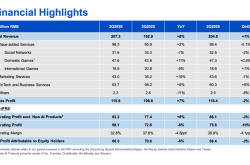
The report shows single-quarter revenue of 207.336 billion yuan, up 8% year on year. Net profit attributable to shareholders came in at 63.612 billion yuan, and the core business is still growing.
Yet capital expenditure under the cash flow statement reached 65.1 billion yuan, and free cash flow posted a net outflow of 69.1 billion yuan. That is roughly 40 yuan of every 100 yuan in revenue plowed back into the business—mainly into IT infrastructure, data centers, and computing power.
On November 11, at a town hall marking Tencent's 28th anniversary, Pony Ma noted that everything the company had done in the past was asset-light, and that this was its first foray into such capital-intensive territory—one that demands different financial and organizational approaches.
He also stressed: "The wave has already crashed over us. We can't just stand on the shore and admire it; we have to shift from land warfare to sea warfare."
Clearly, Tencent's evolution from an internet company into an AI technology company amounts to far more than routine business adjustment.
Standing at the 28-year milestone, Tencent has embarked on a new round of corporate evolution.
The first three turns changed course; this one changes the foundation
Across Tencent's 28-year history, strategic pivots are nothing new.
The mobile push around 2012 was a shift in terminals and entry points. WeChat carried Tencent from the QQ relationship chain of the PC era into the always-on interface of the smartphone. The commercial core stayed the same—build scenarios, accumulate relationships, then monetize through traffic and value-added services.
The "930" restructuring in 2018 was a shift in organization and service targets. CSIG (Cloud and Smart Industries Group) was established, and businesses such as Tencent Cloud and smart industries were pushed to the fore. The customer base expanded from consumers to enterprises.
Tencent's role remained that of a digital tool provider—packaging internal capabilities and exporting them, selling capabilities, solutions, and connection efficiency.
The cost-cutting and efficiency drive after 2021 was a shift in efficiency and boundaries. Peripheral businesses were trimmed, and resources flowed back to more certain areas such as gaming, Video Accounts, and advertising. That was a defensive turn, aimed at reorganizing the cards in hand.
In three turns, Tencent changed its terminals, its customers, and its approach—but the underlying structure never budged. It still earned returns through software, relationships, traffic, and content. Assets were light, marginal costs were low, and the bigger the scale, the fatter the margin.
The 2026 transformation is different: Tencent wants to rebuild itself along a new dimension—heavy assets, long cycles, hard engineering. AI has long outgrown the label of "product feature." It demands bets placed years in advance, chips purchased, computer rooms built, computing power scheduled, and models trained.
In the past, Tencent could absorb the failure of a product. Now, it must first pay for a cost curve that is still far from certain.
By traditional standards, heavy assets are not sexy. Factories, production lines, and equipment mean depreciation, inventory, and utilization rates. Once demand shifts, assets grow heavier and turning grows slower.
Heavy assets in the AI era follow a different logic.
They are not tied to a single geographic location and can move with electricity, networks, and policy conditions. They can be scheduled in unison.
Today they train models, tomorrow they run inference, and the day after they take outside orders. Their versatility is extraordinary. The same batch of infrastructure can serve office, advertising, gaming, cloud, and search.
This point is crucial. Computing power can be reused across purposes. The higher the utilization rate, the lower the cost per invocation. The more it resembles water and electricity, the more qualified it is to enter everyday products.
When computing power is scarce, it also appreciates—like a kind of "silicon-based gold." Old heavy assets were tied to a single production line. New heavy assets carry the fate of whether intelligent production can continue.
This is also where Tencent has truly changed: the center of the ledger has shifted from user numbers to the cost curve.
The first three turns changed Tencent's course and formation. This time, it changes the engine and the fuel.
After bulking up, the key question is where the money flows
Platform companies collectively bulking up has become a global phenomenon. With similarly huge investments, market evaluations differ sharply. The reason lies in where computing power ultimately flows and whether that flow can form a closed loop.
Category one: computing power itself is the business
Oracle and CoreWeave rent out AI infrastructure externally and recoup investment through computing power. The path is direct; once customers sign contracts, revenue is visible.
The cost is equally clear. Once customers and utilization rates fluctuate, cash flow backfires. Oracle's capital expenditure in the most recent quarter was 28.5 billion US dollars. Free cash flow has been negative for six consecutive quarters, and expansion relies mainly on financing.
Category two: cloud first, self-use second
Amazon and Microsoft sell most of their computing power to enterprise customers and keep a portion for self-developed models and assistants. The high growth of AWS and Azure shows that external demand is sufficiently strong.
Microsoft is a rare exception. In the quarter, operating cash flow still covered capital expenditure, with free cash flow of 18.6 billion US dollars. When such a company bulks up, the market reads it as growth investment.
Category three: fully absorbed internally
Meta has no public cloud; tens of billions of US dollars of computing power are used to train models and optimize recommendations and advertising. Returns land directly on the main business. The cost is that there are no external customers to smooth the tides of computing power.
After free cash flow turned negative, Zuckerberg also softened his stance, saying external services would not be ruled out if computing power runs surplus.
Category four: mainly self-use, with external sales as a supplement
Google and Tencent—the latter now taking shape—both fall into this category. Google Cloud revenue in the third quarter was 30.7 billion US dollars, up 103%. Self-developed TPUs have begun to be offered externally.
Tencent holds three buffer zones. First, the cash cow of the main business provides a floor. Third-quarter revenue grew 8%. Excluding new AI products, Non-IFRS operating profit was 83.3 billion yuan, up 8%, with a profit margin of 40%. Total cash at period end was 525.7 billion yuan, and the fair value of listed investments was 505.4 billion yuan.
Second, high-frequency intelligent products consume computing power. WorkBuddy has over 10 million daily active users, over 100 trillion daily average tokens, and nearly 500 million US dollars in annualized revenue over the past seven days. "Xiaowei" has 30 million daily active users.
Here, computing power is invoked by real tasks and converted into usage time, subscription revenue, and advertising efficiency.
Finally, Tencent Cloud retains an outlet for external leasing. Management previously revealed that if some computing power orders were resold, the price could be more than 30% higher than the procurement price. Tencent still prioritizes reserving resources for self-developed models and applications. Selling computing power is a fallback; it has not yet reached that point.
This path began to produce financial echoes in the third quarter. More computing power was allocated to MaaS and GPU leasing. Combined with the boost from WorkBuddy, cloud service revenue growth rose to 35%.
Revenue from fintech and enterprise services increased 9% year on year to 63.655 billion yuan. Capital expenditure as a share of revenue rose to 39%, entering the same range as Google and Amazon.
Tencent's becoming heavier is supported by a foundation, sustained by products, and backed by a channel. It is using existing cash flow to buy time for the next growth curve.
There is no standard answer to "becoming heavier" itself. Whether computing power can become revenue, efficiency, and products is something the market will keep asking.
The shape of an AI technology company is emerging
When does a company count as an AI technology company?
The criterion can be very simple: whether AI has rewritten its cost structure, business processes, and product relationships.
Tencent's progress unfolds precisely along this line. Model capability determines how strong intelligence can be, and inference cost determines how widely intelligence can spread.
After the release of Hy4, it ranked first among Chinese models in Agent Arena. Hy4 Flash compressed the cost of a single task to one-twentieth of Hy4—at 0.5 yuan per million input tokens and 2 yuan for output, and only 0.02 yuan when the cache is hit.
The low price here carries strategic meaning: only when the cost is low enough is AI qualified to become infrastructure.
For a company holding WeChat, games, advertising, and the office ecosystem, a drop in unit intelligence cost by more than an order of magnitude means AI can move from a trial feature for a few users into the daily actions of more than a billion people.
Cheap intelligence, if it cannot enter real processes, will still struggle to deliver greater value. Accordingly, Tencent has put more effort into Agent engineering.
Tencent Cloud has brought model access, permissions, data, evaluation, runtime, and security into a Harness system. TokenHub handles scheduling among multiple models according to cost and performance. Agent Runtime allows agents to run stably. Tencent Cloud ADP (Agent Development Platform, an enterprise-level AI Agent development platform) manages their release and operations.
This stuff may not sound sexy. But it determines whether agents can enter real scenarios.
WorkBuddy has already been connected to WeCom, Tencent Docs, Meetings, and WeDrive, linking to ERP and CRM through MCP, and invoking enterprise knowledge assets within the authorized scope. Since the release of WorkBuddy Enterprise Edition, 60% of China's top 100 enterprises have become customers.
Models are responsible for answering questions. Engineering is responsible for ensuring that in real organizations it does not overstep authority, go offline, or spiral out of control.
Scenarios are the layer Tencent knows best. In the past, Tencent connected people with people, people with content, and people with services. After AI enters, the objects of connection change from information to intent, and from clicks to execution.
WorkBuddy processes more than 100 trillion tokens every day. "Xiaowei" has entered more than 30 touchpoints in WeChat. The upgrade of AI ranking drove Video Accounts advertising impressions up by more than 50%.
These numbers are scattered across multiple scenarios such as office, social, and advertising, but they point to the same thing—AI is becoming a general capability of Tencent's products.
Tencent's understanding of an AI technology company is also hidden here. Its position spans the underlying layer that provides intelligence and the application layer that distributes it.
AI has been placed into the company's trunk: cost, engineering, products, and organization. The next question is whether this trunk can grow into a new growth curve.
Returning to the third-quarter report at the beginning, it looks like a financial report under profit pressure—and even more like a receipt for transformation.
Tencent used to be best at making things light. Now, it must learn to make things heavy, and then turn heavy assets back into light experiences.
At 28, Tencent is setting off again.
-
![]()
XPeng's Strongest Financial Report Yet — and the Challenges That Lie Ahead
-
![]()
Alibaba Q3 Report: Revenue Beats by 1 Billion Yuan, Profit Falls 6.7 Billion Yuan Short
-
![]()
Is the "Battle for the Entry Point" of AI Office Work Over?
-
BAIC Abandons Independent Battery Swapping Strategy
-
![]()
Tencent's Shareholders Must Bear a Little More Hardship
-
![]()
At 28, Tencent Begins Rebuilding Itself Around AI
-
![]()
Tencent: A Rare Profit "Reversal"—How Long Will This AI Tuition Have to Be Paid?
-
![]()
Managing These 17 Automakers Well Means Managing the Entire Auto Market Well