Tencent's Shareholders Must Bear a Little More Hardship
 11/20 2026
 467
Making money is no longer as easy as spending it.
Author: Xue Xingxing | Editor: He Jian
Cover: Inception
Tencent, long accustomed to making money effortlessly, must now learn to pay for the future.
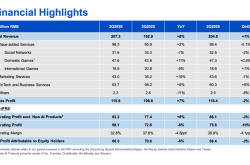
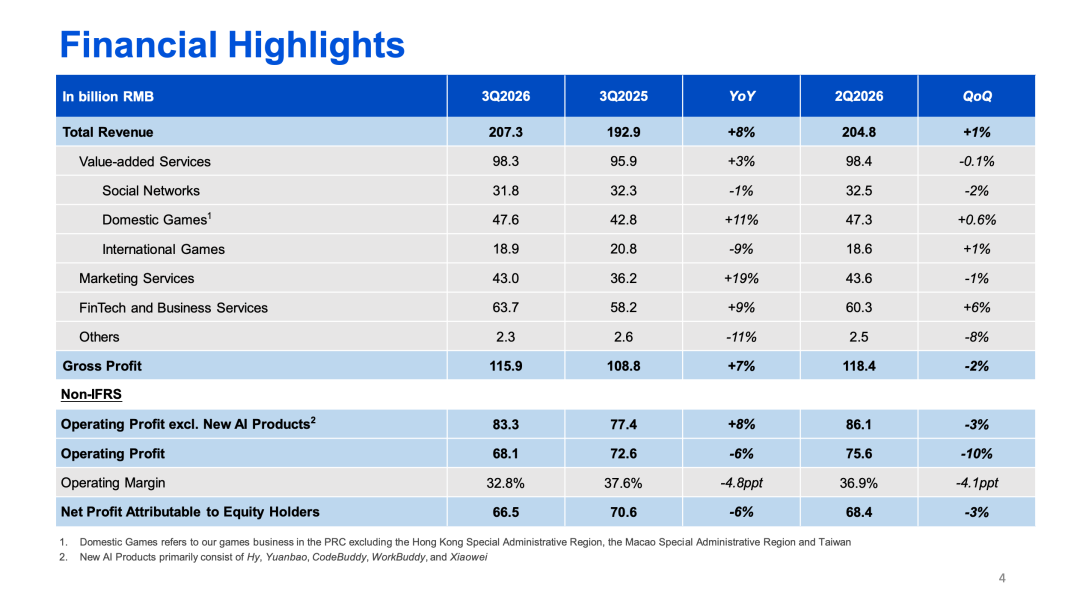
On November 18, Tencent released its Q3 2026 financial report, showing slowing revenue growth and operating profit turning from growth to decline. In the quarter, Tencent's revenue was 207.3 billion yuan, up 8% year-on-year—a growth rate 3 percentage points lower than the previous quarter. Operating profit was 59.1 billion yuan, down 7% year-on-year, compared with growth of 12% in the previous quarter. Net profit attributable to shareholders was 63.6 billion yuan, up only 0.8% year-on-year.
Tencent financial report
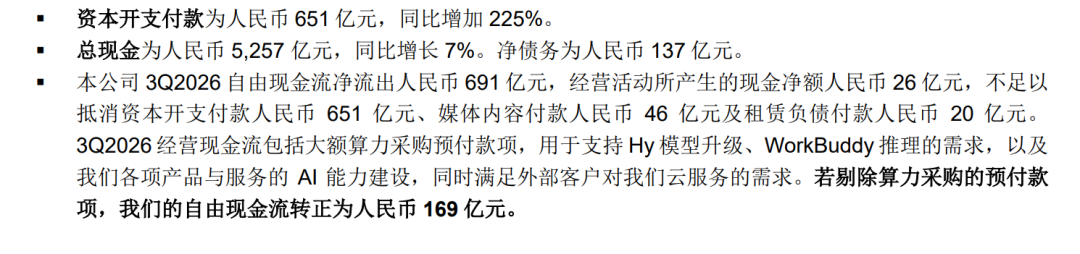
Tencent's speed of making money can no longer keep pace with its spending. In the previous quarter, Tencent's free cash flow turned from positive to negative, and in this quarter it was a net outflow of 69.1 billion yuan. Net cash generated from operating activities plunged from 85.3 billion yuan in the same period last year to 2.6 billion yuan, down 97% year-on-year. At the end of the previous quarter, Tencent still had net cash of 58.2 billion yuan on hand; now it has swung to net debt of 13.7 billion yuan.
Once again, it is AI investment that has gone too far. In Q3, Tencent's capital expenditure reached 81.4 billion yuan, up 527% year-on-year, exceeding the whole of last year. In the first three quarters of this year, Tencent's cumulative capital expenditure reached 166.2 billion yuan, close to the total investment of the past three years. Even compared with Alibaba, which has pledged 380 billion yuan over three years, Tencent is giving no ground at all.
It seems that, as Pony Ma said, the current AI competition has reached a matter of "life and death"; if you do not invest and do not embrace it, you will be disrupted. In Tencent's view, it is precisely the accumulation of the past 28 years that has given Tencent the opportunity to participate in this technological competition. "Being able to invest is an honor," and it should be an epic spending spree—investing heavily and specifically, with everything aligned to AI.
On the earnings call, Tencent management said externally that capital expenditure for the remainder of 2026 and each quarter of 2027 will fluctuate around the current peak level, and may only improve in 2028.
Tencent's shareholders can only be made to endure a bit more hardship. At today's Hong Kong stock market close, Tencent fell more than 6%, with its share price dropping below HK$350, a new two-year low. So far this year, Tencent's share price has fallen more than 40%, and the scale of buybacks has decreased by nearly half compared with last year.
Being Able to Invest Is an Honor
Tencent, once slow for an elephant to turn around, now has the penguin spending heavily on computing power.
In Q1 this year, Tencent's capital expenditure was 31.9 billion yuan, rising to 52.8 billion yuan in Q2, and further soaring to 81.4 billion yuan in Q3. In just half a year, the single-quarter investment scale increased by nearly 50 billion yuan. In Q3 last year, Tencent's capital expenditure was only 13 billion yuan.
Tencent CFO John Lo said on the earnings call that the company is accelerating investment in AI infrastructure to support the upgrade of the Hunyuan model, meet the inference needs of WorkBuddy, and provide computing power to cloud service customers.
Large-scale computing power procurement has forced Tencent to pay huge sums in advance. In Q3, Tencent's free cash flow was a net outflow of 69.1 billion yuan, but excluding prepayments for computing power procurement, it was positive 16.9 billion yuan. Q2 free cash flow was also affected by prepayments; excluding them, it was positive 37.6 billion yuan.
Tencent financial report
On the earnings call, analysts were particularly focused on Tencent's persistently high capital expenditure and computing power investment for two consecutive quarters, essentially asking management directly how much more computing power they still need to buy. "How far has this round of large-scale computing power procurement progressed? By your standards, how far are you from a sufficient scale of computing power?"
Tencent Chief Strategy Officer James Mitchell said the long-term computing power contracts the company hoped to sign have basically been signed, and future prepayment expenditures will gradually decline. He also revealed that Tencent is exiting some contracts for which it had previously paid prepayments, and in some future quarters it may even receive refunded prepayments.
Mitchell said that based on actual capital expenditure payments of about 65 billion yuan in Q3, Tencent's current investment level has roughly reached its peak. In 2027, capital expenditure payments in each quarter may continue to remain near this level, and only afterwards gradually decline.
Perhaps to reassure investors, Tencent President Martin Lau tried to justify this massive capital expenditure. He compared this round of investment to building a factory: once built, it can train the next generation of models and continuously produce tokens; in short, it will not be a one-off investment and can be used continuously in the future.
Moreover, as hardware prices decline and computing efficiency improves in the future, the same equipment can produce more tokens, and new investment demand is also expected to decrease. "We believe conditions will be much better in 2028 and beyond," Martin Lau said.
Facing the AI wave, Tencent is not investing mindlessly either. For example, Yuanbao, which once participated in the red envelope battle at the beginning of the year, no longer blindly pursues user scale. On the earnings call, Martin Lau rarely admitted, "Yuanbao did not meet our expectations." They have significantly cut related spending and shifted focus from acquiring users to improving product capabilities.
At the same time, Tencent has begun tightening cash returns to shareholders. In Q3, the company spent about HK$7 billion on share buybacks, down 67% year-on-year and about 58% quarter-on-quarter. In the first three quarters of this year, cumulative buybacks were about HK$31.4 billion, nearly half less than the same period last year.
As early as March this year, Tencent said externally that in order to increase AI investment, the amount of share buybacks in 2026 might be lower than last year. Martin Lau believes that their investment in AI will certainly create huge value returns for shareholders in the future.
Making Money Is Also Not as Fast as Before
While investing heavily in AI, Tencent's own business growth is also slowing. In Q3, Tencent's revenue grew 8% year-on-year, but adjusted operating profit fell 6% year-on-year. In the previous two quarters, adjusted operating profit grew 9% year-on-year.
Although Tencent's net profit attributable to shareholders in the quarter grew only 0.8% year-on-year, it came more from investment gains. In Q3, Tencent's investment gains and other net gains reached 10.1 billion yuan, compared with only 2.8 billion yuan in the same period last year. After excluding certain adjusted items such as investment gains, Tencent's adjusted net profit attributable to shareholders was 66.5 billion yuan, down 6% year-on-year.
AI again dragged down profit. Tencent disclosed in its financial report that excluding new AI products such as Hunyuan, Yuanbao, WorkBuddy, and Xiaowei, adjusted operating profit in Q3 was 83.3 billion yuan, up 8% year-on-year.
But even excluding new AI products, profit growth in Tencent's original businesses is also slowing. In Q1 and Q2 this year, Tencent's operating profit excluding new AI products grew 17% and 19% year-on-year respectively, both far exceeding Q3.
Games, advertising, and even finance—businesses where Tencent used to make easy money—are now facing various difficulties.
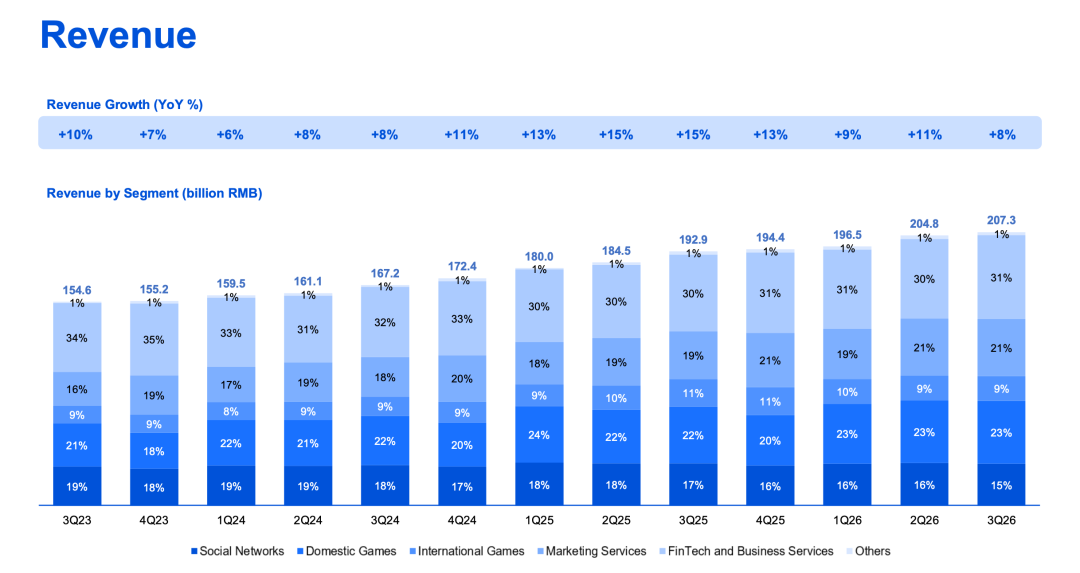
Tencent financial report
In Q3, Tencent's domestic game revenue grew 11% year-on-year to 47.6 billion yuan, but international game revenue fell 9% year-on-year (or down 4% year-on-year at constant currency). Tencent said this was mainly affected by last year's high base. Analysts were once worried that GTA6 affected Tencent's international game market, and Mitchell had to admit frankly that their growth slowdown came earlier than GTA6's preheating.
Although the advertising business still maintained 19% year-on-year growth, gross margin fell 4 percentage points to 52%, partly affected by increased costs from AI operations and short drama content. Mitchell said the performance of WeChat's Green Bubble short drama entry exceeded expectations and clearly boosted advertising revenue. Without the contribution of the short drama business, Tencent's advertising growth this quarter would have been even slower.
The fintech business was dragged down by weak consumption, achieving only low single-digit growth in the quarter; the number of commercial payment transactions increased, but the average transaction amount declined.
Another pressure comes from rising hardware prices. Mitchell revealed on the earnings call that earlier this year DRAM prices once rose about 400% year-on-year, and some costs have begun to pass through to Tencent's core businesses. They expect the pressure from weak consumption and rising hardware costs to continue for several more quarters.
Tencent is trying to turn AI investment into revenue as quickly as possible. In Q3, Tencent's cloud service revenue grew 35% year-on-year, higher than 21% in Q2. Among them, WorkBuddy revenue grew more than fivefold quarter-on-quarter, model-as-a-service revenue grew more than twofold, and computing power leasing revenue grew more than 30%.
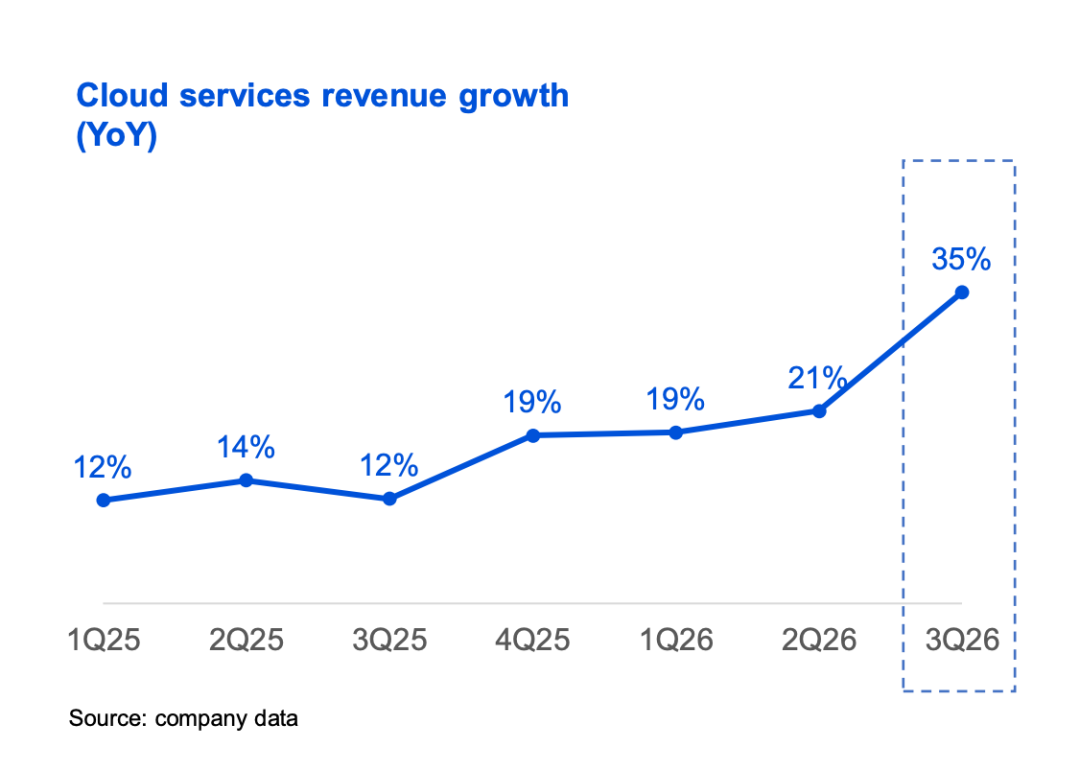
Tencent financial report
WorkBuddy is one of the most successful products in Tencent's AI business. Martin Lau revealed on the earnings call that WorkBuddy has more than 10 million daily active users and consumes more than 100 trillion tokens per day. Based on revenue levels in the most recent week, WorkBuddy's annualized revenue exceeds US$500 million, more than twice that of Tencent Meeting.
But these are still not enough to offset the current drag of AI products on the main business's profit. On the earnings call, analysts were concerned about when the impact of new AI products on group profit would narrow. Martin Lau did not give an exact time. He believes that AI-native businesses need to first attract users, then gain revenue, and ultimately achieve profit.
Tencent has already seen progress in model capabilities and product commercialization, but as for exactly when the turning point will begin, he said no one knows.

Copyright owned by Shanshang. Unauthorized reproduction is prohibited.
-
![]()
XPeng's Strongest Financial Report Yet — and the Challenges That Lie Ahead
-
![]()
Alibaba Q3 Report: Revenue Beats by 1 Billion Yuan, Profit Falls 6.7 Billion Yuan Short
-
![]()
Is the "Battle for the Entry Point" of AI Office Work Over?
-
BAIC Abandons Independent Battery Swapping Strategy
-
![]()
Tencent's Shareholders Must Bear a Little More Hardship
-
![]()
At 28, Tencent Begins Rebuilding Itself Around AI
-
![]()
Tencent: A Rare Profit "Reversal"—How Long Will This AI Tuition Have to Be Paid?
-
![]()
Managing These 17 Automakers Well Means Managing the Entire Auto Market Well