After 15 months at the helm of Hisense's Air Solutions Business Division, Yin Bitong departs. Amid the integration of five brands, localized growth struggles to offset the decline in HVAC revenue. Whe
 09/16 2026
 431
431
Just 17 days after a leadership change in its air conditioning business, Hisense brought new products to Berlin.
On September 3 (local time), on the eve of IFA 2026, Hisense launched its AI Companion Series, covering family scenarios such as kitchens, laundry, and air.

▲ Hisense Official WeChat Account
Among them, the AI Air Companion made its public debut, monitoring whole-house temperature, humidity, and air quality through an environmental sensing system. It can also adjust air direction and volume based on human movement. After the official opening on September 4, air conditioning and home energy management were integrated into a unified smart home scenario, as Hisense sought to extend the boundaries of air conditioning to encompass whole-house air and smart home environments.
Seventeen days earlier, Yin Bitong, who had led Hisense's Air Solutions Business Division for approximately 15 months, departed. On August 17, Hisense Home Appliances announced that due to work arrangement adjustments, Yin Bitong resigned from his positions as employee director, member of the Strategy Committee, and member of the ESG Committee, and would no longer serve in any capacity at the listed company. On the same day, Zhang Wenqiang was elected as the employee representative director of Hisense Home Appliances. According to a report by
In the first half of 2026, Hisense Home Appliances reported revenue of RMB 46.766 billion, a year-on-year decrease of 5.22%, with net profit attributable to shareholders of RMB 1.658 billion, a year-on-year decrease of 20.16%. Among these figures, HVAC revenue stood at RMB 22.353 billion, a year-on-year decrease of 5.66%, accounting for 47.80% of the company's total revenue. During the same period, the gross profit margin for HVAC decreased from 27.12% in the previous year to 24.24%.
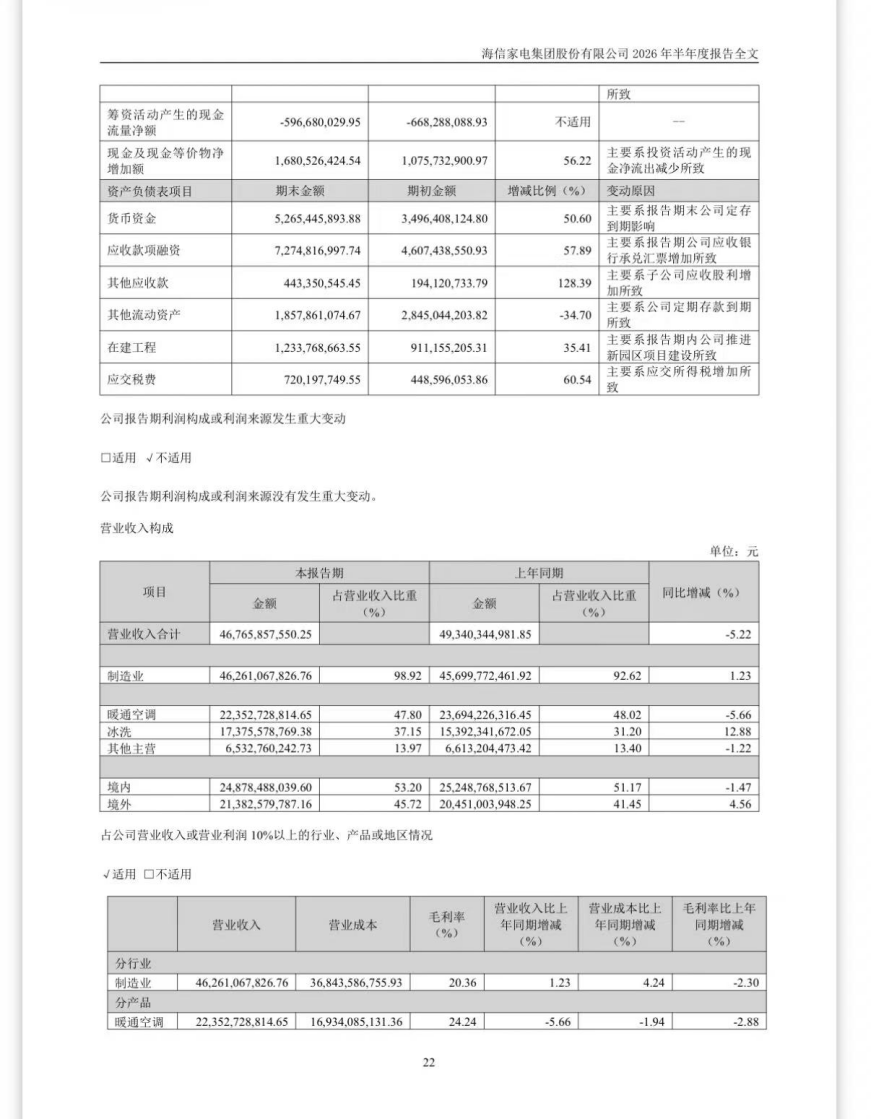
▲ Hisense Financial Report
Hisense Air Conditioning's internal performance was not uniformly declining. In 2025, Hisense's domestic sales of household air conditioners increased by 9.6% year-on-year, outpacing the industry's growth rate by 8.9 percentage points.
In the first half of 2026, Hisense's home installation business revenue grew by 10.51%, Kelon's home installation segment shipments increased by 25%, York's ceiling-mounted floor-standing water and multi-split system shipments grew by 15%, and York's data center business expanded by 130%, with a domestic market share in multi-split systems still reaching 26.6%.
Following Yin Bitong's departure, the Air Solutions Business Division did not disappear. Instead, new products released in September continued to expand whole-house air scenarios. Hisense has consolidated multiple brands and businesses into a larger air industry ecosystem. The next challenge is to translate sales volume, market share, and segment growth achieved over the past year into increased revenue and profits across the entire HVAC business.
1. With Five Brands Already in Hand, Why Does Hisense Continue to Integrate Its Air Conditioning Business?
Before joining Hisense, air conditioning was already one of the largest businesses within Hisense Home Appliances. In 2025, Hisense Home Appliances' HVAC revenue reached RMB 38.829 billion, accounting for 44.16% of the company's total revenue. During the same period, revenue from refrigeration and washing appliances stood at RMB 31.195 billion, with HVAC remaining the company's largest product segment.
Hisense also boasts significant air conditioning resources, with Hisense and Kelon in the household market and Hitachi, York, and other brands in the central air conditioning sector. These products cater to mass consumption, home installation, engineering, and commercial markets. Notably, central air conditioning represents a well-established business for Hisense. In 2025, Hisense's water-based systems saw a 69% year-on-year increase in performance within the data center industry and a 15% increase in the industrial sector.
However, the household air conditioning market faces a different competitive landscape, with Midea, Gree, and Haier dominating the primary market, while Xiaomi and Aux have been expanding their online businesses in recent years. For Hisense, which holds advantages in central air conditioning and multiple brands, simply increasing household air conditioning sales is insufficient. The key lies in whether capabilities previously dispersed across different products and brands can be shared, directly impacting the efficiency of the entire HVAC business.
In May 2025, Hisense further integrated its household and central air conditioning businesses, marking a new phase for the Air Solutions Business Division. Hisense, Kelon, Hitachi, York, and Sparkle subsequently appeared as a unified lineup, covering mass household, high-end home installation, and commercial scenarios. Hisense proposed integrating technical, channel, talent, engineering, and supply chain resources, consolidating previously independent businesses into a unified operating system.
It was during this phase that Yin Bitong joined Hisense. With a long tenure at Midea, he had previously overseen Little Swan and Midea's household air conditioning businesses. At Hisense, Yin served as President of the Air Solutions Business Division, Party Secretary, General Manager of the Domestic Marketing Center, and, by late July 2025, became an employee representative director on Hisense Home Appliances' board.
Hisense's restructuring involved more than just adding another air conditioning brand. It required addressing complex relationships, such as whether R&D platforms could reduce redundant investments, whether procurement and manufacturing could achieve scale advantages, whether engineering, technical, and service capabilities accumulated in central air conditioning could be leveraged across other businesses, and whether channels and customers of several brands could generate new cross-selling opportunities. Ultimately, these changes needed to reflect in revenue, costs, and profits.
According to industry data cited in Hisense Home Appliances' annual report, the company's domestic sales of household air conditioners increased by 9.6% year-on-year, outpacing the industry's growth rate by 8.9 percentage points. During the same period, the domestic household air conditioning market exhibited significant differentiation between volume and price, with terminal sales volume increasing while average industry prices remained at multi-year lows.
While Hisense's household air conditioning sales outperformed the industry, overall HVAC revenue declined by 3.61% to RMB 38.829 billion, with the gross profit margin dropping to 27.43%, a year-on-year decrease of 1.12 percentage points. Growth in a single business segment did not translate proportionally into increased revenue and profits across the entire HVAC business, with this discrepancy widening further in 2026.
2. Why Is Overall HVAC Performance Under Pressure Despite Household Air Conditioning Sales Outperforming the Industry and Segment Growth?
In the first half of 2026, Hisense's HVAC division still demonstrated growth in several areas. Revenue from Hisense's home installation business increased by 10.51% year-on-year, Kelon's home installation segment shipments grew by 25%, York's ceiling-mounted floor-standing water and multi-split system shipments increased by 15%, and engineering market efficiency improved by 22%. York's data center business expanded by 130% year-on-year.
During the same period, Hisense Home Appliances maintained a strong market position in the domestic multi-split system segment, with a market share of 26.6%. Coupled with the growth in household air conditioning sales in 2025, Hisense had no shortage of highlights to include in its financial reports.
However, HVAC revenue had already declined by 3.61% year-on-year in 2025. In the first half of 2026, revenue in this segment further dropped to RMB 22.353 billion, a year-on-year decrease of 5.66%. Operating costs during the same period amounted to RMB 16.934 billion, a year-on-year decrease of only 1.94%. Revenue declined significantly faster than costs, causing the gross profit margin to drop from 27.12% to 24.24%.
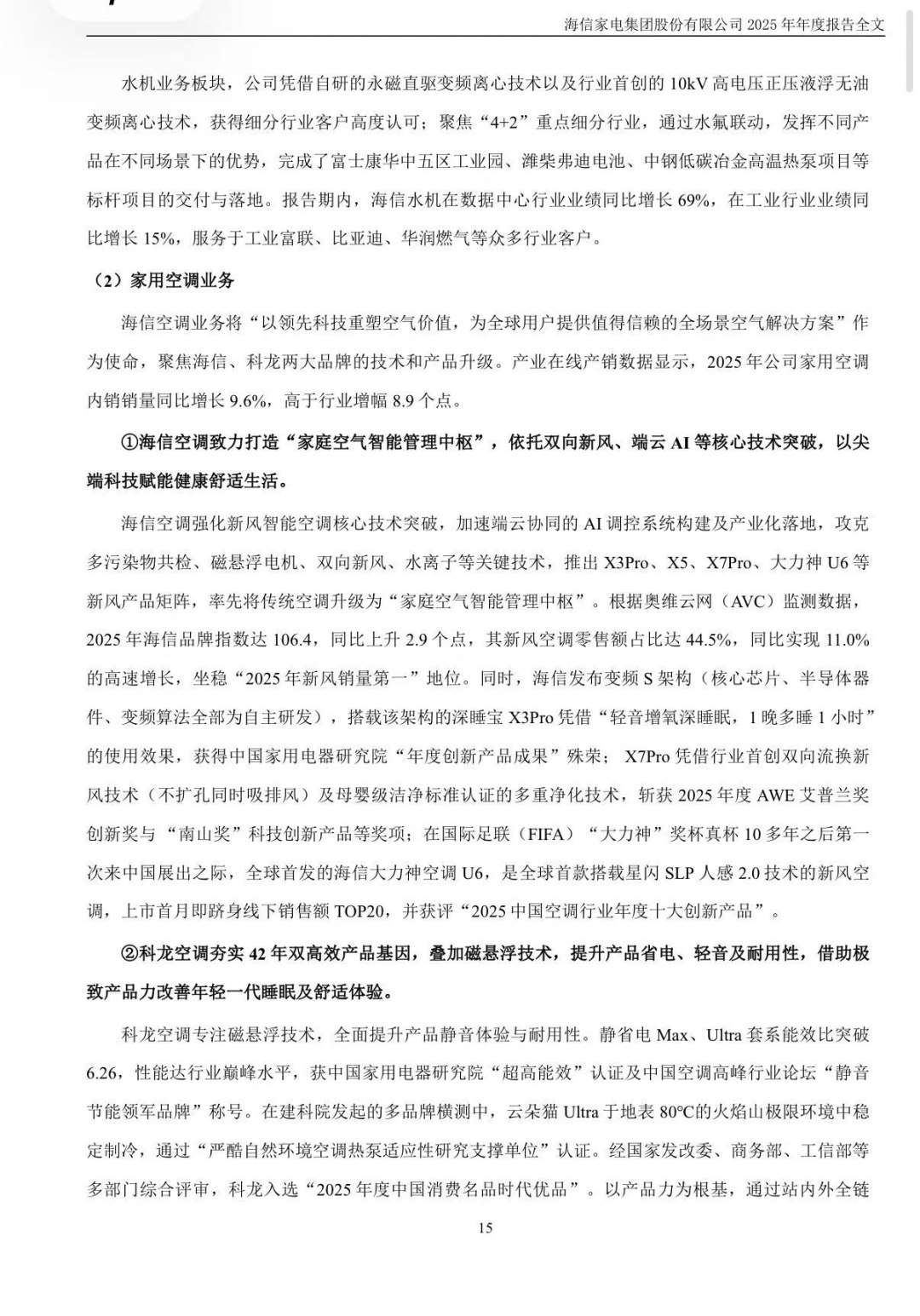
▲ Hisense Financial Report
This created a disconnect between sales volume growth, segment growth, and overall HVAC revenue. In 2025, domestic sales of household air conditioners increased by 9.6%. By 2026, Hisense's home installation, Kelon's home installation, York's multi-split systems, and data center businesses continued to expand, yet revenue and profitability across the entire HVAC segment remained in decline.
In 2025, household air conditioning sales outperformed the industry, but HVAC revenue declined. In the first half of 2026, several segment businesses continued to grow, yet the gross profit margin decreased by 2.88 percentage points year-on-year. After securing more orders and increasing sales volume, if products are concentrated in highly competitive price ranges or if selling prices decline, revenue and profits may follow a trajectory entirely different from sales volume.
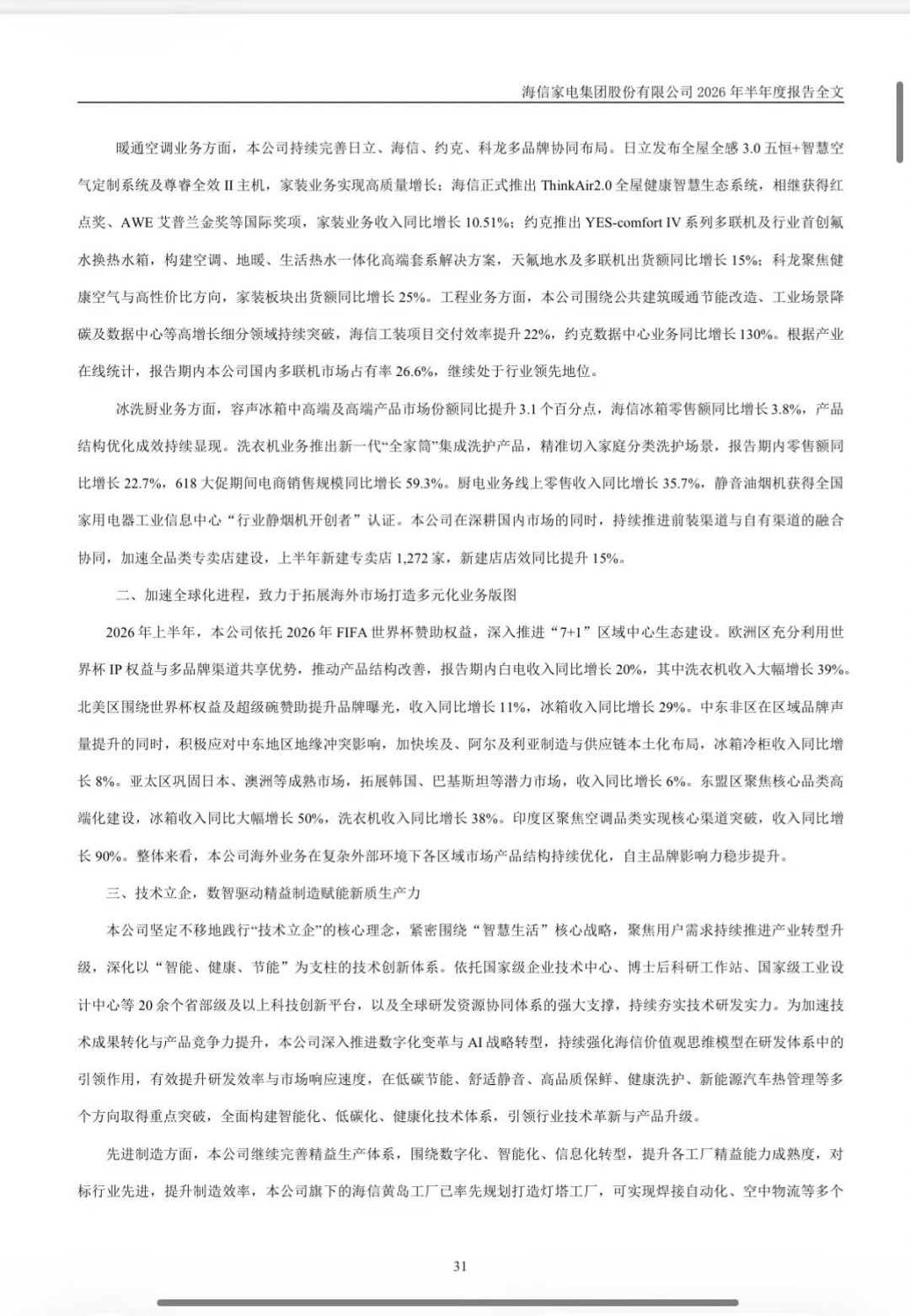
▲ Hisense Financial Report
Since the establishment of the Air Solutions Business Division, Hisense has emphasized technology, supply chain, channel, and service synergies. In its 2026 interim report, the company reiterated its commitment to continuously improving the collaborative layout of its multi-brand portfolio, including Hitachi, Hisense, York, and Kelon. Growth was already evident in Hisense's home installation, Kelon's home installation, and certain York businesses.
However, HVAC revenue declined by 5.66% in the first half of 2026, while costs decreased by only 1.94%. Key questions remained: How much could procurement costs decline after integrating several brands into a single system? How much redundant R&D investment could be eliminated? What scale effects could be achieved in manufacturing? To what extent could channel and after-sales networks be shared? Ultimately, these factors would influence cost accounting. If integration had been ongoing for over a year, cost-side synergies needed to begin reflecting alongside revenue-side improvements.
Hisense Bosch added another layer of structural complexity to this integration.
In July 2026, Qingdao Hisense Hitachi Air Conditioning Systems Co., Ltd. officially renamed itself Qingdao Hisense Bosch Air Conditioning Systems Co., Ltd. This change did not alter Hisense Home Appliances' controlling relationship with the company, and existing brand licenses, core technologies, R&D systems, manufacturing, channels, and after-sales services for Hitachi continued unchanged.
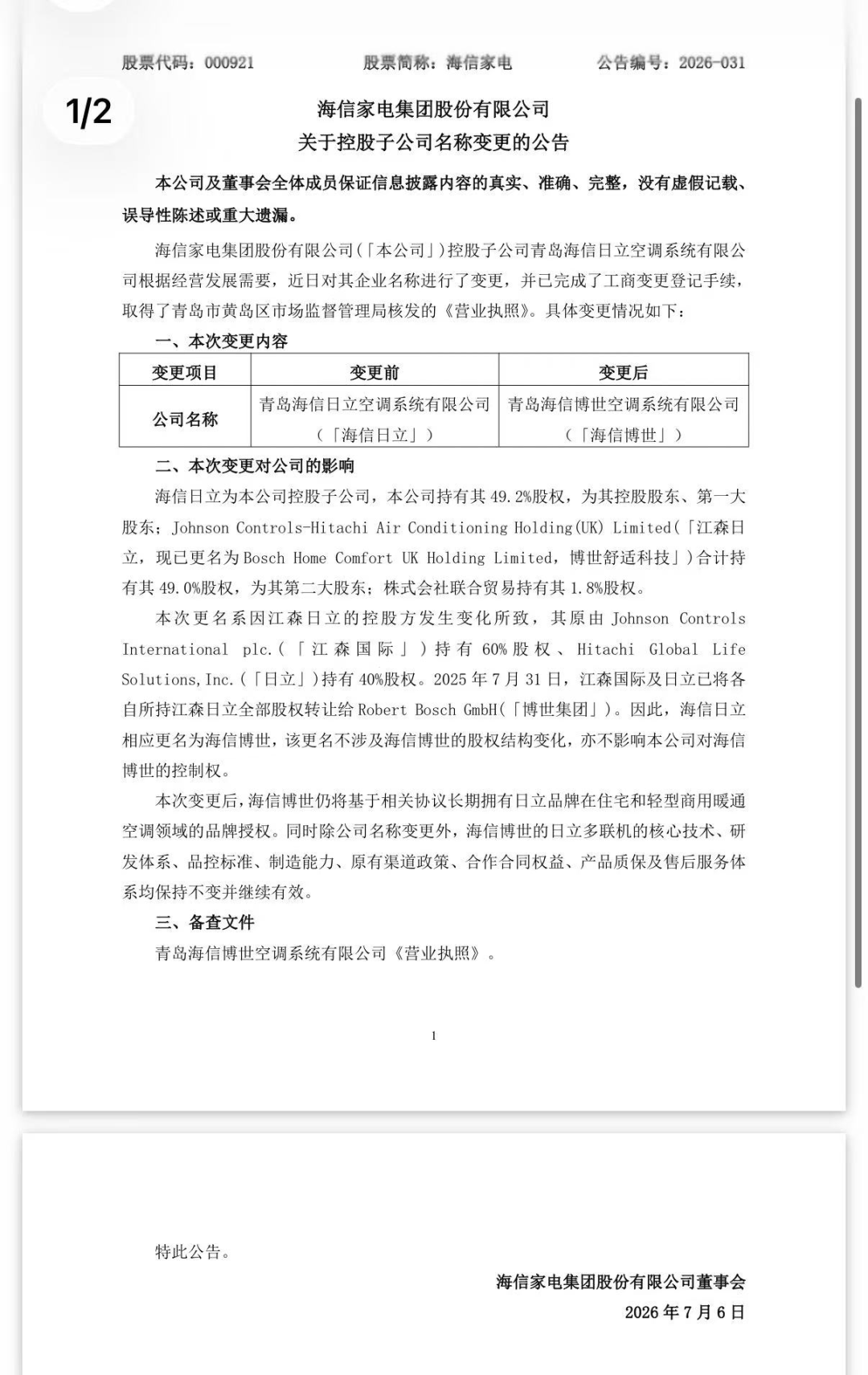
▲ Hisense Announcement
Hisense's air industry strategy does not involve molding several brands into identical shapes. Instead, it seeks to identify shared R&D, manufacturing, procurement, and service resources while preserving brand positioning and existing business systems.
Hisense's household air conditioning sales outperformed the industry, multi-split systems maintained a high market share, and growth was evident in home installation, engineering, and data center businesses. This indicates that Hisense still has untapped market potential. However, the consecutive pressure on HVAC revenue and gross profit margins suggests that localized growth has not offset contractions in other businesses, nor has it led to significant cost-side improvements.
Over the past year, Hisense has identified several growth drivers. The next challenge is to synthesize these drivers into overall growth.
3. With Yin Bitong's Departure and the Group CEO Taking Over, Hisense Must Complete the Integration Accounting
On August 17, Yin Bitong resigned from his positions at Hisense Home Appliances, with the company citing work arrangement adjustments as the reason and not disclosing a direct link between his departure and HVAC operating data. On the same day, Zhang Wenqiang, who had long served within the Hisense Hitachi and Hisense Bosch systems, joined Hisense Home Appliances' board.
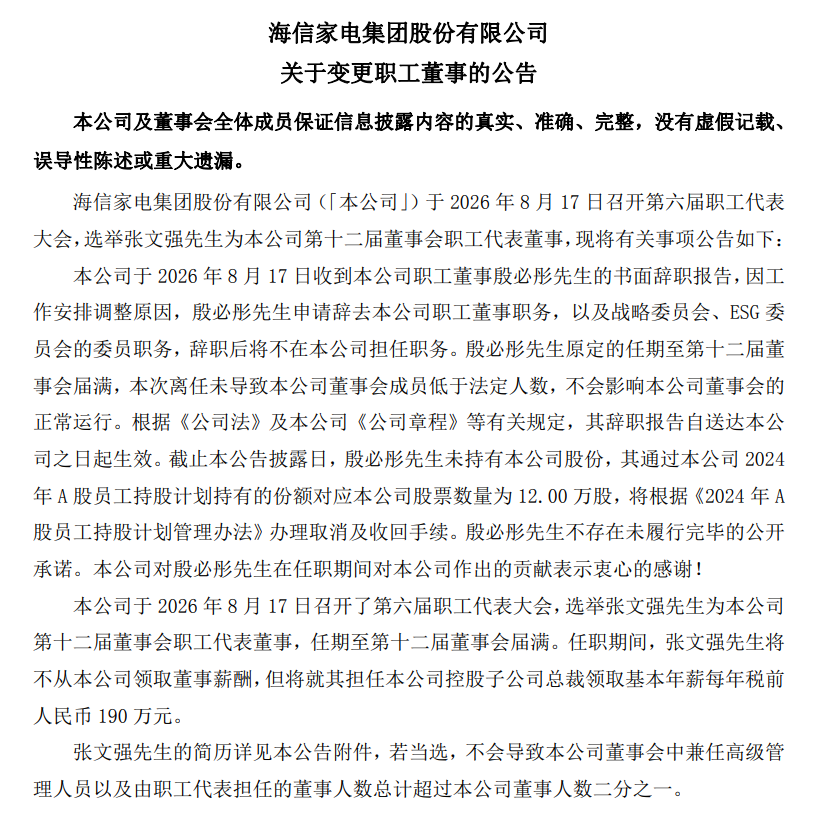
▲ Hisense Announcement
Zhang Wenqiang had previously served as Assistant General Manager, Deputy Chief Engineer, Director of the Development Center, General Manager of the Overseas Business Division, and Vice President. He currently serves as Party Secretary and President of Hisense Bosch, overseeing R&D centers and water-based system industrial operations within the Air Solutions Business Division. The head of the Air Solutions Business Division was directly assumed by group management, with public reports indicating that Yu Zhitao, CEO of Hisense Group, took on this role.
Following the leadership change, the Air Solutions Business Division's original organizational framework remained intact. The 2026 interim report continued to list multi-brand collaboration among Hitachi, Hisense, York, and Kelon as a key operational focus for the air conditioning business. Hisense did not publicly announce a re-separation of its previously integrated household and central air conditioning businesses.
At IFA in September, new product initiatives emerged. Hisense introduced the AI Air Companion, expanding temperature regulation to include air quality monitoring, human presence detection, and cross-device collaboration, while integrating air and home energy management into a single smart home system. The leadership change did not disrupt the rhythm of extending air conditioning into whole-house air scenarios; instead, the air industry's coverage of scenarios continued to expand.
The business Yu Zhitao now oversees differs from that of the Air Solutions Business Division at its inception in 2025.
After more than a year of adjustments, household air conditioning sales have grown, central air conditioning maintains a high market share, and Hisense, Kelon, and York each have rapidly growing segment businesses.
In 2025, HVAC revenue stood at RMB 38.829 billion, a year-on-year decrease of 3.61%, with the gross profit margin declining from 28.55% in the previous year to 27.43%. By the first half of 2026, revenue continued to decline by 5.66%, and the gross profit margin further decreased to 24.24%. Meanwhile, household air conditioners, multi-split systems, home installation, and data center businesses experienced varying degrees of growth.
This contrast makes Hisense Air's next tasks more specific than they were 15 months ago. Growth in individual brands is no longer sufficient. The key questions now are whether total HVAC revenue can resume growth after managing multiple brands, whether cost reductions can keep pace with business changes, and whether the gross profit margin can halt its consecutive decline. These factors will determine the financial legacy of the air industry integration.
When Yin Bitong joined Hisense in May 2025, market attention focused on what a seasoned executive with years of Midea experience would bring to Hisense Air Conditioning. Fifteen months later, his departure has left behind a performance record that cannot be simply summarized as a success or failure.
On the other hand, HVAC revenue has faced consecutive pressure, cost improvements have not kept pace with revenue changes, and the gross profit margin has narrowed further.
Hisense has completed a round of brand and organizational integration. The next challenge is to prove that growth dispersed across different brands, products, and markets can truly contribute to HVAC revenue and profits.
The upcoming financial report will provide a clearer indication of the progress of this air industry integration than the next personnel appointment.
Source:
Image: Hisense
-
![]()
AI Short Dramas Enter the 'Era of Perception'
-
![]()
After 15 months at the helm of Hisense's Air Solutions Business Division, Yin Bitong departs. Amid the integration of five brands, localized growth struggles to offset the decline in HVAC revenue. Whe
-
![]()
Pre-orders for "Doubao Mobile Phone II" Surpass 370,000 Units; Official Launch Set for September 16 with Innovative AI Physical Button and Cross-App Functionality
-
The Most Perilous Aspect of AI: Not Job Loss for the Elite
-
![]()
Returning AITO to Seres, Huawei Remains 'Cunning'
-
![]()
After a 200 Billion Yuan Loss, Seres Reclaims Its 'Soul,' But Will Yu Chengdong Continue to Back AITO?
-
![]()
Will you still buy AITO after its prefix changes from 'HIMON Auto' to 'Seres'?
-
![]()
Atlas Paves the Way with 3D Reconstruction, Ushering in a New Measurable Era for World Models