National Day & Double 11 Refrigeration and Laundry Market Outlook: Navigating Growth Amid Structural Shifts
 09/29 2026
 380
380
As the National Day Golden Week and Double 11 shopping festivals draw near, the refrigeration and laundry industry is poised to enter a pivotal annual sales period.
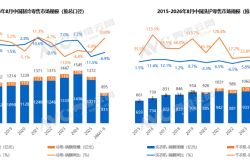
Reflecting on market evolution, the refrigeration and laundry sectors have faced challenges due to the waning impact of real estate growth since 2022, resulting in sluggish expansion. AVC data reveals that in 2022, refrigerator retail sales reached RMB 124.6 billion, marking a slight 0.1% year-on-year decrease, while washing machine sales hit RMB 88.1 billion, down 6.5% from the previous year. However, in 2024, the industry witnessed a surge fueled by national subsidies. This growth momentum persisted into the first half of 2025 (H1), but a market correction ensued in the second half (H2) due to a high comparison base and dwindling demand. 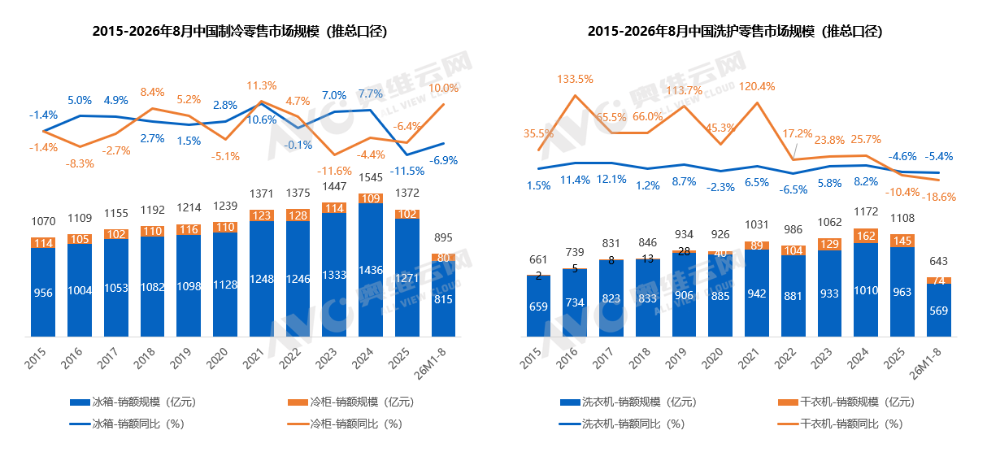
Against this backdrop, the sales base for the 2025 Double 11 period is relatively modest.
AVC tracking data indicates that during the 2025 Double 11 period (October 13-November 16), online refrigerator sales amounted to RMB 7.46 billion, reflecting a 25.1% year-on-year decline, while online washing machine sales reached RMB 5.35 billion, down 16.8% year-on-year.
Despite concerted efforts by companies and retailers to spur demand, weak consumer sentiment and the timing of subsidies have limited the effectiveness, leading to an overall sluggish market. This sets the stage for a relatively mild comparison base and a potential rebound during this year's Double 11. 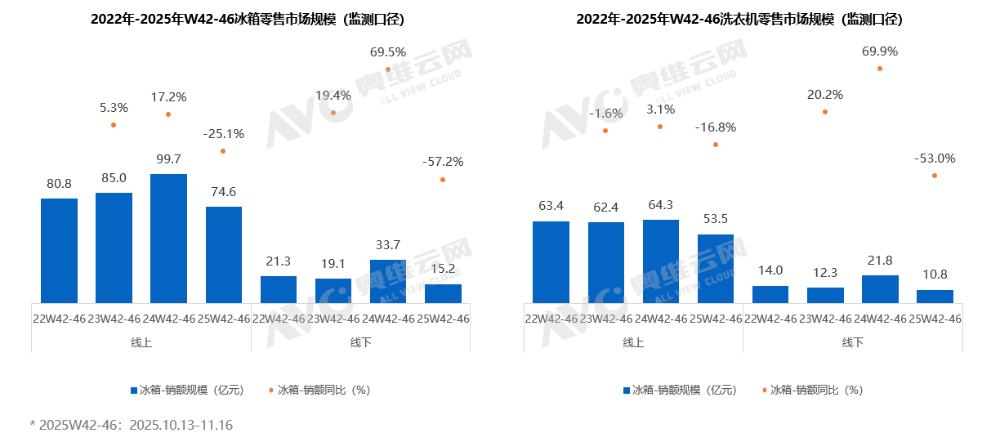
As we step into 2026, although the first half continues to face significant year-on-year pressure, the refrigeration and laundry market is showing signs of resilient growth.
AVC data for January to August 2026 shows that total refrigerator retail sales across all channels reached RMB 81.5 billion, a 6.9% year-on-year decrease, while washing machine sales amounted to RMB 56.9 billion, down 5.4% year-on-year. Despite these declines, the single-digit drops underscore the sectors' resilience. Notably, categories undergoing structural upgrades, such as multi-compartment washing machines, heat pump washer-dryer combos, and large-capacity refrigerators, are bucking the trend, creating new value opportunities for the industry.
This year's National Day and Double 11 promotional cycle follows last year's extended model, with platforms launching pre-sales from October 7, overlapping with the Mid-Autumn Festival, ensuring a smooth transition between the Mid-Autumn, National Day, and Double 11 periods. The fourth quarter (Q4) will be a crucial冲刺 (sprint) window for the refrigeration and laundry industry, which is expected to maintain its resilient growth trajectory from the first half of 2026 while exploring structural upgrade opportunities. Amid a high comparison base from the previous year, the market is anticipated to demonstrate resilient growth during the National Day period. 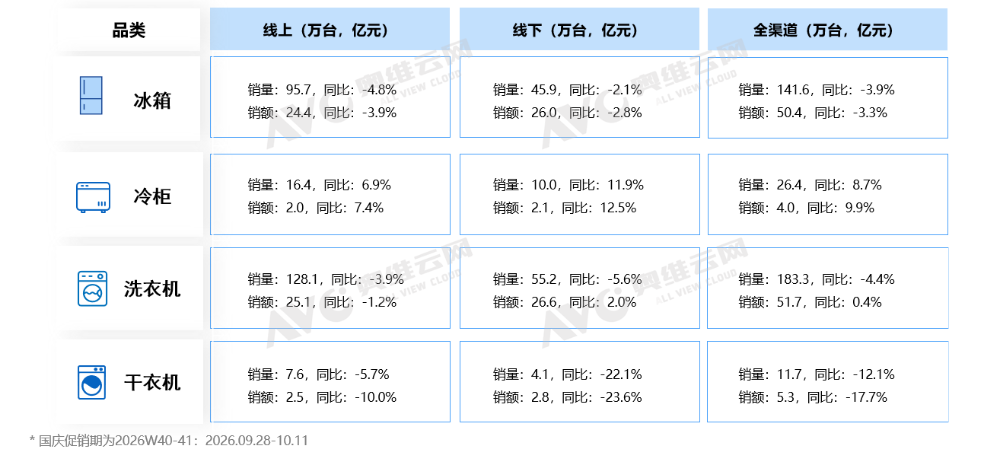
1. Refrigeration Category: Refrigerators and freezers continue to exhibit the scissor-gap trend observed in the first half of 2026, with online sales structures recovering. The refrigerator market is expected to encounter some pressure during National Day due to a high comparison base from the previous year. AVC forecasts indicate a slight 3.3% year-on-year decline in total channel sales, signaling relative resilience.
Freezers, less impacted by subsidy depletion, are expected to experience relatively controlled policy transition effects. The National Day market for freezers is projected to remain stable overall. AVC forecasts predict a 9.9% year-on-year increase in total channel sales for freezers, continuing the growth trend from the third quarter (Q3). Traditional small freezers' market share continues to decline, while niche products like ice bars and wine cabinets gain traction, driving steady category value growth.
2. Laundry Category: Product innovation and essential demand render washing machines more resilient than refrigerators. Tumble dryers face demand depletion but maintain a solid value foundation. During National Day, washing machines, as essential products, exhibit stronger resilience, with declining sales volumes but stable values and rising average prices, driven by industry-wide price structure upgrades. AVC forecasts show a 0.4% year-on-year increase in total channel sales for washing machines.
Tumble dryer sales are expected to decline significantly. AVC forecasts indicate a 17.7% year-on-year drop in total channel sales for tumble dryers during National Day. However, dryer demand persists, and the double-digit decline is partly attributable to a high comparison base from the previous year. Notably, offline average prices for tumble dryers remain elevated, indicating a stable category value foundation. Double 11 Forecast: The refrigeration and laundry categories are expected to transition from year-on-year sales declines to growth during Double 11. 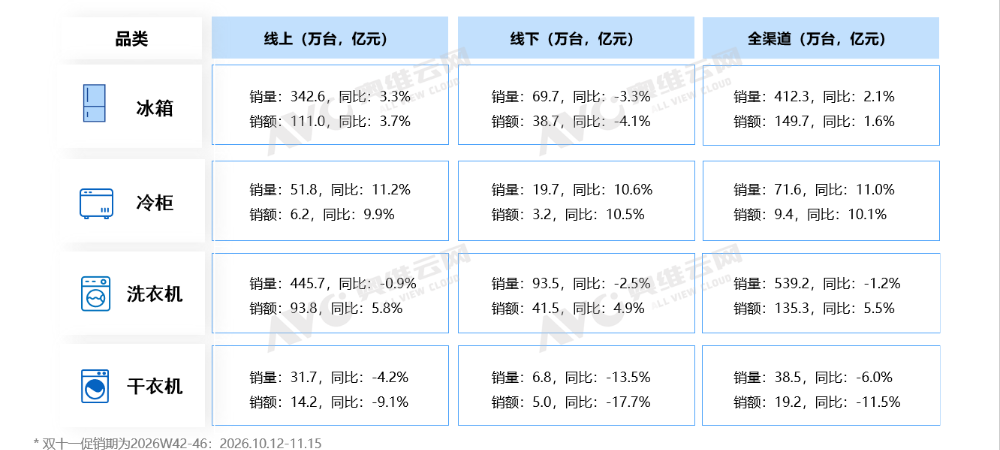
1. Refrigeration Category: Refrigerators are poised for slight growth, driven by product upgrades; freezer demand is recovering steadily, albeit amid persistent price competition. Double 11 is expected to witness slight growth in total refrigerator channel sales. AVC forecasts indicate a 1.6% year-on-year increase, with the online market more likely to recover due to steady national subsidy allocations and H1 product upgrade trends, while offline inventory levels remain high, exerting downward pressure. In terms of products, penetration rates for large-capacity, dual-system, and built-in refrigerators continue to rise, supporting online average prices, while ice-making functions expand from premium to mainstream markets.
In the market competition, the Matthew effect intensifies, with market concentration increasing among leading, differentiated mid-tier, and premium brands. Product differentiation is the key driver of growth, rendering price competition alone insufficient for sustained high growth. The freezer market is expected to sustain high growth during Double 11. AVC forecasts predict a 10.1% year-on-year increase in total channel sales, driven by high-value categories like ice bars and wine cabinets, although price competition persists for essential freezers and chillers. In the long term, natural replacement demand and high-value categories are growth highlights, while small freezers may see declining shares due to substitution by large-capacity refrigerators, with essential product prices remaining under pressure.
2. Laundry Category: Washing machines, driven by essential demand, are poised for "profit recovery" amid challenges; tumble dryer demand remains stable but faces popularization obstacles. The washing machine market during Double 11 will feature declining sales volumes but increasing values and average prices. AVC forecasts indicate a 5.5% year-on-year increase in total channel sales. In the market competition, leading brands' structural advantages intensify, potentially leading to further industry consolidation.
The cessation of enterprise self-subsidies during the "policy transition period" leads to "passive price recovery," while penetration rates for structured products like multi-compartment washers and heat pump washer-dryer combos rise, driving structural growth. However, long-term market competition may intensify price competition for individual products.
The tumble dryer market's decline is expected to narrow compared to National Day. AVC forecasts indicate an 11.5% year-on-year drop in total channel sales during Double 11, with online average prices under pressure and offline prices remaining high due to scenario-based experiences. In the long term, space constraints, drying habits, and purchase costs remain the three major obstacles to popularization. Currently, category sales heavily rely on washer-dryer combos and real estate fully furnished housing matching, with weak independent sales of individual products.
Strategic Outlook: Embracing the New Normal, Anchoring Growth through Structural Upgrades. Entering the third year of the national subsidy cycle, the refrigeration and laundry industry bids farewell to broad-based growth dividends. Companies must shift their growth logic and focus on value growth driven by structural upgrades.
1. Pursue structural upgrades resolutely, prioritizing profit generation. Abandon the simplistic price-for-volume approach and aim for value growth that outpaces volume growth. Refrigerators should focus on high-value products like built-in and large-capacity models; freezers on ice bars and wine cabinets; washing machines on optimizing product structures with multi-compartment washers and heat pump washer-dryer combos, improving profitability through average price recovery.
2. Leverage the national subsidy window to avoid price wars in entry-level products. Utilize the current balanced policy window to allocate resources toward offline experiences and online user engagement for premium products, achieving structural upgrades through policy dividends and promotional windows.
3. Shift from selling products to offering scenario-based solutions. Refrigerators should create scenario value around embedded kitchens, food zoning, and home ice drinks; freezers should expand beyond basic freezing to niche scenarios like wine cabinets and maternal-infant storage; tumble dryers should de-emphasize single-product price competition and promote washer-dryer combos, offering integrated services like balcony renovations and embedded installations. Focus on promoting combos online and leveraging supporting services offline, using scenario value to offset declines in individual product sales.
4. Proactively build growth capabilities for the post-subsidy era. Regularly operate businesses like stock replacements and home appliance renovations to establish endogenous growth capabilities independent of subsidies, gaining an early advantage in cycle transitions. The withdrawal of national subsidies is not the end for the refrigeration and laundry industry but the starting point of an elimination race. After the subsidy dividends fade, companies that can stand firm in the market competition will be those that have established core barriers in product structural upgrades and user value.
-
![]()
Baolong Technology: Air Suspension Supports All Growth, But 2.6 Billion in Short-Term Debt Looms—Can Quality Be Sustained?", "Baolong Technology, Revenue, Profit, Air Suspension, Short-Term Borrowings
-
![]()
Why Does the Beijing-Tianjin-Hebei Region, Boasting a Trillion-Yuan Automotive Industry, Aspire to Become a World-Class Automotive Hub?
-
![]()
China’s Wealthiest Entrepreneur Zhang Yiming Leads in Computing Power, Outpacing Alibaba, Tencent, Baidu, and Huawei
-
![]()
Two Major Auto Brands Officially Merge!
-
![]()
AMD Acquires Li Feifei's Spatial Intelligence Startup World Labs: Accelerating the Deployment of Physical AI
-
![]()
Mistral, the second largest AI company in Europe, completes €3 billion Series D funding round, with valuation rising to €21.3 billion
-
![]()
Huawei’s Tri-Fold Phone Is a Sensation, But Another Buzz Is Even More Electrifying
-
![]()
National Day & Double 11 Refrigeration and Laundry Market Outlook: Navigating Growth Amid Structural Shifts