Baolong Technology: Air Suspension Supports All Growth, But 2.6 Billion in Short-Term Debt Looms—Can Quality Be Sustained?", "Baolong Technology, Revenue, Profit, Air Suspension, Short-Term Borrowings
 09/29 2026
 567
567
However, the gap between net profit attributable to shareholders and net profit excluding non-recurring items was 126 million yuan in non-recurring gains and losses, with a single-quarter difference of 145 million yuan in Q2. Nearly all growth came from the air suspension business, paired with 2.638 billion yuan in short-term borrowings and 693 million yuan in cash.
The turnaround is real, but its quality deserves two discounts. Moreover, the recall incident has raised concerns at NIO about the quality of air suspensions.
Part 1: The Quality of the Turnaround—Net Profit Doubles, but Core Earnings Up Only 40%
Baolong Technology's first-half income statement looks impressive at first glance.
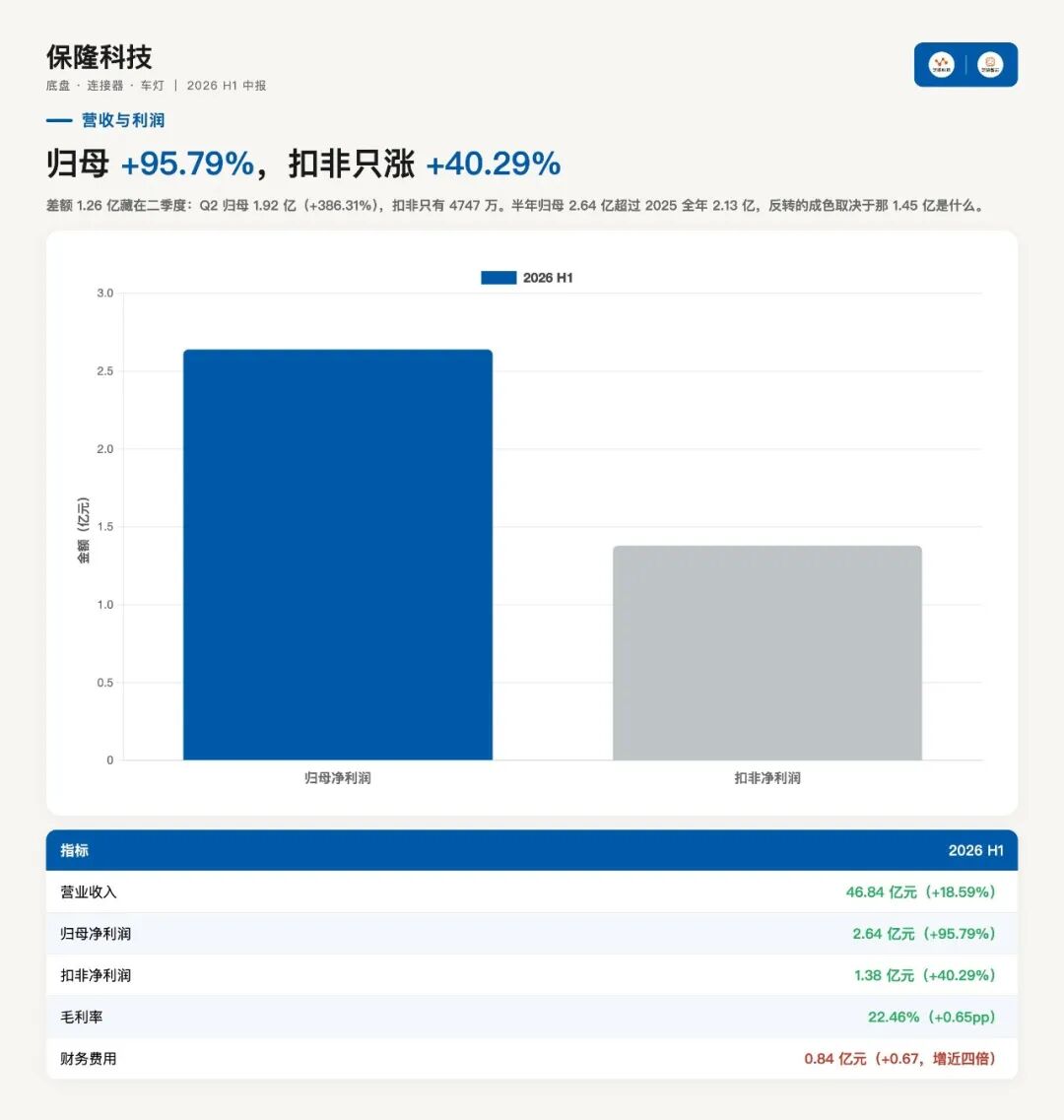
◎ First-half revenue reached 4.684 billion yuan, up 18.59% year-on-year.
◎ Net profit attributable to shareholders was 264 million yuan, surging 95.79%—resembling a classic turnaround story.
◎ However, net profit excluding non-recurring items was 138 million yuan, a mere 40.29% increase.
The gap between net profit attributable to shareholders and core earnings was 126 million yuan in non-recurring gains and losses.
Breaking it down quarterly, Q2 net profit attributable to shareholders was 192 million yuan, up 386.31% year-on-year. Core net profit for the same quarter was just 47.47 million yuan, a 187% increase. The single-quarter gap was 145 million yuan.
Only about a quarter of Q2's 192 million yuan profit came from core operations. The rest, not detailed in the interim report, is listed as a pending verification item—analyzed here based on visible financial clues.
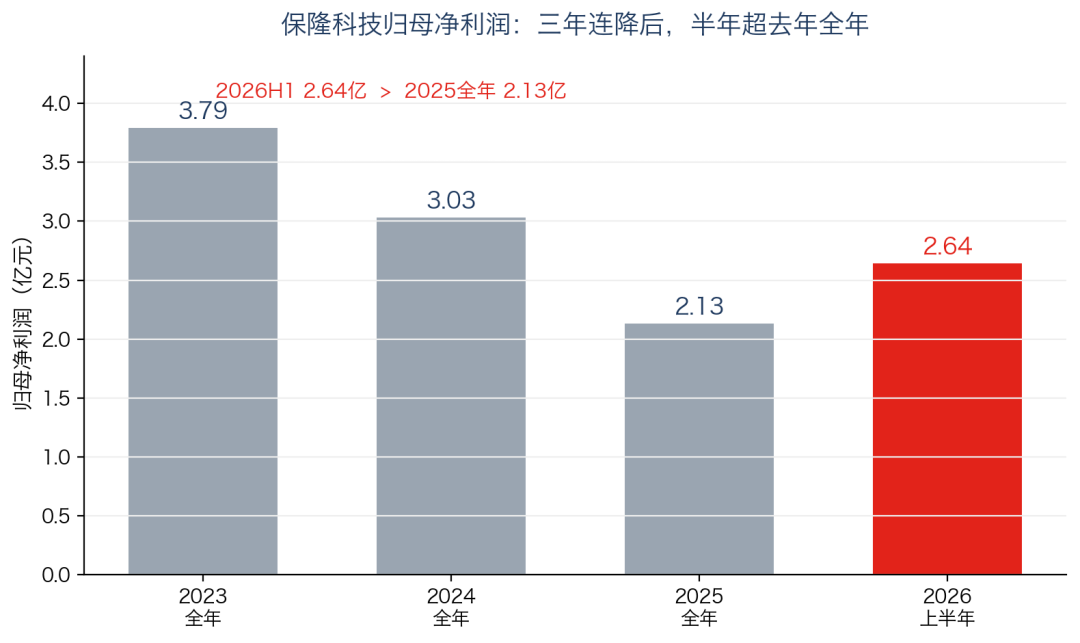
Baolong's net profit attributable to shareholders had declined for three consecutive years: 379 million yuan in 2023, 303 million yuan in 2024, and 213 million yuan in 2025. This year's first-half profit of 264 million yuan already exceeds the full-year total for 2025.
The turnaround is confirmed, but the question lies in quality.
◎ Gross margin has Really, really improved. Revenue was 4.684 billion yuan, operating costs 3.632 billion yuan, gross profit 1.052 billion yuan, and gross margin 22.46%—up 0.65 percentage points from 21.81% a year earlier. The improvement is modest but in the right direction.
◎ Expenses tell a different story. Selling expenses were 137 million yuan, administrative expenses 227 million yuan, financial expenses 84 million yuan, and R&D expenses 324 million yuan—totaling 772 million yuan. A year earlier, these expenses were 640 million yuan, an increase of 132 million yuan.
◎ Financial expenses saw the biggest change, jumping from 17 million yuan to 84 million yuan—a nearly fourfold increase of 67 million yuan. The balance sheet reveals why: short-term borrowings stood at 2.638 billion yuan, while cash reserves were just 693 million yuan. The company is relying on short-term loans to fund operations and expansion, with interest costs directly impacting profits.
◎ R&D expenses of 324 million yuan accounted for 6.92% of revenue—the highest among seven comparable companies. This intensity reflects simultaneous progress in intelligent suspensions, ADAS, and sensors. All three lines are burning cash, with no full payoff yet in sight.
◎ After deducting 772 million yuan in four major expenses from gross profit of 1.052 billion yuan, 280 million yuan remains. Subtracting 39 million yuan in impairment losses and investment losses, plus other gains like government subsidies, the final operating profit was 363 million yuan. After income tax (71 million yuan) and minority interest (26 million yuan), net profit attributable to shareholders reached 264 million yuan.
◎ Among the 363 million yuan in operating profit, a significant portion came from non-core gains, primarily government subsidies. This differs from the 145 million yuan in quarterly non-recurring gains mentioned earlier but points to the same issue: Baolong's profits include more non-operational elements than meet the eye.
Compared to a year earlier (operating profit: 229 million yuan, net profit attributable to shareholders: 135 million yuan), this year's operating profit increased by 134 million yuan. Gross profit contributed 191 million yuan of that, while expenses consumed 132 million yuan, with non-recurring gains covering the rest.
The true quality of this turnaround is best judged by core earnings.
Core net profit of 138 million yuan against revenue of 4.684 billion yuan yields a core net margin of 2.95%. Compared to 2025's full-year core net margin of 1.55% (135 million yuan divided by 8.747 billion yuan), this represents nearly a doubling. However, 2.95% remains thin. Financial expenses of 84 million yuan consumed 8% of gross profit. Without improving the debt structure, this pressure will persist.
Part 2: Business Breakdown—Air Suspension Drives Two-Thirds of Growth
By product, Baolong's growth now hinges almost entirely on one line.
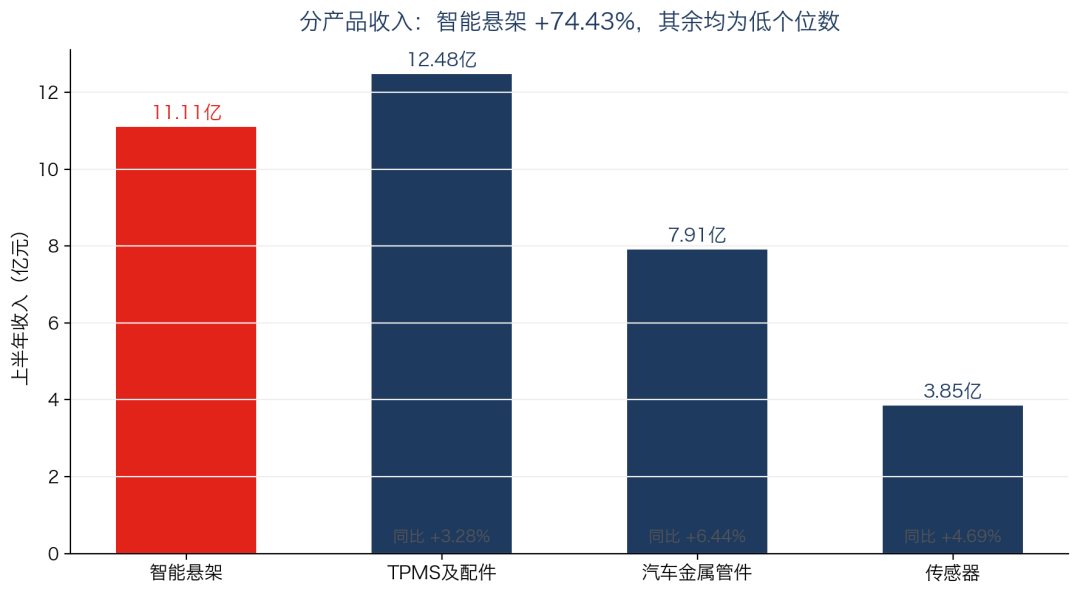
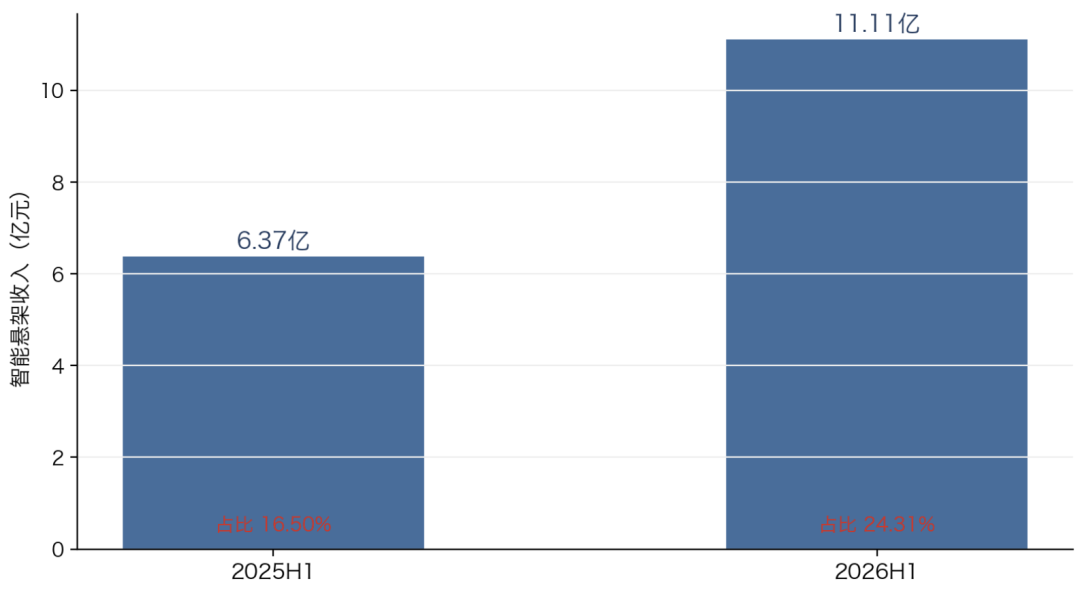
◎ Intelligent suspension revenue reached 1.111 billion yuan, up 74.43% year-on-year, with its share of revenue rising from 16.50% a year earlier to 24.31%.
◎ TPMS, accessories, and tools generated 1.248 billion yuan, a 3.28% increase.
◎ Automotive metal tubes contributed 791 million yuan, up 6.44%.
◎ Sensors brought in 385 million yuan, a 4.69% increase.
Intelligent suspensions alone added about 474 million yuan. The other three categories combined added roughly 130 million yuan, with the remaining difference coming from other businesses. Total revenue increased by 734 million yuan, with intelligent suspensions contributing about 65%.
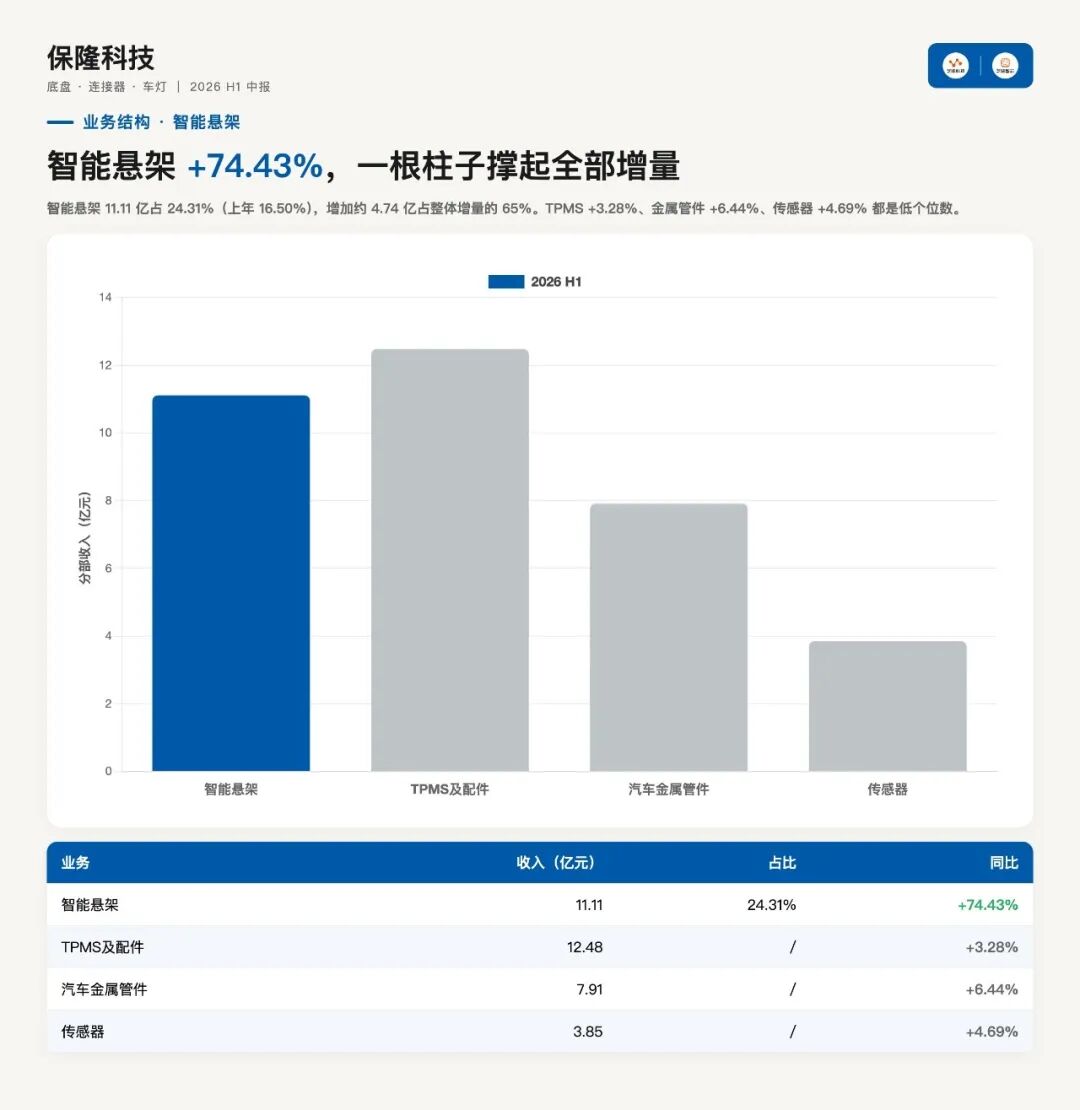
Nearly all growth came from one source: air suspensions.
Why are air suspensions so dominant? Once exclusive to luxury cars priced over 1 million yuan, localization and cost reductions in recent years have brought them to models priced at 300,000 yuan or even 200,000 yuan.
Per-unit value ranges from several thousand to over ten thousand yuan—an order of magnitude higher than Baolong's existing TPMS products (a few hundred yuan) and metal tubes. Selling one air suspension system matches selling dozens of tire pressure sensors.
Baolong's entry into this track (sector) leveraged its established supply relationships with automakers built through TPMS.
Intelligent suspensions can tap these existing customer resources without starting from scratch with automakers. The interim report mentions that new projects for intelligent suspensions, ADAS, and other product lines have entered mass production. Order backlogs are converting into revenue, not just staying as PPT slides.
The issue lies here.
When a single product contributes two-thirds of growth, any price declines in air suspensions outpacing cost reductions—or automakers switching to alternative solutions—could derail growth. The interim report did not disclose specific gross margin figures for intelligent suspensions in H1.
Given that overall gross margin improved by only 0.65 percentage points, the high-growth air suspension business may not have margins above the company average. Volume has risen, but profits may not follow suit.
By market:
◎ OEM automotive revenue reached 3.766 billion yuan, up 22.86% year-on-year, with its share rising from 79.44% to 82.43%.
◎ Aftermarket (AM) revenue was 769 million yuan, a 2.45% increase.
The OEM share continues to rise, while the aftermarket shows virtually no growth. Baolong is increasingly reliant on pre-installation sales, with the aftermarket's stabilizing effect weakening.
By region:
◎ Domestic revenue was 2.788 billion yuan, up 32.45% year-on-year, accounting for over 60% for the first time.
◎ Overseas revenue was approximately 1.785 billion yuan.
Domestic growth is directly tied to intelligent suspension clients. Domestic new-energy automakers are the most aggressive adopters of air suspensions, propelling Baolong's business in this area.
At the industry level, air suspensions' rapid penetration in recent years stems from localization and cost reductions.
An imported air suspension system once cost 10,000–20,000 yuan; domestic alternatives now cost several thousand yuan, making them viable for models priced at 200,000–300,000 yuan. This cost-reduction curve underpins Baolong's growth.
Risks emerge from two directions.
◎ First, price cuts. Automakers, under cost-reduction pressure, demand annual price reductions from suppliers. Air suspensions, newly extended to lower-priced models, still have room for price flexibility, which will squeeze margins.
◎ Second, competition. Besides Baolong, Konghui Technology, Tuopu Group, and Zhongding Corp are also in the air suspension market. More new entrants mean renegotiations on both prices and market share. The localization dividends Baolong now enjoys are accessible to competitors as well.
TPMS, a traditional strong suit, grew just 3.28% in H1, indicating maturity. Metal tubes increased by 6.44%, and sensors by 4.69%—both low single-digit growth.
The entire company now rides on intelligent suspensions. The trajectory of this segment will determine the company's direction for the next 2–3 years. A single pillar supports the house: if it holds, the house stands; if it cracks, all collapses.
Part 3: 2.6 Billion in Short-Term Debt—Leverage at Seven-Year High, Cash Flow Lags
A striking line on Baolong's balance sheet: short-term borrowings.
Total assets stand at 12.797 billion yuan, with total liabilities at 9.028 billion yuan—a debt-to-asset ratio of 70.55%, the highest among seven comparable companies. This figure was 69.28% at the end of 2025 and continues to rise.
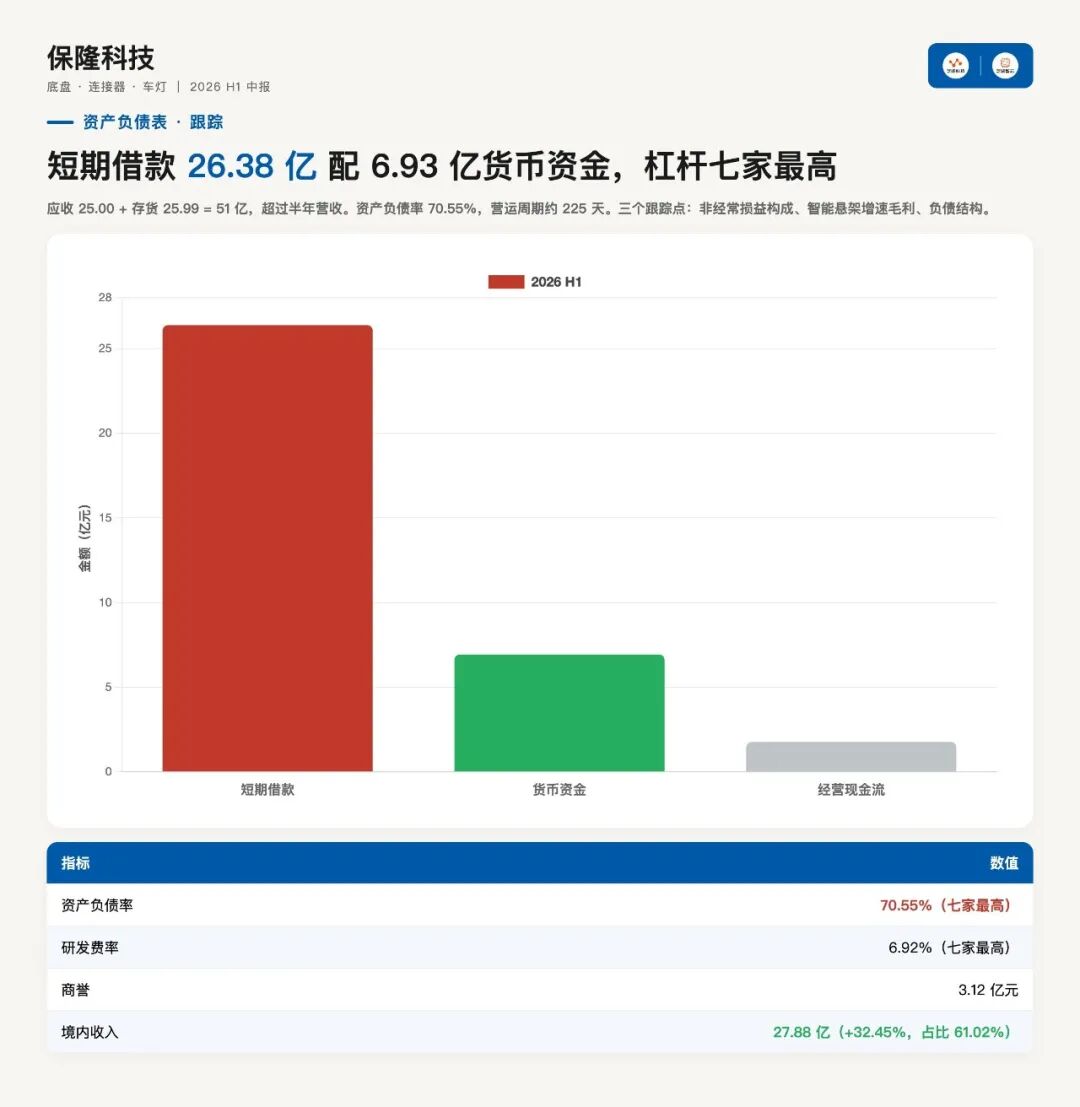
◎ Among 7.444 billion yuan in current assets, cash reserves were 693 million yuan, accounts receivable 2.500 billion yuan, and inventory 2.599 billion yuan. Receivables plus inventory totaled 5.1 billion yuan—exceeding H1 revenue of 4.684 billion yuan. These two categories tie up funds, directly causing high short-term borrowings.
◎ Current liabilities were 6.863 billion yuan, including 2.638 billion yuan in short-term borrowings and 1.861 billion yuan in accounts payable. Non-current liabilities were 2.166 billion yuan. Interest-bearing debt was 4.727 billion yuan at the end of 2025, with an interest-bearing debt ratio of 57.59%.
◎ Goodwill stood at 312 million yuan from historical M&A. The company expanded through acquisitions in recent years, including overseas TPMS and sensor businesses. The risk of goodwill impairment bears watching. M&A brought revenue but also goodwill, interest expenses, and integration costs—unavoidable costs during expansion.
◎ On the cash flow side, net cash from operations was 177 million yuan, below net profit attributable to shareholders of 264 million yuan—a cash conversion rate of 67%. This ratio isn't high, as a significant portion of profits remains tied up in receivables and inventory, unconverted into cash.
◎ Net cash used in investing activities was 506 million yuan, including 336 million yuan in cash paid for fixed assets, intangible assets, and other long-term assets. Net cash from financing activities was 599 million yuan, with cash inflows of 1.720 billion yuan and outflows of 1.121 billion yuan.
Combined, cash and cash equivalents at period-end were 673 million yuan, up 255 million yuan from 418 million yuan at the start. However, short-term borrowings rose to 2.638 billion yuan during the same period. Cash flow was net positive, but liabilities also increased. The company used short-term loans to cover both capital expenditures and working capital gaps.
Why are short-term borrowings so high? The asset side provides answers.
Receivables of 2.500 billion yuan and inventory of 2.599 billion yuan total 5.1 billion yuan.
◎ Inventory of 2.599 billion yuan corresponds to operating costs of 3.632 billion yuan, with a turnover period of about 129 days.
◎ Receivables of 2.500 billion yuan correspond to revenue of 4.684 billion yuan, with a turnover period of about 96 days.
Combined, these two categories require 225 days—over seven and a half months—from material input to cash collection. Such a long operating cycle can only be funded through debt.
◎ Short-term borrowings of 2.638 billion yuan precisely cover the portion of receivables plus inventory (5.1 billion yuan) exceeding accounts payable (1.861 billion yuan).",
-
![]()
Baolong Technology: Air Suspension Supports All Growth, But 2.6 Billion in Short-Term Debt Looms—Can Quality Be Sustained?", "Baolong Technology, Revenue, Profit, Air Suspension, Short-Term Borrowings
-
![]()
Why Does the Beijing-Tianjin-Hebei Region, Boasting a Trillion-Yuan Automotive Industry, Aspire to Become a World-Class Automotive Hub?
-
![]()
China’s Wealthiest Entrepreneur Zhang Yiming Leads in Computing Power, Outpacing Alibaba, Tencent, Baidu, and Huawei
-
![]()
Two Major Auto Brands Officially Merge!
-
![]()
AMD Acquires Li Feifei's Spatial Intelligence Startup World Labs: Accelerating the Deployment of Physical AI
-
![]()
Mistral, the second largest AI company in Europe, completes €3 billion Series D funding round, with valuation rising to €21.3 billion
-
![]()
Huawei’s Tri-Fold Phone Is a Sensation, But Another Buzz Is Even More Electrifying
-
![]()
National Day & Double 11 Refrigeration and Laundry Market Outlook: Navigating Growth Amid Structural Shifts