Why Does the Beijing-Tianjin-Hebei Region, Boasting a Trillion-Yuan Automotive Industry, Aspire to Become a World-Class Automotive Hub?
 09/29 2026
 530
530
This marks the 134th original article published by ThinkAI Society.
With a total of approximately 1,425 characters, the estimated reading time is 5 minutes.
Consider the following statistics: By 2025, the Beijing-Tianjin-Hebei region is projected to manufacture over 3.22 million vehicles annually, including more than 1.08 million new energy vehicles, with the automotive-related industry's output value exceeding RMB 1 trillion.
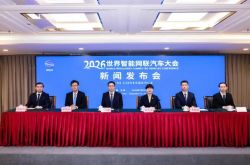
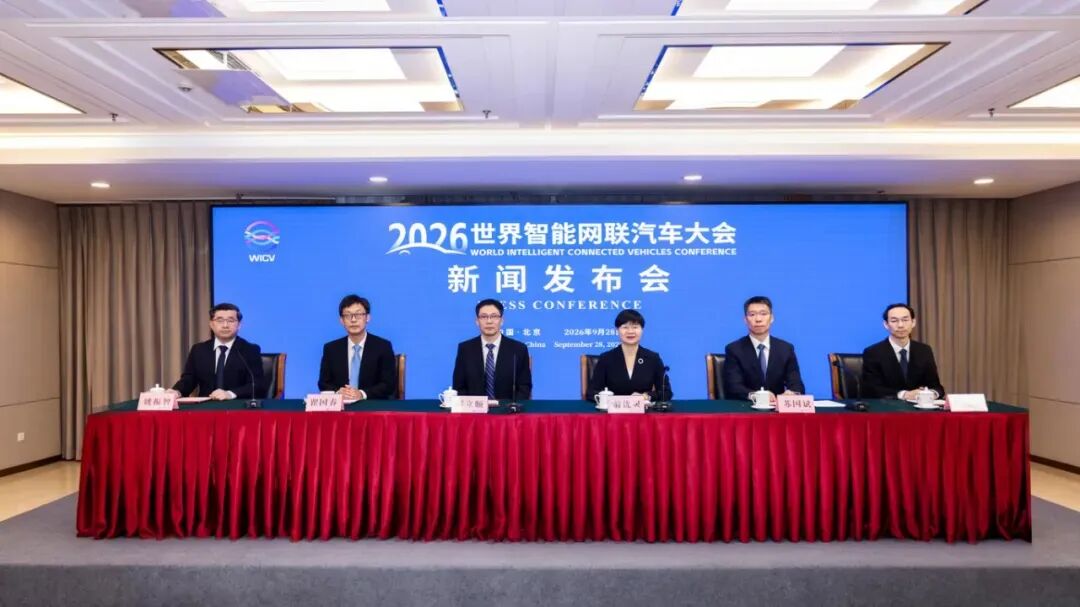
These figures were revealed at a press conference held in Beijing on September 28.
On October 21 of the following year, the 2026 World Intelligent Connected Vehicle Conference is set to commence in Yizhuang, Beijing. During the pre-conference press briefing, Su Guobin, Deputy Director of the Beijing Municipal Economy and Information Technology Bureau, clarified: Beijing-Tianjin-Hebei will expedite the development of a world-class advanced manufacturing cluster for intelligent connected new energy vehicles.
Pay heed to the term—world-class. To make such a bold assertion, one must first assess the available resources.
First Card: A Robust Foundation
Consider the scale. With a 13% increase in vehicle production to 3.22 million units, including 1.08 million new energy vehicles, and an output value surpassing RMB 1 trillion, the region boasts over 5,000 automotive supply chain enterprises, 24 complete vehicle manufacturers, and a workforce exceeding 300,000.
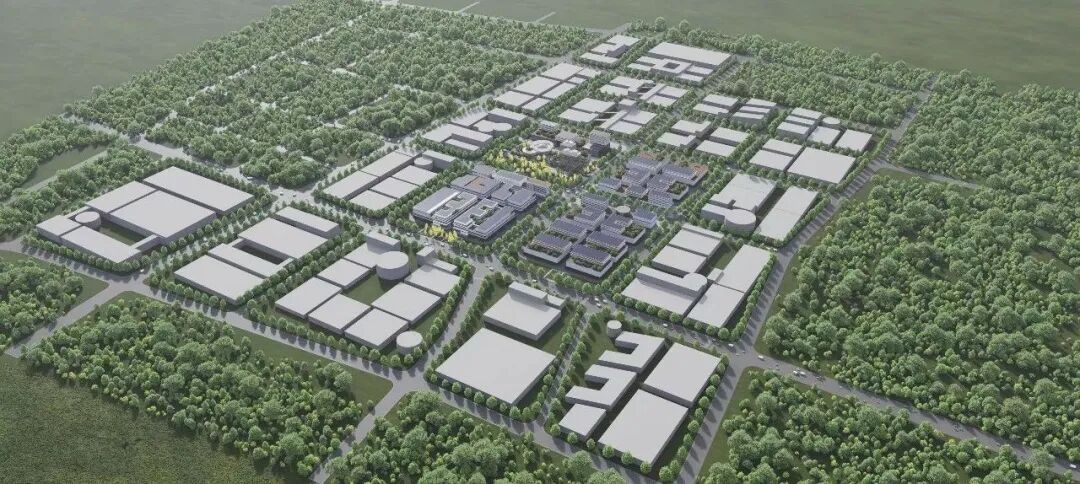 Planning Map of the Beijing-Tianjin-Hebei Intelligent Connected New Energy Vehicle Technology and Ecology Port
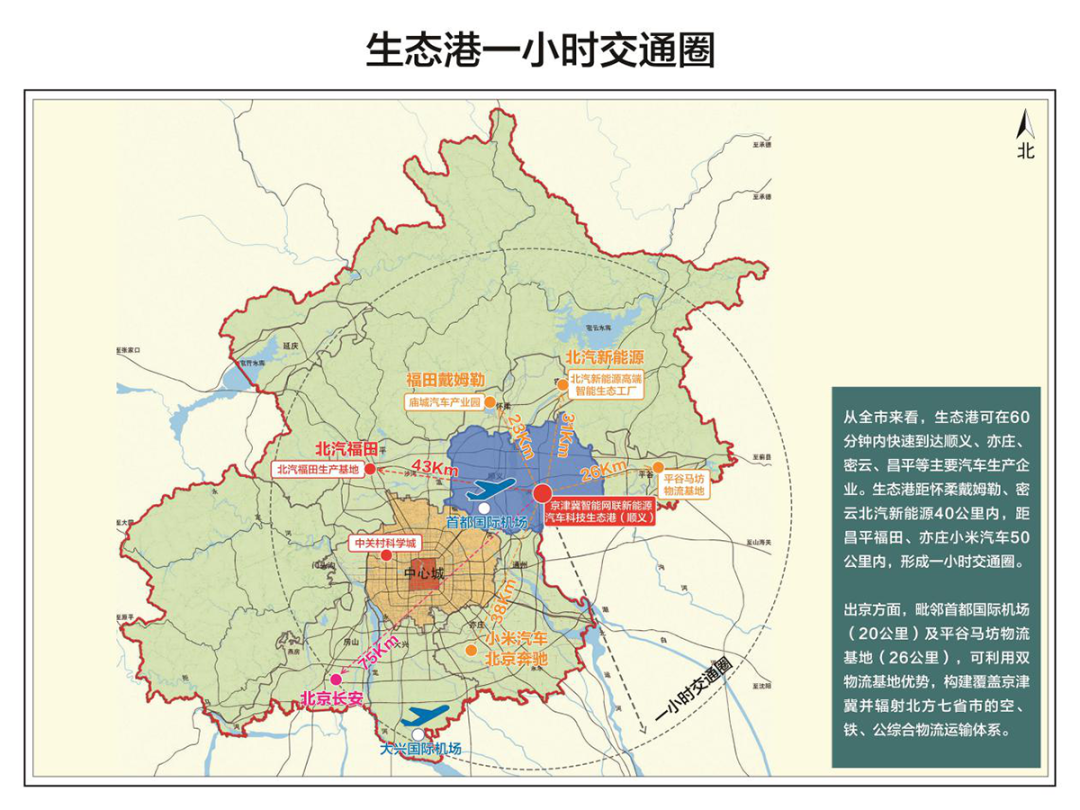
The epicenter is Yizhuang. By 2025, Yizhuang New City is anticipated to produce over 800,000 complete vehicles, with an automotive industry output value of RMB 310 billion, accounting for over 60% of Beijing's total.
Leading vehicle manufacturers such as Beijing Benz, Xiaomi Auto, and BAIC New Energy are headquartered here, surrounded by nearly a hundred component suppliers.
Not to overlook the practical applications in intelligent connected vehicles: the demonstration zone already hosts over forty enterprises and more than 1,500 vehicles in operation, with autonomous driving safety test mileage exceeding 65 million kilometers. Eight types of scenarios, including unmanned shuttles, unmanned deliveries, unmanned sanitation, and trunk logistics, have become commonplace. This is not just theoretical; it's a daily reality on the roads.
Second Card: A Strong Commitment to Innovation
If production volume signifies scale, then Beijing-Tianjin-Hebei's true focus lies in technological advancement.
The three regions have collectively established thirty-nine national-level innovation platforms and nearly one-third of the country's university laboratories. This underscores a strategy that prioritizes not just production volume but also intelligence.
Several key advancements were highlighted at the press conference: the Horizon Journey 6, a high-computing-power intelligent driving chip, has entered mass production with a computing power of 560 TOPS; Li Auto's full-stack open-source vehicle operating system; Xiaomi's cross-vehicle general model tailored for in-vehicle scenarios; and the establishment of a ten-ton-scale sulfide solid-state electrolyte pilot line.
Collectively, these advancements encompass chips, operating systems, large models, and next-generation batteries—all core components of intelligent electric vehicles that are most prone to "bottlenecks."
This strategy is bolstered by the jointly constructed Intelligent Connected New Energy Vehicle Technology and Ecology Port, which has garnered deep involvement from over 200 supply chain enterprises, with over sixty high-quality enterprises on board. In essence, Beijing and Tianjin contribute research and development and intellectual resources, while Hebei provides manufacturing and space, forging a unified force across the three regions.
Third Consideration: World-Class Status Entails More Than Just Production Volume
Let's inject some realism. For Beijing-Tianjin-Hebei to achieve "world-class" status, several obstacles must be surmounted.
First, consider the competitive landscape. Beijing-Tianjin-Hebei is not the sole contender for "world-class" status. The Yangtze River Delta, led by Shanghai, the Pearl River Delta with Guangdong's extensive vehicle and component systems, and regions like Sichuan-Chongqing and Hubei are also heavily invested. In this race, Beijing-Tianjin-Hebei does not hold a commanding position.
Now, look inward. With 1.08 million new energy vehicles out of a total production volume of 3.22 million, electrification still has room for growth. In terms of overall vehicle manufacturing volume, it is not the largest in the country. While regional coordination has been discussed for years, achieving seamless integration between "Beijing R&D and Hebei manufacturing" and resolving benefit distribution remains a work in progress.
More critically, the benchmark for a "world-class cluster" is not merely production volume. The national 15th Five-Year Plan explicitly states: the focus is on building an ecosystem for key components and cultivating leading enterprises.
In other words, there must be globally recognized leading enterprises, a component system that others cannot do without, and the ability to set prices and rules.
Therefore, in addition to technological breakthroughs, ecological optimization, factor support, and safety and quality, Su Guobin specifically mentioned going global—promoting the simultaneous expansion of complete vehicles, components, and services, transitioning from "product exports" to "ecosystem exports."
The sales networks of Beijing-Tianjin-Hebei automakers already span over 170 countries and regions worldwide, providing a solid foundation for this strategy.
Ultimately, from the "semi-annual report card" in late July to today's proclamation of a "world-class cluster," the Beijing-Tianjin-Hebei region's strategy is clear: not relying solely on production volume, but on achieving global recognition for its strengths in intelligence.
Next month's conference will be the first systematic showcase of this strategy. Whether it can truly attain world-class status will not hinge on slogans but on whether, in the coming years, this region can nurture several enterprises that the world cannot overlook. That is the true essence of the term "world-class."

All content is sourced from publicly available information and represents personal viewpoints only.
-
![]()
Baolong Technology: Air Suspension Supports All Growth, But 2.6 Billion in Short-Term Debt Looms—Can Quality Be Sustained?", "Baolong Technology, Revenue, Profit, Air Suspension, Short-Term Borrowings
-
![]()
Why Does the Beijing-Tianjin-Hebei Region, Boasting a Trillion-Yuan Automotive Industry, Aspire to Become a World-Class Automotive Hub?
-
![]()
China’s Wealthiest Entrepreneur Zhang Yiming Leads in Computing Power, Outpacing Alibaba, Tencent, Baidu, and Huawei
-
![]()
Two Major Auto Brands Officially Merge!
-
![]()
AMD Acquires Li Feifei's Spatial Intelligence Startup World Labs: Accelerating the Deployment of Physical AI
-
![]()
Mistral, the second largest AI company in Europe, completes €3 billion Series D funding round, with valuation rising to €21.3 billion
-
![]()
Huawei’s Tri-Fold Phone Is a Sensation, But Another Buzz Is Even More Electrifying
-
![]()
National Day & Double 11 Refrigeration and Laundry Market Outlook: Navigating Growth Amid Structural Shifts