OPPO Becomes Manus's First Domestic Client?
 10/15 2026
 342
342
Domestic Product Not Yet Launched, But Mobile Collaboration Comes First.
While Manus's domestic product is still in preparation, Chinese smartphone manufacturers have become its partners.
On October 13, OPPO announced a collaboration with Manus to integrate its AI agent capabilities into the AI Mind Pilot of ColorOS 17, with the Find X10 series as the inaugural model. Users will be able to have AI complete multi-step tasks within their mobile system. The specific markets supported will be announced at the product launch.
This news came quite suddenly. Manus, which faced obstacles in its acquisition by Meta, just announced its return to independent operation; on October 8, its parent company, Butterfly Effect, announced the completion of over $500 million in financing, led by Boyu Capital and IDG Capital, with continued investment from existing shareholders such as Tencent, Sequoia China, and ZhenFund. Just a few days later, Manus appeared in OPPO's new phone plans.
Manus, which has been unavailable domestically, now has a new possibility in the Chinese market: integrating its capabilities into Chinese manufacturers' phones. It provides AI agent services, while smartphone manufacturers offer system access. Users can first buy an OPPO phone and then get to know Manus inside it.
01 Doubao as a Mobile Assistant, Manus Integrated into Mobile Assistant
This collaboration easily draws comparisons to Doubao Mobile. Organizing data and handling cross-app tasks are already common demonstrations for mobile AI. When looking at feature lists together, the differences in collaboration models may not be apparent.
Doubao's collaboration with Nubia involves creating a mobile assistant named Doubao.
As this assistant enters the phone, Doubao is also opening service access to developers. It has integrated services like Cao Cao Chuxing and mapping, supporting task completion through simulated clicks and tool calls. Users interact with Doubao, which organizes the subsequent apps and services. For ByteDance, the phone brings Doubao from an app that needs to be opened to buttons, voice wake-ups, and system interactions.
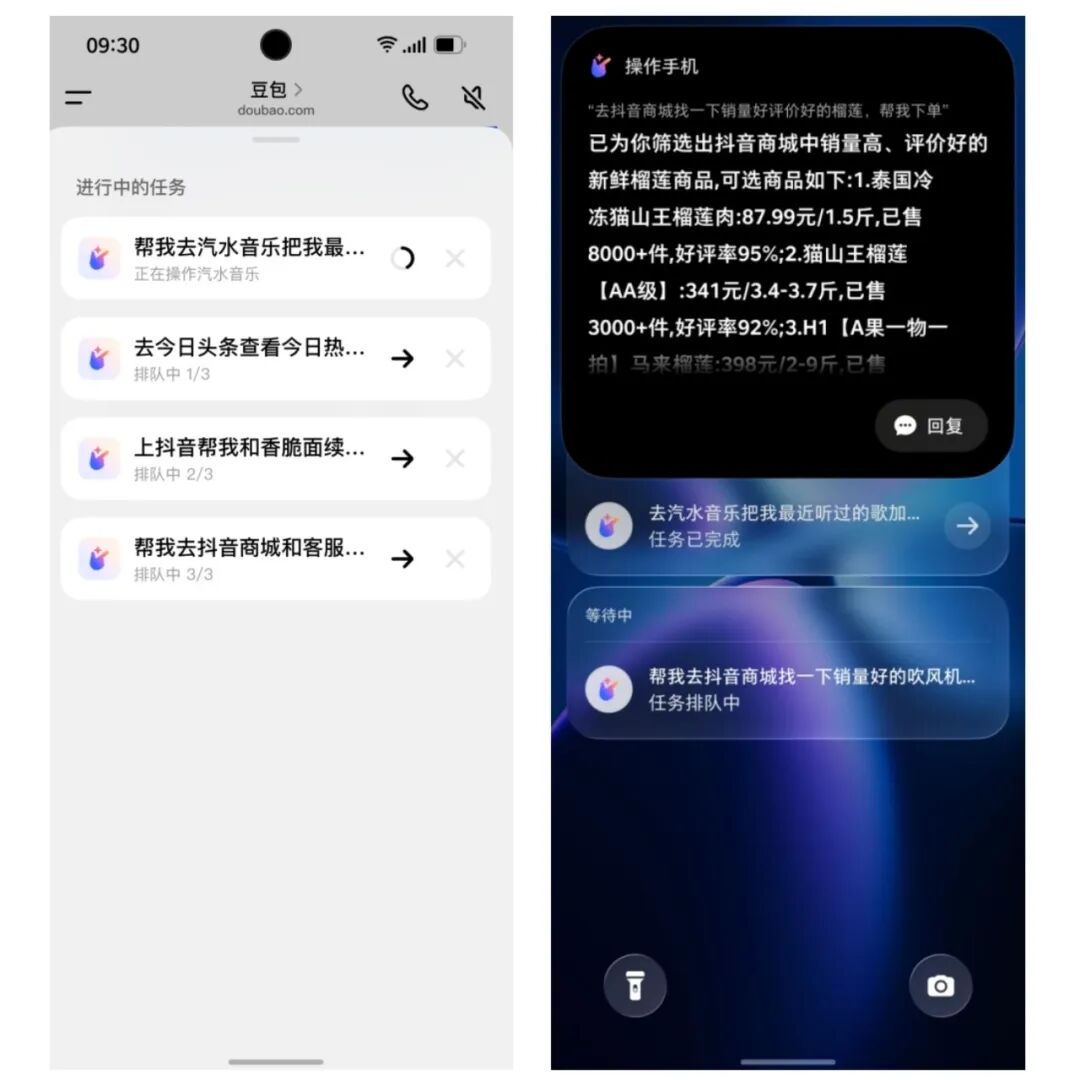
The cross-app task list and execution status displayed on the Doubao Mobile Assistant official website.
Manus's position in the OPPO collaboration is different. OPPO's own AI Mind Pilot remains the user entry point, with the new Agent mode initially supporting both Manus and ChatGPT. Users can bind their existing subscriptions to continue using them; OPPO will also provide free quotas. The earlier Ask mode already includes Gemini, Perplexity, and ChatGPT.
OPPO's announced ColorOS 17 features also include data organization and photo editing. According to its introduction of ColorOS 17, AI Mind Space can save long articles and links, automatically grouping related content; photo editing is handled by AI Photo Agent, where users describe the desired effect, and the system makes the specific adjustments.
What Manus adds to AI Mind Pilot is the ability to complete multi-step tasks using mobile data. Taking OPPO's demonstrated itinerary organization as an example, users state their travel plans, and AI Mind Pilot finds flight tickets, hotel reservations, and attraction tickets on the phone, then combines online information to generate an itinerary. Manus provides target understanding, multi-step planning, and task execution capabilities, while OPPO adapts it into the system, allowing mobile data to be accessed with user consent. Tasks that previously required users to collect, upload files, and operate them one by one can now be completed within a single assistant.
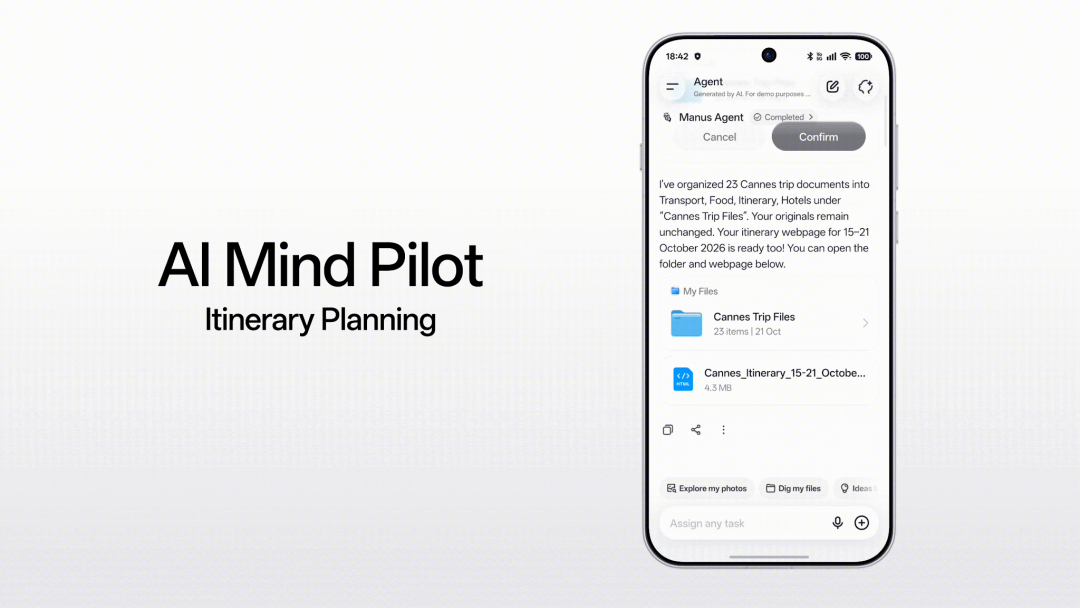
In Manus's official demonstration, AI Mind Pilot generates a travel itinerary based on data within the phone.
This collaboration also maintains local processing boundaries. According to OPPO, local tasks like file searching, organizing, and renaming are handled by on-device models, keeping raw content on the phone; when tasks require external processing, the system requests explicit user authorization before uploading or sharing related content. Manus gains the opportunity to enter mobile workflows, but which data it can access and how it is used still depends on system arrangements and user consent.
From the announced product form, Doubao cultivates an assistant relationship with users, while Manus becomes one of the services that OPPO's assistant can call upon. The former has the opportunity to make users develop the habit of 'turning to Doubao for anything'; the latter first gains usage opportunities through OPPO's entry point, then relies on task completion effectiveness to strive for (compete for) users to continue choosing it.
Both approaches require smartphone manufacturers to cooperate at the system level. Doubao has not become a company that manufactures its own phones, and Manus's collaboration with OPPO also involves deep adaptation. The difference lies in how much work AI companies take on in front of users and how much experience smartphone manufacturers organize within their products.
02 Smartphone Manufacturers Are Familiar with Such Collaborations
In 2022, when Xiaomi announced its collaboration with Leica, Lei Jun discussed a specific detail: Leica engineers came to Beijing and worked with the Xiaomi team on joint tuning. By July 2025, OPPO and Hasselblad announced an extension of their collaboration, which had spanned multiple generations of Find models, to continue developing the next-generation imaging system.
These collaborations bring camera companies' professional expertise into phones. Consumers open their phone cameras and can use the tuning results from both sides; the names Leica and Hasselblad also give this part of the experience distinctiveness. Smartphone manufacturers add selling points with external teams, while camera companies gain access to people who have not previously purchased professional cameras.
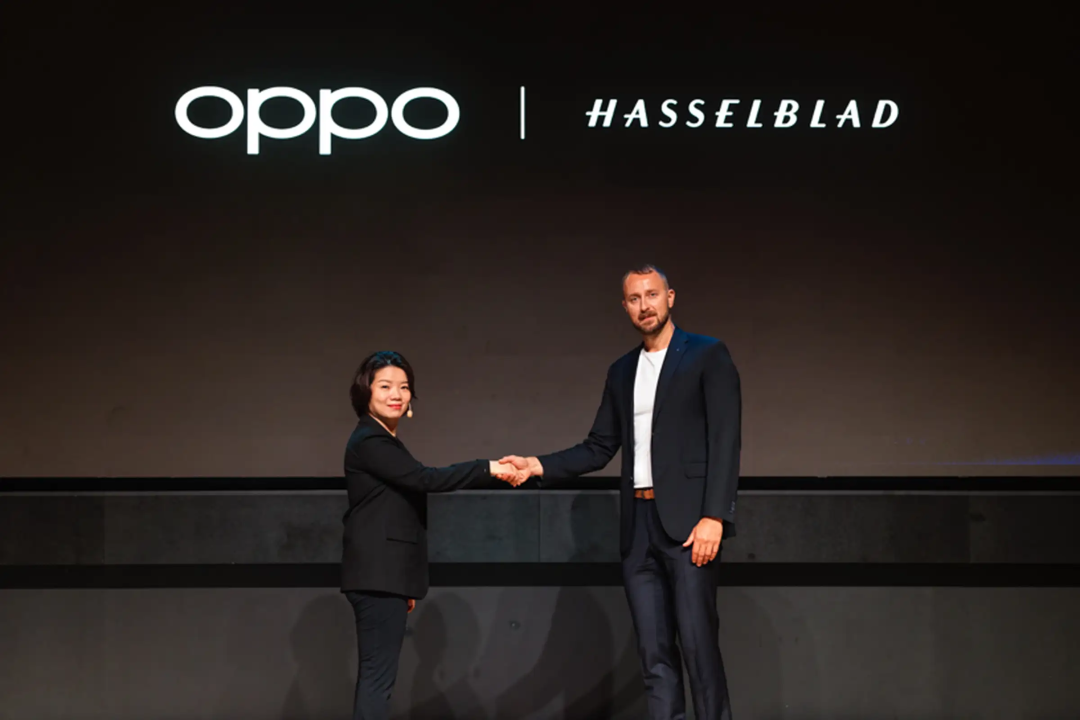
In July 2025, OPPO and Hasselblad announced an extension of their imaging collaboration.
OPPO has already introduced other AI services in this way. The Reno14 supports long-pressing the side button to evoke (activate) Gemini; in India, the Find X9's purchase benefits include a three-month Google AI Pro subscription. Delivering new services to users with their phones is already a method OPPO uses to sell products.
For Manus, OPPO provides a sales channel that has been operating for years. According to Omdia, OPPO's global smartphone shipments in 2025 were 100.7 million units. Starting collaboration with the new Find X10 series, Manus faces consumers preparing to buy phones. They might not have specifically sought out an Agent product before, but now they can get a chance to use Manus with their new phone.
Users start tasks from OPPO's assistant and may remember OPPO first. With Manus and ChatGPT in the same entry point, existing usage habits and actual task effectiveness will influence which one users choose next. Meanwhile, existing subscriptions can be bound to the phone, preserving the relationship between Manus and its paying users. A paying user can bring their account into the phone; new users, after a free trial, also have the opportunity to become its subscribers.
Imaging and Agent collaborations both require continuous R&D and adaptation for new models. Agent services also incur ongoing computational expenses as tasks are executed. Manus's billing explanation lists model calls, virtual machines, and third-party API consumption. After a phone is sold, the more users use it, the more services need to be provided behind the scenes.
OPPO's free quotas make it easy for users to try it out first. The post-experience payment arrangements will affect service usage and determine who bears these ongoing costs. Neither side has disclosed licensing fees, call fees, or revenue-sharing terms, nor the income generated by the collaboration. After delivering services to users with their phones, operational and maintenance work will continue, and both sides' investments will extend beyond new product launches.
Providing AI capabilities to smartphone manufacturers has long been a business. Volcano Engine has already provided the Doubao model and online retrieval capabilities for OPPO's Xiao Bu Assistant, jointly developing agent applications. In 2025, Alibaba and Honor signed an AI strategic collaboration agreement to jointly develop on-device models, agents, and multimodal capabilities based on Tongyi Qianwen. Besides self-research, smartphone manufacturers have also been leveraging external collaborations to integrate AI deeper into their systems.
Manus has now joined this table. What it brings to OPPO is the already-productized multi-step planning and task execution capabilities. For Manus, this means that besides directly strive for subscription users, it has an additional commercial path through collaboration with smartphone manufacturers. The mobile AI upgrade business that Volcano Engine and Tongyi Qianwen have already participated in now also includes Manus to get a share.
03 Manus's Product Is Still Waiting, But Using Manus Isn't
On October 8, when announcing its financing, Manus also published job listings for 17 positions, including product, R&D, operations, and growth, to supplement its team in Beijing.
This is not Manus's first mention of a domestic product. In March 2025, it announced a collaboration with Alibaba's Tongyi Qianwen team to explore using domestic models and computational power to achieve domestic functionality. A year and a half later, when releasing the overseas-oriented Manus 2.0, the company again stated that it was forming a domestic product team and advancing collaborations with domestic model vendors and ecosystem partners, still without announcing a launch date for the domestic version.
OPPO's collaboration can progress alongside these preparations. The domestic team continues to prepare the local product, while the Manus services already available overseas have the opportunity to enter the global sales system of a Chinese smartphone manufacturer first. It does not have to wait until domestic consumers can register and use it to establish new business relationships with Chinese companies.
This also gives 'returning to China' a more specific meaning. Hiring in Beijing and finding domestic model partners is to build the product; collaborating with a Chinese smartphone manufacturer can first add channels for overseas business. The nationality of users and partner companies does not need to completely overlap.
On October 21, OPPO will release the Find X10 series in Mallorca, Spain. Manus's domestic product has not yet officially launched, but a Chinese smartphone manufacturer has already included it in its overseas release plans.
However, AIOS still faces the same permission issue. The day after OPPO announced its collaboration, Doubao Mobile Assistant's screen automation operation statement agreement ended its 30-day public notification period, and the official also announced the latest list of apps that refuse operations. For apps that explicitly refuse, Doubao states it will not operate on behalf of users.
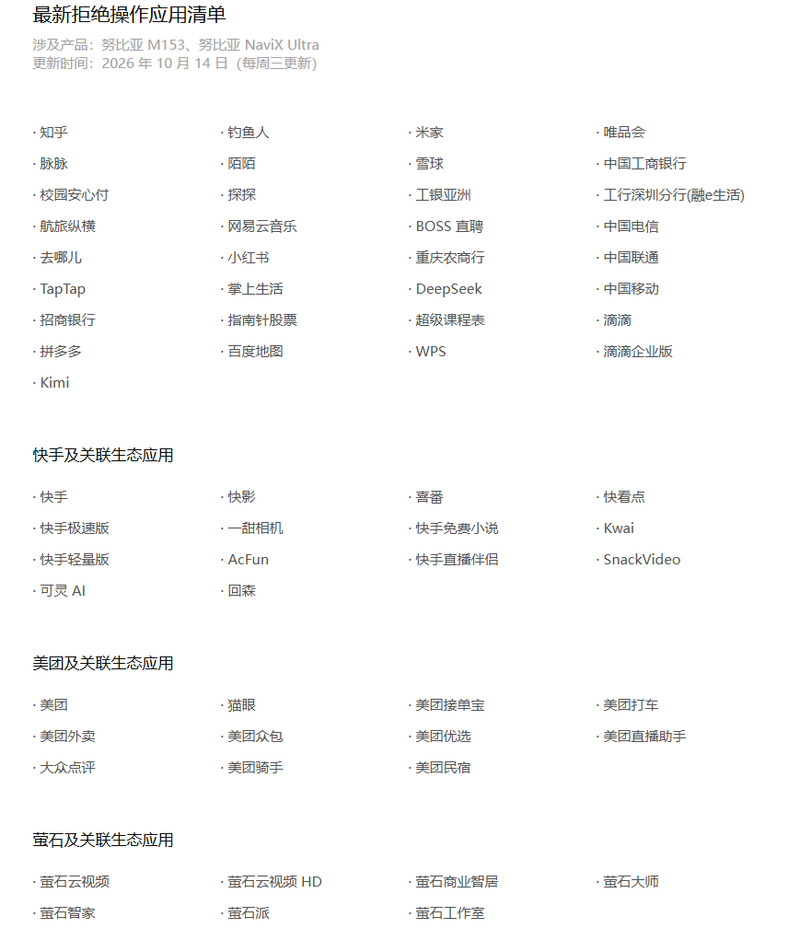
The list of apps that refuse operations (partial) announced by Doubao Mobile Assistant on October 14.
If tasks extend from organizing itineraries to booking tickets and placing orders, OPPO and Manus will also encounter permissions and rules from app vendors. Smartphone manufacturers can decide which Agent to integrate but cannot decide for app vendors whether to allow it to act on behalf of users.
The line drawn by app vendors is one that OPPO and Manus will also encounter. When tasks extend from organizing itineraries to booking tickets and placing orders, they need to face different apps' permissions and rules. Smartphone manufacturers can decide which Agent to integrate but must continue to engage with app vendors providing the services.
Even so, in terms of the intensity of introducing external general Agents, OPPO has taken a quite aggressive step among traditional smartphone manufacturers. It has integrated Manus into a system-level assistant, allowing a product developed by an external team to have the opportunity to plan and execute tasks by combining information within the phone. The collaboration delves into users' daily phone usage, meaning OPPO is willing to entrust a significant part of the product experience to be jointly completed by both sides.
This is also why smartphone manufacturers are worth continuing to invest in. Phones already store much of the information users need to handle tasks, but in the past, finding it, understanding the relationships between data points, and deciding what to do next were mainly the user's responsibilities. OPPO's collaboration with Manus begins to shift some of this to the system. Even if tasks like booking tickets and making payments still require user involvement, the preceding searching, organizing, and planning have independent usage value.
For OPPO, the next step is to make this convenience a stable daily experience. If a demonstration can complete a travel plan, users will naturally expect it to handle the next equally troublesome task. Tasks will become increasingly complex, requiring coordination with more apps. The list Doubao published already shows the resistance along this path in advance.",
-
![]()
Apple Order Cuts or Not, Apple Supply Chain Inventory Demands Attention!
-
![]()
Toyota’s North-South Integration at a Pivotal Moment: Huang Jian Steps In to Steer Key Initiatives
-
![]()
Avatr Steers Away from Pioneering Aesthetics, Embracing a More Mainstream Appeal
-
![]()
How 79-Year-Old Lao Gan Ma Founder Tao Huabi Leveraged AI to Achieve 5.4 Billion Yuan in Revenue
-
![]()
Breaking News! Doubao Faces a Collective 'Ban' from Tencent, Alibaba, and Others for Attempting Mobile Phone Manipulation
-
![]()
How Robust Are China’s New Energy Vehicles? A Look at Eight Months of Global Market Sales
-
Competition in Ecosystems: AI’s Next Frontier
-
![]()
The cost per vehicle is 73,000 yuan higher in Europe than in China; European markets can't stop Chinese cars by any means