After 100 days, Step's Agent Phone Still Only Half Released
 10/16 2026
 335
335
Can Step Build a New House from Scratch?
On the evening of October 13, Step Terminal officially launched the STEPX Neo, continuing to compete with smartphone manufacturers such as Doubao Phone II, Huawei, Honor, Xiaomi, OPPO, and vivo for the 'Agent Phone' label.
This marks Step Chairman Yin Qi's fulfillment of the '100-day promise' made three months ago.
On July 13 this year, the STEPX Neo made its debut. Step introduced the AI terminal brand STEPX, the native system Step AOS, and the main agent Amoo, theoretically establishing a 'Model-Software-Hardware' trinity closed loop.
Yin Qi stated at the event that their decision to enter the hardware market was a difficult one, and this was just the first half. The next 100 days would focus on building an agent ecosystem with users.
At the time, I analyzed that Step's AI terminal was only 'half released.' That launch merely presented concepts, frameworks, and narratives ahead of the industry, but it was still far from a deliverable, experienceable, and scalable 'product' in the second half. There were at least two generations of Doubao AI phones separating it from true market readiness.
After 100 days, this assessment still holds.
Priced at Just 3,999 Yuan?
According to Step's product logic, AI terminal players in the market can be divided into two approaches based on how they enter the arena:
The first is the integrated approach. It starts with existing smartphones, operating systems, apps, or hardware forms, integrating large models and agent capabilities into the existing product ecosystem. However, AI must adapt to the existing architecture, and related capabilities are easily dispersed across different applications and entry points, ultimately remaining at the level of feature stacking or partial transformation.
The second is the native approach. It does not pre-determine the terminal form but first defines the perception, memory, reasoning, and execution capabilities required by the Personal Agent, then reverse-engineers the model, system, and hardware.
Step Terminal positions itself in the second category, calling it a 'heavier path.'
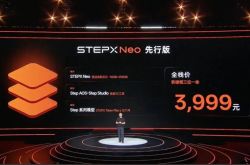
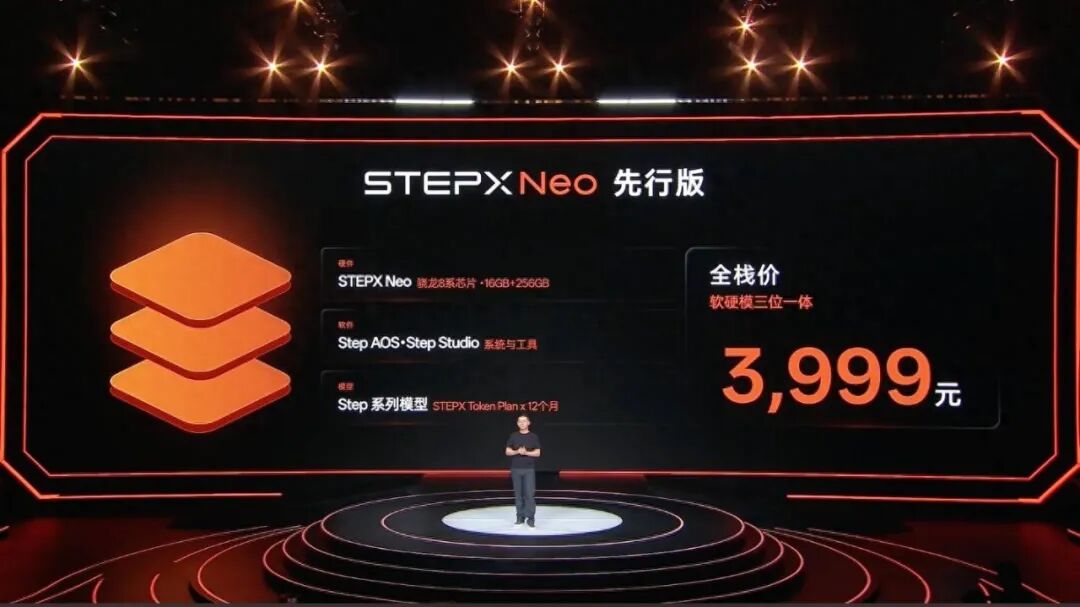
Unlike traditional smartphone manufacturers, Step extends the 'Model-Software-Hardware' integration to pricing. The STEPX Neo Early Access Edition bundles the Step series models, Step AOS system, Step Studio tools, and smartphone hardware, introducing a fresh pricing term—'full-stack price'—at 3,999 yuan.
Additionally, purchasers receive the STEPX Token Plan, which includes 10 billion tokens per month for 12 consecutive months to explore and develop native agent applications.
Combined, the 'full-stack price' of the STEPX Neo Early Access Edition is even 2,000 yuan cheaper than the Doubao Phone II. In today's smartphone industry, where prices are generally rising, this appears bold and even risky.
Take domestic flagship smartphones as an example: the Huawei Mate 90 starts at 5,999 yuan, an increase from the previous generation; the Xiaomi 18 Pro starts at 5,999 yuan, continuing to target higher price points, with the foldable flagship Xiaomi 18 Fold starting at 10,999 yuan. The OPPO Find X10 series starts at 4,999 yuan; the vivo X500 Standard Edition starts at 5,499 yuan.
The result of 'declining volumes, rising prices' is a significant drop in smartphone sales compared to previous years. Notably, the Honor Magic 9 series boldly set the starting price for its standard version at 3,999 yuan after national subsidies, becoming this year's dark horse in the Android camp.
Yin Qi mentioned that personal terminals iterate every 20 years. Against the backdrop of this launch event's theme—Ready Builder One—it appears that this model-oriented company is prepared to rebuild a house from scratch in the manner of an agent and squeeze into (make its way into) the top tier of AI terminals.
In fact, this seemingly attractive pricing strategy hides Step's shrewd business calculations and highlights its internal conflict.
On the one hand, it wants to use low prices to attract new users, lowering the barrier to entry for trying out its products, encouraging more consumers to purchase and use them, thereby accumulating real-world user feedback and usage data.
On the other hand, Step hopes that purchasers will use the STEPX Token Plan as little as possible, reducing computational cost expenditures.
According to official data, Step 5 Preview charges 7 yuan per million tokens for input (cache miss), 0.35 yuan for input (cache hit), and 20 yuan for output—a price difference of over 20 times.
At this rate, the monthly 10 billion token allowance has a conservative face value of over 60,000 yuan, totaling over 700,000 yuan nominally over a year. The 3,999 yuan smartphone price resembles a prepayment for Step's token business: collect money upfront and delay delivery.
The 'Stellar Ticket' follows the same logic, with the first 10,000 users who complete specified tasks eligible to exchange their Neo for any new STEPX model free of charge within five years.
This resembles the annual membership model of gyms and swimming pools, where operators also offer free smartphones with prepaid phone plans. Moreover, Step has not clarified how the '10 billion tokens per month' will be consumed—which model will they run on, whether it counts as input or output, and whether on-device usage is included?
A few hours after the launch event, Step announced that starting at 00:30 on October 14, the price of Step 5 Preview would increase, with the input price for cache hits rising from 0.35 yuan to 0.7 yuan per million tokens.
This is equivalent to the platform doubling the price of promised benefits before the phone even goes on sale.
This move, combined with Step's claim that the 'Early Access Edition does not pursue initial shipment volumes,' appears to be a risk control measure for pricing. By discouraging heavy use of the STEPX Token Plan, Step reduces its subsidy for computational costs.
In other words, while traditional smartphone manufacturers see their fixed costs dilute as hardware sales increase, Step faces an additional layer of computational costs under its current pricing system. Every time a purchaser uses Amoo to run a task, Step must cover the inference costs.
For Step, it wants users to buy the phone to complete its narrative but hopes they won't use it to run too many tasks.
However, as Hu Xiu questioned, why would consumers spend 3,999 yuan on a phone whose agent capabilities still need continuous improvement? Compared to the Doubao Phone II, Step's pricing does bring AI phones into the mid-range segment. But for average users, this remains a significant expense.
Especially given the current oversupply of smartphone performance, agent phones have yet to prove their maturity or how much 'smarter' they are than previous-generation AI assistants.
They must answer why consumers would buy a new phone specifically for agent functionalities they might not even use.
Step's Agent Phone Is Still Only 'Half Released'
If, 100 days ago, Step Terminal 'only released half' due to the gap between concept and delivery,
this time, the missing half lies in its biggest bottleneck on the agent phone path: super apps. Currently, it has made commitments to handle tasks and partially secured the qualifications to act on behalf of users, but it still lacks full control over half of the decision-making process.
Step's vision is a 'Software-Hardware-Model' trinity: the model handles understanding and decision-making, the software organizes and schedules, the hardware perceives and carries, and the system connects personal memory, tools, and permissions with external services.
However, whether this closed loop can function depends on the attitude of super apps. In December 2025, the first-generation Doubao Phone extended agent capabilities to terminals through screen reading and simulated clicks across apps. However, this approach quickly triggered risk control alerts from apps like WeChat and Taobao and ultimately failed.
The second-generation Doubao Phone adopted a 'smarter' approach, trying to 'knock before acting' by introducing the SAEP (Screen Automation Operation Declaration Protocol): a 30-day public notice period, after which failure to reject implies default openness. This marked a qualitative shift from covert operations to prior notification.
The SAEP public notice period ended on October 14, with 151 apps, including WeChat, QQ, Taobao, Meituan, Kuaishou, DeepSeek, Pinduoduo, and Xiaohongshu, refusing to open screen automation operations.
This 'rejection' list does not reflect the inadequacy of Doubao's agent capabilities but rather the inherent difficulty of this approach.
Step is not unaware of this. It has chosen a seemingly stupid (clumsy) way to proceed: negotiating authorizations one by one from the start.
According to official information, Step's Amoo has partnered with nearly 100 enterprises or products, including Alipay, Tencent, Ctrip, Didi, CapCut, Gaode, and Meituan, achieving bottom-layer ecosystem integration in local life, travel, office efficiency, and content creation.
This approach may also fall into the same 'trap' as Doubao Phone. Once it proves that negotiating authorizations is the only viable path, the first to reap the benefits may not be Step. WeChat, Taobao, and others, with their massive user bases and transaction volumes, could develop their own agent assistants at a much lower cost than Step.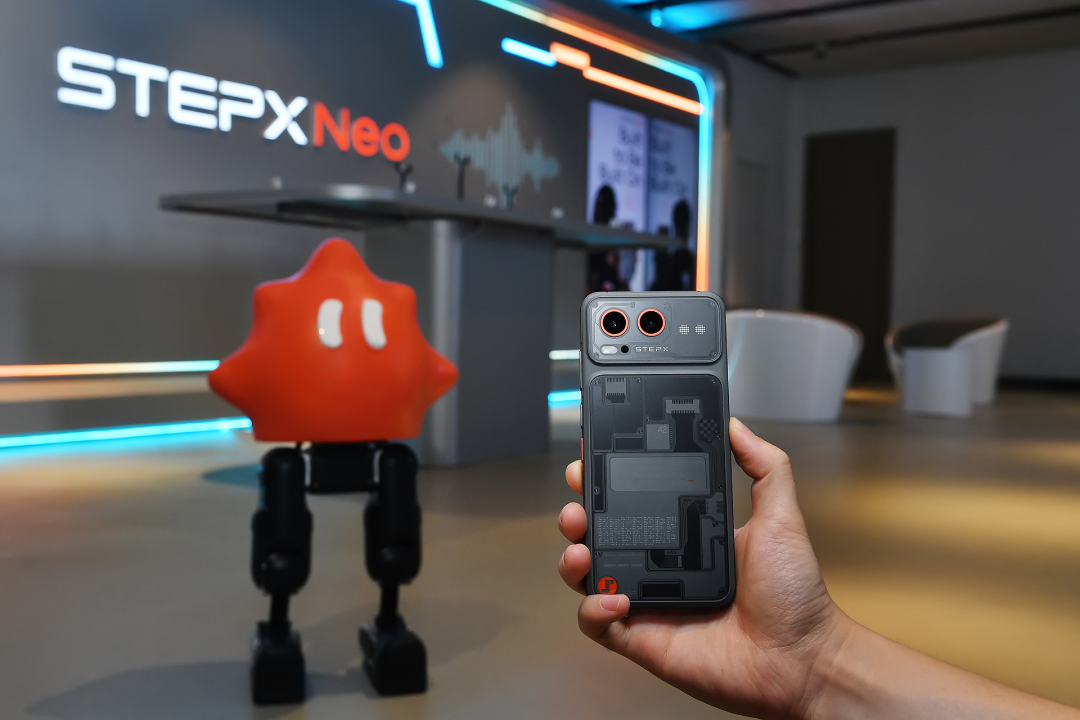
STEPX Neo Early Access Edition. Source: Jiemian News
Given that its capabilities are constrained by others and that higher sales volumes lead to greater computational costs, why did Step Terminal rush to launch the phone within these 100 days?
Clues can be found in Yin Qi's timeline. He became Step's chairman in January, securing over 5 billion yuan in a B+ round of financing in the same month; completed the company's shareholding reform in April; finalized a nearly 2.5 billion USD Pre-IPO round and dismantled the red chip structure in May; rumors of a Hong Kong Stock Exchange listing application emerged in June; made the 100-day promise in July; and launched the phone in October.
In short, this product strategy centered on 'Hardware-Software-Model' integration is essentially Step's path to going public.
For large model companies, a compelling narrative centered on the Personal Agent trend can persuade markets and investors more effectively than a standalone hardware product.
A typical (typical) example is Meta, whose personal agent Muse added approximately 260 billion USD to its market value within a month of launch.
Previously, Yin Qi disclosed similar thinking, stating that AI coding might not work in China. Could the commercialization of Chinese large model companies involve a soft-hard integration approach? 'I don't know, but I believe in this path, so I decided to try it,' he said.
He is also willing to give the product time: 'The first iPhone wasn't impressive; true mass adoption came with the iPhone 4.'
However, Yin Qi may have overlooked an industry-wide issue: the smartphone market is shrinking, and user demand for new phones is weakening. IDC data shows that global smartphone shipments in Q2 2026 reached 277.5 million units, down 6.7% year-over-year, with the Chinese market declining for five consecutive quarters.
Step may also pay another price: before making this phone, it was one of China's largest suppliers of on-device models, providing OPPO's 'One-Touch Flash Note' and Honor MagicOS 9.0's 'Autonomous Driving Agent,' with model installations exceeding 42 million units.
By entering the smartphone market itself, regardless of the mode, its relationship with clients will inevitably shift from supplier to competitor.
In my view, Step's ability to validate its approach will hinge on two critical time points: how many people are willing to pay 3,999 yuan on October 16 for the first sale, and how many are willing to renew their Token Plan subscriptions after the annual allowance expires.
The first time point is about capitalizing on the trend to tell a listing story; the second is the true hurdle Step must overcome for its business to succeed.
Thus, whether Step can secure the other half of the initiative depends on the attitudes of WeChat, Taobao, Doubao, and others.
References:
36Kr, 'Exploring the Future of Agent Terminals: STEPX Neo Unveils a New Form of Human-Machine Symbiosis'
Hu Xiu, '2,000 Yuan Cheaper Than Doubao Phone: Step and ByteDance Clash'
Tang Chen's Classmate, 'Step's AI Terminal Is Only 'Half Released,'' 'Top 10 Questions About the Second-Generation Doubao Phone'
-
![]()
Why Are New Automakers Focused on Creating a ‘Second Home’ in Cars, While Traditional Brands Bet on Boxy SUVs?
-
![]()
Chinese Automakers Make a Splash at Paris Auto Show, as EU Imposes 350,000-Unit Cap on Hybrid Vehicle Exports
-
![]()
September’s Top 10 Sedan Sales: Fuel-Powered Classics Still Holding Their Ground
-
![]()
Analysis Report on Reputation Index for Q3 2026
-
![]()
Is Apple Now Taking a Swipe at Xiaomi in the Smart Home Arena?
-
![]()
The Waning Influence of 'Golden September, Silver October'
-
![]()
Three Departments Launch Joint Probe into Zunjie Brake Issue; Yu Chengdong: Justice Will Prevail
-
![]()
After 100 days, Step's Agent Phone Still Only Half Released