The Waning Influence of 'Golden September, Silver October'
 10/16 2026
 343
343
Exploring Peak Seasons Beyond Borders
Author|Wang Lei
Editor|Qin Zhangyong
Traditionally, September and October have marked pivotal times for boosting automobile sales, driven by a straightforward rationale: an uptick in new energy vehicle (NEV) sales sparks market enthusiasm.
This year, however, this trend seems to have lost its momentum.
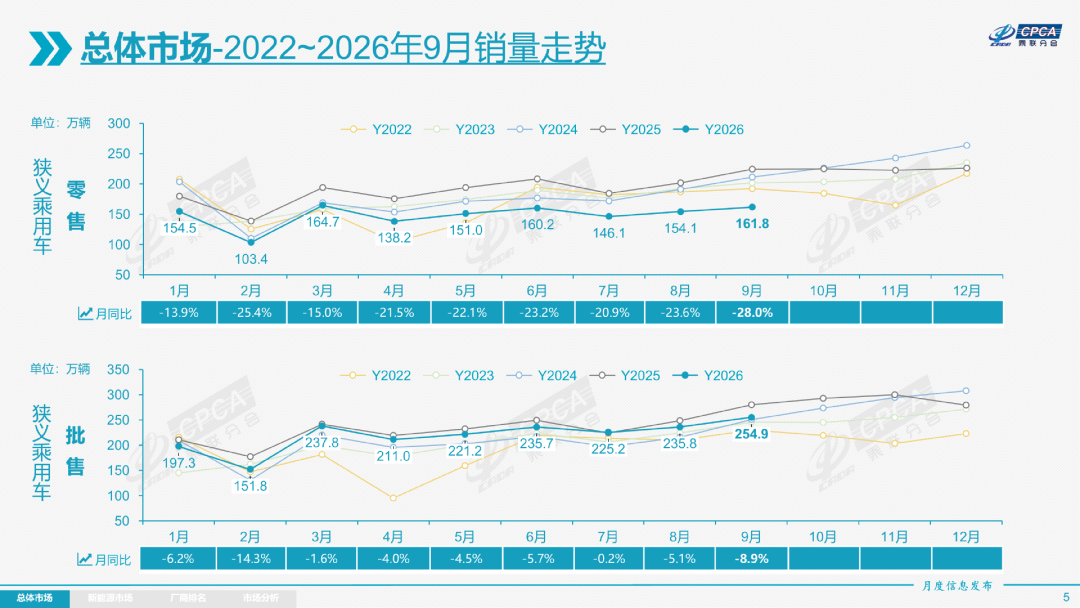
Data from the China Passenger Car Association (CPCA) reveals that retail sales of passenger cars in September reached just 1.618 million units, with a year-on-year decline widening to 28%—the steepest drop in retail sales since the beginning of the year. Although there was a modest 5% month-on-month recovery compared to August, the rebound was minimal.
Feedback from dealers was even more blunt: 54.2% of dealers reported that this year's 'Golden September, Silver October' peak season was notably weaker than in previous years, 33.7% stated that it had largely vanished, and only 3.6% felt it was better than before.
In essence, nearly nine out of ten dealers experienced a lackluster peak season this year.
The start of October has not brought any improvement. From October 1 to 11, retail sales of passenger cars nationwide reached 459,000 units, continuing to decline by 24% year-on-year.
01 The Disappointment of the Peak Season
A review of major automakers' sales in September shows that their performance was not weak, with several mainstream independent brands setting new monthly sales records.
BYD sold 463,600 units, a 16.98% year-on-year increase, marking a new annual high. Geely Auto also set a new annual record, joining Chery Auto in surpassing the 290,000-unit mark, while SAIC Group returned to the 400,000-unit level.
NEV startups also fared well, with Leapmotor achieving over 100,000 units sold for three consecutive months, while XPeng and Xiaomi both surpassed 40,000 units.
However, it is crucial to note that the sales figures announced by manufacturers do not equate to actual consumer purchases. Two distinct metrics must be clarified: wholesale and retail sales.
In the automotive industry's distribution system, wholesale sales represent the completion of product channel placement by automakers—i.e., transportation to dealer stores—allowing them to count these as sales for reporting purposes. Retail sales, conversely, reflect actual consumer purchases and are the core indicator of market demand.
The disparity between these two metrics precisely mirrors the current mismatch between market supply and demand.
The 28% year-on-year drop in retail sales in September reveals the true state of terminal demand. According to CPCA data, retail sales of passenger cars nationwide in September 2026 reached 1.618 million units, down 28.0% year-on-year and up 5.0% month-on-month. Cumulative retail sales from January to September totaled 13.334 million units, down 21.7% year-on-year.
This not only represents the largest single-month decline in 2026 but also exceeds the cumulative retail sales decline from January to September by 6.3 percentage points. In other words, September's performance was weaker not only compared to the same period last year but also relative to the overall level of the first nine months of this year.
Fewer consumers are actually spending money on purchases, yet automakers have not slowed down their pace of launching new models.
Instead, automakers continue to adopt an aggressive strategy of flooding the market with new models. In previous peak seasons, concentrated new model launches were a core means of activating market enthusiasm and driving terminal consumption—and this September was no exception.
According to incomplete statistics, 26 new models were launched in the final week of September alone, with nine new models hitting the market on September 23. These included highly anticipated models such as the Li Auto i9, Fangchengbao S, Geely Galaxy TT, and Mercedes-Benz GLE.
The product range spanned from affordable family cars to mid-to-high-end hybrid and luxury pure electric models, covering all price segments and powertrain types, including pure electric, extended-range, plug-in hybrid, and fuel-powered vehicles. However, these launches failed to effectively stimulate potential buyers' replacement and purchase demands, missing an opportunity to drive sales growth during the peak season.
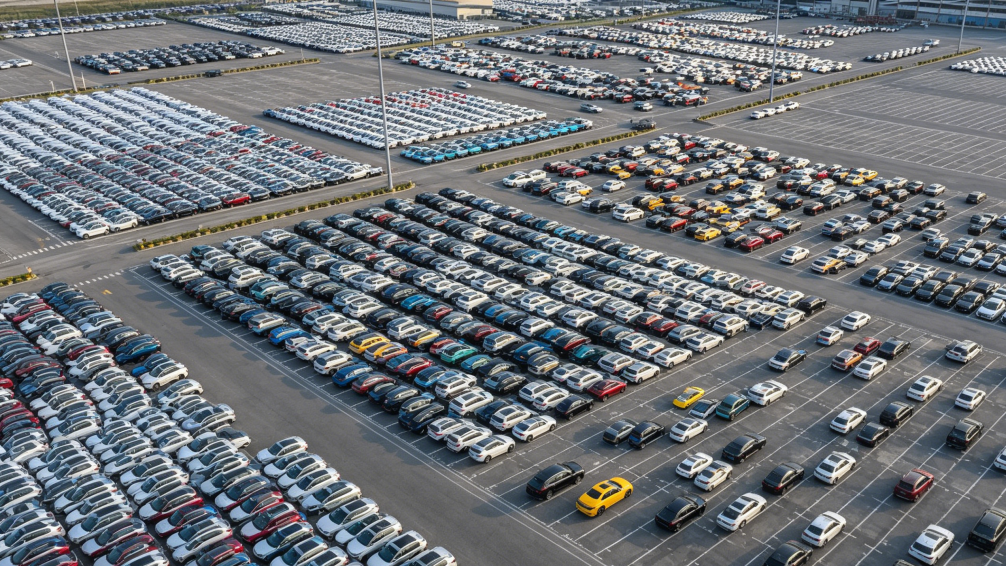
Instead, dealers were left scrambling. Data from the China Automobile Dealers Association (CADA) showed that the inventory alert index for auto dealers in September reached 63.2%, up 8.7 percentage points year-on-year and remaining above the 50% industry threshold. A higher number indicates more vehicles piling up in dealers' hands.
This created the most ironic situation of this year's 'Golden September': automakers were busy meeting annual KPIs by continuously pushing inventory onto channels and releasing impressive sales posters, while frontline dealers were trapped in inventory challenges and had to persuade hesitant consumers to make purchases.
Meanwhile, with a constant stream of new energy products hitting the market, the structure of new car sales has further diversified. Throughout September, the contraction of the fuel vehicle market was evident, with retail sales down 43% year-on-year, including a 49% drop for pure fuel vehicles.
Regardless of whether they were independent, joint-venture, or luxury brands, fuel vehicle segments generally saw sharp declines. For example, independent brands were down 47%, mainstream joint ventures down 42%, and luxury brands down 41%—all accelerating their phase-out.
On the other hand, the domestic retail penetration rate of new energy vehicles climbed to 67.0%, up 9.1 percentage points year-on-year, just shy of the 70% mark. The wholesale penetration rate also reached 65.4%, up 12 percentage points year-on-year, with both metrics setting new historical records.
Among these, the penetration rate of new energy vehicles among independent brands reached 84.5%, among luxury brands it was 44.9%, and among mainstream joint-venture brands it was 15.9%.
Comparing this set of data—retail sales of new energy passenger vehicles reached 1.084 million units in September, down 16.7% year-on-year—indicates that regardless of whether for new energy or fuel vehicles, real market purchasing power continues to contract, with consumers adopting a wait-and-see attitude.
02 Shifting Focus to Global Markets
However, do not be misled by the 65.7% new energy penetration rate.
A common misconception is that many people view the new energy penetration rate as the core indicator of industry prosperity, but the 65.7% penetration rate has significant structural cognitive biases.
Penetration rate measures the proportion of new energy models in the overall retail market, representing only the structural shift from fuel to electric vehicles—not an expansion of the overall auto market size.
The true state of the current market is that the fuel vehicle market continues to contract, with new energy models replacing the existing share of fuel vehicles. However, the retail growth of new energy vehicles themselves has also entered a slowdown phase. The industry has long moved beyond the growth era where 'new energy growth drove overall market growth' and has entered a stock competition phase characterized by internal structural shifts and overall market stabilization.
This is the core data logic behind this year's weakened 'Golden September' peak season. While structural industry upgrades continue, the incremental dividend of widespread car purchases has completely dissipated, and the focus of market competition has shifted from expanding the pie to dividing it.
Indeed, despite the new energy penetration rate reaching a historical high, the actual sales figures for new energy vehicles are declining, and the situation remains lackluster even entering 'Silver October.'
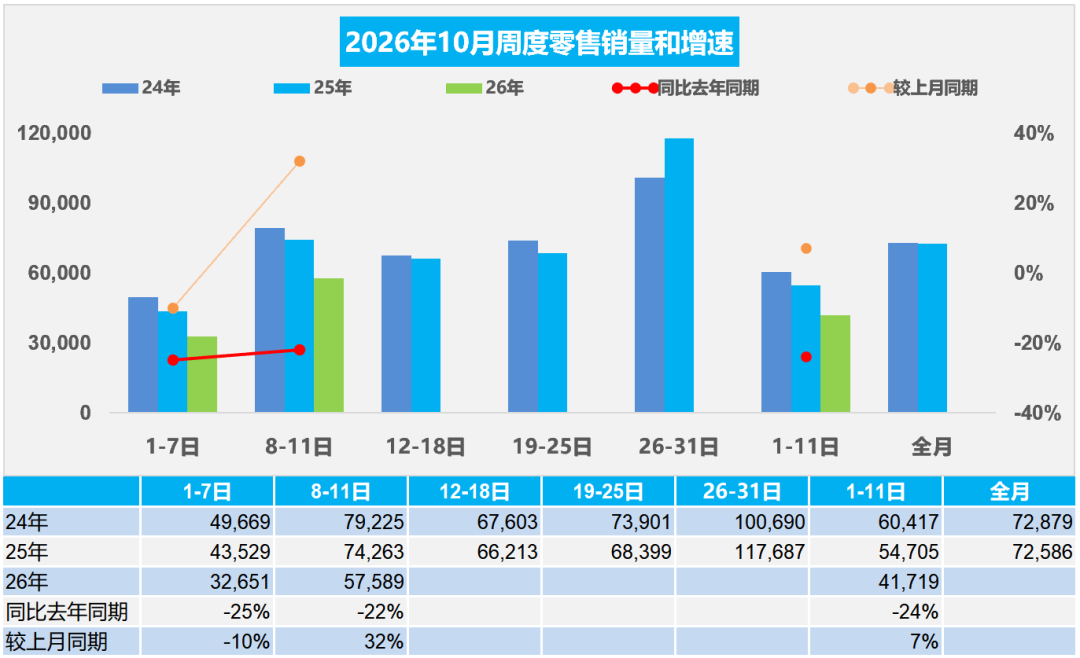
From October 1 to 11, retail sales of passenger cars reached only 459,000 units, down 24% year-on-year and up just 7% month-on-month compared to the same period last month. Retail sales of new energy vehicles reached 281,000 units, showing both year-on-year and month-on-month declines of 13% and 7%, respectively. Despite aggressive new model launches by automakers and significant terminal discounts, consumer purchasing demand remains unstimulated.
Even worse, profits have not kept pace. CPCA data shows that the operating profit margin of the automotive industry from January to August 2026 has dropped to 3.6%. According to the latest data from the National Bureau of Statistics, the operating profit margin of industrial enterprises above a certain scale from January to August 2026 was 5.66%. The automotive industry has underperformed the overall market for three consecutive years.
However, when shifting the statistical focus to production and wholesale dimensions, 'Golden September' was not entirely without bright spots.
Wholesale sales by domestic passenger car manufacturers reached 2.549 million units in September, down 8.9% year-on-year and up 8.1% month-on-month. Production reached 2.590 million units, down 9.1% year-on-year and up 10.3% month-on-month.
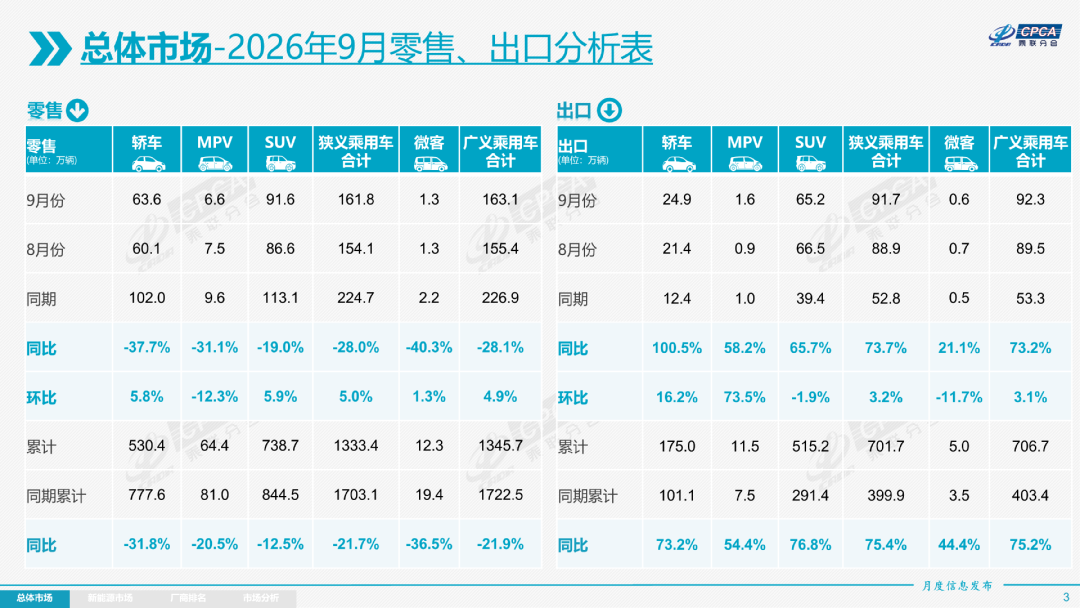
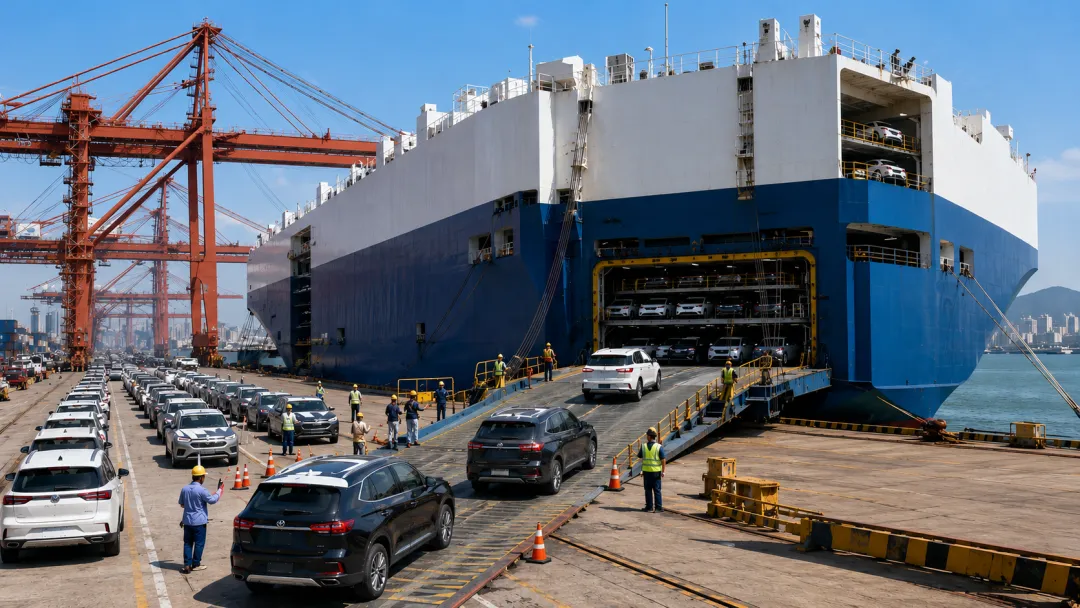
Compared to the 28% year-on-year decline in retail sales, the smaller drop indicates that a significant portion of production capacity has begun to be absorbed through other channels—namely, exports, which represent the sole growth engine for Chinese automakers during 'Golden September.'
In September, domestic passenger car exports reached 917,000 units, up 73.7% year-on-year. New energy vehicles accounted for 60.8% of total exports, a substantial increase of 21 percentage points compared to the same period. Exports by independent brands reached 812,000 units, up 75% year-on-year, while joint-venture and luxury brands exported 105,000 units, up 62% year-on-year.
The CPCA specifically noted in its report that some automakers already have exports accounting for over 50% of their total sales, and the number of manufacturers with exports making up 70% of their total is rapidly increasing. For these automakers, overseas markets are no longer supplementary but have become a 'lifeline.'
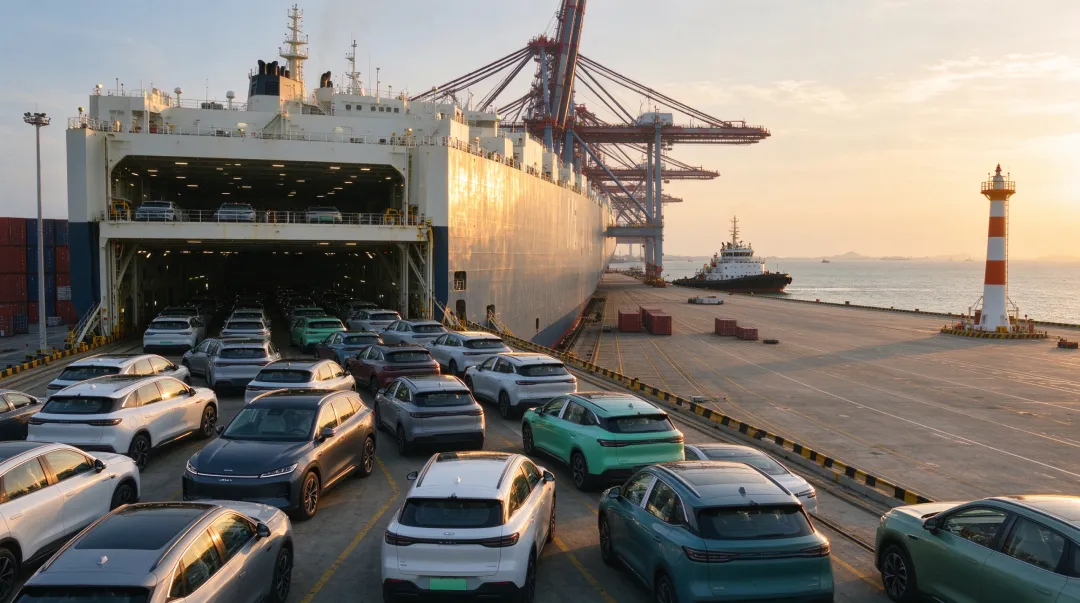
Take Chery, a major exporter, as an example. Its September exports reached 207,800 units, with cumulative exports in the first three quarters totaling 1.551 million units, up 65.6% year-on-year. Exports accounted for over 70% of its total sales, making it the independent automaker with the highest export dependency among leading players.
BYD is another typical representative. In September, BYD's passenger car and pickup truck overseas sales reached 179,900 units, up 153.9% year-on-year. Cumulative overseas sales in the first three quarters reached 1.3378 million units, accounting for 42.88% of its total sales. In just two years, BYD's overseas sales share has risen from less than 10% to over 40%.
Geely and SAIC also saw significant export growth. Geely exported 106,700 units in September, up 162% year-on-year, one of the highest growth rates among leading automakers. SAIC Group's overseas sales reached 150,000 units, up 49.07% year-on-year.
Meanwhile, going overseas is no longer exclusive to 'established players with overseas channels.' Among new energy startups, Leapmotor exported over 27,000 units in September alone, with overseas markets emerging as a new direction for breaking through sales ceilings.
As 'Golden September' becomes less reliable and exports serve as a crucial support, automakers must now focus not only on selling more cars domestically during peak seasons but also on establishing a more stable combination of domestic and international markets.
This is an inevitable sign of China's automotive market entering a stock competition phase. Rather than saying this year's 'peak season is lackluster,' it would be more accurate to say that China's automotive industry has matured.
-
![]()
Why Are New Automakers Focused on Creating a ‘Second Home’ in Cars, While Traditional Brands Bet on Boxy SUVs?
-
![]()
Chinese Automakers Make a Splash at Paris Auto Show, as EU Imposes 350,000-Unit Cap on Hybrid Vehicle Exports
-
![]()
September’s Top 10 Sedan Sales: Fuel-Powered Classics Still Holding Their Ground
-
![]()
Analysis Report on Reputation Index for Q3 2026
-
![]()
Is Apple Now Taking a Swipe at Xiaomi in the Smart Home Arena?
-
![]()
The Waning Influence of 'Golden September, Silver October'
-
![]()
Three Departments Launch Joint Probe into Zunjie Brake Issue; Yu Chengdong: Justice Will Prevail
-
![]()
After 100 days, Step's Agent Phone Still Only Half Released