Analysis Report on Reputation Index for Q3 2026
 10/16 2026
 334
334
After the release of September data, the Q3 2026 automotive reputation index analysis report from Qichemen.com is now available. In the third quarter, the automotive reputation index reached 45,254.75, slightly higher than the same period last year, with overall performance remaining relatively stable. During this period, feedback on reputation for most automakers was generally uneventful, primarily focusing on longstanding issues without concentrated feedback emerging.
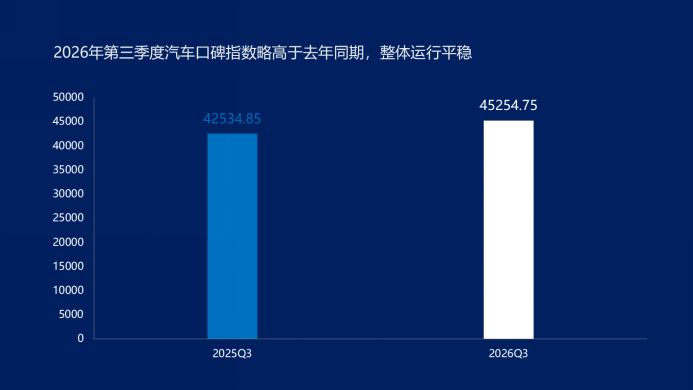
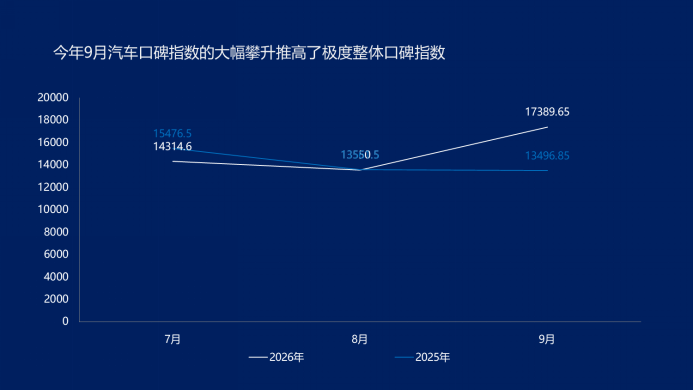
The reason for the higher reputation index in the third quarter of this year compared to the same period last year is directly attributed to the significant month-over-month increase in the September reputation index. The monthly trend chart shows that the reputation indices for July and August this year were both lower than those of the same period last year and exhibited a downward trend. However, the reputation index in September saw a substantial month-over-month increase, rising by 29% compared to September last year.
The previously released September automaker reputation index analysis revealed that on this month's top 10 list for automaker reputation indices, nine automakers experienced varying degrees of increases. Notably, Tesla China and Beijing Benz both faced concentrated issue feedback. As a result, Tesla China's reputation index increased by 3.5 times month-over-month, while Beijing Benz's index nearly doubled.
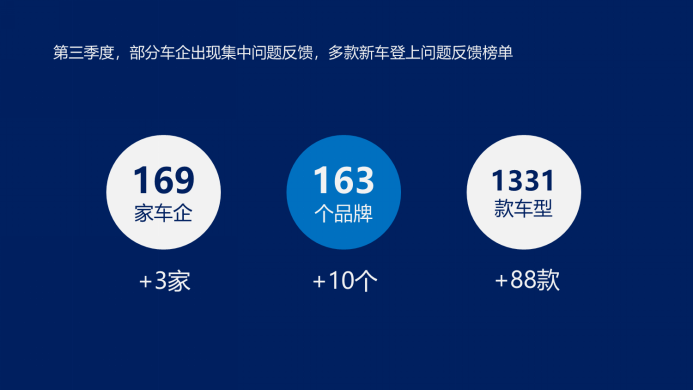
In the third quarter of this year, a total of 169 automakers and 163 brands, encompassing 1,331 vehicle models, appeared on the issue feedback list, representing an increase of 3 automakers, 10 brands, and 88 models compared to the same period last year. Several newly introduced models received issue feedback.
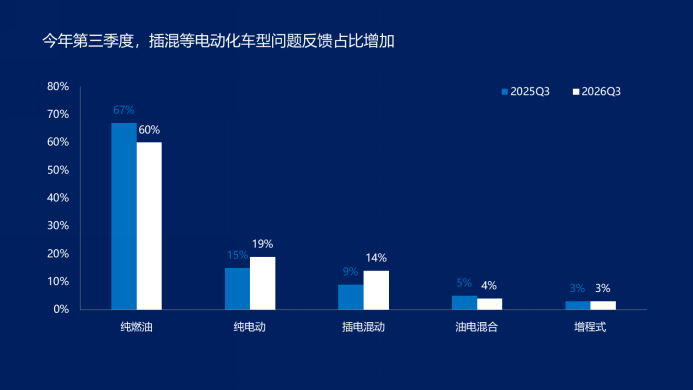
From the perspective of powertrain distribution among problematic models, fuel vehicles remained the most frequently reported type in the third quarter of this year, although their proportion of feedback decreased. Meanwhile, the proportions of feedback for pure electric vehicles and plug-in hybrid models increased significantly, collectively accounting for nearly one-third of the total feedback.
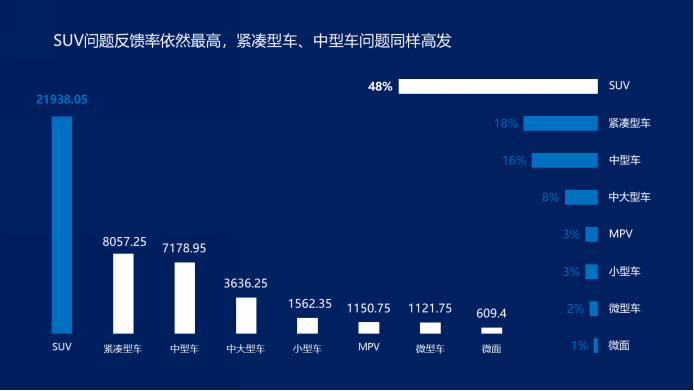
In terms of vehicle classification, SUVs, compact cars, and mid-size cars continued to be the top three segments with the highest rates of issue feedback in the third quarter of this year, collectively accounting for over 80% of the feedback. SUVs alone represented nearly half of the feedback, reflecting their market prevalence.
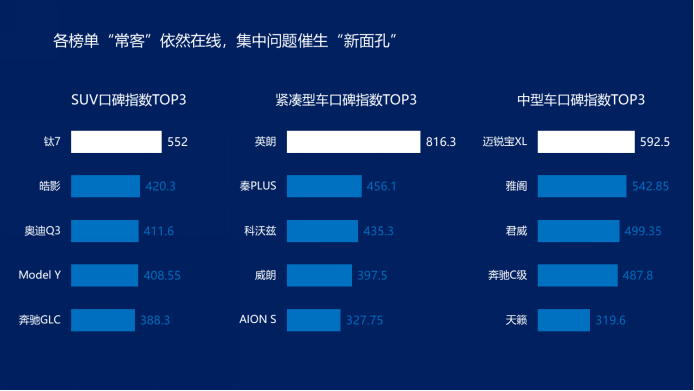
The top five positions on the three most frequently reported segment lists for the third quarter were consistently occupied by perennial "regulars." Meanwhile, several models that experienced concentrated issue feedback in September also appeared on these lists.
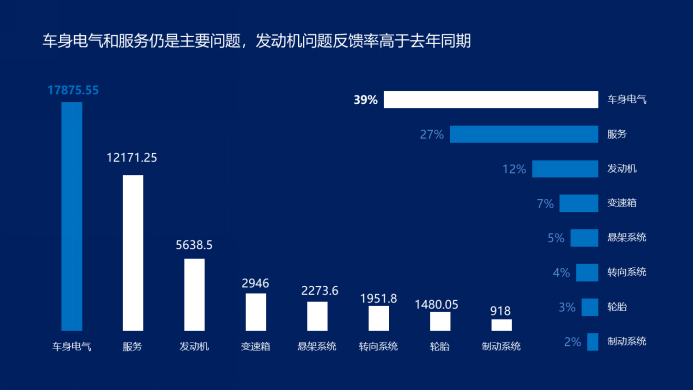
From the perspective of issue classification, complaints about vehicle electrical systems remained the most frequently reported problem in the third quarter, accounting for 39% of the feedback. Service-related issues followed closely, making up 27% of the feedback. Behind this trend, the increasing prevalence of electrification and intelligence has led to various usage issues, keeping the reputation indices for vehicle electrical systems and services high. The reputation index for engines remained third, with Honda—plagued by persistent engine noise issues—and Mercedes-Benz—recently criticized for potential shed (detachment) risks in the camshaft center valve filter—driving up the engine reputation index.
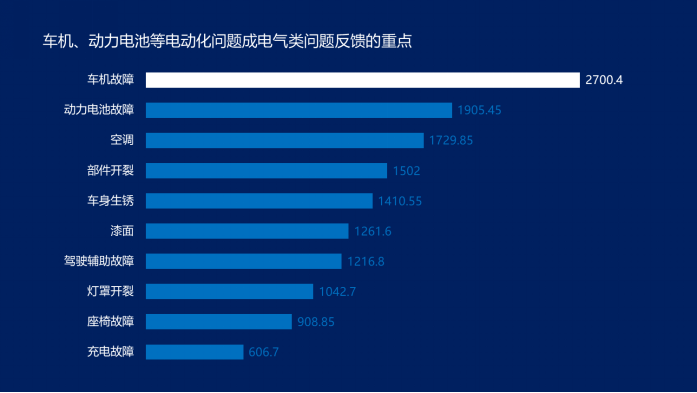
The distribution of specific issues related to vehicle electrical systems revealed that in the third quarter of this year, infotainment systems remained the most frequently reported electrical issue by vehicle owners, with reputation indices exceeding 500. Problems such as infotainment system issues, paint cracking, and lamp cover cracking also had reputation indices surpassing 400. The top 10 reported electrical system issues were all common, recent problems primarily related to electrification and various aging issues.
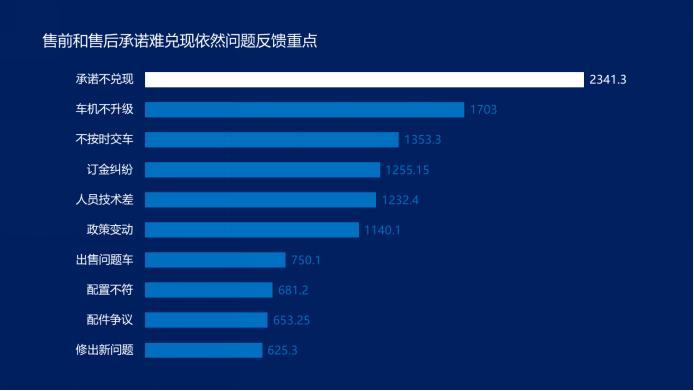
In the third quarter, various unfulfilled promises were the most frequently reported service-related issues by users. Problems such as unfulfilled pre-sale Equity (rights and interests) promises, mismatches between configurations and official announcements, and unfulfilled after-sales maintenance commitments received significant user feedback. Additionally, issues like infotainment system non-upgrades, delayed vehicle deliveries, and price or Equity (rights and interests) adjustments shortly after market launch also drew considerable user dissatisfaction. Furthermore, after-sales service issues such as lack of parts, use of non-original parts, new problems arising from repairs, and the sale of problematic vehicles were also key areas of user feedback.
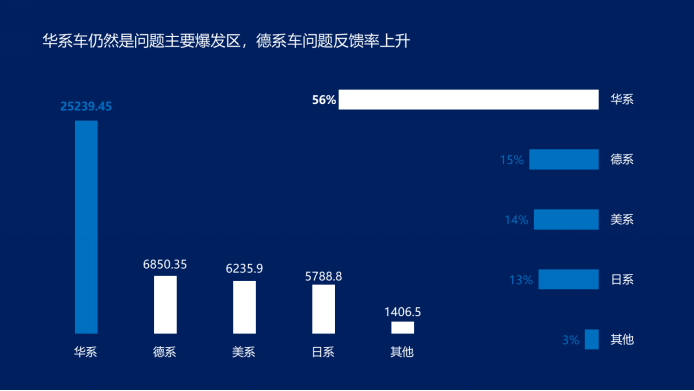
Due to their large market presence, Chinese-brand vehicles had the highest rate of issue feedback in the third quarter, accounting for 56% of the total. Feedback on German, American, and Japanese vehicles was less than one-third of that for Chinese-brand vehicles. Notably, due to concentrated issue feedback from brands like Mercedes-Benz and Tesla, the proportions of feedback for German and American vehicles both increased.
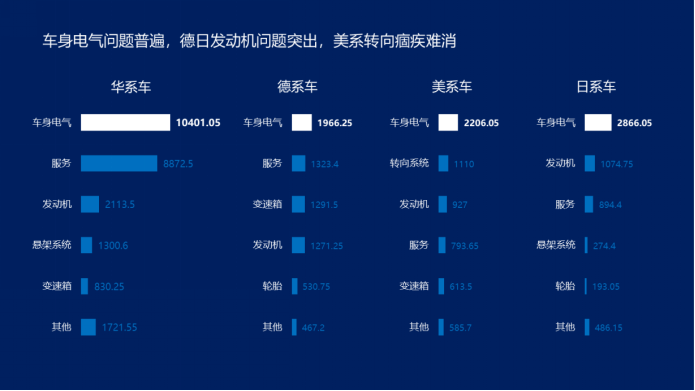
Specifically, Chinese-brand vehicles had significantly higher rates of feedback on vehicle electrical systems and services compared to other automakers, with their large market presence objectively contributing to the emergence of issues. In contrast, German vehicles generally had higher rates of feedback on services, transmissions, and engines compared to American and Japanese vehicles, driven by persistent issues such as Audi's transmission mechatronic unit failures over the years and the recent risk of detachment in Mercedes-Benz engine camshaft center valve filters. Additionally, engine issues in Japanese vehicles and steering stuttering and noise issues in American vehicles were also key areas of owner feedback.
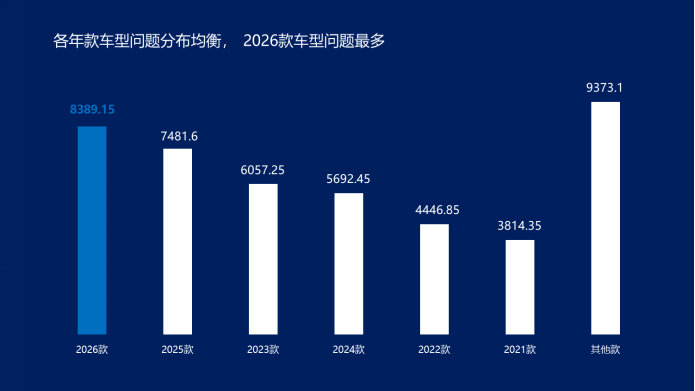
The distribution of issue feedback by model year revealed that in the third quarter, the reputation indices for various model years were relatively balanced. Specifically, the 2026 model year, with its continuously increasing market presence, had the highest reputation index for the quarter. The 2025 and 2023 model years followed, with in-warranty models accounting for 47.6% of the feedback. Meanwhile, the reputation index for models over six years old exceeded 21%, with "chronic" issues on several models remaining a concern for owners.
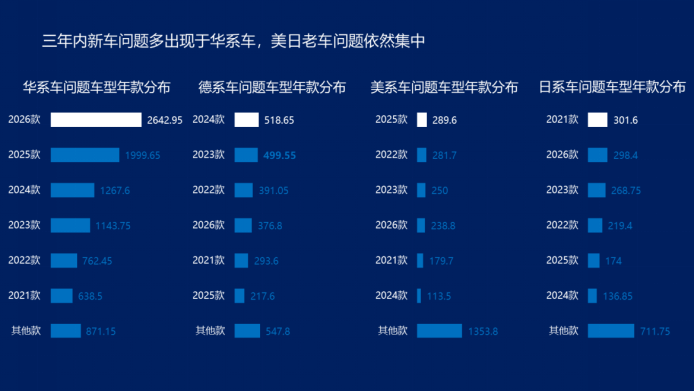
From the perspective of issue feedback distribution by model year across different vehicle brands, issues with Chinese-brand vehicles were concentrated on in-warranty models within three years. Among them, the 2026 model year had the highest reputation index, followed by the 2025 and 2024 model years. Issues with German, American, and Japanese vehicles were more prevalent in models from 2025 and earlier. Specifically, German vehicle issues were generally found in older models over three years old. American vehicle issues were mostly found in models over six years old. Japanese vehicles had a relatively high proportion of feedback on the 2026 model year. Behind this trend, issue feedback on recently launched new models from Japanese brands contributed to the increase.
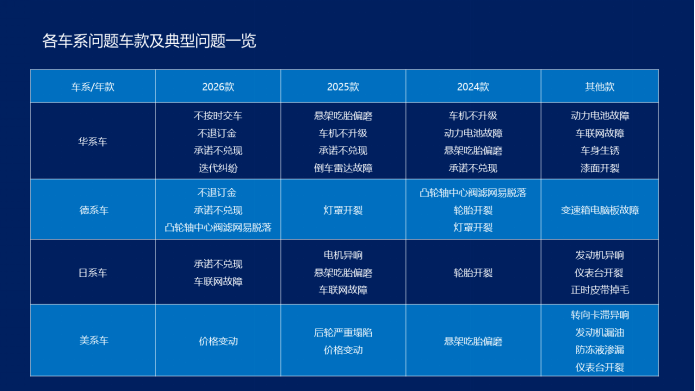
From the perspective of issue feedback by model year and typical issues across different vehicle brands, in the third quarter, typical issues with new Chinese-brand vehicles within three years were more prevalent, primarily related to price reductions, infotainment systems, and various electrification issues. Problems such as non-delivery of vehicles, sale of problematic vehicles, non-refund of deposits, unfulfilled promises, and mismatches between configurations and official announcements received significant user feedback this month. Meanwhile, new German and American vehicles also received considerable issue feedback, with Mercedes-Benz and Tesla, as mentioned earlier, being the main sources of feedback.
Complaint Index: Qichemen.com's automotive quality reputation index calculation model (QCMS) categorizes vehicle quality complaints into eight major types, assigning weights based on the severity of issues related to engines, transmissions, vehicle bodies and electrical systems, braking systems, steering systems, suspension systems, tires, and services. Additional weighting is applied to concentrated incidents, ultimately forming an effective reputation index—the higher the index, the more severe the issues.
Data Source: Qichemen.com
Time Period: July 1, 2026 - September 30, 2026
Produced by: Qichemen.com Data Department
-
![]()
Why Are New Automakers Focused on Creating a ‘Second Home’ in Cars, While Traditional Brands Bet on Boxy SUVs?
-
![]()
Chinese Automakers Make a Splash at Paris Auto Show, as EU Imposes 350,000-Unit Cap on Hybrid Vehicle Exports
-
![]()
September’s Top 10 Sedan Sales: Fuel-Powered Classics Still Holding Their Ground
-
![]()
Analysis Report on Reputation Index for Q3 2026
-
![]()
Is Apple Now Taking a Swipe at Xiaomi in the Smart Home Arena?
-
![]()
The Waning Influence of 'Golden September, Silver October'
-
![]()
Three Departments Launch Joint Probe into Zunjie Brake Issue; Yu Chengdong: Justice Will Prevail
-
![]()
After 100 days, Step's Agent Phone Still Only Half Released