Net Profit Halved in the First Three Quarters, 'Apple Supply Chain Queen' Still Dominates as China's Richest Woman
 10/28 2026
 513
Produced by Leadar Radar | Text by Zhou Hui | Edited by Meng Shuai
On October 27, the <2026 Hurun China Rich List> was unveiled, with ByteDance founder Zhang Yiming once again becoming China's richest person with a net worth of 670 billion yuan, setting a new record for China's wealthiest individual. Meanwhile, the crown of China's richest woman was claimed by Zhou Qunfei, with a fortune of nearly 130 billion yuan.
However, just two days before the list was released, Lens Technology, the 'Apple supply chain leader' helmed by Zhou Qunfei, reported a third-quarter performance with net profit halved.
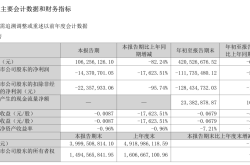
Financial results showed that in the first three quarters of this year, Lens Technology achieved revenue of 47.902 billion yuan, down 10.74% year-on-year, and recorded a net profit attributable to shareholders of 1.42 billion yuan, a 50.06% decrease from the same period last year.
Looking at the longer-term trend, Lens Technology's performance has been declining since the fourth quarter of last year. In the first quarter of this year, its net profit attributable to shareholders even turned from profit to loss, with a quarterly loss of 150 million yuan.
At the same time, the company's core smartphone and computer businesses, which form the foundation of its performance, are facing growth challenges. In 2025, revenue growth for these businesses plummeted from 28.63% in 2024 to just 5.94%. In the first half of this year, revenue from these businesses reached 22.382 billion yuan, down about 17.67% year-on-year.
Although the company saw revenue growth in its smart vehicle and cockpit, smart head-mounted display and wearable, and other smart terminal businesses in the first half of the year, their relatively small scale makes it difficult to fully reverse the downward performance trend.
Facing performance pressures, Lens Technology has chosen to accelerate its Layout (layout) in emerging strategic sectors such as AI edge hardware and AI computing power hardware.
On October 16, Lens Technology announced plans to acquire a 59.78% stake in PMG for $25 million (approximately 172 million yuan) in cash. Its controlled subsidiary, Zhejiang Yuanshi, is one of NVIDIA's RVL-certified server cabinet suppliers.
Billion-dollar 'Apple supply chain' giant sees net profit halved in the first three quarters
On October 25, Lens Technology, one of the giants in the 'Apple supply chain,' disclosed its third-quarter report for 2026. The data paints a less-than-optimistic picture.
Financial results showed that in the first three quarters of this year, Lens Technology achieved revenue of 47.902 billion yuan, down 10.74% year-on-year, and recorded a net profit attributable to shareholders of 1.42 billion yuan, a roughly 50% decrease from the same period last year.
Breaking it down quarter by quarter, Lens Technology's revenue has been declining since the fourth quarter of last year. From the fourth quarter of 2025 to the third quarter of this year, the company reported revenue of 20.747 billion yuan, 14.14 billion yuan, 14.727 billion yuan, and 19.035 billion yuan, with year-on-year growth rates of -12.34%, -17.13%, -7.36%, and -8.05%, respectively.
Lens Technology's profit performance has been even more 'glaring.' In the fourth quarter of 2025, its profit growth curve began to decline, with a net profit attributable to shareholders of 1.175 billion yuan, down 6.23% year-on-year.
Entering 2026, the company's net profit attributable to shareholders turned from profit to loss in the first quarter, with a loss of 150 million yuan. In the second quarter, it returned to profitability, recording a net profit attributable to shareholders of 726 million yuan, up slightly by 1.77% year-on-year.
However, the good times were short-lived. In the third quarter, the company's net profit attributable to shareholders declined again, falling 50.42% year-on-year to 843 million yuan, directly 'halved' from 1.7 billion yuan in the same period last year.
In terms of expenses, for the first three quarters, Lens Technology's selling expenses were 374 million yuan, down 11.19% year-on-year; administrative expenses were 2.279 billion yuan, up 8.35% year-on-year; and research and development expenses were 2.435 billion yuan, down slightly by 0.2% year-on-year.
During the same period, the company's financial expenses surged 1068.19% year-on-year to 716 million yuan, primarily due to increased net foreign exchange losses during the reporting period.
It's worth mentioning that non-recurring gains and losses have, to some extent, supported Lens Technology's performance. In the first three quarters, the company's non-recurring gains and losses were 422 million yuan, accounting for about 30% of its net profit attributable to shareholders for the period.
After excluding non-recurring gains and losses, the decline in the company's profit indicators would widen further, with a year-on-year decrease of as much as 63.07%.
As of the end of the third quarter, Lens Technology's total assets were approximately 91.165 billion yuan; total liabilities were 37.979 billion yuan; and the asset-liability ratio was about 41.66%, up 6.19 percentage points year-on-year.
On October 27, Lens Technology's stock closed at 26.58 yuan per share, with a latest market capitalization of approximately 140.3 billion yuan.
Zhou Qunfei becomes China's richest woman as the company's primary growth engine stalls
According to Tianyancha information, Lens Technology Co., Ltd. (referred to as 'Lens Technology') went public on the ChiNext board of the Shenzhen Stock Exchange in 2015, with Zhou Qunfei as its legal representative.
On October 27, in the latest <2026 Hurun China Rich List> released by Hurun Research Institute, Zhou Qunfei became China's richest woman with a fortune of nearly 130 billion yuan, appearing on the list alongside her husband, Zheng Junlong.
However, before becoming China's richest woman, Zhou Qunfei had a humble beginning as a 'factory girl.' Due to family poverty, she dropped out of middle school and started working at Aoya Optical Glass Products Factory. Her outstanding performance made her highly valued by her supervisors.
In 1993, at the age of 23, Zhou Qunfei left Aoya Optical and began her entrepreneurial journey, taking on orders through a home-based workshop. Later, an opportunity provided by a friend led her to accidentally enter the mobile phone glass industry.
In 2003, Zhou Qunfei officially founded Lens Technology, focusing on the research, development, production, and sales of mobile phone protective window glass. With strict quality control and continuous innovation, Lens Technology stood out in the fierce market competition.
In 2006, Lens Technology began collaborating with Apple, and together they developed the first-generation iPhone's glass full-screen display. The following year, Lens Technology successfully passed Apple's supplier certification and became a member of the 'Apple supply chain.'
After partnering with Apple, Lens Technology's performance soared, and its smartphone and computer businesses gradually became its long-term growth engines.
According to iFinD data from Tonghuashun, in 2023, these businesses generated 44.901 billion yuan in revenue for Lens Technology, accounting for as much as 82.4% of its total revenue. In 2024, revenue from these businesses further surged to 57.754 billion yuan, up 28.63% year-on-year.
By 2025, revenue from Lens Technology's smartphone and computer businesses successfully exceeded 60 billion yuan, but revenue growth sharply declined to just 5.94%, a significant slowdown from the previous year.
In the first half of this year, revenue from these businesses contributed 22.382 billion yuan, down 17.67% year-on-year, accounting for about 77.54% of total revenue.
Lens Technology attributed this primarily to cyclical disruptions in terminal demand caused by memory chips and a decrease in assembly business revenue.
In its semi-annual report, Lens Technology admitted that in the first half of 2026, the global memory chip market experienced a rare supply-demand gap, with memory prices rising rapidly and supply chain price increases being passed down to Terminal (terminal) consumer prices.
Multiple research institutions pointed out signs of weakening in the consumer electronics market, especially for entry-level and mainstream consumer products, which are more price-sensitive, leading to longer consumer replacement cycles.
At the same time, market research firm IDC's quarterly monitoring data showed that global smartphone shipments fell 4.1% year-on-year in the first quarter and 6.7% year-on-year in the second quarter. TrendForce repeatedly downgraded its global notebook shipment forecasts for 2026.
Facing industry-wide demand fluctuations, Lens Technology actively adjusted its product and customer mix, expanding into well-known domestic customers and introducing high-end product assembly businesses such as action cameras, attempting to offset revenue decline pressures from some low-margin businesses by increasing shipments of high-margin premium products.
As a result, the gross margin of the company's smartphone and computer businesses increased, rising 2.99 percentage points year-on-year to 16.17%.
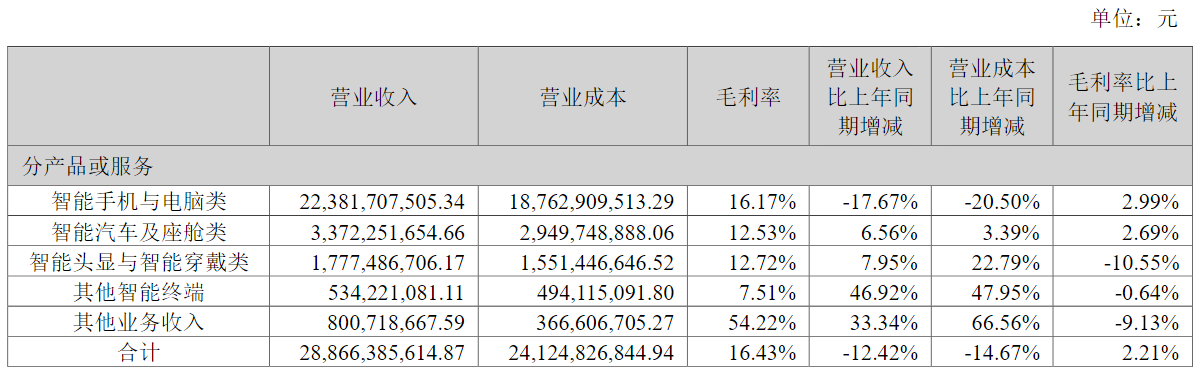
During the same period, Lens Technology's smart vehicle and cockpit businesses achieved revenue of 3.372 billion yuan, up 6.56% year-on-year; smart head-mounted display and wearable businesses generated about 1.777 billion yuan in revenue, up 7.95% year-on-year.
Other smart terminal businesses contributed 534 million yuan in revenue during the reporting period, up 46.92% year-on-year. Lens Technology stated that with the accelerated industrial land (implementation), its embodied intelligence business continued to grow rapidly, with shipments ranking among the top in the industry.
According to Lens Technology, its Layout (layout) in core components such as robot dexterous hands and joint modules, as well as complete machine (complete machine) assembly, is gradually entering the harvest phase, with batch (mass) delivery of related products contributing significant revenue growth to other smart terminal businesses.
However, in terms of scale, other smart terminal businesses accounted for only 1.85% of revenue in the first half of this year, a vast difference compared to the smartphone and computer businesses, making it difficult to fully offset the performance pressures caused by the latter's revenue decline in the short term.
Plans to spend heavily to acquire controlling stake in PMG, bolstering AI computing power track (sector) Layout (layout)
Under performance pressures, Lens Technology explicitly stated in its semi-annual report that while solidifying its consumer electronics foundation, it would focus on cultivating emerging strategic sectors such as AI edge hardware and AI computing power hardware.
On October 16, Lens Technology announced that it had signed a share purchase agreement with relevant parties, including Lv Songshou, Peimeigao International Co., Ltd. (referred to as 'PMG'), Zhejiang Yuanshi, and Lv Shaohua, on the same day, planning to acquire a 59.78% stake in PMG for $25 million (approximately 172 million yuan) in cash.
Lens Technology stated that the funds for this purchase would come from the company's own or raised funds and other legal sources. Upon completion of the purchase, PMG would become a controlled subsidiary of Lens Technology and be included in the company's consolidated financial statements.
Financial data disclosed in the announcement showed that from January to April 2026, PMG's revenue was approximately 11.9557 million yuan, with a net profit of about 7.045 million yuan. As of April 30 this year, PMG's net assets were approximately 11.4532 million yuan, with an asset-liability ratio of 75.08%.
Given these financial figures, PMG's performance is not particularly impressive, leading some to believe that Lens Technology is actually targeting Zhejiang Yuanshi, which it controls. It is understood that Zhejiang Yuanshi's main business is AI server cabinets and their structural components.
According to the announcement, relevant companies have completed expansions in AI server structural components and efficient liquid cooling systems in the Songshan Lake Industrial Park and have passed inspections by leading domestic and international customers, securing formal orders and entering the mass production ramp-up phase.
It's worth mentioning that Zhejiang Yuanshi has another identity—one of NVIDIA's RVL-certified server cabinet suppliers.
According to Hunan Daily, within NVIDIA's ecosystem, the core of global AI computing power, RVL certification suppliers face high thresholds and long certification cycles, often taking years from certification to formal supply.
As one of the few server cabinet suppliers to receive this certification, Zhejiang Yuanshi has supplied MGX racks, slide rails, and other core components for NVIDIA's GB200/GB300 series, with multiple products ready for mass production. It has also officially joined the development team for the next-generation mainstay server, Vera Rubin, deeply participating in key hardware R&D.
Some analysts pointed out that this acquisition could be a crucial step for Lens Technology to enter the global AI computing power hardware supply chain.
According to the equity acquisition agreement, the seller commits to negotiating in good faith with the buyer (Lens Technology) after closing, leveraging their respective resources and advantages to jointly develop Chinese and international customers, as well as exploring liquid cooling product development and OEM cooperation in new areas such as forging technology and high-end notebook high-power vapor chambers (VC).
In fact, as early as December 2025, Lens Technology had begun laying the groundwork to secure this AI computing power 'ticket.' At that time, Lens Technology signed an intention (letter of) agreement with Lv Songshou to acquire a 100% stake in PMG.
In June this year, Lens Technology further invested 50 million yuan in cash to increase its stake in Zhejiang Yuanshi to 14.28%.
Lens Technology stated that after this transaction is completed, the acquisition of the remaining 40.22% stake in PMG will be further negotiated by relevant parties based on PMG's actual operating conditions, audit, and appraisal results, with the terms to be determined in a subsequent acquisition agreement by both parties.
In addition, in July this year, Lens Technology also announced a 'partnership' with Intel to jointly explore TGV advanced packaging technology.
The two sides will discuss and evaluate potential cooperation in key processes (including but not limited to) such as glass substrate through-hole forming, high-precision laser processing, metallized through-hole deposition, and multi-layer interconnect wiring.
It is understood that TGV glass substrates offer advantages such as low loss, high-temperature resistance, warpage resistance, and extremely high surface flatness, making them ideally suited to meet the stringent packaging requirements of AI computing power chips. They are considered by the market to be the ideal material for the next generation of advanced packaging.
Omdia's estimated data shows that the global market size for packaging glass substrates will reach $18.6 billion in 2026 and is expected to exceed $32 billion by 2030, with a compound annual growth rate of about 14.5%. The industry also regards 2026 as the first year of commercialization for glass substrates.
In Lens Technology's view, this cooperation will help establish a long-term, stable, and mutually trusting strategic partnership with Intel. Leveraging the strong professional expertise and operational capabilities of all parties in their respective fields (including precision manufacturing, materials science, and global supply chain management), it will promote the early large-scale application of related new technologies and facilitate the achievement of the company's medium- and long-term strategic goals.
After its former growth engine stalled, can 'Apple supply chain' giant Lens Technology achieve more breakthroughs in new sectors? Leadar Radar will continue to monitor the situation.
-
![]()
Can the ZON 09, Priced from 169,900 Yuan, Strike a Balance Among Model 3, Xiaomi SU7, and Itself?
-
![]()
From Recommendation to Mandatory: The Countdown Begins for C-V2X's 'Birth Certificate'
-
![]()
The Auto Market Price War: A Call for an Immediate Halt
-
![]()
A Century-First: Audi Unveils Dual-Brand Strategy, with Chinese Tech Pioneering Its Future
-
![]()
Chery Sets Sights on North American Market
-
![]()
A Staggering 4 Billion 'Deficit' Looms Large: Haima Automobile Faces Severe Challenges in Q3
-
![]()
Breaking News! 'Anthropic' (ANT) Poised for Record-Breaking IPO, the Largest in History
-
![]()
After Perusing Anthropic's Prospectus, I Can't Help But Worry About the Future of China's Domestic Large-Scale Models